Writober 2025: Our Deepest Fears>Prompt Post
🔗Post contains Amazon associate links (shown with Aal in parentheses)
🔗Links in the Table of Contents are Jump links to each of the challenges to navigate easily to the prompt of your interest: OctPoWriMo for poetry; Writober Flash Fiction for flash fiction; Halloween Photography Challenge for photography
🐦⬛Example poems are copied here for educational purposes.
🖼️I made these banners from my photos and free for commercial use fonts. Feel free to use them in your posts.

Welcome to Writober 2025. I am so glad you’re here. If you are not interested in the introduction and just want to go to a specific challenge prompt, click on one of the links below. Have fun, and don’t forget to put a link to your creation(s) in the comments.
🎃OctPoWriMo 🦇Writober Flash Fiction 👻Halloween Photography Challenge
Today’s Theme: Breath
I encountered a very creepy sound while playing Kinect Sports on Xbox(Aal) with my nephew. In a few of the games, when it’s game point, the crowd noise and music die away and all you hear is breathing and a heart beat until the game is over. I recorded this from the game:
That sound makes me really uncomfortable. Breath is our constant rhythm, our source of life, but it’s easy to forget about it. Breath just happens. However, in situations when we can’t breathe, even for a second, it’s all we can think about.
Durham University has an Online Exhibition called Catch Your Breath for all sorts of inspiration for writing about breath.
In creative writing, punctuation is a way we can create breath. The comma is a pause. Often, when reading aloud, we can find where a sentence needs a comma by feeling where we want to breathe. The semi-colon is a longer pause, the colon a long pause, and the period a complete stop.
In poetry, line breaks are also a place to breathe. White space on the page in prose is a place for breath.
Iambic pentameter (ten syllables with the stress or accent on the second syllable of every pair or foot) is the most common in English metric verse because it is what a person can read aloud in one breath. Or, as Mary Oliver puts it in Rules for the Dance(Aal), “it is the line which is the closest to the breathing capacity of our lungs.”
How can you bring breath into your writing and imagery today?
OctPoWriMo
Mary Oliver begins her book, Rules for the Dance(Aal), with breath. She says, “Metrical poetry is about: breath. Breath as an intake and a flow. . . . A cardinal attribute of breath (or breathing) is, of course, its repetition. The galloping footbeats of the heart, that spell fear. Or the slow and relaxed stretch of breath of the sleeping child. In either case, by their repetition, they make a pattern.”
Example Poem: The Visitor by Tess Taylor from Monster Verse: Poems Human and Inhuman(Aal)
The Visitor
There’s something living underneath our floor.
We aren’t sure what it is, or if it wants
to scratch its way up to where we are.
We drown it out sometimes. Sometimes we can’t.
But nights, up from the floorboards, in the dark
it starts again, the rough, irregular
heave and rasp—the creature hard at work
in some crevice, god knows, of the old house.
In some dark place the mind is loath to venture,
it comes and goes without any permit.
And that this force cannot consider us,
is wholly ignorant of who we are,
seems monstrous in its total independence:
It is not trapped: It cannot be let out.
~ Tess Taylor
How does this poem breathe?
Prompt: Focus on your breath. Cover your ears and listen to your own breathing. Use punctuation, repetition, enjambment, and/or internal rhyme to create breath in your poem. Write about one of your deepest fears, expressing how your breathing changes when gripped by fear.
Possible Form: Breath poem – The breath poem is a condensed syllabic form created by Robert T. Randolph. It consists of a title and three lines with the syllable count 3-3-4. The aspect of the breath poem that I found particularly interesting is it is to be read aloud with a specific breathing pattern: After reading the title, read the first line while breathing in, the second line while breathing out, the first syllable of the third line while breathing in, and the last three syllables while breathing out, or inhale the first three syllables and exhale the fourth.
If you would like to share your poem, leave a link in the comments. Or, if you can’t link up, leave your poem in the comments and make sure to add your name.
Writober Flash Fiction Challenge
Click on the link and take a look at the image. How might this image relate to today’s theme? Write a piece of flash fiction, anything from a six-word or one sentence story to 999 words. Feel free to bring in the OctPoWriMo prompt and the Photography Challenge prompt, anything that inspires your story.
Leave a link to your story in the comments.
Flash Fiction Tip: Focus the story on one life-changing conflict, a singular moment that changes the character (or characters) in a significant way.
5 Reasons to Use Pictures as Writing Prompts from The Write Practice
Halloween Photography Challenge
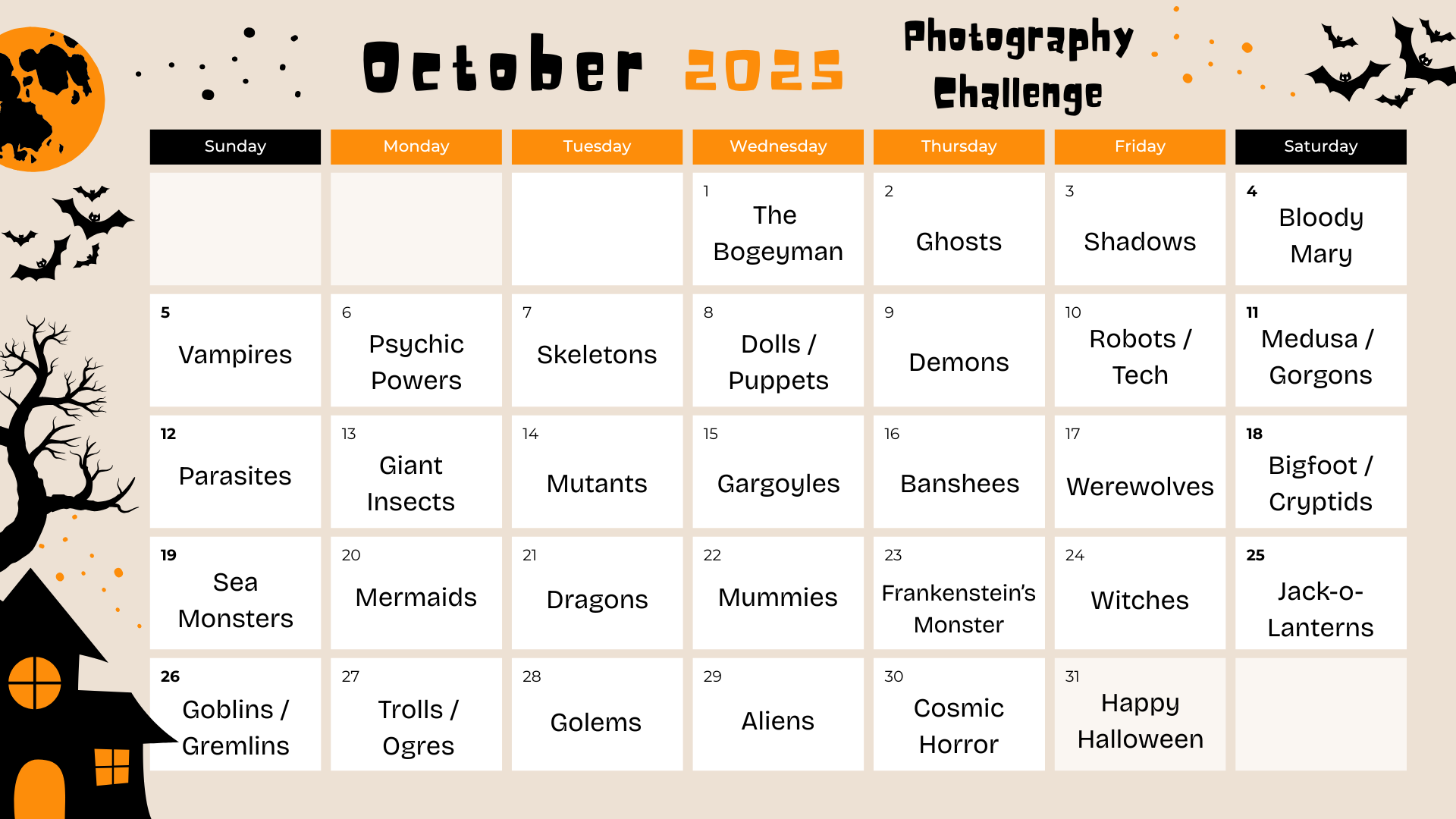
Last year I chose abstract words for this challenge. This year, I wanted to get back to more concrete symbols of Halloween. I read both On Monsters: An Unnatural History of Our Worst Fears(Aal) by Stephen T. Asma and Writing Monsters(Aal) by Phillip Athans while exploring our deepest fears, and noticed how I associate different fears with different monsters. We all have different associations and memories with different monsters, so I thought they would make good prompts that would take our photography deeper.
Your photos may be of a physical attribute of the monster, your interpretation of the monster, or an image that represents the fear that monster evokes in you. Your photo may be of a space where you imagine that monster lives or hides; it could be a picture of where you first remember learning about that monster, or a photo that captures a mood of that monster. The possibilities are endless.
Here are some reasons that monsters are scary from Writing Monsters(Aal) by Phillip Athans:
- They are unpredictable
- They have a disturbing capacity for violence
- They exhibit an “otherness”
- Our imagination makes them scarier
- They are amoral
- They are beyond our control
- They are terrifying in appearance
- They turn us into prey
Today’s monster, the Bogeyman or Boogieman, has been around in different forms to scare children for a very long time. Here’s a fun video about the history of the Bogeyman around the world.
Thank you so much for joining me for this year’s October challenges. Remember to link to your creative works in the comments and support each other by visiting and commenting on as many links as you can as we explore our Deepest Fears in anticipation of Halloween.
Remember, all of the prompts are provided as inspiration. You may use any of them or none of them. The only goal of the challenges is to come up with creative work each day. Hopefully the prompts will help you stretch yourself to try new things. Have fun!
Here’s some music to get us moving and in the mood:
 Experience Writing
OctPoWriMo Day 1. When the Lock Clicks // It All Starts With the Breath
~ Oizys.
LikeLike
Writober Day 1 Responses: Staying with the Breath
LikeLike