Writober 2025: Our Deepest Fears>Prompt Post
🔗Post contains Amazon associate links (shown with Aal in parentheses)
🔗Links in the Table of Contents are Jump links to each of the challenges to navigate easily to the prompt of your interest: OctPoWriMo for poetry; Writober Flash Fiction for flash fiction; Halloween Photography Challenge for photography
🐦⬛Example poems are copied here for educational purposes.
🖼️I made these banners from my photos and free for commercial use fonts. Feel free to use them in your posts.
🎃OctPoWriMo 🦇Writober Flash Fiction 👻Halloween Photography Challenge
Today’s Theme: Spells
One thing story witches show us again and again is that words have power. Saying the right words in the right conditions if they’re from the right book, can do just about anything, including raising the dead, or demons from hell.
In my experience as a musician, I often heard the opposite. My bandmates were quick to tell me, “No one listens to the lyrics” or “the words don’t matter.” But when it comes to an evil earworm ( a song stuck in my head for days), it’s not just some pretty melody swimming around, it’s a dang chorus, as in words, stuck on repeat.
When people say “Actions speak louder than words.” They aren’t saying that words don’t have power; they’re saying that people are hypocrites, and liars. This is also expressed in almost the opposite saying, “Do as I say, not as I do.”
Spells come in many forms in stories: commonly they are in an ancient language like Sumerian, or something closer, but not in common use like Latin. Or they are in rhyming couplets or quatrains like the witches in Shakespeare’s Macbeth(Aal), “Double, double toil and trouble; Fire burn and caldron bubble.”
As writers we can put our readers under a spell by bringing them into a scene, letting them fill in the blanks, and not telling them how to feel.
Bring reader into a scene: Use surprising sensory details and unique descriptions. Layer at least three different senses, so the reader sees, hears, and smells what’s happening or tastes, feels textures, and hears the situation.
Let the reader fill in the blanks: Only show the world through your main character’s perceptions. Our moods, biases, histories, and education, along with many other things, filter how we experience the world. Describe the character’s perceptions through these filters, don’t tell the reader what these filters are. Give the reader just enough sensory detail then let the reader figure it out for themselves.
Don’t tell them how to feel: The quickest way to break a spell is to tell someone they’re under a spell. A writer wants to evoke an emotion, that emotion might be different in every reader, so don’t tell them how to feel.
OctPoWriMo
Each poem could be seen as a spell: words put together with the intent to have control over another human being: to make them think, to make them feel, to make them read the poem again.
Think of all the ways that your poem might put your reader under your spell:
- onomatopoeia
- rhyme
- rhythm
- repetition
- nonsense words
- alliteration
- assonance and consonance
- euphony and cacophony
Example Poem: “The Apparition” by John Donne from Poems Dead and Undead(Aal)
The Apparition
When by thy scorn, O murderess, I am dead
And that thou think’st thee free
From all solicitation from me,
Then shall my ghost come to thy bed,
And thee, feigned vestal, in worse arms shall see;
Then thy sick taper will begin to wink,
And he, whose thou art then, being tired before,
Will, if thou sstir, or pinch to wake him, think
Thou call’st for more,
And in false sleep will from thee shrink;
And then, poor aspen wretch, neglected thou
Bathed in a cold quicksilver sweat wilt lie
A verier ghost than I.
What I will say, I will not tell thee now,
Lest that preserve thee; and since my love is spent,
I had rather thou shouldst painfully repent,
Than by my threatenings rest still innocent.
~John Donne
Prompt: Write a poem to keep your reader spellbound. Match the sound of your words to your meaning as you predict what you will do if you come back for revenge.
Possible form: Rhyming couplets in trochaic tetrameter (each line has four feet of DUM dah—8 syllables with stresses on 1, 3, 5, and 7) after the witches of Macbeth. You may also try using occasional Catalexis —which is the omission of the final syllable at the end of the line—to mix things up.
Writober Flash Fiction Challenge
Click on the link and take a look at the image. How might this image relate to today’s theme? Write a piece of flash fiction, anything from a six-word story to 999 words. Feel free to bring in the OctPoWriMo prompt and the Photography Challenge prompt, anything that inspires your story.
Halloween Photography Challenge
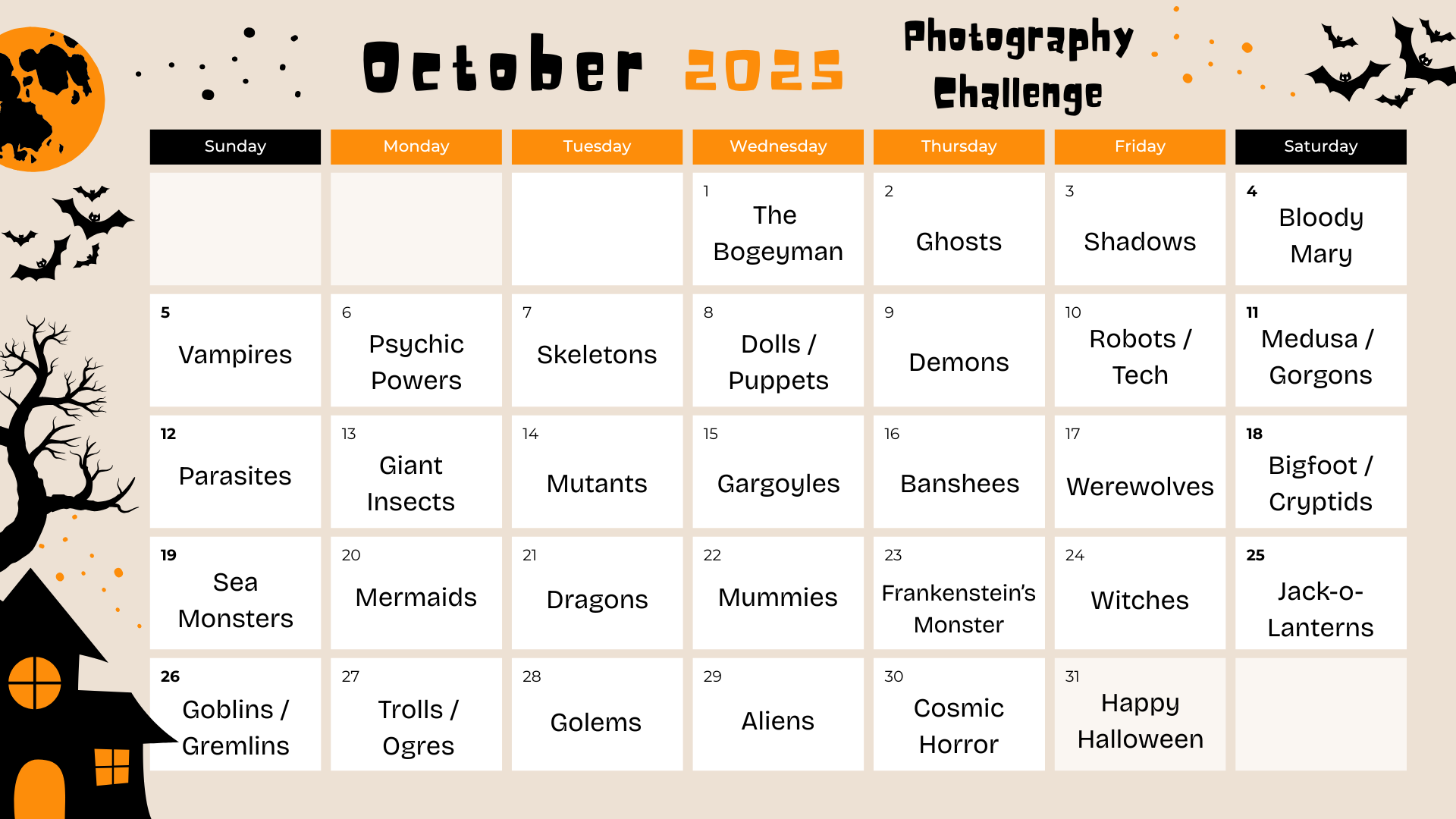
Thank you so much for joining me for this year’s October challenges. Remember to support each other by visiting and commenting on as many links as you can as we explore our Deepest Fears in anticipation of Halloween.
If you enjoy these posts and the work I do here, please head to my buymeacoffee page and show your support! Thank you so much. Every bit helps keep this site going.
Music to get us moving:
 Experience Writing
OctPoWriMo Day 24. Cauldron Bubble (In trochaic tetrameter, after the witches of Macbeth)
~ Oizys.
LikeLiked by 1 person