In the News and Trends section of the May/June 2019 Poets&Writers Magazine, in an article called “The Bookshop Band” about an English band called The Bookshop Band that toured America, playing book-inspired music in libraries and bookstores, I read, America is such a huge place, and when you look at it from afar without really knowing it or experiencing it, you don’t expect to find such tight-knit communities around the bookshops.
This stuck with me for several reasons, but mostly for the contrast of looking at something from afar and really knowing something. Then also, once you really know something, you see unexpected connections. Both of these ideas apply to poetry.
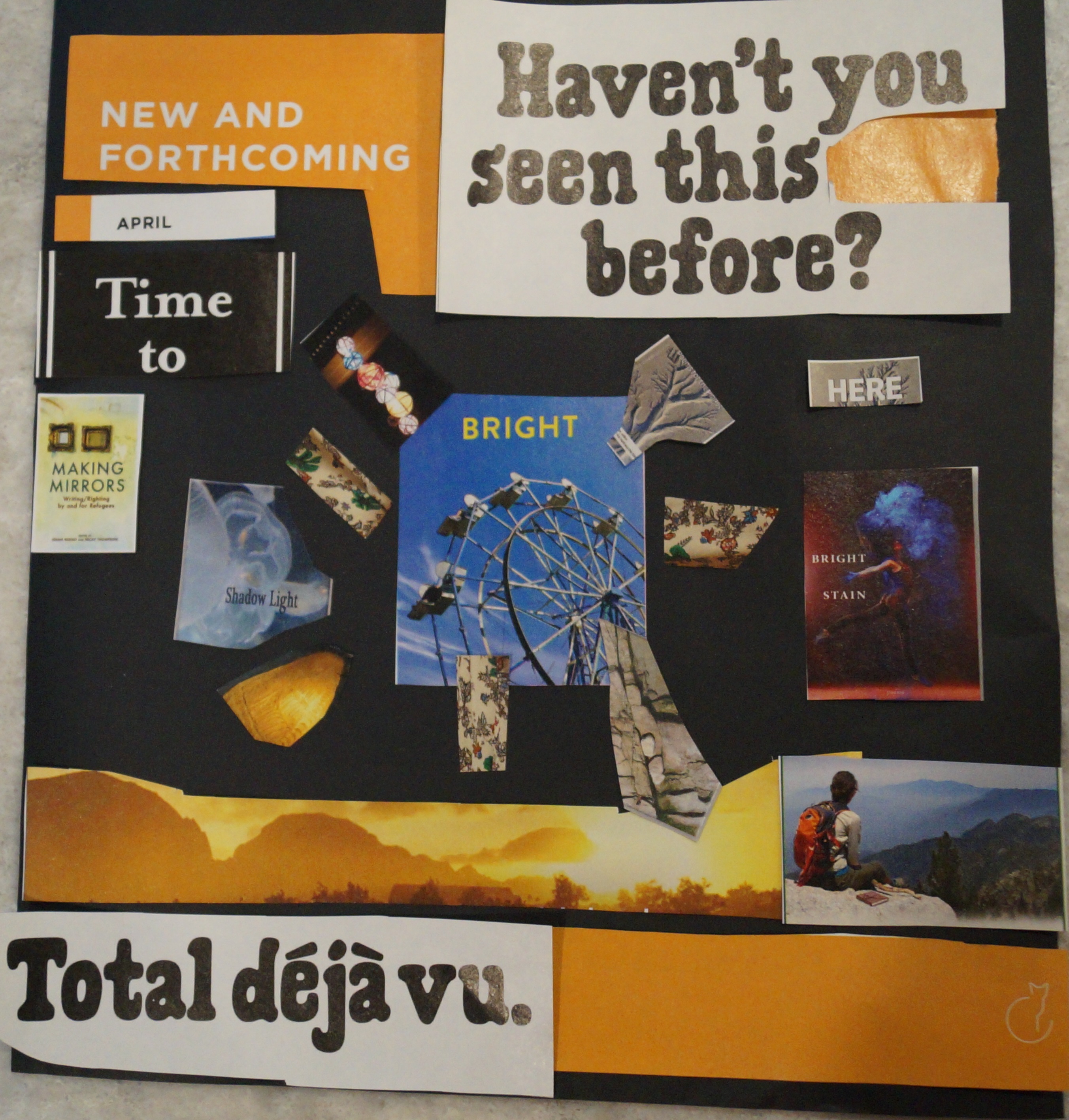
But something else stuck with me too. In the profile on poet Paisley Rekdal, the editor of the Kenyon Review (in 2019), David Baker, was quoted as saying, “One of the things I find remarkable about Paisley’s work is the complexity and brightness of the questions—her ability to bring mythology into personal memory, science into family stories, trauma set alongside beauty and devastation alike. Nothing is ‘easy’ in her poems, whether that might be a polyphonic form or voice or a museum of battered skulls or the invention of the kaleidoscope.”
I looked up the invention of the kaleidoscope and read about the Scottish physicist Sir David Brewster (1781–1868) putting “several long mirrors in a narrow brass cylinder to reflect an image as it traveled from its source to the viewer’s eye” (Kaleidoscope, The Huntington). Then I found Sir David Brewster’s A Treatise on the Kaleidoscope from 1819.
I started wondering what Paisley Rekdal had to say about the invention of the kaleidoscope, and found that The Invention of the Kaleidoscope was the name of her collection of poems about failure. Sadly, my library system does not have a copy, but I was able to read the beginning of the titular poem on Barnes & Noble.
This got me thinking about kaleidoscope poetry and found a prompt from Adele Kenny’s Poetry Blog that she posted in 2012. She includes eight great kaleidoscope questions to ask yourself while attempting a poem using a kaleidoscope as a metaphor for life.
I found this quote from, Kaleidoscope: Poetic Forms and Collective Histories, a discussion from last year’s PEN World Voices Festival.
“When we hear “kaleidoscope,” we imagine a lensed instrument revealing striking, mesmeric patterns. But the word kaleidoscope itself, derived from the Greek kalos, “beautiful,” + eidos, “form,” reminds us that poems too are a lens through which we see patterns, both beautiful and not, of the world around us.”
The discussion was led by Douglas Kearney who is also the instructor of Sharpened Visions: A Poetry Workshop the free online poetry workshop on Coursera I’m enjoying (for the third time).
The Prompts
NaPoWriMo : Write a poem that plays with the idea of a “tall tale.”
PAD Challenge : Write a funny poem.
Poetry Non-stop: Fill a poem with clichés.
Today’s Poem
Rational Amusement
It was a dark and stormy night when he
invented the instrument that changed
how the whole world sees
He was a physicist experimenting
but never judge a book by its cover
He was on a search for beauty and he was unrelenting
You don’t have to read between the lines
You will believe your own eyes
the grass is no longer greener on the other side
because David Brewster was born for greatness
he removed all limitations to degrees of perfection
to provide the highest service in all art’s ornateness
if you play your cards right
like a bolt from the blue
all will be clear with your first sight
The Royal Academy gave him a medal
as plain as the nose on your face
because he was first though so many raced to pedal
his instrument of scientific visual study
as a bit of child’s play
the secret out, his patent ownership got muddy
Like a thief in the night
lower than a snake’s belly
he lost his first manufacturing rights
But feast your eyes on this
he wrote his own treatise
so the masses would not miss
the potential of the instrument they held
he explained the math like a broken record
making plain the kaleidoscope’s spell
But when swirling in color and shapes
the beauty of form to see
ignorance is bliss no sour grapes
 Experience Writing