Welcome back for the third day of Writober. Today, all our prompts will continue to explore the universal fear of Ego death: the loss of subjective self-identity by looking at shame.

“According to philosopher Hilge Landweer of the Free University of Berlin, certain conditions must come together for someone to feel shame. Notably, the person must be aware of having transgressed a norm. He or she must also view the norm as desirable and binding because only then can the transgression make one feel truly uncomfortable. It is not even always necessary for a disapproving person to be present; we need only imagine another’s judgment.” (Scientific American)
Some people feel shame more readily than others, a trait that has been termed “shame-proneness.” There are two types of shame “State shame” and “Trait shame.” State shame is a temporary reaction to an event. Trait shame is a consistent feeling of shame often due to trauma.
To combat shame we need to learn to separate what we do from who we are. We can’t let our mistakes define how we see ourselves.
Fighting Fear of the Blank Page: When we want to write, sometimes the blank page stares back like a judgemental enemy or a white-washed wall. But what if the page isn’t blank to start with?
Write in different directions: Try crumpling up a piece of paper and flattening it back out. Write along all the lines created by the crumpling. Let your words flow all over the page in every direction.
*Quick Note about links in this post: I am an amazon associate, so most of the links in my post will take you to amazon products. If you buy from these links, I will make some pennies which will help me pay for this site and my creative endeavors.
OctPoWriMo
Poetry Toolbox
These are quick exercises that I hope you’ll do every day. We will build on these exercises throughout the month.
- Word list: Write down the first ten words you think of when you think of fear or shame. Any words at all. Anything that comes to mind. Then choose your three favorite and say them aloud a few times until you hear the accented and unaccented syllables (if more than one syllable) and notice the duration of each syllable. Do any of the words have the same vowel sounds? (Assonance) or the same consonant sounds (Consonance)? (Inspired by Frances Mayes’ list of a hundred favorite words in The Discovery of Poetry)
I created this Excel Spreadsheet for you to use to collect and explore your fear words.
- Sensory Imagery: In your journal or a word processing file, fill in these lines as quickly as you can with something different from yesterday. You may want to revisit one or two in more detail if you’re inspired and have time.
I saw
I heard
I carried
I smelled
I followed
The crowded room
The slap of
I tasted
The heat of my cheeks
I witness
I touch
(Inspired by a week one exercise in the poetry chapter of The Portable MFA in Creative Writing)
Poetry Building
Assonance is the repetition of vowel sounds in words that are close to each other in a sentence or phrase. Example: “Who gave Newt and Scooter the blue tuna?” (from litcharts.com)
Consonance is the repetition of consonant sounds. Example: “”Zach sneezed when he heard jazz music.” (from litcharts.com)
Today’s example poem, copied here for educational purposes from Poem Hunter, is Being But Men by Dylan Thomas.
Being but men, we walked into the trees
Afraid, letting our syllables be soft
For fear of waking the rooks,
For fear of coming
Noiselessly into a world of wings and cries.
If we were children we might climb,
Catch the rooks sleeping, and break no twig,
And, after the soft ascent,
Thrust out our heads above the branches
To wonder at the unfailing stars.
Out of confusion, as the way is,
And the wonder, that man knows,
Out of the chaos would come bliss.
That, then, is loveliness, we said,
Children in wonder watching the stars,
Is the aim and the end.
Being but men, we walked into the trees.
In this poem, Thomas talks about fears of adults that children don’t have. How children are full of wonder while the men are afraid. Notice all the different “o” sounds in the third stanza. The assonance of confusion/wonder/chaos. And the consonance of way/wonder/would and confusion/chaos/come.
Today’s poem: Write a poem about what you would do if you had never known shame. What would you do as a child, that you won’t as an adult because you know it to be shameful?
Form: If you’re looking for more of a challenge, write a pantoum. “The pantoum is a poem of any length, composed of four-line stanzas in which the second and fourth lines of each stanza serve as the first and third lines of the next stanza. The last line of a pantoum is often the same as the first.” (poets.org) Use consonance and/or assonance in your repeating lines.
Writober Flash Fiction
Write a story with a beginning, middle, and end with conflict that leads to change in less than a thousand words (no minimal word count) inspired by one of the images in the Ego death folder of the Writober 2024 Pinterest board. How does shame skew your character(s)’s point of view (POV)?
NaNo Prep
Now that you have the idea for your novel, let’s start looking at the main character. This is a person you’ll be spending all your time with for a very long time, so make it someone you find fascinating. Your main character can be absolutely anyone, so give him or her traits that you admire. In Writing the Breakout Novel, Donald Maass recommends giving your MC characteristics of your personal heroes.
What is your character’s wound that warps her/his point of view? What happened? When did it happen? How does it show itself in the character’s behavior?
What is your character’s flaw? How can it become a strength.
What is your character’s deepest secret? The one he or she would do anything to keep hidden? What would happen if it ever came to light?
We’ll be working on our characters for a while, so just sit with your character and brainstorm what would make your character the most interesting to you.
You may want to set a timer for fifteen minutes and write as your character. Let him/her answer the questions above. Or you may want to imagine you’re interviewing your character.
Look for images of your character. For fun you can cut parts of people out of old magazines and make a collage of your character, or play around in photoshop or GIMP (free photo manipulation software) to create how your character looks.
Halloween Photography Challenge
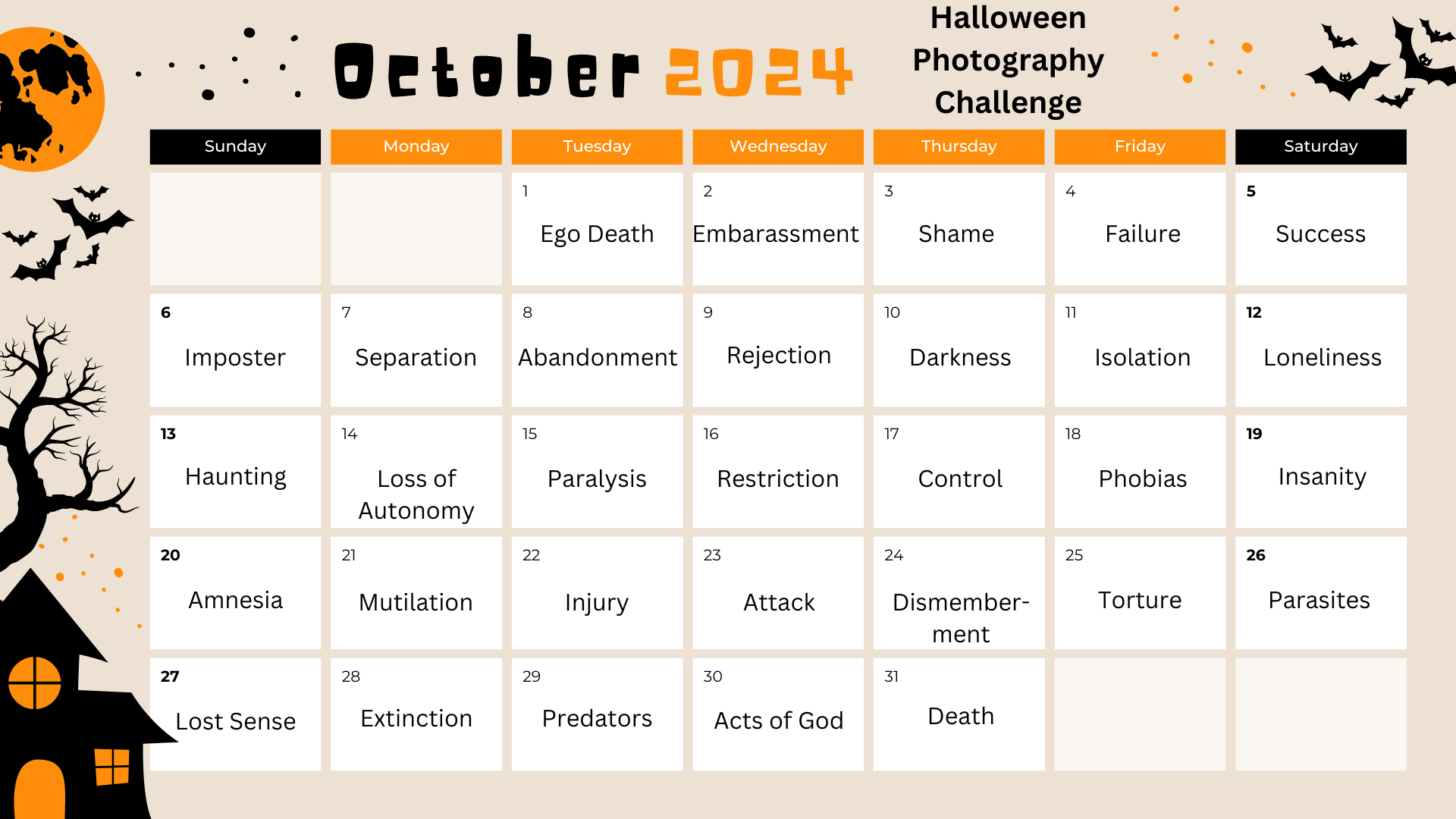
Take a photograph that depicts shame, fear of shame, or how to deal with shame and link to your photo in the chat.
Get Moving
Now that you’ve read all the prompts and have all these ideas running around in your head, it’s time for motion. It may seem counter-intuitive, but while you are moving, your mind will still be working on your ideas while you are busy doing something else. Write down some quick notes, your initial thoughts from the prompts and then get your body moving in any way you can that you enjoy. This summer I got a lot of exercise playing sports on my Xbox 360 with my nephew. Some suggestions:
Kinect Sports. I really enjoy the bowling and boxing. I have these fun weighted gloves for boxing to give a little extra resistance. My nephew really enjoyed the volleyball, and we both like track and field.
Just Dance. There are so many songs to choose from and you forget you’re even exercising as you try to match the moves.
Don’t forget to come back and post a link your work in the comments.
 Experience Writing
My #Writober: Our New Hour Gone Out & Photo for the Challenge.
LikeLike
Writober – Such a shame – Ladyleemanila (wordpress.com)
LikeLike