
Welcome back for the twelfth day of Writober. Today we’re exploring the universal fear of separation by looking at fear of loneliness.
After looking for fear of isolation yesterday, but finding fear of being alone, today I’m wondering if fear of loneliness is also different from fear of being alone. I think it is. I like being alone, but could understand a fear of loneliness. I would assume that people who are afraid of being alone, are avoiding a feeling of loneliness, but may also fear the physical experience of being alone.
I liked how looking at definitions got me thinking yesterday, so here’s the definition of lonely from dictionary.com:
adjective lone·li·er, lone·li·est.
- affected with, characterized by, or causing a depressing feeling of being alone; lonesome.
- destitute of sympathetic or friendly companionship, intercourse, support, etc.:a lonely exile.
- lone; solitary; without company; companionless.
- remote from places of human habitation; desolate; unfrequented; bleak:a lonely road. Synonyms: unpopulated, uninhabited
- standing apart; isolated:a lonely tower. Synonym: secluded
Until I looked at these definitions, I hadn’t been thinking of loneliness in relation to place. I also really like the phrase, “destitute of sympathetic” in the second definition.
Phrase: Dysphemism
- the substitution of a harsh, disparaging, or unpleasant expression in the place of a more neutral one. 2. an expression so substituted, as “cancer stick” for “cigarette.” Can you think of examples of the rhetorical device of dysphemism used to manipulate and persuade? How could dysphemism make your writing more persuasive?
Fighting Fear of the Blank Page: Sometimes fighting fear of the blank page means not looking at the page at all.
Magnetic poetry kits: I go really into poetry kits this year during April’s National Poetry Writing Month (NaPoWriMo). I was house sitting for my sister and needed something to cheer me up, so I got the Metal Easel Board and the Psycho Kitty Magnetic Word Kit. Using the available words in a poetry kit is a fun constraint, and arranging the words on the metal board is a different experience of connecting words than writing on the page. In April I also got: The Artist Kit, Music Lover, and Original Edition.
Here are links to some of the poems I wrote with these kits.
Quadrille Monday (The Artist Kit)
I took photos of poems I wrote with these magnetic kits and used them for cards for my family (Mother’s Day and Birthdays) and they really liked them.
There’s also an online magnetic poetry program. It doesn’t give the satisfying feel of putting the magnets on the board and arranging them, but it’s still a different way of approaching the page (as you await your magnet kits to arrive 🎃).
*Quick Note about links in this post: I am an amazon associate, so most of the links in my post will take you to amazon products. If you buy from these links, I will make some pennies which will help me pay for this site and my creative endeavors.
OctPoWriMo
Poetry Toolbox
These are quick exercises that I hope you’ll do every day. We will build on these exercises throughout the month.
- Word list: Write down the first ten words you think of when you think of fear. Any words at all. Anything that comes to mind. Then choose your three favorite and say them aloud a few times until you hear the accented and unaccented syllables (if more than one syllable) and notice the duration of each syllable. (Inspired by Frances Mayes’ list of a hundred favorite words in The Discovery of Poetry)
I created this Excel Spreadsheet for you to use to collect and explore your fear words.
2. Sensory Imagery: In your journal or a word processing file, fill in these lines as quickly as you can. Notice they are slightly different from last week. You may want to revisit one or two in more detail if you’re inspired and have time.
I see
I hear
I carry
I smell
I follow
The empty room
The tug of
I taste
The cold down my spine
I witnessed
I touched
(Inspired by a week one exercise in the poetry chapter of The Portable MFA in Creative Writing)
3. More Sensory Imagery: I find a great place to start when exploring abstract ideas, is to brainstorm sensory imagery. Write down the first few things you think of to answer these questions:
What does loneliness smell like?
What does loneliness taste like?
What texture is loneliness? What does it feel like to the touch? What temperature is loneliness? Where do you feel it?
What does loneliness sound like?
What color(s) is loneliness? What is a symbol of loneliness? What does it look like?
4. Choose one poem to study all week: Read your chosen poem again. Read it aloud. What is the purpose of the poem? What do you think inspired the poet to write the poem? What is the Why of the poem?
Poetry Building
Example poem: Today we’re looking at Animals Above Me by Deborah Keenan, copied here from poets.org for educational purposes.
Animals Above Me
My neighbor cradles a coyote at the top of the hill behind my house.
She is screaming at me to stop being so afraid.
Then the keening yet ecstatic cry of our neighborhood hawk, and then
The plunge, the lift, the rabbit, crying.
Worst, the nightly dreams of the snake, huge, yellow and green,
On the high shelving in my old house, sometimes the bedroom,
Sometimes the dining room. The dream makes me sick
And I wake from it every night between 3:30 and 4:00. Comforting
Books do not comfort, so I get up exhausted and start the day.
Other neighbors keep telling me: as long as you see it, you don’t need
To be afraid. Then in the next dream, I cannot see it.
I am sick and afraid. I wake up again.
The bear straddling my maple tree, about twenty feet up.
Is he scared?
I am so sick of thinking about how safe I am, so sick of making
Animals carry all my fear. The human beings in our country,
Half, at least, live in terror. In our world, half, at least,
Terrified, desperate, sick with fear. I see it. I cannot see it.
I see it.
Copyright © 2018 Deborah Keenan. Used with permission of the author. This poem originally appeared in Tin House, Fall 2018.
Today’s prompt: Write a poem exploring the fear of loneliness using dysphemisms.
Form: If you’re looking for more of a challenge, write your poem using animal imagery and symbolism.
Writober Flash Fiction
Write a story with a beginning, middle, and end with conflict that leads to change in less than a thousand words (no minimal word count) inspired by one of the images in the Separation folder of the Writober 2024 Pinterest board. How does fear of loneliness affect your character’s perspective and behavior?
NaNo Prep
Now that we have an idea, a main character, an antagonist, some secondary character ideas, and some setting ideas, lets try brainstorming some main plot points for our outline.
There are as many different kinds of outlines as there are writers, but here are a some options to choose from:
The hero’s journey
The heroine’s journey
Three Act Structure
Four Act Structure
The Chiastic Outline (or symmetrical plotting)
Once you have chosen the outline that looks to fit the story you want to write, imagine what you character is doing on an ordinary day in his or her ordinary world right before the story begins: brainstorm at least ten different ideas, or set a timer for ten minutes and list as many ideas as you can, and then a few more. Then do the same thing for the inciting incident: brainstorm at least ten ideas of what happens to your main character that sets your story in motion.
I’ve enjoyed using tarot to help with outlining and plotting. If that’s something that interests you, you may want to check out Mapping the Hero’s Journey with Tarot by Arwen Lynch, and/or Jump Start Your Novel by Mark Teppo.
Halloween Photography Challenge
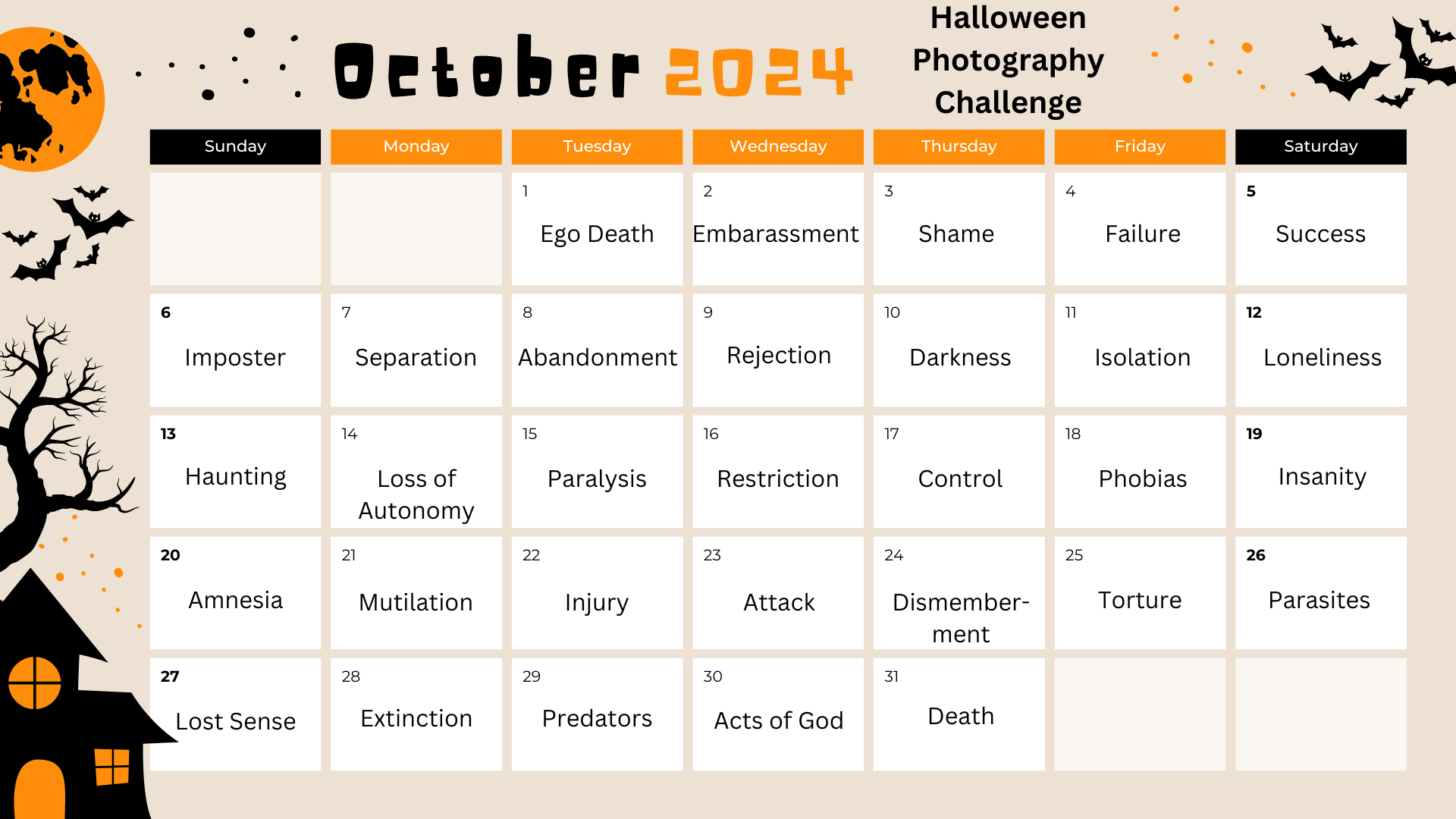
Take a photograph that depicts loneliness or fear of loneliness and link to your photo in the chat.
Get Moving
Now that you’ve read all the prompts and have all these ideas running around in your head, it’s time for motion. Some suggestions:
A New View: Try to look at the world from as many perspectives as you can. Lay on the ground and stare up at things, roll on your belly and look down at the ground, climb up a ladder, climb a tree, climb a hill, lay on a bench and look at things sideways. Get creative. Stretch first. Tighten your core while bending and twisting. Be careful. And have fun!
 Experience Writing
LaCharta from me 🙂
Writober – So alone – Ladyleemanila (wordpress.com)
LikeLike