
Welcome back for the fifteenth day of Writober. Today we’re exploring our third universal fear: loss of autonomy through fear of paralysis.

Fear of paralysis is the fear of losing control of your body, but as I looked into it, I also found “fear paralysis” which is becoming paralyzed or frozen by fear. So this could also be about the fear of fear paralysis. That repetition of the word “fear” could be an example of epizeuxis.
Rhetorical Device: Epizeuxis
Epizeuxis, also known as palilogia, is repeating a word or phrase in quick succession to create emphasis or emotional appeal.
Fighting Fear of the Blank Page: Last week was the beat poets’ week at ModPo. One of the resources was Jack Kerouac’s “Essentials of Spontaneous Prose”:
“Essentials of Spontaneous Prose”
by Jack Kerouac
SET-UP The object is set before the mind, either in reality. as in sketching (before a landscape or teacup or old face) or is set in the memory wherein it becomes the sketching from memory of a definite image-object.
PROCEDURE Time being of the essence in the purity of speech, sketching language is undisturbed flow from the mind of personal secret idea-words, blowing (as per jazz musician) on subject of image.
METHOD No periods separating sentence-structures already arbitrarily riddled by false colons and timid usually needless
SCOPING Not “selectivity’ of expression but following free deviation (association) of mind into limitless blow-on-subject seas of thought, swimming in sea of English with no discipline other than rhythms of rhetorical exhalation and expostulated statement, like a fist coming down on a table with each complete utterance, bang! (the space dash)-Blow as deep as you want-write as deeply, fish as far down as you want, satisfy yourself first, then reader cannot fail to receive telepathic shock and meaning-excitement by same laws operating in his own human mind.
LAG IN PROCEDURE No pause to think of proper word but the infantile pileup of scatological buildup words till satisfaction is gained, which will turn out to be a great appending rhythm to a thought and be in accordance with Great Law of timing.
TIMING Nothing is muddy that runs in time and to laws of time-Shakespearian stress of dramatic need to speak now in own unalterable way or forever hold tongue-no revisions (except obvious rational mistakes, such as names or calculated insertions in act of not writing but inserting).
CENTER OF INTEREST Begin not from preconceived idea of what to say about image but from jewel center of interest in subject of image at moment of writing, and write outwards swimming in sea of language to peripheral release and exhaustion-Do not afterthink except for poetic or P. S. reasons. Never afterthink to “improve” or defray impressions, as, the best writing is always the most painful personal wrung-out tossed from cradle warm protective mind-tap from yourself the song of yourself, blow!-now!-your way is your only way-“good”-or “bad”-always honest (“ludi- crous”), spontaneous, “confessionals’ interesting, because not “crafted.” Craft is craft.
STRUCTURE OF WORK Modern bizarre structures (science fiction, etc.) arise from language being dead, “different” themes give illusion of “new” life. Follow roughly outlines in outfanning movement over subject, as river rock, so mindflow over jewel-center need (run your mind over it, once) arriving at pivot, where what was dim-formed “beginning” becomes sharp-necessitating “ending” and language shortens in race to wire of time-race of work, following laws of Deep Form, to conclusion, last words, last trickle–Night is The End.
MENTAL STATE If possible write “without consciousness” in semi-trance (as Yeats’ later “trance writing”) allowing subconscious to admit in own uninhibited interesting necessary and so “modern” language what conscious art would censor, and write excitedly, swiftly, with writing-or-typing-cramps, in accordance (as from center to periphery) with laws of orgasm, Reich’s “beclouding of consciousness.” Come from within, out–to relaxed and said.
Follow Kerouac’s Essentials: Write like a jazz musician in a trance state, allowing your subconscious to be uninhibited, allowing free association in undisturbed flow.
*Quick Note about links in this post: I am an amazon associate, so most of the links in my post will take you to amazon products. If you buy from these links, I will make some pennies which will help me pay for this site and my creative endeavors.
OctPoWriMo
Poetry Toolbox
These are quick exercises that I hope you’ll do every day. We will build on these exercises throughout the month.
- Word list: Write down the first ten words you think of when you think of fear. Any words at all. Anything that comes to mind. Then choose your three favorite and say them aloud a few times until you hear the accented and unaccented syllables (if more than one syllable) and notice the duration of each syllable. (Inspired by Frances Mayes’ list of a hundred favorite words in The Discovery of Poetry)
I created this Excel Spreadsheet for you to use to collect and explore your fear words.
2. Sensory Imagery: In your journal or a word processing file, fill in these lines as quickly as you can. Notice they are slightly different from last week. You may want to revisit one or two in more detail if you’re inspired and have time.
I didn’t see
I didn’t hear
I can’t carry
I didn’t smell
I wouldn’t follow
The dead end road
The frustration of
I can’t taste
The burn of
I witness
I touch but don’t feel
(Inspired by a week one exercise in the poetry chapter of The Portable MFA in Creative Writing)
3. More Sensory Imagery: Ask yourself sensory questions about fear of paralysis.
4. Choose one poem to study all week: Read your chosen poem again. Read it aloud. Journal about your thoughts on the poem. Has your understanding changed in any way? Have new questions come up? Look up the poem online. Are there any interviews with the poet? Has anyone else written insights about the poem?
Poetry Building
Epizeuxis creates a rhythm in its repetition of sounds. Are there sounds in your favorite words from your word list today that when repeated over and over make you think of fear of paralysis?
Example poem: Today we’re looking at The Bells by Edgar Allan Poe, copied here from poets.org for educational purposes.
The Bells
1809 –1849
I.
Hear the sledges with the bells—
Silver bells!
What a world of merriment their melody foretells!
How they tinkle, tinkle, tinkle,
In the icy air of night!
While the stars that oversprinkle
All the heavens, seem to twinkle
With a crystalline delight;
Keeping time, time, time,
In a sort of Runic rhyme,
To the tintinabulation that so musically wells
From the bells, bells, bells, bells,
Bells, bells, bells—
From the jingling and the tinkling of the bells.
II.
Hear the mellow wedding bells,
Golden bells!
What a world of happiness their harmony foretells!
Through the balmy air of night
How they ring out their delight!
From the molten-golden notes,
And all in tune,
What a liquid ditty floats
To the turtle-dove that listens, while she gloats
On the moon!
Oh, from out the sounding cells,
What a gush of euphony voluminously wells!
How it swells!
How it dwells
On the Future! how it tells
Of the rapture that impels
To the swinging and the ringing
Of the bells, bells, bells,
Of the bells, bells, bells, bells,
Bells, bells, bells—
To the rhyming and the chiming of the bells!
III.
Hear the loud alarum bells—
Brazen bells!
What tale of terror, now, their turbulency tells!
In the startled ear of night
How they scream out their affright!
Too much horrified to speak,
They can only shriek, shriek,
Out of tune,
In a clamorous appealing to the mercy of the fire,
In a mad expostulation with the deaf and frantic fire,
Leaping higher, higher, higher,
With a desperate desire,
And a resolute endeavor
Now—now to sit or never,
By the side of the pale-faced moon.
Oh, the bells, bells, bells!
What a tale their terror tells
Of Despair!
How they clang, and clash, and roar!
What a horror they outpour
On the bosom of the palpitating air!
Yet the ear it fully knows,
By the twanging,
And the clanging,
How the danger ebbs and flows;
Yet the ear distinctly tells,
In the jangling,
And the wrangling.
How the danger sinks and swells,
By the sinking or the swelling in the anger of the bells—
Of the bells—
Of the bells, bells, bells, bells,
Bells, bells, bells—
In the clamor and the clangor of the bells!
IV.
Hear the tolling of the bells—
Iron bells!
What a world of solemn thought their monody compels!
In the silence of the night,
How we shiver with affright
At the melancholy menace of their tone!
For every sound that floats
From the rust within their throats
Is a groan.
And the people—ah, the people—
They that dwell up in the steeple,
All alone,
And who tolling, tolling, tolling,
In that muffled monotone,
Feel a glory in so rolling
On the human heart a stone—
They are neither man nor woman—
They are neither brute nor human—
They are Ghouls:
And their king it is who tolls;
And he rolls, rolls, rolls,
Rolls
A pæan from the bells!
And his merry bosom swells
With the pæan of the bells!
And he dances, and he yells;
Keeping time, time, time,
In a sort of Runic rhyme,
To the pæan of the bells—
Of the bells:
Keeping time, time, time,
In a sort of Runic rhyme,
To the throbbing of the bells—
Of the bells, bells, bells—
To the sobbing of the bells;
Keeping time, time, time,
As he knells, knells, knells,
In a happy Runic rhyme,
To the rolling of the bells—
Of the bells, bells, bells—
To the tolling of the bells,
Of the bells, bells, bells, bells—
Bells, bells, bells—
To the moaning and the groaning of the bells.
From The Works of the Late Edgar Allan Poe, vol. II, 1850. For other versions, please visit The Edgar Allan Poe Society of Baltimore site: http://www.eapoe.org/works/poems/index.htm#B.
How does this poem make you feel? What is the effect of the extensive use of epizeuxis in this poem?
Today’s prompt: Write a poem exploring the fear of paralysis using epizeuxis.
Form: If you’re looking for more of a challenge, write your poem as an alouette. The alouette, created by Jan Turner, consists of two or more stanzas of 6 lines each, with the syllabic sequence: 5, 5, 7, 5, 5, 7 and the rhyme scheme: a, a, b, c, c, b.
Writober Flash Fiction
Write a story with a beginning, middle, and end with conflict that leads to change in less than a thousand words (no minimal word count) inspired by one of the images in the Loss of Autonomy folder of the Writober 2024 Pinterest board. How does fear of paralysis affect your character?
NaNo Prep
Yesterday we started thinking about our novel’s ending. Did any of your ideas have a twist?
Novel Writing Blueprint Workbook: A Storyteller’s Journal, Jill Harris offers some ideas for plot twists that we might want to think about to make our endings more surprising:
- Identity Twist – one of the main characters turns out to be someone or something other than they seem.
- Death Twist – one of the main characters is killed off in a surprising way.
- Motive Twist – A character is revealed to want the opposite of what they had appeared to desire.
- Perception Twist – The main character realizes that they had perceived their surroundings incorrectly (Example: The Truman Show).
- Fortune Twist – The character is given something at the beginning that is taken away at the end: a twist of fate.
- Fulfillment Twist – The character gets what they want but it turns out to be a disaster.
Brainstorm as many ideas as you can for each of these twists then explore your favorites to see how they create the most surprising and fulfilling ending to your story.
Halloween Photography Challenge
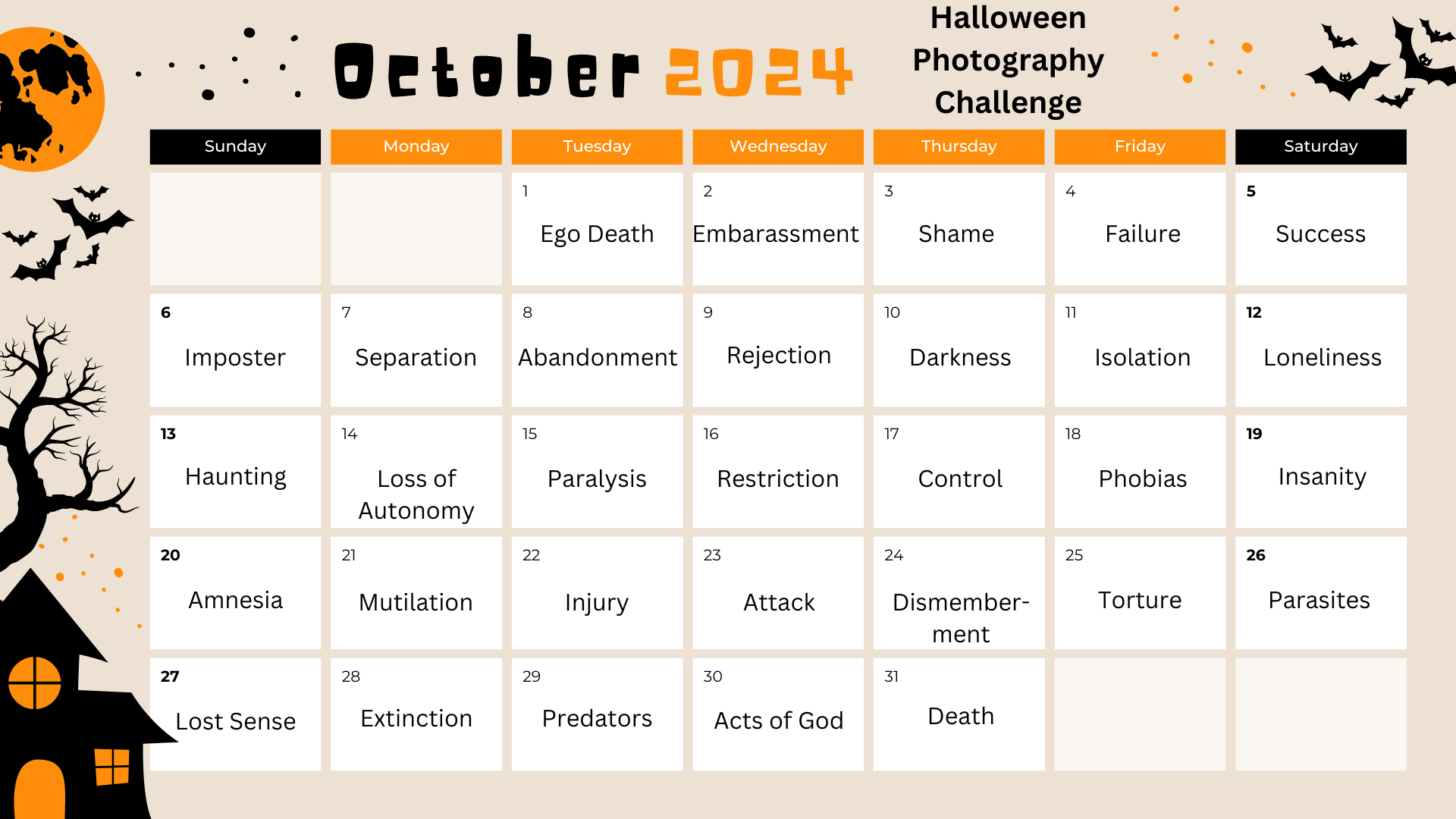
Take a photograph that depicts paralysis or fear of paralysis and link to your photo in the chat.
Get Moving
Now that you’ve read all the prompts and have all these ideas running around in your head, it’s time for motion. What better way to fight fear of paralysis than getting moving? How about some scary walks in Sweden? Use your imagination. Some suggestions:
Listen to a horror story in a Swedish forest as you take a walk.
Watch and listen to a night walk in Sweden while marching in place.
 Experience Writing
Only Poe could afford to write the word ‘bell’ so many times and make it seem like each time it was a different bell sound 🔔🔔🔔
LikeLiked by 1 person
alouette from me 🙂
Writober – I cannot move – Ladyleemanila (wordpress.com)
LikeLike