It’s already April, and at Experience Writing that means it’s time for NaPoWriMo (National (Global) Poetry Writing Month) and the A-Z Challenge.
This year, I’m looking at the A-Z of Depth. Have certain definitions of depth peaked your interest? When I first typed up all the definitions of depth, I was intrigued by “sounding.” Sounding is one of the concrete definitions. It is a technique for measuring depth. I’ll talk about it later in the month. I’ll leave the definitions up for the rest of this week for you to peruse.

Today, I’m talking about complexity. Complexity is the quality of being intricate or complicated. Why do we associate depth with complexity? Maybe because it adds a whole dimension to our world and that complicates things. When depth is involved we have to use visuospatial reasoning; we have to think about distance; and we might have to calculate volume, or learn how to draw a cube. 😁
Deeper understanding often requires paying attention to intricate details, multiple perspectives, and interconnected concepts. Back in January, when I was starting this depth study, I found an interesting framework of thinking called Depth & Complexity. It is made up of eleven modes of thinking to deepen one’s understanding of any subject. You can read all about it in my post “Our Depth Study Gets Meta with Depth & Complexity.”
Today, I’m going to talk about the aspects of complexity which are:
📚Across Disciplines: Relate the area of study to other subjects within, between, and across disciplines.
🎡Multiple Perspectives: How would others see the situation differently?
🔭Change Over Time: How are elements related in terms of the past, present and future? How and why do things change? What doesn’t change?
How would using these modes of thinking add depth to our writing? Let’s say we’re writing about our favorite movie: Instead of just summarizing the plot and what we like about it, we can think about why we feel this way. We can go deeper by exploring our own movie watching biases and tendencies and where they come from, but to add complexity, we need to look outside ourselves.
Looking across disciplines we can write about the camera work, costuming, acting techniques, directing, editing (quick cuts or smooth transitions), scene dressing and props, writing and screen adaptation, and other aspects of film creation. Then we can go further across disciplines and talk about the philosophy or psychology of the film, the history of the setting or the film itself, etc.
This has already taken our writing from a blurb to an essay, but we can get even more complex by writing about other people’s perspectives of the film. What do experts on the topic of the film think of it? What about people from different countries and cultures? Do different age groups have different opinions of the film? Then, for more complexity, we can compare this film to other films from different eras of film, and/or different eras of the topic. How have opinions on the film’s subject matter changed over time? Will the film hold up in the future? Are there noticeable trends with similar films over time?
As we add complexity to our writing in this way, we include many more people in our writing, and thus can create more interest for a broader audience.
Our world is full of complexity. Sometimes, when we think something is too complex, we get overwhelmed and avoid it or shut down. When that happens, it can help to break something down into its simplest parts and tackle them one at a time.
Making the complex simple and the simple complex
For today’s exercise, I made a tool for us to use (made with Canva):
Once you print it out, you can use it with the complex topic at the top, turn it on it’s side, or turn it upside down with the simple concepts at the top to build complexity.
You could also use this for top down and bottom up processing. Top down starting with prior knowledge and expectation and breaking it down to its sensory details, and Bottom up starting with sensory details and building to an abstract concept.
Let’s look at an example of breaking down a complex idea like depth into its simplest parts (just a quick brainstorm I did this morning):
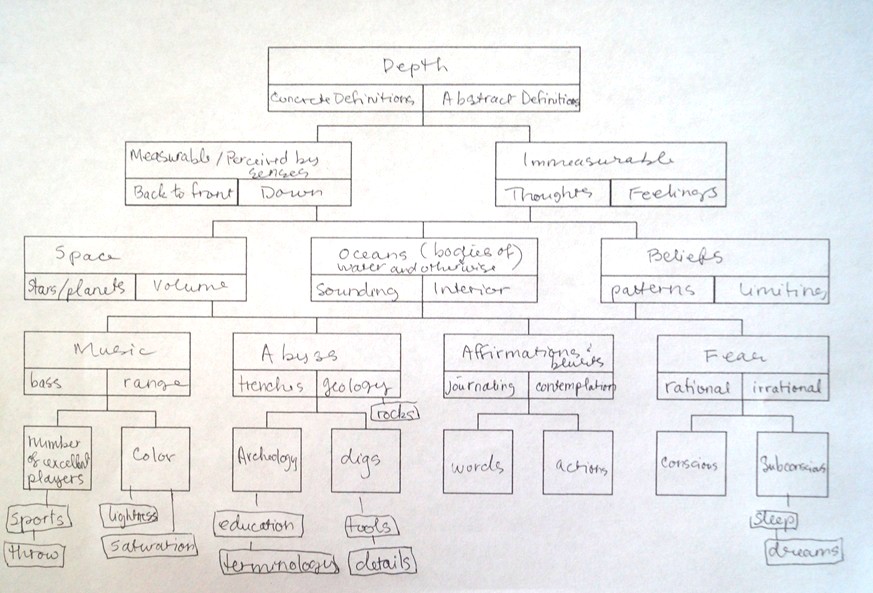
That tool really worked for me. As you can see, it’s adaptable: I added more boxes where I wanted them. I think I’ll try another one and see if I can simplify the complexities of poetry. 🤞🤣
Today’s Poem
Word Sculpture
I am not a sculptor
but sometimes I would like
to make giants out of metal—
their patina changing in the baking
heat and monsoon rains—
like those growing leafing vines
from their hands, shoulders, or heads
in City Park that I loved to visit
on my bike when I first moved to New Orleans.
Silent mysteries
all my own
I was always alone with them
so never alone.
But I am not a sculptor
I am a poet. I can turn
those giants into short lines
simplified with underlying complexity
and pose them perpetually in that time;
call them from the past to the page;
show them to you without need
of chains and machinery to lift
their monstrous weights.
Examples of humanoid strength
being reclaimed by nature
you can look up into their lineless
faces and feel their endless peace.
This poem was inspired by today’s prompts at NaPoWriMo and Writer’s Digest’s April Poem a Day (PAD) Challenge.
Thank you so much for coming by and reading my post. I appreciate your comments and interaction. Any thoughts or questions about Complexity? Did you try the simplification/complexity tool? How did it go? Come back tomorrow for more depth exploration and poetry. Happy April.
 Experience Writing
Whoa… I LOVE THIS!!! “Sometimes, when we think something is too complex, we get overwhelmed and avoid it or shut down. When that happens, it can help to break something down into its simplest parts and tackle them one at a time.” That’s exactly how I feel, but breaking it down is something I’ve never (consciously) tried. This is a great worksheet – thanks for sharing!
– Allison
https://lightningflashwriting.blogspot.com/
LikeLiked by 1 person
Thank you. I’m so glad you’re enjoying my posts.
LikeLike
An interesting theme and post – as a sometime geography student, I was intrigued to realise that Meteorologists use deep, as in a depression deepening, which is kind of counter-intuitive, though a s metaphor for mental health it makes perfect sense…
LikeLiked by 1 person
I was certainly amazed at all the definitions of depth – you’ve got lots to work with in your challenge. I enjoyed your look at complexity, and the tool looks interesting. It’s clear from your example it works well.
I enjoyed your poem as well. I’m delighted by the image of poet as sculptor of words and images. All together, very nice, Maria!
LikeLiked by 1 person
Thank you, Deborah. Thanks for reading and commenting.
LikeLiked by 1 person
Excellent poem. Thank you for the very helpful tool.
LikeLiked by 1 person
Thank you so much, and you’re welcome.
LikeLike
I got as far as printing out the template. Great poem. Poetry keeps us human (in the best way) I think. You don’t live in New Orleans now do you? For some reason I thought you lived in Europe?
LikeLiked by 1 person
No, I didn’t go back after Hurricane Katrina. I live near Seattle now. You may have thought I live in Europe because I speak Swedish (and have a Swedish name), but I only lived there for a year when I was turning thirteen. I’m glad you liked my poem.
LikeLiked by 1 person
Oh ok. I remember you talking about a place on a lake that had family connections and about a neighbor obstructing your view? My memory is like a drawer of jelly beans with dust on them.
LikeLiked by 1 person
😆The neighbor nextdoor, luckily, is not obstructing my view, they have been driving me completely mad with construction since early last summer. They did a complete tear down and built a hovering beast of a McMansion that’s barely feet from my bedroom. Now that they are working on the interior, there’s some sort of fan that goes on and off all night and they start pounding away at 5 am. There was an earth mover and stone cutter in the pouring rain two days ago. But, happily, the view is beautiful (when the rain stops, and the clouds clear like right now).
LikeLiked by 1 person
I hope things calm down next door soon. So nice you still have your view.
LikeLiked by 1 person