It’s already April, and at Experience Writing that means it’s time for NaPoWriMo (National /Global Poetry Writing Month) and the A-Z Challenge. Continuing this year’s theme, I’m writing about the A to Z of Depth.
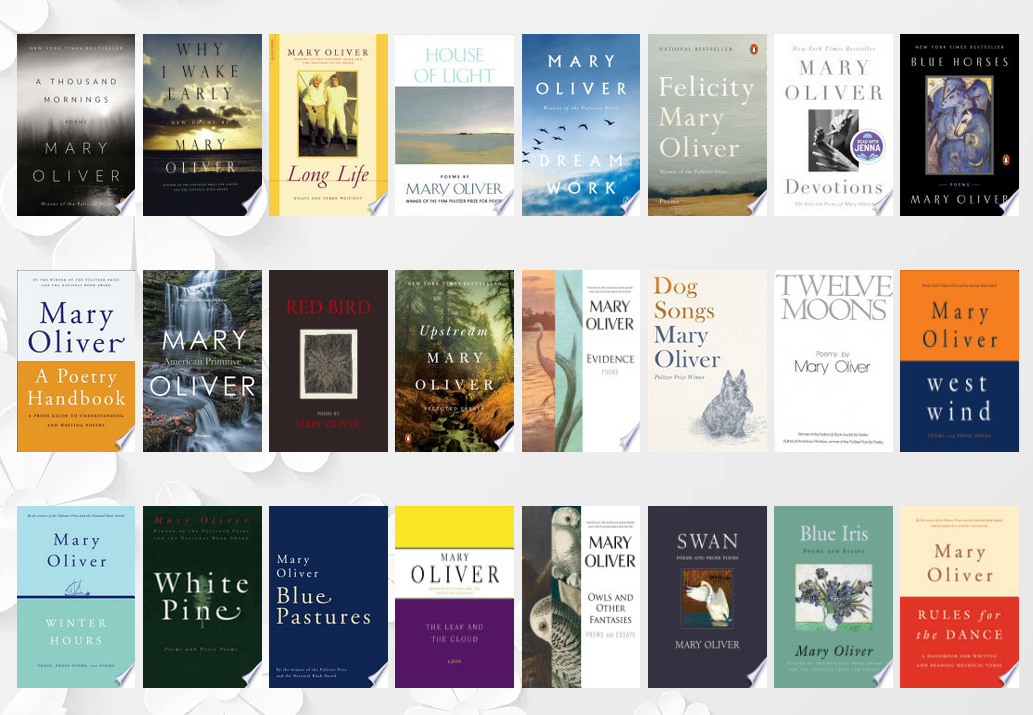
“Mary Oliver’s poetry is fine and deep; it reads like a blessing. Her special gift is to connect us with our sources in the natural world, its beauties and terrors and mysteries and consolations.” ~ Stanley Kunitz
I found this quote on the back of Mary Oliver’s Pulitzer-winning collection, American Primitive. I have copies of Mary Oliver’s craft books A Poetry Handbook and Rules for the Dance, but had never read much of her poetry. So when I started my third round of Portable MFA Poetry program by Rita Gabis from the book, The Portable MFA in Creative Writing from The New York Writers Workshop, I decided to study Mary Oliver. (amazon assoc. links)
Mary Oliver (1935-2019) was a prolific writer of poetry and essays, and The New York Times wrote that she was “far and away, this country’s [America’s] best-selling poet.” She authored twenty-one volumes of poetry and six books of prose. She grew up near Cleveland, Ohio, then lived in Cape Cod, then Vermont. Her work is very focused on nature, drawing lessons and conclusions from observations on daily nature walks.
Mary Oliver was influenced by James Wright, a Deep Image poet who was deeply influenced by Robert Bly. Upon Wright’s death she wrote 3 Poems for James Wright and she dedicated American Primitive, “For James Wright in memory.”
After reading Stanley Kunitz‘s quote, I set out to answer, “What makes Mary Oliver’s poetry deep?”
In her book Winter Hours, she told me herself. She said that she has three rules for every one of her poems:
- Every poem must have a genuine body – she pays careful attention to the shape and form of her poems.
- Every poem must have sincere energy – she believes that every poem is an implicit pact between the author and reader.
- Every poem must have a spiritual purpose.
She then revealed other “admonitions and consents”- the poem must:
- “rest” in intensity
- be rich with “pictures of the world”
- carry threads from the perceptually felt world to the intellectual world (deep image)
- indicate a life lived with intelligence, patience, passion and whimsy
- ask something and, at its best moments, let the question remain unanswered
- make clear that answering the question is the reader’s part in the author-reader pact
- have a pulse, a breathiness, some moment of earthly delight
- not contain anything that would keep the reader from becoming the poem’s speaker
That’s a lot to put into every poem, but it provides a window into the depth of her thought process. What rules do you have for your poetry?
When I started studying Mary Oliver’s poems, one poem for a week at a time, I chose a poem called “Something” from American Primitive. After so much discussion on Rattle’s Critique of the Week about the importance of titles, and the power of a good title, I was surprised that Mary Oliver would title her poem “Something.” Imagine my surprise when I found another, completely different poem titled “Something” in her collection, Why I Wake Early. I started noticing that she uses the word “something” a lot:
Devotions 49 times
Red Bird 14
Felicity 8
Dog Songs 7
I searched, expecting to find an MFA or PhD thesis or two on the use of “something” in Mary Oliver’s work, but didn’t find anything. Perhaps the spiritual purpose rule for each of her poems left her always searching for “something.”
Today’s Poem
We Can Be Brave Together
When you’ve got my back
I do not fear the faceless
dancer in the hallway.
The curved horns of the albino
bull with his crystal ball
are not piercing.
He becomes an elegant teacher
when I feel you at my side.
You are the music from my walls
the nest in my chair
the flowers growing between
the tiles beneath my feet.
You are my prism making rainbows
my overflowing toolbox.
When you hold my hand
I only see beauty
and I have everything I need.
As we face the oracle’s expanding
petals and wide-spread eyes
while the greyhound howls
at the faceless dancer’s
shadow approaching
I only quiver in anticipation
because together I know we can
face any future prediction, any
fate, and even in the strangest
times, you’ll make it fun.
This poem was inspired by today’s prompts at NaPoWriMo and the Meet the Bar (MTB) prompt at dVerse Poets Pub. My poem was inspired by the paintings: Remedios Varo, “Armonía” (Harmony) (1956) and Leonora Carrington. And Then We Saw the Daughter of the Minotaur. 1953.
Thank you so much for coming by and reading my post. Any thoughts or questions about Mary Oliver’s deep poetry? Come back tomorrow for more depth exploration and poetry.
 Experience Writing
Love how your poem feels against the backdrop of Mary Oliver’s. Beautiful imagery, Maria.
LikeLiked by 1 person
Wonderful poem, Marial!
Yvette M Calleiro 🙂
http://yvettemcalleiro.blogspot.com
LikeLiked by 1 person
I feel the “you” in hold of your back and the albino bull becoming teacher and oracle in your poem is one and the same man. And I wonder what motivates your love and your trust? He is faceless?A writing to ponder upon is this.
LikeLike
A wonderful share, thank you. I have her book, Devotions and have been a long-time fan. Something to see her titles in one image.
LikeLike
She is one of my favorite poets. Love how she inspired you to be brave on your journey. Being together with a loved one can make it worthwhile and fun.
LikeLiked by 1 person
I love your poem and the strength of moving on together in life. The faceless dancer has no power of two joined together in love and commitment. Well done.
LikeLiked by 1 person
Thank you.
LikeLiked by 1 person
You are welcome!
LikeLike
Mary Oliver’s opus is wonder and rapture — a Yes which is such physic for the howl and scowl of our exhausted time. Hers is the courage to accept crossed by the refusal to shun joy — empowering lines like, “When you hold my hand / I only see beauty / and I have everything I need.” Her masteries are so portable, are they not? Tin buckets for life’s ecstasies!
LikeLike
The images from the two paintings shone through your poem, Maria. I particularly love the lines:
‘You are the music from my walls
the nest in my chair’
and
‘You are my prism making rainbows
my overflowing toolbox’.
LikeLiked by 1 person
Thank you.
LikeLiked by 1 person
p.s. your poem is one I dreamily fell into. A ideal dream companion if there ever was one.
LikeLiked by 1 person
Glad you liked it.
LikeLiked by 1 person
I appreciate you featuring Mary Oliver. That is a good catch by you on her (over?)use of something. Would love to know if it was intentional or not. I have read one of her books (Blue Horses?) and enjoyed it. Maybe it her accessibility that makes her the best … selling poet?
LikeLiked by 1 person
I love the images in your poem, Maria!
LikeLiked by 1 person
Thank you.
LikeLike
Absolutely stunned.. Such good writing. Fascinating – a whole new style opened up here, that I like very much. That first stanza, wonderfully leading in.
LikeLiked by 1 person
Thank you so much.
LikeLiked by 1 person