“If we approach reading mindfully, we’ll get more out of it.” ~Brian Jackson

One thing that came up in April’s exploration of Depth that I wanted to explore further was Deep Reading. In Madhu Bazaz Wangu’s Unblock Your Creative Flow(Amazon assoc. link), she says Deep Reading is “transformative reading that will help you grow in your writing and enrich your daily life.” She describes Deep Reading as reading hard books, and challenging texts, but also describes it as slowing down to absorb the texts at a deeper level: reading mindfully, with attention and awareness.
Dr. Maryann Wolf, author of Reader Come Home: The Reading Brain in a Digital World(Amazon assoc. link) equates Deep Reading with turning off your cell phone and devices and concentrating on the text. I would just call that reading, but I guess in today’s Short-Attention-Span Theater, people need to be reminded that reading takes concentration and attention.
In Deep Reading: Teaching Reading in the Writing Classroom(Amazon assoc. link) editors Sheridan Blau, Patrick Sullivan, and Howard Tinberg relate Deep Reading to inquiry. And here’s where things got interesting for me.
In her article Teaching Deep Reading Skills During Inquiry, Barbara Stripling presents The Stripling Model of Inquiry:
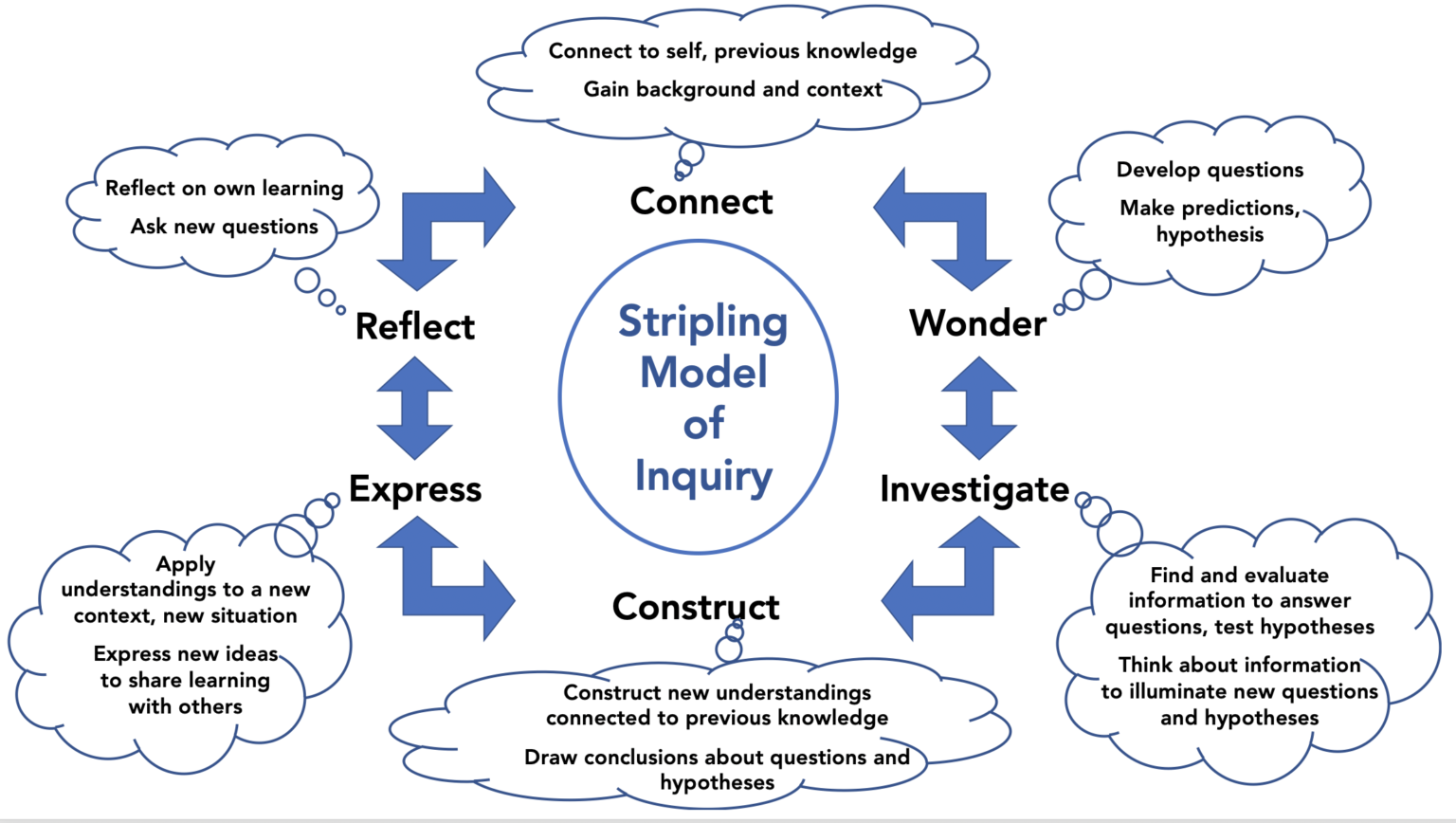
I really love how each step of the model moves forward and backward, every step informing new questions and new answers, leading to new questions.
Her article led me to Emerging America’s Inquiry Strategies which led me to Right Question Institute and the Question Formulation Technique, and Harvard’s Project Zero’s Thinking Routines Toolbox. So many exciting free resources. I’ll talk more about these in an upcoming post on forming deep questions, a continuation of the Deep Questions post from April.
In Mindful Writing by Brian Jackson, he talks about deep rhetorical reading. Like rhetorical writing, he promotes using different reading techniques for different types of text. I think his ideas are most in line with my thoughts on Deep Reading.
A Plan for a Deep Reading Practice
Today, let’s celebrate Summer Reading, and the library’s Summer Reading Bingo program. I got my Summer Reading Bingo card right when it came out. Usually I forget until summer’s half over and I have to rush through the books. But this year, I can take my time, savor the stories and insights, and practice Deep Reading.
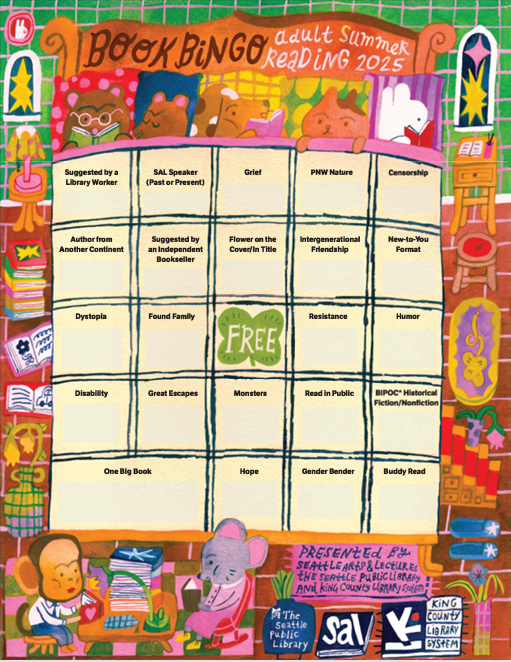
I want my summer reading to keep with my depth theme: not only in content, but also in how I select the books, and how I experience them.
This Summer’s Deep Reading Plan
In deep rhetorical reading as well as the inquiry model, there’s some learning and thinking involved before even cracking open the book. I like this quote from Brian Jackson:
Reading, too, is a social act; as audience you complete a circuit and connect with another person’s intentions.
He says we should read with a mindful awareness of:
- who writers are (rhetors)
- why they wrote when they did [exigence (deep need) and kairos (timing)]
- what they hoped readers will feel, think, or do (purpose)
- what rhetorical strategies they use when they write
- how they have constructed an experience for a specific kind of reader (audience)
So with all of that in mind, what actions can we take to read more deeply?
Choosing the books: In the past, I often read anything I thought would fit in the bingo square. But this year, I want each of my reading experiences to have positive personal value. How can I do this? First, I need to define the values I’m looking for:
- I’m looking for books that will inform our depth study
- I’m looking for books that will inform our Writober prompt posts
- I’m looking for books that evoke emotions, so I can learn from example to write more deeply.
In other words, I want to learn something and feel something every time I read this summer.
Planning: Once we have chosen a book based on our values, it’s time to plan for deep reading.
- Set an intention. Ask: Why am I reading this? What do I want to get from it?
- Purpose. Ask: Do I need to remember what’s in the text? (content) Do I need to respond to this text? (conversation)
- Research the author. Ask: Who wrote this text and why? What potential biases should I be aware of? (I especially like this question on bias) Who is the author’s intended reader?
- Think about the books place in history. Ask: What conversation is this text joining or responding to? When was it written? Is it still timely?
- Make the book personal. Start a conversation with the text. Ask: What do I already know about the topic?
Pre-reading: Quickly skim through the book. Look at the layout, chapters, headings and subheadings. Keep a journal handy while reading. Before starting, predict the answer to these questions:
- What does this writer want me to feel, think, or do?
- What kind of judgement am I being asked to make?
Reading: Don’t feel rushed. Take your time, and make sure you’re reading and understanding the words on the page.
- Take notes: not only about the content, but also the reading experience.
- Draw pictures: make your own infographics/concept maps, using contrast, development, or hierarchy to organize the material.
Self-regulating: While reading, we need to take breaks when our minds wander off. Also mixing up where and when we read can keep the experience fresh.
Review and Reflection: Don’t wait for the end of the book to contemplate what you’ve read. Choose points in the book, perhaps at the end of each chapter, to close the book, and summarize for yourself what you just read, or what you have learned so far. Have your questions been answered? Have new questions come to mind? While reading we are revising (also called calibration), checking to see if we need to adjust our understanding. Not only are we calibrating our understanding of the topic, but also our reading strategies and values.
During my summer reading, I will attempt to practice Deep Reading, and share my experiences here with you. I hope you’ll join me.
I want to answer the questions:
Does Deep Reading provide a different reading experience from how I was reading before? Do I think it’s better?
Am I having a deeper reading experience?
Do these techniques and ideas deepen my reading?
 Experience Writing
❤️
LikeLiked by 1 person