Welcome to the first day of Writober. Today, all our prompts will start to explore the universal fear of Ego death: the loss of subjective self-identity.
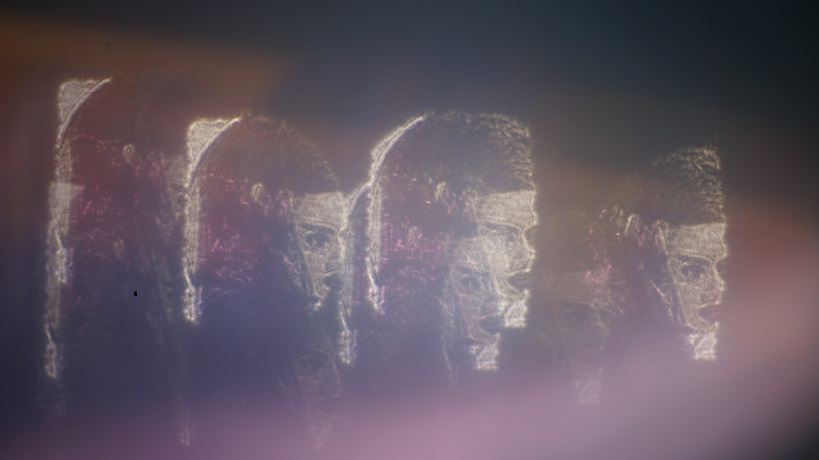
The fear of Ego Death encompasses all the fears of damage to one’s ego, one’s pride, such as embarrassment, shame, fear of failure, fear of success, and the feeling of being an imposter (imposter syndrome). These fears can lead to social anxiety and social phobias.
Exploring our fears isn’t easy, but your journal is a completely safe space. Try to get to the specifics of your experiences, not vague feelings. Write down specific objects, colors, smells, taste, and textures that you interacted with while afraid. Facing our fears can also be thrilling as long as we believe we won’t really get hurt like amusement park rides, horror movies, and Halloween.
Fighting Fear of the Blank Page: Writing isn’t just about coming up with ideas for stories and poems, it’s about expressing those ideas on the page clearly with words. Sometimes the blank page stares back like a judgemental enemy or a white-washed wall. Every day this month we’ll explore techniques for pushing through this fear and turn it into excitement, starting with writing as someone not afraid of the blank page at all.
Create a persona: When facing fears in our writing, it may be easier to create a persona, an imagined person, not ourselves, someone braver, stronger, more daring that’s doing the writing. What does that person look like? Smell like? Do you have a piece of clothing or a perfume/cologne you could wear to help you become the persona when you want to be more daring in your writing?
*Quick Note about links in this post: I am an amazon associate, so most of the links in my post will take you to amazon products. If you buy from these links, I will make some pennies which will help me pay for this site and my creative endeavors.
OctPoWriMo
Poetry Toolbox
These are quick exercises that I hope you’ll do every day. We will build on these exercises throughout the month. I recommend creating a folder on your computer labeled “Poetry Toolbox” for collecting all the useful tools and references we’ll be working with this month.
- Word list: Write down the first ten words you think of when you think of fear. Any words at all. Anything that comes to mind. (Inspired by Frances Mayes’ list of a hundred favorite words in The Discovery of Poetry)
I created this Excel Spreadsheet for you to use to collect and explore your words. Don’t worry about all the columns today. Just type your ten words into the first column.
- Sensory Imagery: In your journal or a word processing file, fill in these lines as quickly as you can with as much specific detail as you can. You may want to revisit one or two in more detail if you’re inspired and have time.
I saw
I heard
I carried
I smelled
I followed
The crowded room
The slap of
I tasted
The heat of my cheeks
I witness
I touch
(Inspired by a week one exercise in the poetry chapter of The Portable MFA in Creative Writing)
Poetry Building
For this first day of October Poetry Writing Month, we’re going to look at the smallest building block we poets have, the letter. In A Poetry Handbook, Mary Oliver calls the alphabet our “raw material” and “Families of Sound.” Each letter is a symbol for sounds we make in combination to communicate meaning. All of the sounds of English are either vowels or consonants.
Take a look at the Classification of Sounds from Dickinson College Commentaries:
The simple Vowels are a, e, i, o, u, y.
The Diphthongs are ae, au, ei, eu, oe, ui, and, in early Latin, ai, oi, ou. In the diphthongs both vowel sounds are heard, one following the other in the same syllable.
Consonants are either voiced (sonant) or voiceless (surd). Voiced consonants are pronounced with the same vocal murmur that is heard in vowels; voiceless consonants lack this murmur.
- The voiced consonants are b, d, g, l, r, m, n, z, consonantal i, and v.
- The voiceless consonants are p, t, c (k, q), f, h, s, and x.
Consonants are further classified as in the following table:
| LABIALS | DENTALS | PALATALS | ||
| Voiced (mediae) | b | d | g | |
| MUTES | Voiceless (tenuēs) | p | t | c (k, q) |
| Aspirates | ph | th | ch | |
| NASALS | m | n | n (before c, g, q) | |
| LIQUIDS | l, r | |||
| FRICATIVES | (Spirants) | f1 | s, z | |
| SIBILANTS | s, z | |||
| SEMIVOWELS | v | consonant i |
Double consonants are x (= cs) and z (= dz); h is merely a breathing.
***************************************************************************************************************
Say each of the sounds aloud. Feel where the sounds are in your mouth, how they move from the lips to the tongue and teeth to the throat as you read across the table. Fun, right?
Familial Rhyme
These letter groupings are also useful for rhythm and rhyme which we will come to later in the month. When you can’t, or don’t want to, come up with an exact rhyme, another letter from the sound family will make a close rhyme. Look at this familial rhyme chart from lyricist, teacher, and author, Pat Pattison. I enjoyed his course “Songwriting: Writing the Lyrics” on coursera, and his books, Writing Better Lyrics and Songwriting Without Boundaries.

Notice the similarities to the groupings in the consonant groupings chart?
Example Poem
Today’s example poem, copied here from poets.org for educational purposes, is “The Pleasures of Fear” by Judith Ortiz Cofer. Read it through how you normally would. Then read it again aloud, taking your time to look at the letters and feel the sounds in your mouth.
The Pleasures of Fear
Judith Ortíz Cofer 1952 –2016
We played a hiding game,
the son of my mother’s friend and I,
until he chased me into the toolshed
and bolted the door from outside. It was there,
in the secret, moist dark, the child’s game changed
to adventure. As I listened through the splintered wood
to his ragged breath, his weight pressing down
on the thin wood, making it groan, waiting
while I stood on the other side, I was
caught in time, thrilled and afraid by his power,
by his power to strike, and mine to yield.
I crouched close to the ground
inhaling the sour-sweet potpourri of rancid oil,
rotting wood, old leather, and rust. I could have died
right then and there, of anticipation,
and become one with the molecules
in the laden air. I was deliciously afraid of all
the invisible creeping, crawling dangers inhabiting
the luscious ground where I squatted to pee,
allowing impulse and need to fully overtake me,
inviting all the demons that reside in dark damp
hiding places into my most secret self.
Not since then has pleasure and fear in the dark
been so finely tuned in my mind, except perhaps
in moments of passion when all we know
is surrendered to the demands of skin and blood.
Then the pizzicato of the predictable afternoon shower
on that half remembered island, rain every day at four,
and her piercing voice, growing nearer,
the cutting slash of light. She had caught the boy
peeking through a crack at me doing what?
She did not want to know.
I was sent straight to the bath, as if
the delectable stink of danger I had discovered
could ever be washed off with plain soap and water.
Copyright © 2005 Judith Ortiz Cofer. From A Love Story Beginning in Spanish.
What did you notice? What stays with you? How did the poem make you feel? What images came to mind as you read? How does this poem explore fear? How does it explore fear of ego death?
Notice the sounds at the ends of the lines: lots of r, d, s, and n sounds. Where are they in our chart? They are all dentals, all where our tongue meets our teeth. Also, look at how she uses pairs and triplets of words that start with the same letter in the second stanza: “crouched/close,” “air/afraid/all,” “creepy/crawling,” “demons/dark/damp.” These are examples of the first rhetorical device we’re going to look at, alliteration.
Rhetorical device: A rhetorical device is a use of language that is intended to have an effect on its audience beyond the meaning of words. Alliteration is the same letter or sound at the beginning of adjacent or closely connected words.
Today’s Poetry Prompt
Write a poem exploring ego death using alliteration. Look at the ten fear words you jotted down. Do any start with the same letter? You may want to start with that letter for your alliteration. Notice the sounds that end and begin each word. Are they flowing together, or stopping and creating space? Are the sounds creating the feeling you want in your poem? Read your poem aloud. Where are the sounds in your mouth? Does your poem have nice mouth feel?
Form: Which letter of the alphabet is the scariest? If you are looking for a little more challenge, you can try a lipogram which is a poem in which a certain letter (or group of letters) of the alphabet has been completely excluded. Defeat that scary letter by not using it at all.
Write your poem and post it to your site (blog/ website/ other), then post a link in the chat. You may also post your poem in the chat if you do not have a place to post it. If you are posting as “someone” or “anonymous,” please put your name at the end of the poem. Throughout the day, please check back when you can to read and encourage other poets, to learn from each other, and enjoy each other’s efforts.
If you’re only here for OctPoWriMo, you may want to skip down to the end of this post to “Get Moving.”
Writober Flash Fiction
Write a story with a beginning, middle, and end with conflict that leads to change in less than a thousand words (no minimal word count) inspired by one of the images in the Ego death folder of the Writober 2024 Pinterest board. Post a link to your story in the chat.
If you are only here for the #Writober flash fiction challenge, you may want to jump down to “Get Moving.”
NaNo Prep
All this daily writing can also prepare for November’s National Novel Writing Month (NaNoWriMo). Poets, Flash Fiction/ Short Story Writers, and Novelists all use the same tools—sounds of language: letters, words, phrases, and sentences—to evoke a response from readers. Earlier this summer I had an idea for a literary fiction novel. This month I’ll be fleshing out my characters, settings, and stakes, and plotting a possible outline.
If you are participating in NaNoWriMo, or have thought about giving your novel a try, I hope you’ll join me for some Novel prep this month. I like worksheets and workbooks and recommend taking a look at:
NaNo Prep 101 from NaNoWriMo.org
Novel Writing Blueprint Workbook: A Storyteller’s Journal by Jill Harris
Writing the Breakout Novel (book) and Workbook by Donald Maass
Plotting Your Novel (book) and Workbook by Janice Hardy
Prompt: Set a timer for ten minutes. Write all of your ideas for this year’s novel as fast as you can. Don’t think, just write. Who are the characters? Where are they? What happens to them that changes their lives forever? Write it all down in any order it comes, just get as many ideas as you can onto the page.
Don’t have the idea for your novel yet? Think about a novel you want to read that hasn’t been written yet, answering the same questions as above.
Halloween Photography Challenge
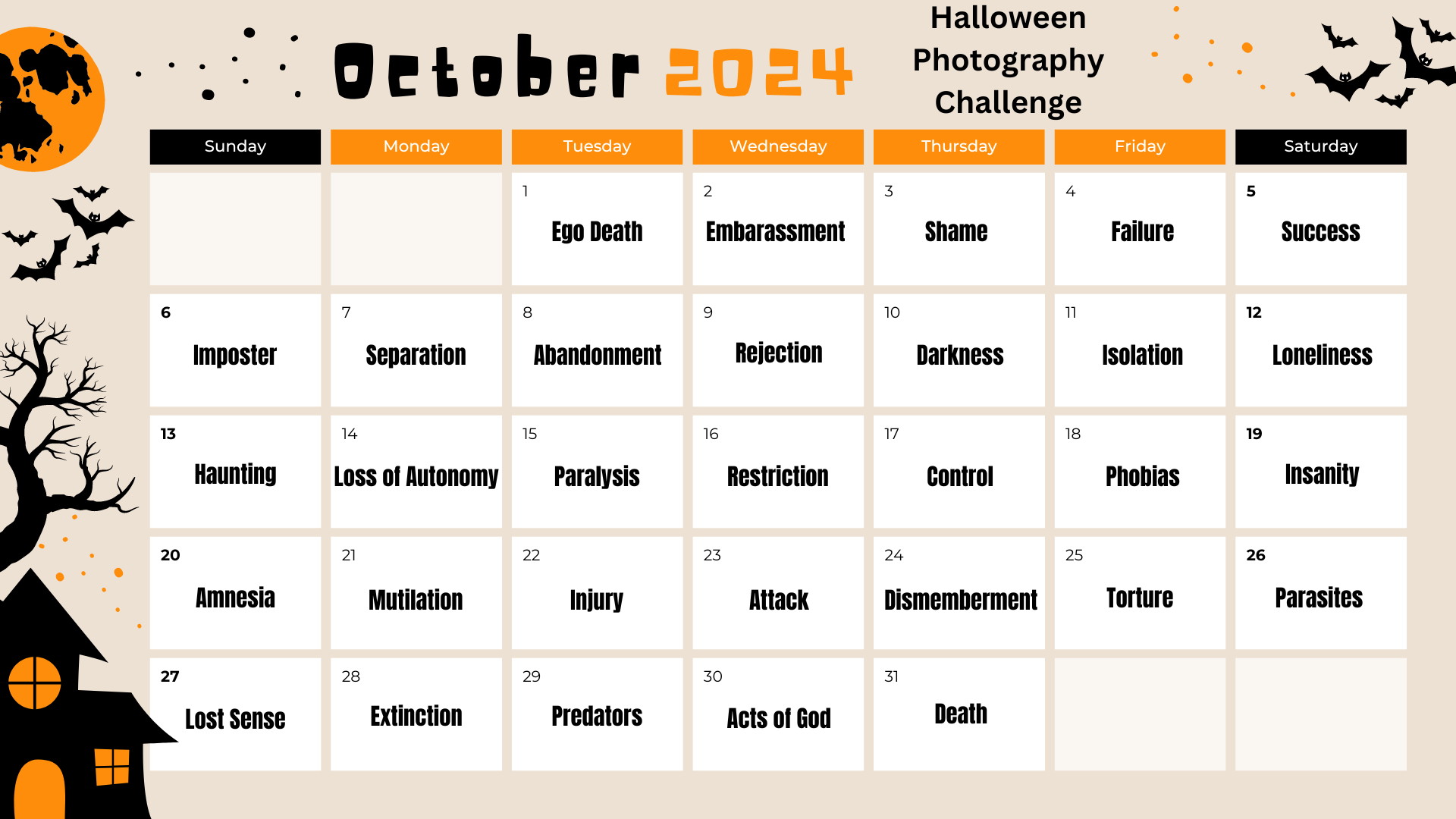
This year, the prompt words are more abstract than in previous years. Take a picture of anything the word(s) inspires.
Today’s prompt: Take a photograph that depicts Ego death, fear of ego death, or an ego in peril. Post a link to your photo in the chat.
Tunetober
Create an eerie melody in a minor key on any instrument. Work on it during the week and share it on Sunday.
Sewtober
Create a Halloween quilt square. Share what you create on Sunday.
All of these prompts are here to inspire creative action. Don’t worry about being “off prompt.” Any new work you create after reading this post meets the challenge. I look forward to seeing and reading what you come up with. And please come back to see how these prompts inspire me today as well.
Get Moving
Now that you’ve read all the prompts and have all these ideas running around in your head, it’s time for motion. It may seem counter-intuitive, but while you are moving, your mind will still be working on your ideas while you are busy doing something else. Write down some quick notes, your initial thoughts from the prompts and then get your body moving in any way you can that you enjoy. Get some oxygen to your brain, relax your muscles, and distract your inner critic (that mean voice we all have that spends its time telling us what we’re doing is bad and wrong, and not good enough. That voice is only good for nit-picky final revisions, so we’ll turn it off as much as we can this month.) Some suggestions:
Go outside. Breathe deeply, and stretch. I very seldomly buy clothes, but I picked up these very comfy pants that are great for morning stretching. They are warm, so soft inside, and are tapered at the ankle so they stay in place while stretching and moving your body. I also really like having pockets, even in my stretch-pants.
Go for a brisk walk. Bring along something to record your voice. If you don’t have a cell phone (like me), you may want a pocket mp3 player to record any thoughts that pop up while you explore your neighborhood. I’ve been using this model for music, listening to audio books while I mow, and recording sounds and thoughts for many years now. Nothing fancy, but it’s all I need.
Take a hot shower. I got myself Aqua Notes Waterproof notepad and pencil for the shower, and I really love it. I often jot down words and rhymes or quick lines that pop into my mind once it’s warmed by hot water.
I know this has been a long post. Thank you for reading (or scrolling) to the end. You can expect more concise posts as we move through the month and become familiar with how all the different prompts work, and can work together.
 Experience Writing
Letters and Sounds: Language between words and Nature #Writober poetry & photo 🌧️
Hope your Saturday 🎃 is going well 🕸️
LikeLiked by 1 person
a trijan refrain from me 🙂
Writober – A shattered existence so blurred – Ladyleemanila (wordpress.com)
LikeLiked by 1 person
Fun form. Thanks for joining in. I enjoyed the repeating lines in this poem, and the top photo is beautiful.
LikeLiked by 1 person
It’s so fun that your word list inspired you.
LikeLike
A great reminder that people can jump in to these creative challenges at any time. Creativity and fun are important even when we’re busy.
LikeLike