Welcome back for the second day of Writober. How did it go yesterday? Feeling inspired? Don’t forget to put your links in the chat to share what you wrote and made.
Today, all our prompts will continue to explore the universal fear of Ego death: the loss of subjective self-identity by looking at embarrassment.
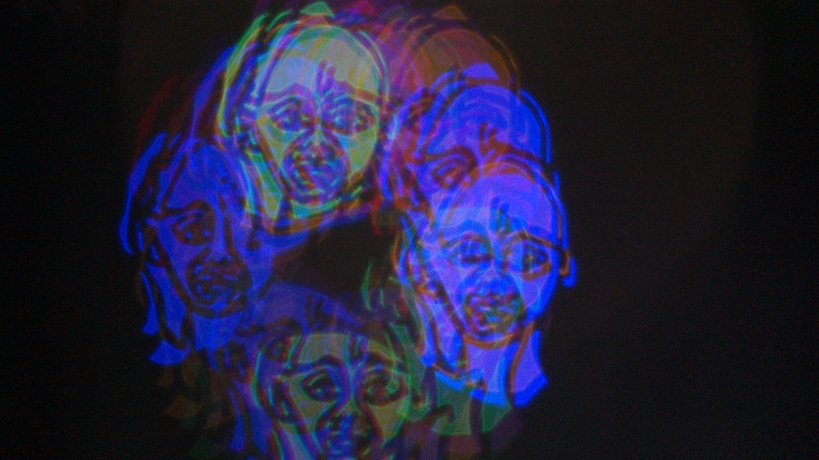
Embarrassment happens to everyone. It’s a sudden horrible feeling when we realize we’ve done something others judge negatively. It usually happens as a young child and can leave a lasting impression of a feeling we want to avoid. If that aversion is strong enough, it can stop us from sharing with others, being the focus of attention, public speaking, and even being in social situations. Embarrassment isn’t completely avoidable. It often occurs due to things that are out of our control. The human body does embarrassing things. People laugh at people who fall and hurt themselves in embarrassing ways: there are entire TV shows based on videos of people in embarrassing situations.
Embarrassment leads to fear of embarrassment. Try to remember the very first time you were embarrassed. What caused it? How did you react to that embarrassment? Think about the most recent time you were embarrassed. What was the same? What was different?
Fighting Fear of the Blank Page: Writing isn’t just about coming up with ideas for stories and poems, it’s about expressing those ideas on the page clearly with words. Sometimes the blank page stares back like a judgemental enemy or a white-washed wall. Every day this month we’ll explore techniques for pushing through this fear and turn it into excitement. What if the page isn’t blank to start with?
Change the color of the page or the text: If you write in a journal, try filling the page with color. I like making inkblots with watercolors. Just drip some paint on the page and fold it in half. Let it dry and then write on it. In The Triggering Town, Richard Hugo says to write with pencil on green, lined paper. I tried it. It didn’t work for me. During NaNoWriMo some writers recommend changing your type to white so you can’t see it as you type. That way you won’t see your mistakes and be tempted to go back and make corrections. This could also work by keeping your text black and changing the page to black.
Play around with page and text colors. What is your favorite combo? Does putting those colors together make you want to write?
*Quick Note about links in this post: I am an amazon associate, so most of the links in my post will take you to amazon products. If you buy from these links, I will make some pennies which will help me pay for this site and my creative endeavors.
OctPoWriMo
Poetry Toolbox
These are quick exercises that I hope you’ll do every day. We will build on these exercises throughout the month. I recommend creating a folder on your computer labeled “Poetry Toolbox” for collecting all the useful tools and references we’ll be working with this month.
- Word list: Write down the first ten words you think of when you think of fear. Any words at all. Anything that comes to mind. Then choose your three favorite and say them aloud a few times until you hear the accented and unaccented syllables (if more than one syllable) and notice the duration of each syllable. Which syllable sounds short? Which syllable sounds longer?(Inspired by Frances Mayes’ list of a hundred favorite words in The Discovery of Poetry)
I created this Excel Spreadsheet for you to use to collect and explore your fear words.
- Sensory Imagery: In your journal or a word processing file, fill in these lines as quickly as you can with something different from yesterday. You may want to revisit one or two in more detail if you’re inspired and have time.
I saw
I heard
I carried
I smelled
I followed
The crowded room
The slap of
I tasted
The heat of my cheeks
I witness
I touch
(Inspired by a week one exercise in the poetry chapter of The Portable MFA in Creative Writing)
Poetry Building
When we start combining letters to make words, we make more complex sounds we know as syllables.
I started wondering what the difference between syllables and phonemes are. From what I read I found: “The phoneme is a minimal speech unit, represented by alphabetic letters in English,” and “A syllable is a cluster of sounds with at least one vowel.”
In poetry a “foot” consists of two syllables. When we say words aloud we place an accent or stress on certain syllables. If you say “afraid.” The first syllable “a” is unstressed and the second syllable “fraid” is stressed. These stresses can be represented as U / (unstressed stressed) This is an iambic foot.
Disyllables
Macron and breve notation: – = stressed/long syllable, ◡ = unstressed/short syllable
| ◡ | ◡ | pyrrhus, dibrach |
| ◡ | – | iamb (or iambus or jambus) |
| – | ◡ | trochee, choree (or choreus) |
| – | – | spondee |
Trisyllables
| ◡ | ◡ | ◡ | tribrach |
| – | ◡ | ◡ | dactyl |
| ◡ | – | ◡ | amphibrach |
| ◡ | ◡ | – | anapaest, antidactylus |
| ◡ | – | – | bacchius |
| – | ◡ | – | cretic, amphimacer |
| – | – | ◡ | antibacchius |
| – | – | – | molossus |
I was finally starting to hear and recognize the different metric feet in poetry when I read The Sounds of Poetry by Robert Pinsky and read about duration. Mind blown. Such an obvious part of words, but I just hadn’t thought about it.
Pinsky gives this example to think about how we stress words:
“Permit me to give you a permit.”
When it comes to duration, he gives the example “popcorn.” The first syllable is stressed, but the second syllable is longer. Then he uses the word “ocean” to demonstrate that the first syllable is both stressed and longer.
Go back to your three favorite words of your word list spreadsheet. Mark the stressed syllables with / for stressed and U for unstressed. Can you find the same stressed and unstressed pattern in the tables above? You can put that name in the “meter” column. You can use a small “s” for short duration and a capital “L” for long duration. And finally put the number of syllables in the “syllables” column.
We’ll talk more about stress and duration when we talk about rhythm. For now, just listen for the stress and duration of syllables as you read aloud.
Today’s example poem, copied here for educational purposes from Poem Hunter, is Fear No More by William Shakespeare.
Fear no more the heat o’ the sun;
Nor the furious winter’s rages,
Thou thy worldly task hast done,
Home art gone, and ta’en thy wages;
Golden lads and girls all must,
As chimney sweepers come to dust.
Fear no more the frown of the great,
Thou art past the tyrant’s stroke:
Care no more to clothe and eat;
To thee the reed is as the oak:
The sceptre, learning, physic, must
All follow this, and come to dust.
Fear no more the lightning-flash,
Nor the all-dread thunder-stone;
Fear not slander, censure rash;
Thou hast finished joy and moan;
All lovers young, all lovers must
Consign to thee, and come to dust.
No exorciser harm thee!
Nor no witchcraft charm thee!
Ghost unlaid forbear thee!
Nothing ill come near thee!
Quiet consummation have;
And renowned be thy grave!
In this poem, Shakespeare says there’s no need to fear when you know you’re going to die.
Marking the stresses (or accents) and identifying the feet (meter) of a poem is called scansion. Just for fun, print out or copy down the poem and mark the stresses of the syllables. Can you identify the meter of the poem? Is it consistent, or does it change line by line? Can you tell if the feet of the poem are disyllabic or trisyllabic? Listen for a repeating pattern.
How many feet are in each line?
- one foot = monometer
- two feet = dimeter
- three feet = trimeter
- four feet = tetrameter
- five feet = pentameter
- six feet = hexameter
- seven feet = heptameter
- eight feet = octameter
Today’s poem: Write a poem about what you wouldn’t fear if you didn’t get embarrassed.
Form: Want a little more challenge? Write a poem in blank verse. Blank verse is a poem in iambic pentameter that doesn’t rhyme.
Write your poem and post it to your site (blog/ website/ other), then post a link in the chat. You may also post your poem in the chat if you do not have a place to post it. If you are posting as “someone” or “anonymous,” please put your name at the end of the poem. Throughout the day, please check back when you can to read and encourage other poets, to learn from each other, and enjoy each other’s efforts.
Writober Flash Fiction
Write a story with a beginning, middle, and end with conflict that leads to change in less than a thousand words (no minimal word count) inspired by one of the images in the Ego death folder of the Writober 2024 Pinterest board. How does embarrassment affect your character(s)?
Post a link to your story, or tell us about your story idea in the chat.
NaNo Prep
Today is about clarifying the kernel of your novel idea. A tool for doing this is the elevator pitch. Imagine you’re in an elevator, and you only have a minute (or less) to tell the other person in the elevator your story, and try to get them to buy it. How would you do that? Sounds impossible, especially since you haven’t written it yet, right? No. There’s actually a bit of a formula to the one or two sentence pitch or logline:
Character + Conflict = Change
What is unique about your character? For some loglines it’s the character’s job, or occupation:
An artist finds a hand-drawn map in her garage with the words “shallow grave” written on it. When she begins to investigate, her curiosity puts her life in danger.
Another thing to think about when developing your idea is comps. Comps are other stories (novels, movies, shows, games) that inspired your ideas, or could be comparable in style to your work. If a character in Salem’s Lot by Stephen King and a plot line or setting in The Bad Weather Friend by Dean Koontz written in the style of Carl Hiaasen inspired your idea, you could add: “Readers of Carl Hiaasen will enjoy this meeting of Salem’s Lot and The Bad Weather Friend,” to your elevator pitch. Notice how adding that to the logline example could make you imagine it differently.
Give it a try. Tell me your novel idea in one or two sentences in the chat. And don’t forget to head over to NaNoWriMo.org, sign up, and put that logline in this year’s project description.
Halloween Photography Challenge
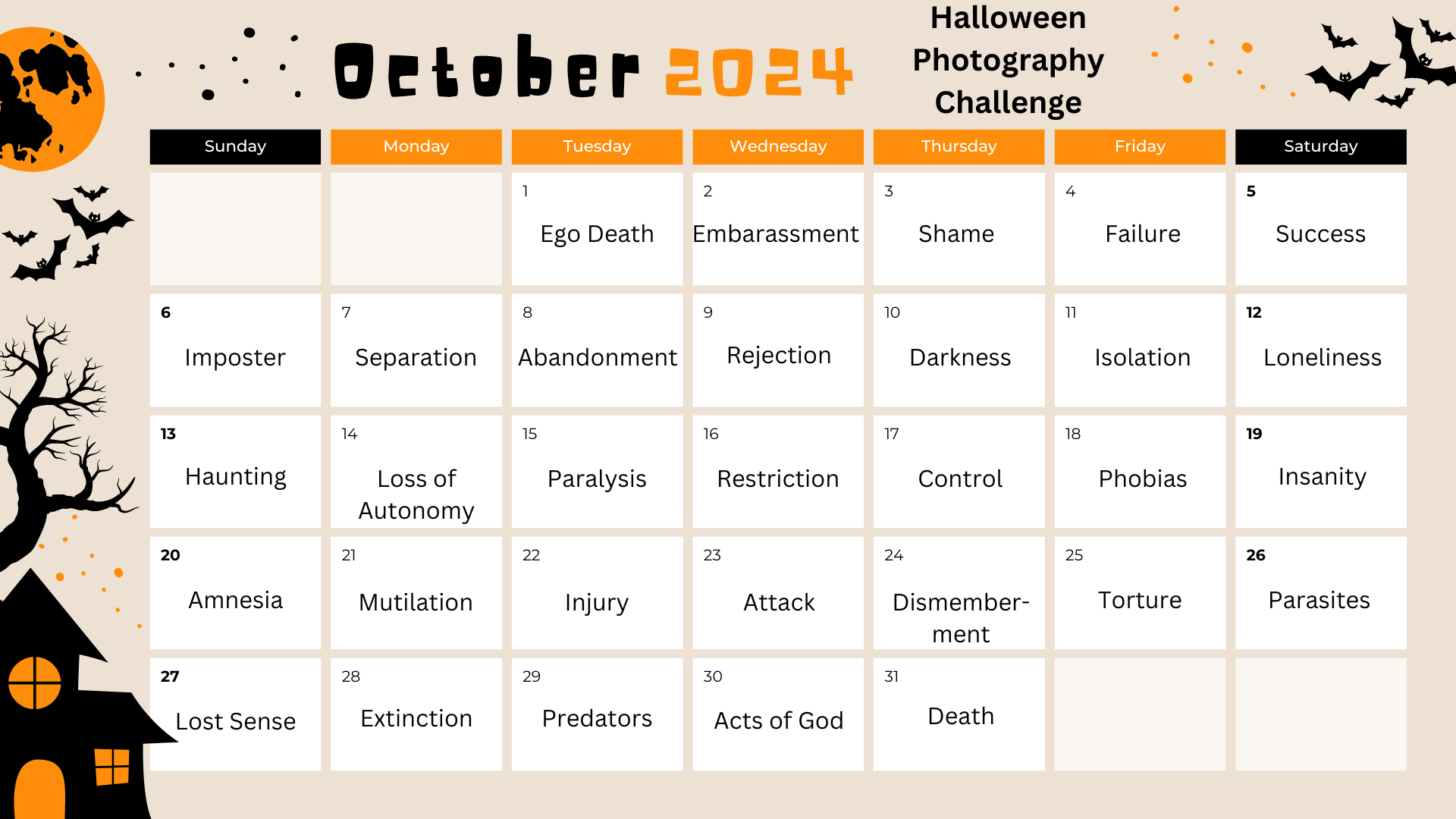
Take a photograph that depicts embarrassment, fear of embarrassment, or how to deal with embarrassment and link to your photo in the chat.
Get Moving
Now that you’ve read all the prompts and have all these ideas running around in your head, it’s time for motion. It may seem counter-intuitive, but while you are moving, your mind will still be working on your ideas while you are busy doing something else. Write down some quick notes, your initial thoughts from the prompts and then get your body moving in any way you can that you enjoy. I like to bounce. Some suggestions:
Exercise ball. An exercise ball is great for stretching your back after hunching over a computer for hours, and is also fun to bounce up and down on.
Mini-trampoline. I really enjoy some low-impact bouncing on my mini-trampoline. I keep it in my office to get some bounces in whenever I take a break.
A rocking chair. Keep moving while you read, write, or watch TV. And look at this folding portable rocking chair for the outdoors.
 Experience Writing
Have a good Sunday 🎃☕️✨ #writober poetry&photo
LikeLike
thanks for the prompt 🙂
Writober – The dark side – Ladyleemanila (wordpress.com)
LikeLiked by 1 person
You’re so welcome.
LikeLiked by 1 person