Welcome back for the fifth day of Writober. Today, all our prompts will continue to explore the universal fear of Ego death: the loss of subjective self-identity by looking at fear of success.

We are such complicated creatures. Not only are we afraid of failure, we’re also afraid of success. Success could lead to unforeseen changes, combining the fear of the unknown and the fear of change even into the prospect of reaching our goals and accomplishing our dreams.
Fighting Fear of the Blank Page: When we want to write, sometimes the blank page stares back like your inner critic is already judging or a giant void of nothingness ready to swallow you up. But what if the page isn’t blank to start with?
Erasure: Creative writing is the action of choosing words and how they join together. Why not start with a full page of words—any full page of text: a newspaper article, a page from your journal, a page from your favorite book, anything—then black out (erase) all the words you don’t want, leaving only the words you choose.
*Quick Note about links in this post: I am an amazon associate, so most of the links in my post will take you to amazon products. If you buy from these links, I will make some pennies which will help me pay for this site and my creative endeavors.
OctPoWriMo
Poetry Toolbox
These are quick exercises that I hope you’ll do every day. We will build on these exercises throughout the month.
- Word list: Write down the first ten words you think of when you think of fear. Any words at all. Anything that comes to mind. Then choose your three favorite and say them aloud a few times until you hear the accented and unaccented syllables (if more than one syllable) and notice the duration of each syllable. Do any of them have beautiful, harmonious sounds? Do any of them flow together in a pleasing way? (Inspired by Frances Mayes’ list of a hundred favorite words in The Discovery of Poetry)
I created this Excel Spreadsheet for you to use to collect and explore your fear words.
- Sensory Imagery: In your journal or a word processing file, fill in these lines as quickly as you can with something different from yesterday. You may want to revisit one or two in more detail if you’re inspired and have time.
I saw
I heard
I carried
I smelled
I followed
The crowded room
The slap of
I tasted
The heat of my cheeks
I witness
I touch
(Inspired by a week one exercise in the poetry chapter of The Portable MFA in Creative Writing)
Poetry Building
Euphony is an agreeableness of sound, a combination of sounds that please the ear. In his book You Can Write Poetry, Jeff Mock gives the example, “Soft is the strain when Zephyr gently blows” from Alexander Pope’s long poem “An Essay on Criticism.”
So how do we create euphony? Not surprisingly, by using some tools we’ve been talking about:
- Using vowel sounds – Vowel sounds are more euphonious than consonants. Longer vowels are especially melodious.
- Using soft consonants – For fun, take a look back at our consonant chart from Day 1. Consonants like L, M, N, R, and W are considered euphonious, even when not next to each other. From our chart, it looks like we want to use liquids and nasals, but avoid mutes because they stop the flow of sound.
- Repeating phrases – Repeating phrases can create a euphonious effect, especially when using sibilant sounds like “s” (consonance).
- Using alliteration (also Day 1) and parallel phrases – Parallel phrases are phrases that use the same grammatical structure such as:
“Mary likes hiking, swimming, and bicycling.” OR
“Mary likes to hike, to swim, and to ride a bicycle.”
Notice the forms of the verbs within each sentence stay consistent or “parallel.” - Writing sentences with many vowels – Sentences with many vowels can contribute to a pleasing rhythm and sameness. This could also be the repetition of the same vowel sound as in assonance from Day 3.
- Listening and reading aloud – Developing an ear for melodious sentences.
Fun how these concepts all work together, right? As we continue through the month, I hope we’ll come to recognize which poems call for euphony, which poems demand cacophony, and which poems are best dramatized through a combination of both.
The Raven came up in my reading as an example of euphony, so let’s take a look at Edgar Allan Poe’s famous poem copied here from owleyes.com.
The Raven
Once upon a midnight dreary, while I pondered, weak and weary,
Over many a quaint and curious volume of forgotten lore,
While I nodded, nearly napping, suddenly there came a tapping,
As of some one gently rapping, rapping at my chamber door. “
“’Tis some visitor,” I muttered, “tapping at my chamber door—
Only this, and nothing more.”
Ah, distinctly I remember it was in the bleak December,
And each separate dying ember wrought its ghost upon the floor.
Eagerly I wished the morrow;—vainly I had sought to borrow
From my books surcease of sorrow—sorrow for the lost Lenore—
For the rare and radiant maiden whom the angels name Lenore—
Nameless here for evermore.
And the silken sad uncertain rustling of each purple curtain
Thrilled me—filled me with fantastic terrors never felt before;
So that now, to still the beating of my heart, I stood repeating, “
“’Tis some visitor entreating entrance at my chamber door—
Some late visitor entreating entrance at my chamber door;—
This it is, and nothing more.”
Presently my soul grew stronger; hesitating then no longer,
“Sir,” said I, “or Madam, truly your forgiveness I implore;
But the fact is I was napping, and so gently you came rapping,
And so faintly you came tapping, tapping at my chamber door,
That I scarce was sure I heard you”—here I opened wide the door;—
Darkness there, and nothing more.
Deep into that darkness peering, long I stood there wondering, fearing,
Doubting, dreaming dreams no mortals ever dared to dream before;
But the silence was unbroken, and the stillness gave no token,
And the only word there spoken was the whispered word, “Lenore!”
This I whispered, and an echo murmured back the word, “Lenore!”—
Merely this, and nothing more.
Back into the chamber turning, all my soul within me burning,
Soon again I heard a tapping somewhat louder than before.
“Surely,” said I, “surely that is something at my window lattice,
Let me see, then, what thereat is, and this mystery explore—
Let my heart be still a moment and this mystery explore;—
‘Tis the wind and nothing more.”
Open here I flung the shutter, when, with many a flirt and flutter,
In there stepped a stately raven of the saintly days of yore.
Not the least obeisance made he; not a minute stopped or stayed he;
But, with mien of lord or lady, perched above my chamber door—
Perched upon a bust of Pallas just above my chamber door—
Perched, and sat, and nothing more.
Then this ebony bird beguiling my sad fancy into smiling,
By the grave and stern decorum of the countenance it wore.
“Though thy crest be shorn and shaven, thou,” I said, “art sure no craven,
Ghastly grim and ancient raven wandering from the Nightly shore—
Tell me what thy lordly name is on the Night’s Plutonian shore!”
Quoth the Raven, “Nevermore.”
Much I marvelled this ungainly fowl to hear discourse so plainly,
Though its answer little meaning—little relevancy bore;
For we cannot help agreeing that no living human being
Ever yet was blest with seeing bird above his chamber door—
Bird or beast upon the sculptured bust above his chamber door,
With such name as “Nevermore.”
But the Raven, sitting lonely on the placid bust, spoke only
That one word, as if his soul in that one word he did outpour.
Nothing further then he uttered—not a feather then he fluttered—
Till I scarcely more than muttered, “other friends have flown before—
On the morrow he will leave me, as my hopes have flown before.”
Then the bird said, “Nevermore.”
Startled at the stillness broken by reply so aptly spoken,
“Doubtless,” said I, “what it utters is its only stock and store,
Caught from some unhappy master whom unmerciful Disaster
Followed fast and followed faster till his songs one burden bore—
Till the dirges of his Hope that melancholy burden bore,
Of ‘Never—nevermore’.”
But the Raven still beguiling my sad fancy into smiling,
Straight I wheeled a cushioned seat in front of bird and bust and door;
Then, upon the velvet sinking, I betook myself to linking
Fancy unto fancy, thinking what this ominous bird of yore—
What this grim, ungainly, ghastly, gaunt, and ominous bird of yore
Meant in croaking “Nevermore.”
This I sat engaged in guessing, but no syllable expressing
To the fowl whose fiery eyes now burned into my bosom’s core;
This and more I sat divining, with my head at ease reclining
On the cushion’s velvet lining that the lamplight gloated o’er,
But whose velvet violet lining with the lamplight gloating o’er,
She shall press, ah, nevermore!
Then, methought, the air grew denser, perfumed from an unseen censer
Swung by Seraphim whose footfalls tinkled on the tufted floor.
“Wretch,” I cried, “thy God hath lent thee—by these angels he hath sent thee
Respite—respite and nepenthe, from thy memories of Lenore;
Quaff, oh quaff this kind nepenthe and forget this lost Lenore!”
Quoth the Raven, “Nevermore.”
“Prophet!” said I, “thing of evil!—prophet still, if bird or devil!—
Whether Tempter sent, or whether tempest tossed thee here ashore,
Desolate yet all undaunted, on this desert land enchanted—
On this home by horror haunted—tell me truly, I implore—
Is there—is there balm in Gilead?—tell me—tell me, I implore!”
Quoth the Raven, “Nevermore.”
“Prophet!” said I, “thing of evil!—prophet still, if bird or devil!
By that Heaven that bends above us—by that God we both adore—
Tell this soul with sorrow laden if, within the distant Aidenn,
It shall clasp a sainted maiden whom the angels name Lenore—
Clasp a rare and radiant maiden whom the angels name Lenore.”
Quoth the Raven, “Nevermore.”
“Be that word our sign in parting, bird or fiend!” I shrieked, upstarting—
“Get thee back into the tempest and the Night’s Plutonian shore!
Leave no black plume as a token of that lie thy soul hath spoken!
Leave my loneliness unbroken!—quit the bust above my door!
Take thy beak from out my heart, and take thy form from off my door!”
Quoth the Raven, “Nevermore.”
And the Raven, never flitting, still is sitting, still is sitting
On the pallid bust of Pallas just above my chamber door;
And his eyes have all the seeming of a demon’s that is dreaming,
And the lamplight o’er him streaming throws his shadow on the floor;
And my soul from out that shadow that lies floating on the floor
Shall be lifted—nevermore!
Do you agree that Poe’s poem is euphonious? Notice the assonance in the very first line with the long “ee” sounds. Then the use of long “o” sounds throughout the poem. Also notice the repetition of words and the use of repeating refrains to end each stanza. What sounds were most pleasing to you?
Today’s poem: Write a poem exploring the fear of success using the techniques for creating euphony.
Form: If you’re looking for more of a challenge, write a ballad. A ballad is a short narrative poem with stanzas of two to four lines with a repeating refrain.
Writober Flash Fiction
Write a story with a beginning, middle, and end with conflict that leads to change in less than a thousand words (no minimal word count) inspired by one of the images in the Ego death folder of the Writober 2024 Pinterest board. Is your character paralyzed by fear of success? How does that affect their actions when facing a life-changing decision?
NaNo Prep
Now that you have met your protagonist (your main character MC) and Antagonist (AC), let’s take a look at how they meet.
What is your MC doing when first thwarted by your AC?
What is your AC doing when recognizing the need to stop the MC?
What is the MC’s goal when the AC gets in the way?
What is the AC’s goal when the MC gets in the way?
Set a timer for 10 minutes and write this scene from your MC’s point of view.
Then set your timer for another 10 minutes and write this scene from your AC’s point of view.
Halloween Photography Challenge
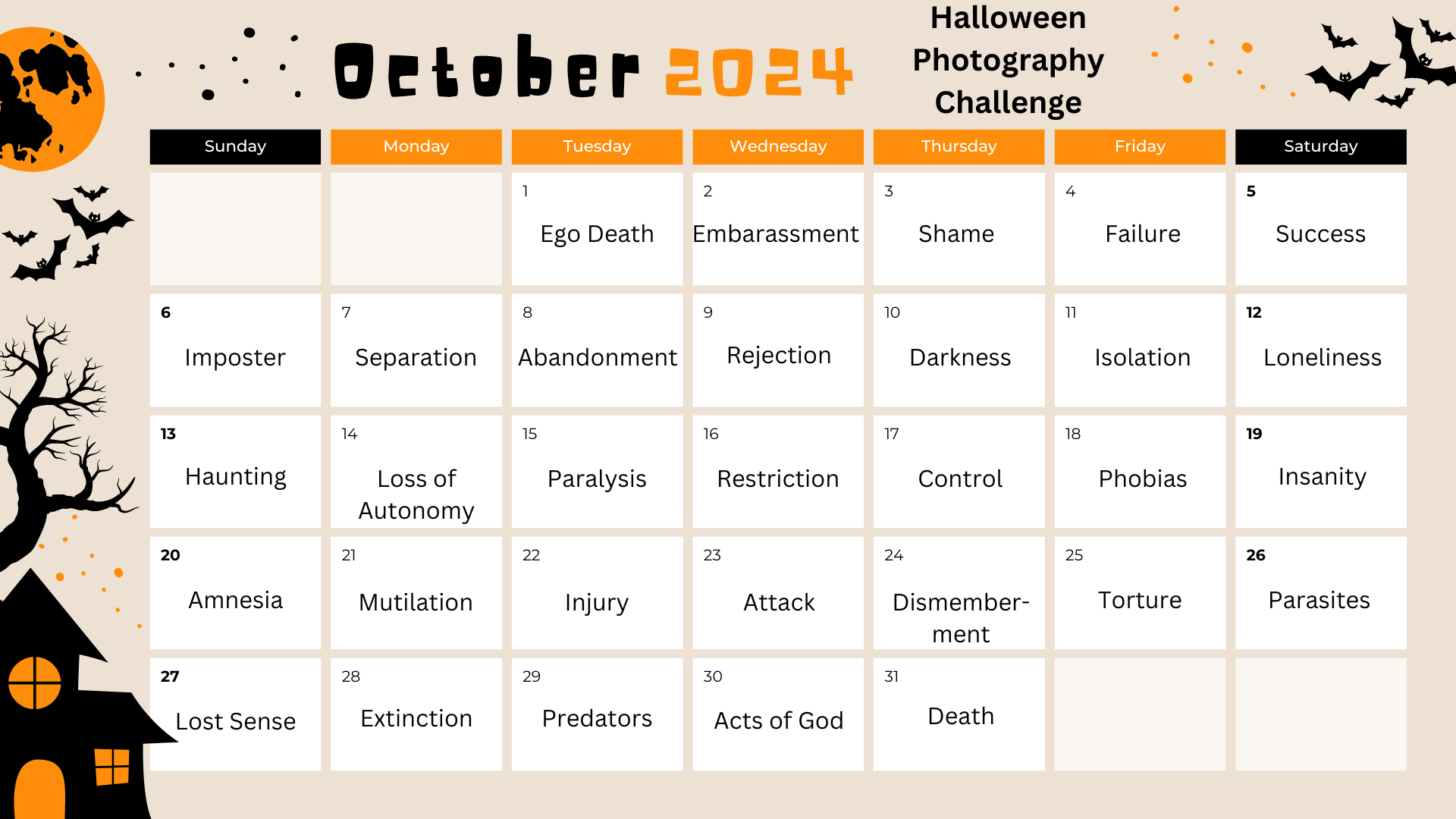
Take a photograph that depicts fear of success and link to your photo in the chat.
Get Moving
Now that you’ve read all the prompts and have all these ideas running around in your head, it’s time for motion. I’m really glad I added this motion section to the prompts because I’m following these prompts, too. After I read the prompt post and take notes in my journal, I get up, stretch and get moving, and while I walk, or bounce, I think about my story and poem and loosen up and feel good. I hope you are having the same experience. Some suggestions:
Free Weights – Anaerobic exercise as resistance training is as important as aerobic exercise to stay strong and healthy. You can use your own body weight for resistance when doing sit-ups, push-ups, planks, or squats but you may also want to pick up some hand weights. I use 2, 5, and eight pound weights. This dumbbell weight set would do the trick.
Resistance Bands – Some people prefer resistance bands. These can also be used during stretching.
Free Weight Exercise Videos – I was excited to find Full Body Every Day Workout on Amazon Prime. A woman does free weight exercises on the beach. Looks like the free weight workout video I’ve been looking for.
Don’t forget to come back and post a link your work in the comments.
 Experience Writing
My poem & fiction
Edgar Allan Poe suffered from ⚰️ corpse bullying. The raven 🦅 is perfect for the oppressed class stressed out everyday by nevermore 🌑
I keep moving by writing✍️✨Farewell for now.
LikeLike
a trijan refrain from me 🙂
Writober – Success to wallow – Ladyleemanila (wordpress.com)
LikeLiked by 1 person