
Welcome back for the tenth day of Writober. Today we’re exploring the universal fear of separation by looking at fear of darkness.
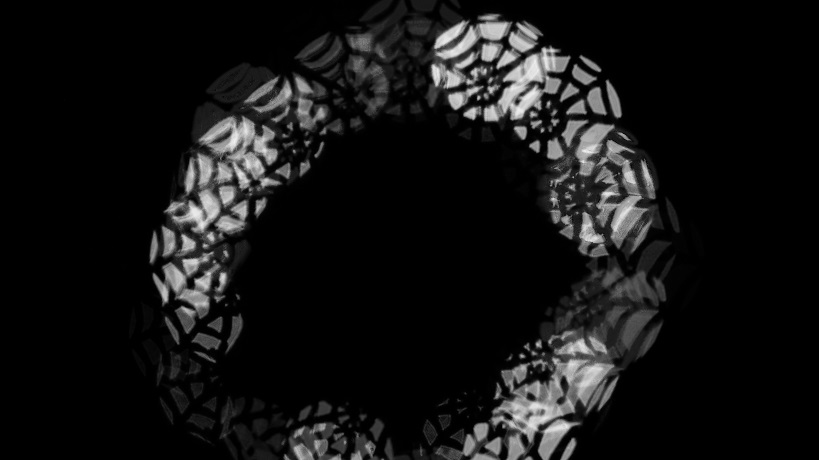
Fear of darkness is a part of fear of separation because in the dark we can’t see anyone or anything else. In that respect we are completely alone, and we fear any noises that make us think we are not alone.
Fear of darkness is also a fear of our own imaginations. What dangers do you imagine lurking in the darkness?
The phrase: Antiphrasis
Antiphrasis is a rhetorical device in which one says the opposite of what is meant, usually ironic or humorous use of words in senses opposite to the generally accepted meanings.
Examples from Wikipedia:
- “Take your time, we’ve got all day”, meaning “hurry up, we don’t have all day”.
- “Tell me about it”, in the sense of “don’t bother, I already know”.
- “Great!”, an exclamation uttered when something unpleasant had happened or is about to happen.
Fighting Fear of the Blank Page: When we want to write, sometimes the blank page stares back like your inner critic is already judging or a giant void of nothingness ready to swallow you up. But what if you only feel the page?
Write in the dark: Try taking your journal into a space with no light. I have a closet I can sit in that gets no light inside. Set a timer and write for five minutes. Start your writing session with whatever you can decipher from the page.
*Quick Note about links in this post: I am an amazon associate, so most of the links in my post will take you to amazon products. If you buy from these links, I will make some pennies which will help me pay for this site and my creative endeavors.
OctPoWriMo
Poetry Toolbox
These are quick exercises that I hope you’ll do every day. We will build on these exercises throughout the month.
- Word list: Write down the first ten words you think of when you think of fear. Any words at all. Anything that comes to mind. Then choose your three favorite and say them aloud a few times until you hear the accented and unaccented syllables (if more than one syllable) and notice the duration of each syllable. What antiphrasis (opposite) could express your three favorites from today’s list? (Inspired by Frances Mayes’ list of a hundred favorite words in The Discovery of Poetry)
I created this Excel Spreadsheet for you to use to collect and explore your fear words.
2. Sensory Imagery: In your journal or a word processing file, fill in these lines as quickly as you can. Notice they are slightly different from last week. You may want to revisit one or two in more detail if you’re inspired and have time.
I see
I hear
I carry
I smell
I follow
The empty room
The tug of
I taste
The cold down my spine
I witnessed
I touched
(Inspired by a week one exercise in the poetry chapter of The Portable MFA in Creative Writing)
3. More Sensory Imagery: I find a great place to start when exploring abstract ideas, is to brainstorm sensory imagery. Write down the first few things you think of to answer these questions:
What does darkness smell like?
What does darkness taste like?
What texture is darkness? What does it feel like to the touch? What temperature is darkness? Where do you feel it?
What does darkness sound like?
What is a symbol of darkness? What does it look like?
4. Choose one poem to study all week: Read your chosen poem again. Read it aloud. Journal about your thoughts on the poem. Has your understanding changed in any way? Have new questions come up? Look up the poem online. Are there any interviews with the poet? Has anyone else written insights about the poem?
Poetry Building
Antiphrasis is a rhetorical device in which one says the opposite of what is meant, usually ironic or humorous use of words in senses opposite to the generally accepted meanings. What are the humorous ironies of fear of darkness?
Example poem: Today we’re looking at The Fear by Robert Frost, copied here from poets.org for educational purposes.
The Fear
A lantern light from deeper in the barn
Shone on a man and woman in the door
And threw their lurching shadows on a house
Near by, all dark in every glossy window.
A horse’s hoof pawed once the hollow floor,
And the back of the gig they stood beside
Moved in a little. The man grasped a wheel,
The woman spoke out sharply, “Whoa, stand still!”
“I saw it just as plain as a white plate,”
She said, “as the light on the dashboard ran
Along the bushes at the roadside—a man’s face.
You must have seen it too.”
“I didn’t see it.
Are you sure——”
“Yes, I’m sure!”
“—it was a face?”
“Joel, I’ll have to look. I can’t go in,
I can’t, and leave a thing like that unsettled.
Doors locked and curtains drawn will make no difference.
I always have felt strange when we came home
To the dark house after so long an absence,
And the key rattled loudly into place
Seemed to warn someone to be getting out
At one door as we entered at another.
What if I’m right, and someone all the time—
Don’t hold my arm!”
“I say it’s someone passing.”
“You speak as if this were a travelled road.
You forget where we are. What is beyond
That he’d be going to or coming from
At such an hour of night, and on foot too.
What was he standing still for in the bushes?”
“It’s not so very late—it’s only dark.
There’s more in it than you’re inclined to say.
Did he look like——?”
“He looked like anyone.
I’ll never rest to-night unless I know.
Give me the lantern.”
“You don’t want the lantern.”
She pushed past him and got it for herself.
“You’re not to come,” she said. “This is my business.
If the time’s come to face it, I’m the one
To put it the right way. He’d never dare—
Listen! He kicked a stone. Hear that, hear that!
He’s coming towards us. Joel, go in—please.
Hark!—I don’t hear him now. But please go in.”
“In the first place you can’t make me believe it’s——”
“It is—or someone else he’s sent to watch.
And now’s the time to have it out with him
While we know definitely where he is.
Let him get off and he’ll be everywhere
Around us, looking out of trees and bushes
Till I sha’n’t dare to set a foot outdoors.
And I can’t stand it. Joel, let me go!”
“But it’s nonsense to think he’d care enough.”
“You mean you couldn’t understand his caring.
Oh, but you see he hadn’t had enough—
Joel, I won’t—I won’t—I promise you.
We mustn’t say hard things. You mustn’t either.”
“I’ll be the one, if anybody goes!
But you give him the advantage with this light.
What couldn’t he do to us standing here!
And if to see was what he wanted, why
He has seen all there was to see and gone.”
He appeared to forget to keep his hold,
But advanced with her as she crossed the grass.
“What do you want?” she cried to all the dark.
She stretched up tall to overlook the light
That hung in both hands hot against her skirt.
“There’s no one; so you’re wrong,” he said.
“There is.—
What do you want?” she cried, and then herself
Was startled when an answer really came.
“Nothing.” It came from well along the road.
She reached a hand to Joel for support:
The smell of scorching woollen made her faint.
“What are you doing round this house at night?”
“Nothing.” A pause: there seemed no more to say.
And then the voice again: “You seem afraid.
I saw by the way you whipped up the horse.
I’ll just come forward in the lantern light
And let you see.”
“Yes, do.—Joel, go back!”
She stood her ground against the noisy steps
That came on, but her body rocked a little.
“You see,” the voice said.
“Oh.” She looked and looked.
“You don’t see—I’ve a child here by the hand.”
“What’s a child doing at this time of night——?”
“Out walking. Every child should have the memory
Of at least one long-after-bedtime walk.
What, son?”
“Then I should think you’d try to find
Somewhere to walk——”
“The highway as it happens—
We’re stopping for the fortnight down at Dean’s.”
“But if that’s all—Joel—you realize—
You won’t think anything. You understand?
You understand that we have to be careful.
This is a very, very lonely place.
Joel!” She spoke as if she couldn’t turn.
The swinging lantern lengthened to the ground,
It touched, it struck it, clattered and went out.
This poem is in the public domain.
How does Frost get the reader to feel fear of darkness? What techniques does he use? What words stood out to you?
Today’s prompt: Write a poem exploring the fear of darkness using antiphrasis.
Form: If you’re looking for more of a challenge, write an Epigram.
Writober Flash Fiction
Write a story with a beginning, middle, and end with conflict that leads to change in less than a thousand words (no minimal word count) inspired by one of the images in the Separation folder of the Writober 2024 Pinterest board. How does fear of darkness play a part in your story?
NaNo Prep
Did you find making a character web useful for understanding your main character’s relationships? Try looking at your antagonists relationships in the same way.
Halloween Photography Challenge
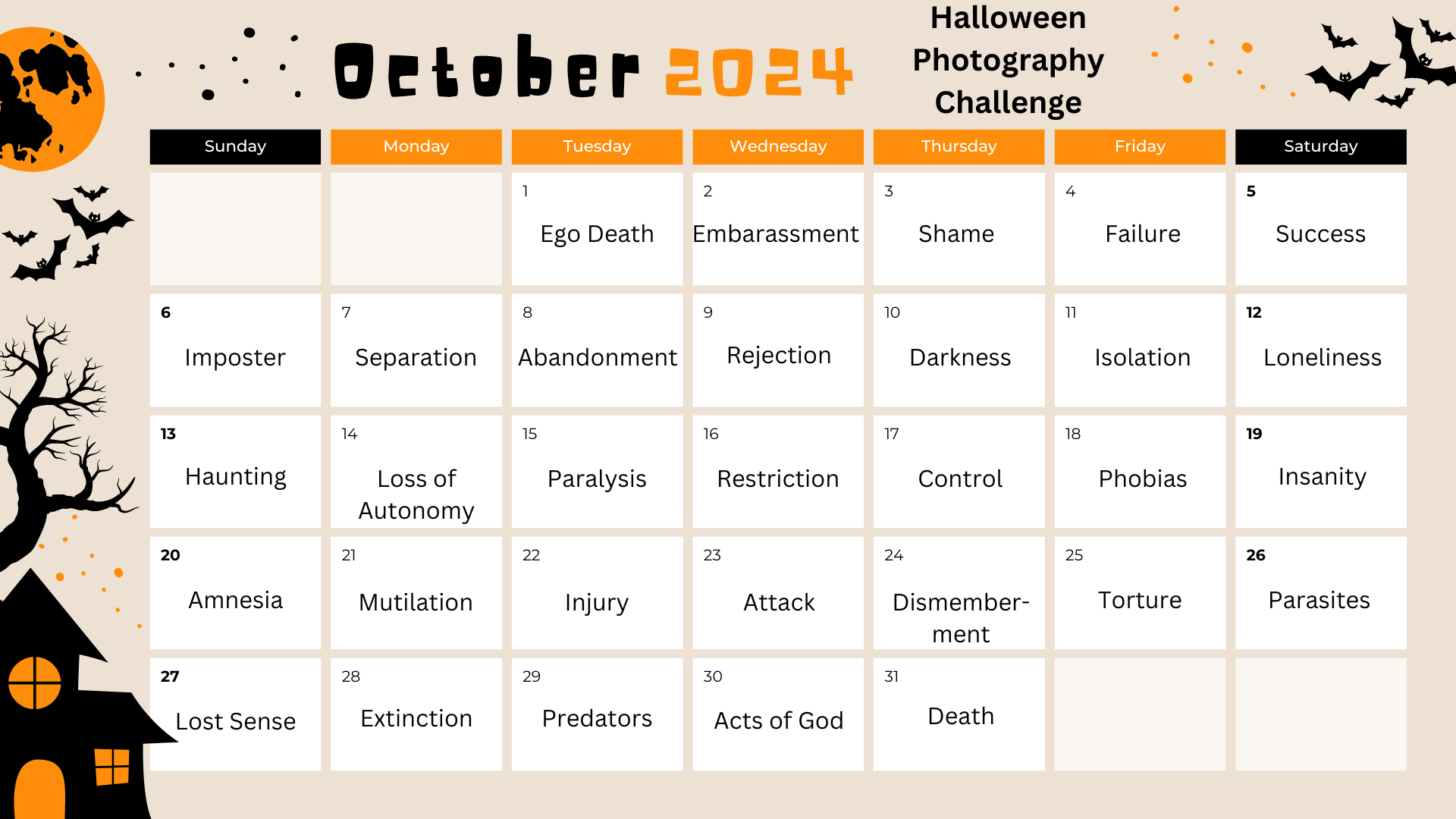
Take a photograph that depicts fear of darkness and link to your photo in the chat.
Get Moving
Now that you’ve read all the prompts and have all these ideas running around in your head, it’s time for motion. Some suggestions:
Move to words: Listen to a reading of your favorite poem or poems on a loop and move to the words. Dance like you would to a song, or walk, run, jump. Anything the words make you feel like doing. Does your body feel a rhythm in the poem? Does your body feel the stresses of the words?
 Experience Writing
a mirror sestet from me 🙂
Writober – Darkness – Ladyleemanila (wordpress.com)
LikeLiked by 1 person