
Welcome back for the fourteenth day of Writober. Hard to believe we’re already in week three and exploring our third universal fear: loss of autonomy.

Fear of loss of autonomy is the fear of losing the ability to do things for yourself, to physically or mentally lose control of your own faculties. This could happen in so many different ways, suddenly due to injury, or slowly due to disease, or decline. Loss of autonomy makes a prison of the self.
Rhetorical Device: Apposition
Yesterday we talked about expanding past the line with enjambment. Today, we’re looking at extending our lines using appositions. There’s a great chapter in The Poet’s Companion by Kim Addonizio and Dorianne Laux called, “A Grammatical Excursion,” in which they explain different forms of appositions with examples and exercises.
The definition of apposition is “the act of placing together or bringing into proximity; juxtaposition.” In grammar, apposition is “a syntactic relation between expressions, usually consecutive, that have the same function and the same relation to other elements in the sentence, the second expression identifying or supplementing the first.” Appositions are how we give the reader more information. The example in The Poet’s Companion is starting with “My grandmother.” If you add her name, and write “My grandmother, Stella,” you’ve added a noun appositive. If you add a description like, “My grandmother, a tiny woman with long white hair,” you’ve added a noun phrase appositive.
Fighting Fear of the Blank Page: How are you feeling about that blank page? Is it still taunting you? What if you give that page a face?
Origami jack-o-lantern: Before writing, fold your page into a jack-o-lantern. Open it back up and put your words inside. Then fold it back into a jack-o-lantern.
Or you could try this origami skull that bites!
*Quick Note about links in this post: I am an amazon associate, so most of the links in my post will take you to amazon products. If you buy from these links, I will make some pennies which will help me pay for this site and my creative endeavors.
OctPoWriMo
Poetry Toolbox
These are quick exercises that I hope you’ll do every day. We will build on these exercises throughout the month.
- Word list: Write down the first ten words you think of when you think of fear. Any words at all. Anything that comes to mind. Then choose your three favorite and say them aloud a few times until you hear the accented and unaccented syllables (if more than one syllable) and notice the duration of each syllable. (Inspired by Frances Mayes’ list of a hundred favorite words in The Discovery of Poetry)
I created this Excel Spreadsheet for you to use to collect and explore your fear words.
2. Sensory Imagery: In your journal or a word processing file, fill in these lines as quickly as you can. Notice they are slightly different from last week. You may want to revisit one or two in more detail if you’re inspired and have time.
I didn’t see
I didn’t hear
I can’t carry
I didn’t smell
I wouldn’t follow
The dead end road
The frustration of
I can’t taste
The burn of
I witness
I touch but don’t feel
(Inspired by a week one exercise in the poetry chapter of The Portable MFA in Creative Writing)
3. More Sensory Imagery: Ask yourself sensory questions about loss of autonomy.
4. Choose one poem to study all week: Choose a new poem to study this week. It may be another by the same poet, or you may choose another poem that you find challenging.
Poetry Building
Apposition isn’t only for nouns, you can add appositives to verbs, adjectives or propositions. An example of a verb phrase appositive (from The Poet’s Companion) is: “The child spins in circles, whirls around until the world spins with her.”
Example poem: Today we’re looking at Variations on the Word Sleep by Margaret Atwood, copied here from poets.org for educational purposes.
Variation on the Word Sleep
I would like to watch you sleeping,
which may not happen.
I would like to watch you,
sleeping. I would like to sleep
with you, to enter
your sleep as its smooth dark wave
slides over my head
and walk with you through that lucent
wavering forest of bluegreen leaves
with its watery sun & three moons
towards the cave where you must descend,
towards your worst fear
I would like to give you the silver
branch, the small white flower, the one
word that will protect you
from the grief at the center
of your dream, from the grief
at the center. I would like to follow
you up the long stairway
again & become
the boat that would row you back
carefully, a flame
in two cupped hands
to where your body lies
beside me, and you enter
it as easily as breathing in
I would like to be the air
that inhabits you for a moment
only. I would like to be that unnoticed
& that necessary.
From Selected Poems II: 1976-1986 by Margaret Atwood. Copyright © 1987 by Margaret Atwood
How does this poem make you feel? What stands out to you? Can you identify appositives in the poem?
Today’s prompt: Write a poem exploring the fear of loss of autonomy using apposition.
Form: If you’re looking for more of a challenge, read Projective Verse by Charles Olson. Want more? Look at Mind, Mouth and Page from the allen ginsberg project. Approach your poem as projective verse.
Writober Flash Fiction
Write a story with a beginning, middle, and end with conflict that leads to change in less than a thousand words (no minimal word count) inspired by one of the images in the Loss of Autonomy folder of the Writober 2024 Pinterest board. How does fear of loss of autonomy affect your character?
NaNo Prep
How’s your outline coming? Let’s start thinking about possible endings. Brainstorm as many different endings as you can. Choose your favorite and do a quick write of that ending. Knowing how the story begins and how it ends, we can start imagining the main events that need to happen in between.
Halloween Photography Challenge
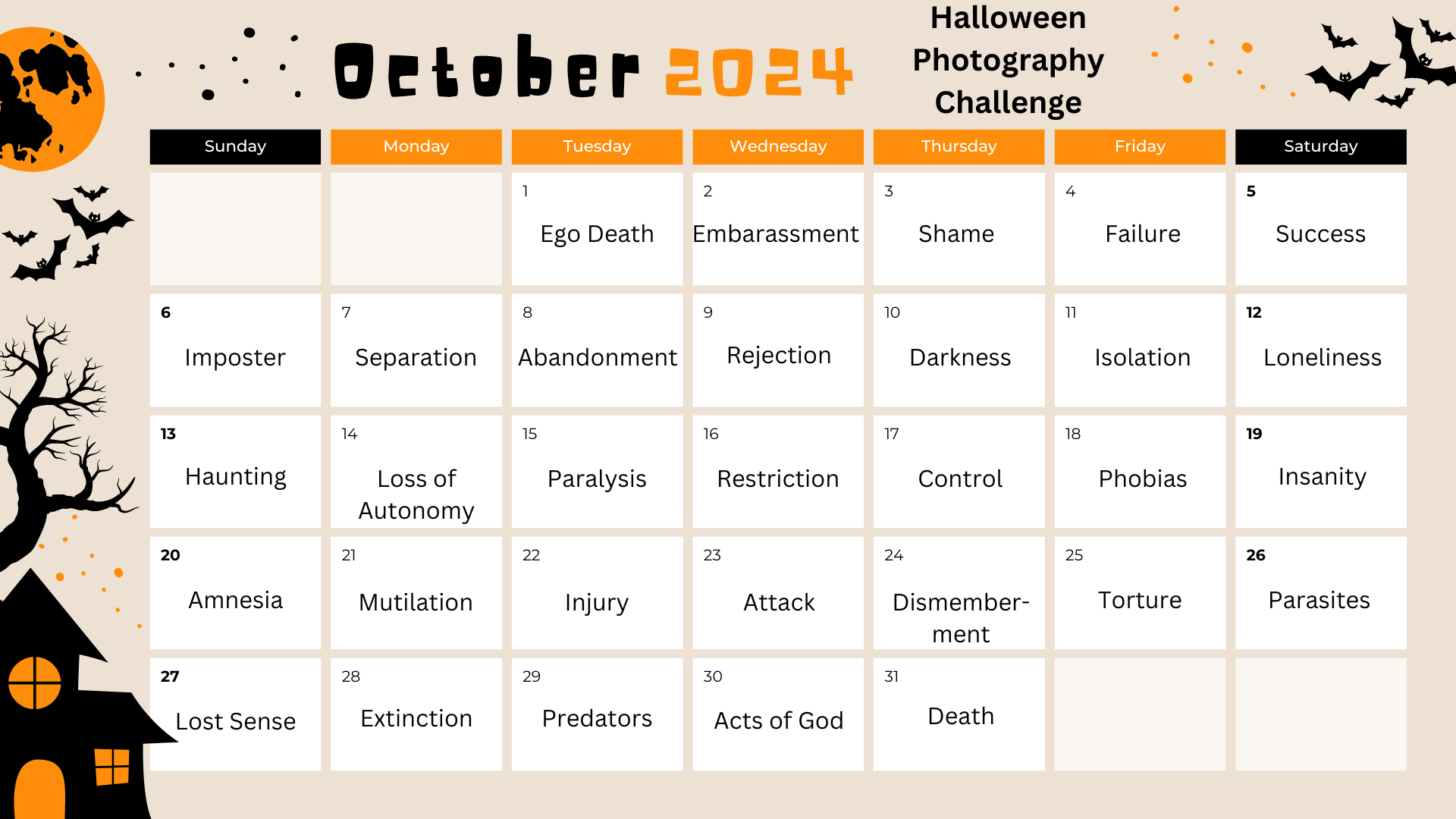
Take a photograph that depicts loss of autonomy or fear of loss of autonomy and link to your photo in the chat.
Get Moving
Now that you’ve read all the prompts and have all these ideas running around in your head, it’s time for motion. How about some fun Halloween workout clothes to motivate some motion? Some suggestions:
 Experience Writing
a quadrilew from me 🙂
Writober – Loss of Autonomy – Ladyleemanila (wordpress.com)
LikeLike
Expected moment, immobile fear & Photo🍂✨
LikeLike