
Welcome back for the twentieth day of Writober. It’s Sunday, and the last day we’ll be looking at the universal fear of loss of autonomy. I was looking through my horror movies and realized that fear of Possession didn’t get on our calendar. I think it’s definitely part of the fear of loss of autonomy, so let’s look at it today along with Amnesia.

Fear of amnesia is not only the fear of forgetting, not knowing, but also the fear of losing oneself. Fear of possession is a similar fear of losing oneself, but because of being taken over by another spirit, or being.
By looking back at this week’s fears, the aspects of the fear of loss of autonomy: paralysis, restriction, control, phobias, insanity, amnesia, and possession have you gotten any closer to any of your core causes of these fears? What memories have come up for you that you may not have thought of since they happened?
Rhetorical Device: Paradox
A paradox is like an oxymoron but extends past words to phrases and sentences. A paradox is a statement that appears self-contradictory, but may be true. My favorite is reading the text “This page intentionally left blank.”
Fighting Fear of the Blank Page: How’s your relationship with the page coming along? Which approaches have been your favorite so far?
Review this week’s techniques: Try one you didn’t try yet, or use your favorite from this week.
*Quick Note about links in this post: I am an amazon associate, so most of the links in my post will take you to amazon products. If you buy from these links, I will make some pennies which will help me pay for this site and my creative endeavors.
OctPoWriMo
Poetry Toolbox
These are quick exercises that I hope you’ll do every day. We will build on these exercises throughout the month.
- Word list: Write down the first ten words you think of when you think of fear. Any words at all. Anything that comes to mind. Then choose your three favorite and say them aloud a few times until you hear the accented and unaccented syllables (if more than one syllable) and notice the duration of each syllable. (Inspired by Frances Mayes’ list of a hundred favorite words in The Discovery of Poetry)
I created this Excel Spreadsheet for you to use to collect and explore your fear words.
2. Sensory Imagery: In your journal or a word processing file, fill in these lines as quickly as you can. Notice they are slightly different from last week. You may want to revisit one or two in more detail if you’re inspired and have time.
I didn’t see
I didn’t hear
I can’t carry
I didn’t smell
I wouldn’t follow
The dead end road
The frustration of
I can’t taste
The burn of
I witness
I touch but don’t feel
(Inspired by a week one exercise in the poetry chapter of The Portable MFA in Creative Writing)
3. More Sensory Imagery: Answer sensory questions about fear of amnesia and/or fear of possession.
4. Choose one poem to study all week: Read your chosen poem again. Read it aloud. Are there parts of it you’ve memorized? Can you recite the whole thing? Are there rhymes and rhythms that make it easy to remember? How do you see the poem differently now? Do you still like and dislike the same things? What has changed? Write about it in your journal.
Poetry Building
Paradox: From Ultius.com “Often, a paradox is a statement that seems to be contradictory to itself, or even amusing; yet it may contain hidden or obvious truth. Paradox is often used to illustrate the speaker or writer’s opinion which is contradictory to accepted traditional thought on the subject. Paradox is used in literature to cause innovative thinking or ideas. The following are examples of paradox:
“The enemy of my enemy is my friend.”
“What a pity that youth must be wasted on the young.” – George Bernard Shaw
Can you think of a paradox that gets to the truth of fear of amnesia?
Example poem: Today we’re looking at Morning in the Burned House by Margaret Atwood, copied here from poets.org for educational purposes.
Morning in the Burned House
In the burned house I am eating breakfast.
You understand: there is no house, there is no breakfast,
yet here I am.
The spoon which was melted scrapes against
the bowl which was melted also.
No one else is around.
Where have they gone to, brother and sister,
mother and father? Off along the shore,
perhaps. Their clothes are still on the hangers,
their dishes piled beside the sink,
which is beside the woodstove
with its grate and sooty kettle,
every detail clear,
tin cup and rippled mirror.
The day is bright and songless,
the lake is blue, the forest watchful.
In the east a bank of cloud
rises up silently like dark bread.
I can see the swirls in the oilcloth,
I can see the flaws in the glass,
those flares where the sun hits them.
I can’t see my own arms and legs
or know if this is a trap or blessing,
finding myself back here, where everything
in this house has long been over,
kettle and mirror, spoon and bowl,
including my own body,
including the body I had then,
including the body I have now
as I sit at this morning table, alone and happy,
bare child’s feet on the scorched floorboards
(I can almost see)
in my burning clothes, the thin green shorts
and grubby yellow T-shirt
holding my cindery, non-existent,
radiant flesh. Incandescent.
From Morning in the Burned House by Margaret Atwood. Copyright © 1995 by Margaret Atwood.
How does this poem make you feel? What is the paradox of the poem?
Today’s prompt: Write a poem exploring fear of amnesia and/or fear of possession using paradox.
Form: If you’re looking for more of a challenge, write your poem as an Inverted Refrain using as many of this week’s rhetorical devices as work with your poem.
Writober Flash Fiction
Write a story with a beginning, middle, and end with conflict that leads to change in less than a thousand words (no minimal word count) inspired by one of the images in the Loss of Autonomy folder of the Writober 2024 Pinterest board. How could fear of amnesia play a role in your story?
NaNo Prep
Let’s finish up looking at creating movement in Act 2 inspired by Novel Writing Blueprint Workbook: A Storyteller’s Journal by Jill Harris.
Hiring: When your MC fails at reaching her/his original goal, does s/he hire someone or recruit someone’s help? How does s/he choose? Why?
Persuading: How does your MC persuade others to join in (Does s/he use the rhetorical devices we’ve been exploring 🎃)?
Halloween Photography Challenge
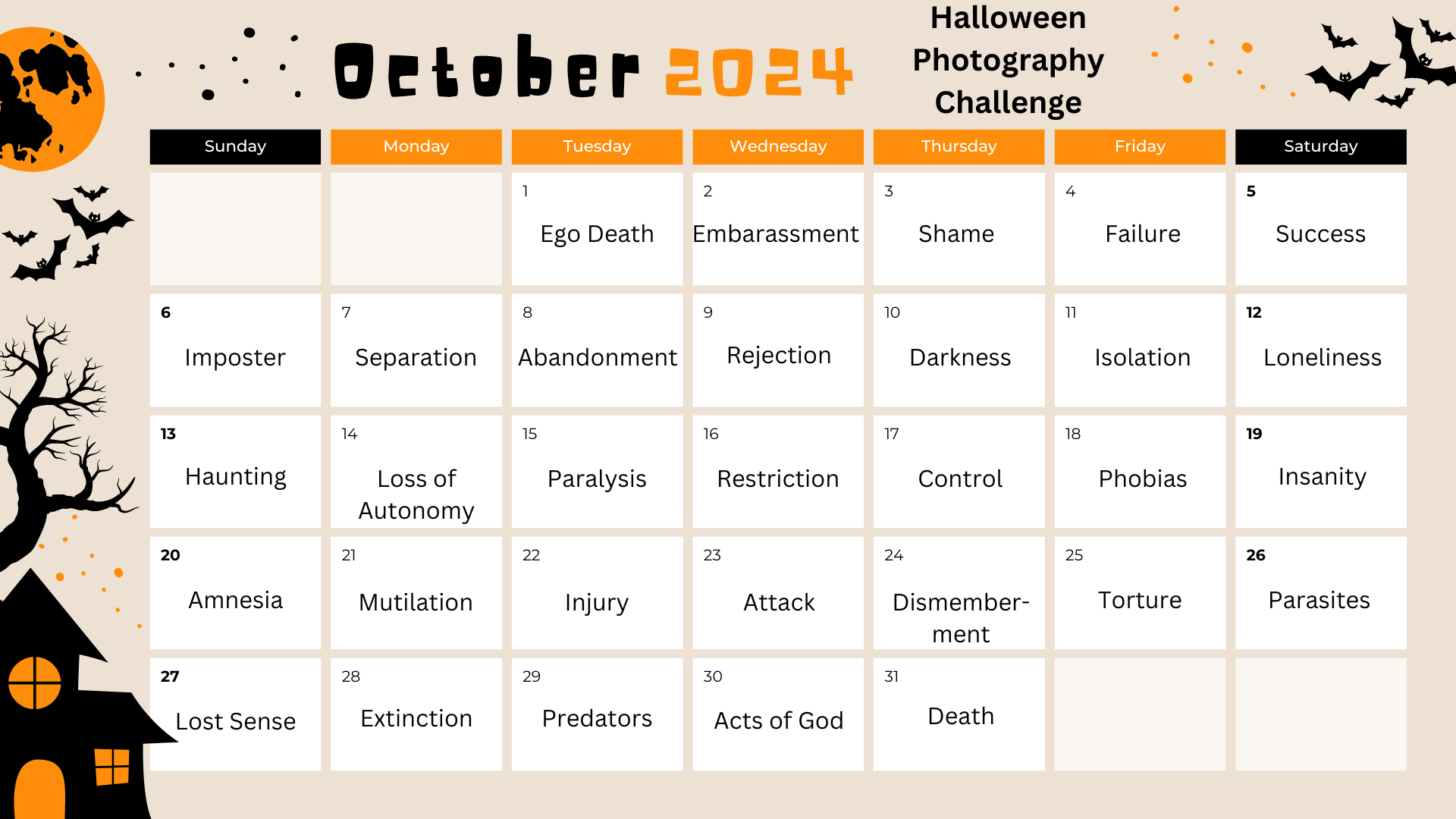
Take a photograph that depicts fear of amnesia or fear of possession and link to your photo in the chat.
Tunetober
How did it go? Is your tune getting scarier as it develops? This week, record a scary sound in nature, or in your environment. Find a way to fit it into your tune.
Sewtober
This week, sew yourself a treat, and share a sewing trick.
Get Moving
Now that you’ve read all the prompts and have all these ideas running around in your head, it’s time for motion. I found this comedy video, but I think the moves will get the blood pumping, and laughter’s good for you too.
 Experience Writing
enjoy your Sunday 🙂
Writober – Finding Memory – Ladyleemanila
LikeLiked by 1 person
Thank you. You too.
LikeLiked by 1 person