Welcome back for the twenty-sixth day of Writober. During this fourth week we’re exploring the universal fear of mutilation. Today we’re looking at fear of parasites.

A parasite is an organism that lives in or on an organism of another species (its host) and benefits by deriving nutrients at the other’s expense. Many great horror movies like the Alien franchise and The Thing grew from a fear of parasites.
When I was a Peace Corps Volunteer in West Africa fear of parasites was a part of daily life. Real life monsters like guinea worm maim and cripple, amoebas attacked my gut and broke down my immune system, malaria can kill and when survived can come out of dormancy and recur. And those are only a few examples.
Literary Device: Abstract and Concrete Nouns
An abstract noun represents an intangible idea. It can’t be measured or physically sensed. The most common abstract nouns are love, beauty, truth, happiness, and good/evil.
A concrete noun is a physical object. A person, place, or thing that can be detected by our sensory organs and can be measured.
Fighting Fear of the Blank Page: One way to fight fear of the blank page is to pre-write, and do some research.
The abstraction study sheet: I started my focus on abstractions three years ago, and it never gets old. During my study, I have created a study sheet for myself that helps me dive into an abstraction and gather lots of concrete nouns and ideas that I connect with the abstraction. So here is a writing tool exclusive for you Writober die-hards still playing along.
You’ll notice an expanded section of sensory details including “line” which means what kind of line is it? Is it jagged, straight, dotted, curved, etc. And animal, insect, weather are all asking what this abstract noun makes you think of in these categories. As for the fight or flight, control, and bias cues, here’s a post that explains that, actually it’s a progression of three posts from April of 2023 that explain it:
Poetry Month Challenges Day 16
Poetry Month Challenges Day 30
I also explore the psychology and philosophy of the abstract noun and look up any famous quotes that use it.
*Quick Note about links in this post: I am an amazon associate, so most of the links in my post will take you to amazon products. If you buy from these links, I will make some pennies which will help me pay for this site and my creative endeavors.
OctPoWriMo
Poetry Toolbox
These are quick exercises that I hope you’ll do every day. We will build on these exercises throughout the month.
- Word list: Write down the first ten words you think of when you think of fear. Any words at all. Anything that comes to mind. Then choose your three favorite and say them aloud a few times until you hear the accented and unaccented syllables (if more than one syllable) and notice the duration of each syllable. Add the least connected exact rhyme, and the strangest slant rhyme. What abstract noun would you connect to your word? (Inspired by Frances Mayes’ list of a hundred favorite words in The Discovery of Poetry)
I created this Excel Spreadsheet for you to use to collect and explore your fear words.
2. Sensory Imagery: In your journal or a word processing file, fill in these lines as quickly as you can. Notice they are slightly different from last week. You may want to revisit one or two in more detail if you’re inspired and have time.
I will see
I will hear
I will carry
I will smell
I will follow
The slice of
The pain of
I will taste
The color of
I will witness
I will touch
(Inspired by a week one exercise in the poetry chapter of The Portable MFA in Creative Writing)
3. More Sensory Imagery: Ask yourself sensory questions about fear of parasites.
4. Choose a poetry collection: Looking through the collection, pick out the abstract nouns. How are they used? What concrete nouns are used to describe them? What imagery is used?
Poetry Building
Abstract and Concrete Nouns: Since the earliest poems, poets have used imagery, metaphor (we’ll get into metaphor next week) and rhetorical devices to express abstract concepts. Abstractions by themselves are vague and different people define them differently. That’s why it’s so important to explore concrete imagery with specific detail when exploring abstractions.
Example poem: Today we’re looking at Ghosts by Ella Wheeler Wilcox, copied here from poets.org for educational purposes.
Ghosts
There are ghosts in the room.
As I sit here alone, from the dark corners there
They come out of the gloom,
And they stand at my side and they lean on my chair
There’s a ghost of a Hope
That lighted my days with a fanciful glow,
In her hand is the rope
That strangled her life out. Hope was slain long ago.
But her ghost comes to-night
With its skeleton face and expressionless eyes,
And it stands in the light,
And mocks me, and jeers me with sobs and with sighs.
There’s the ghost of a Joy,
A frail, fragile thing, and I prized it too much,
And the hands that destroy
Clasped its close, and it died at the withering touch.
There’s the ghost of a Love,
Born with joy, reared with hope, died in pain and unrest,
But he towers above
All the others—this ghost; yet a ghost at the best,
I am weary, and fain
Would forget all these dead: but the gibbering host
Make my struggle in vain—
In each shadowy corner there lurketh a ghost.
This poem is in the public domain. Published in Poem-a-Day on October 19, 2024, by the Academy of American Poets.
How does this poem make you feel? What stands out to you? Notice how the poet personifies the abstractions.
Today’s prompt: Write a poem exploring the fear of parasites using both abstract and concrete nouns.
Form: If you’re looking for more of a challenge, write a clarity pyramid (or series of clarity pyramids) using an abstract noun as the title (first word).
Write your poem and post it to your site (blog/ website/ other), then post a link in the chat. You may also post your poem in the chat if you do not have a place to post it. If you are posting as “someone” or “anonymous,” please put your name at the end of the poem. Throughout the day, please check back when you can to read and encourage other poets, to learn from each other, and enjoy each other’s efforts.
Writober Flash Fiction
Write a story with a beginning, middle, and end with conflict that leads to change in less than a thousand words (no minimal word count) inspired by one of the images in the Mutilation folder of the Writober 2024 Pinterest board. How does fear of parasites affect your character?
Novel Prep
Now that we’ve looked at our MC and antagnoist’s daily routines. What is it that they dream about. What do they wish was different? What did they want to be and do when they were younger? Why didn’t it work out, or why haven’t they achieved it yet? If they could go back and change one thing, what would it be?
Halloween Photography Challenge
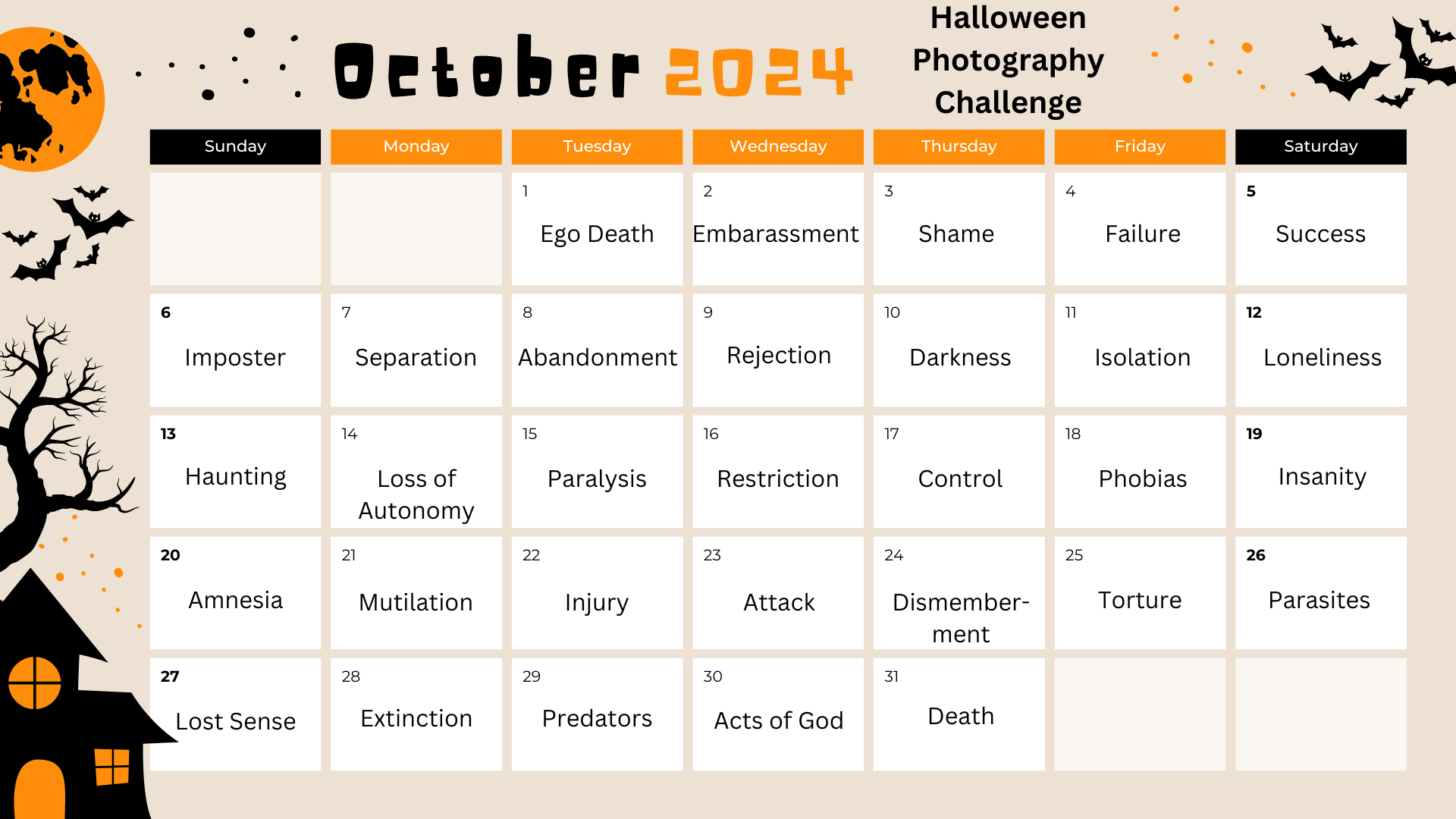
Take a photograph that depicts fear of parasites, and link to your photo in the chat.
Get Moving
Now that you’ve read all the prompts and have all these ideas running around in your head, it’s time for motion. Some suggestions:
Still looking for something different? How about this Prancercise video from 1989.
 Experience Writing
from my archive 🙂
Writober – Parasite and poison – Ladyleemanila
LikeLiked by 1 person
I thought about a flash fiction this time.
LikeLiked by 1 person