In the lost-witch forest tall trees close in the lost witch forest the same trees passed again in the lost-witch forest trees separate and isolate in the lost-witch forest the separated are lost
In the lost-witch darkness frog chirps frighten in the lost-witch darkness lightning bugs light forms in the lost-witch darkness the separate aren’t alone in the lost-witch darkness the forgotten grow
In the darkness deep separation finds connection in the darkness deep tendrils reach for imagined light in the darkness deep the susurrus surrounds and sparrows sing, spying for the trees
Writober Flash Fiction
Lost in the Forest
Clarissa’s sister, Kalli, and her friends piled back into the car, filthy and exhausted. Still no sign of Clarissa and now Max was missing too.
“We can’t just leave him.” Miranda kept looking through the back window as if Max would appear behind them.
“You heard the rangers, Miranda. No signs of struggle. And you saw with your own eyes, his pack and tent were gone. He ditched us. Let him go,” said Brad.
As they drove past the sign for the “Ultra-grow Tree Labs” Kalli shivered. “I still can’t believe they’re using human cells and growth hormones.”
“Hey, if it works, it works,” said Brad. “They say those rapid-growth trees are reversing global warming.”
“Still,” said Kalli. “It’s creepy.”
It would be years after Clarissa’s disappearance before the reports of missing campers led to the labs revealing that their trees had spread into the state parks. And years after that when the reports came out that the scientists knew their trees demonstrated separation anxiety—for humans.
Halloween Photography Challenge
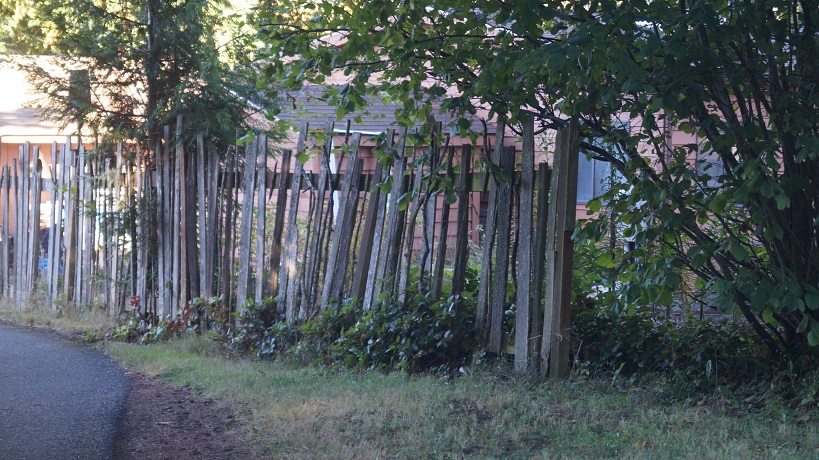
For today’s images I thought I would mix things up, so instead of trying to create fear of separation with light, I took my camera for a walk and looked for fear of separation out in the world.
Observing fear of separation in my neighborhood made me notice fences and gates, thinking of fear of separation as fear of losing things, and privacy. Then, as I walked, I noticed some of my neighbors’ Halloween decorations, and thought how I may not have noticed these fun things if I hadn’t gone out looking for fear of separation. So in a way, fear of separation made me more aware and connected to my surroundings.
Welcome back for the seventh day of Writober. How did last week go? Did you dig deep into ego death: face it and find ways to fight it? Most of all, did you write, create, and have fun? I sure did, and I really enjoyed the poems, stories, and photos you linked up to the different prompt posts.
Separation by Maria L. Berg 2024
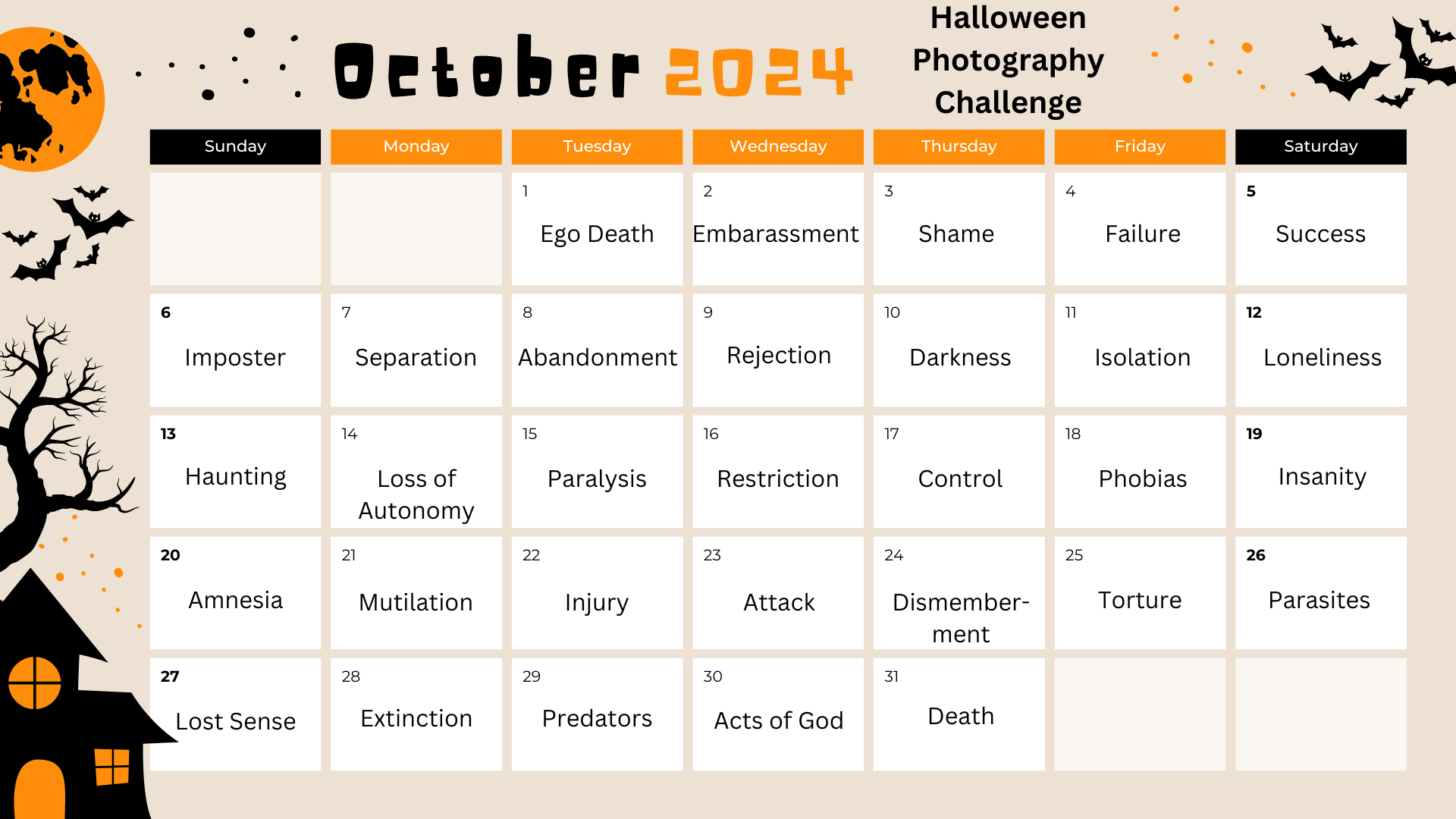
This second week we’ll be exploring the universal fear of Separation. Fear of separation builds on last week’s exploration because part of fear of ego death is fear of rejection, and not being accepted or included. But fear of separation also has to do with survival. Our ancient ancestors needed their clans and tribes to stay safe from predator attack. Separation could lead to death.
The phrase: Anaphora
As for our writing tools, last week we started with our most basic writing building block, the letter, and then combined them into syllables, and then words. This week we’ll combine words to create phrases and combine phrases into the poetic line.
Fighting Fear of the Blank Page: When we want to write, sometimes the blank page stares back like your inner critic is already judging or a giant void of nothingness ready to swallow you up. But what if the page isn’t blank to start with?
Erasure: Creative writing is the action of choosing words and how they join together. Why not start with a full page of words—any full page of text: a newspaper article, a page from your journal, a page from your favorite book, anything—then black out (erase) all the words you don’t want, leaving only the words you choose.
*Quick Note about links in this post: I am an amazon associate, so most of the links in my post will take you to amazon products. If you buy from these links, I will make some pennies which will help me pay for this site and my creative endeavors.
OctPoWriMo
Poetry Toolbox
These are quick exercises that I hope you’ll do every day. We will build on these exercises throughout the month.
Word list: Write down the first ten words you think of when you think of fear. Any words at all. Anything that comes to mind. Then choose your three favorite and say them aloud a few times until you hear the accented and unaccented syllables (if more than one syllable) and notice the duration of each syllable. (Inspired by Frances Mayes’ list of a hundred favorite words in The Discovery of Poetry)
I created this Excel Spreadsheet for you to use to collect and explore your fear words.
2. Sensory Imagery: In your journal or a word processing file, fill in these lines as quickly as you can. Notice they are slightly different from last week. You may want to revisit one or two in more detail if you’re inspired and have time.
3. More Sensory Imagery: I find a great place to start when exploring abstract ideas, is to brainstorm sensory imagery. Write down the first few things you think of to answer these questions:
What does separation smell like?
What does separation taste like?
What texture is separation? What does it feel like to the touch? What temperature is separation? Where do you feel it?
What does separation sound like?
What color(s) is separation? What is a symbol of separation? What does it look like?
4. Choose one poem to study all week: Did one example poem stand out to you last week? Is there a poem or poet that you find challenging? Choose a poem, any poem you would like and copy that poem into your journal. Writing it by hand, or even typing it out, slows you down to make you look at each word? Write in your journal what you like about the poem, what you don’t like about the poem. What stands out to you. What don’t you think you understand. (Inspired by the poetry chapter of The Portable MFA in Creative Writing)
Poetry Building
Anaphora is the repetition of a word or phrase at the beginning of each line.
Example poem: Today we’re looking at Fear by Ciaran Carson, copied here from poets.org for educational purposes.
I fear the vast dimensions of eternity.
I fear the gap between the platform and the train.
I fear the onset of a murderous campaign.
I fear the palpitations caused by too much tea.

I fear the drawn pistol of a rapparee.
I fear the books will not survive the acid rain.
I fear the ruler and the blackboard and the cane.
I fear the Jabberwock, whatever it might be.

I fear the bad decisions of a referee.
I fear the only recourse is to plead insane.
I fear the implications of a lawyer’s fee.

I fear the gremlins that have colonized my brain.
I fear to read the small print of the guarantee.
And what else do I fear? Let me begin again.
Notice how Carson uses anaphora to create a rhythm, and emphasize that fear is always present, until the very last line.
Today’s poem: Write a poem exploring the fear of separation using anaphora.
Form: If you’re looking for more of a challenge, write a blitz poem. Or, use erasure to create your poem.
Writober Flash Fiction
Write a story with a beginning, middle, and end with conflict that leads to change in less than a thousand words (no minimal word count) inspired by one of the images in the Separation folder of the Writober 2024 Pinterest board.
NaNo Prep
Last week we came up with an idea, met our protagonist, and antagonist, and they met the each other. Today, let’s begin to explore our settings. Think of one place that is important to both your protagonist and your antagonist. Perhaps the own has a clocktower, or church with chimes. An important building that can be seen from everywhere in town, or a statue that one character loves and one character hates. Maybe it’s a view of a mountain from a certain spot, or a park by a river, or a lake.
Whatever the important place is, write the scene in which the place became important to your MC. Then write the scene in which the place became important to your antagonist.
How might this place be important to your story. Brainstorm scenes from the beginning, middle, and end of your novel in which the protagonist and antagonists feelings about this place could increase the stakes and affect their actions.
Halloween Photography Challenge
Take a photograph that depicts separation or fear of separation and link to your photo in the chat.
Get Moving
Now that you’ve read all the prompts and have all these ideas running around in your head, it’s time for motion. Some suggestions:
Cardioglide: I have a cardioglide ( similar to the rower squat machine). My neighbor left it on the street for free, and I’ve been enjoying it for years. I keep it on the porch and get fresh air while getting my heart pumping. Most people have some kind of exercise equipment that they bought with the best intentions and then abandoned. What’s your abandoned exercise equipment? Give it a try today. Give it three minutes.
It’s your smile, but not your smell your legs, but not your lilt your hands, but not your holding callouses caress contours incorrectly and your countenance your countenance is clumsy
It can mimic your voice but clicks clip calm courtesies can climb into your clothes but not your vivacity and your stance your stance is too erect
When were you body-snatched? Were you aware as you changed? Was there a moment, if I had been there I could have kept you anchored to the real? But it’s too late, and now that I’ve seen you, it’s too late for me
Writober Flash Fiction
Imposter Syndrome
I’ve been slipping lately. I forget where I put things, or why I enter a room. And I’ve been forgetting I’m not like everyone else.
Imposters can’t slip. We can’t get too comfortable, or our disguises will fall away. Just yesterday, my whole face fell off. It bounced off the rug and landed under the bed. I’m so glad I was alone and no one saw.
I cleaned it off the best I could, but it still feels gritty under there, between my face and me.
Halloween Photography Challenge
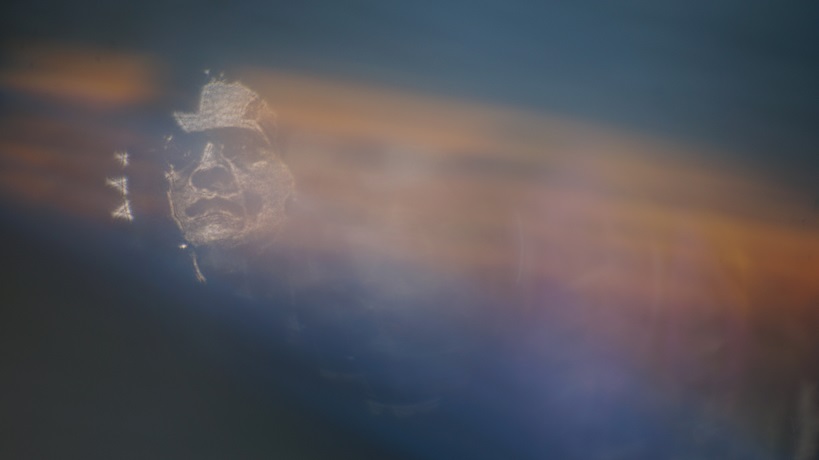
For today’s image, I put a transparency of a photo of me behind the new persona filter I made on Day one and took pictures in the mirrorworld with the lights on (I usually turn off the overhead light and close the door).
Tunetober
I came up with this simple tune on the piano in C minor flat 6, then I recorded it on the mp3 player I mentioned earlier in the week. I like that the conversion from a WAV file to an mp3 added a tinny overtone, adding to the spooky.
Sewtober
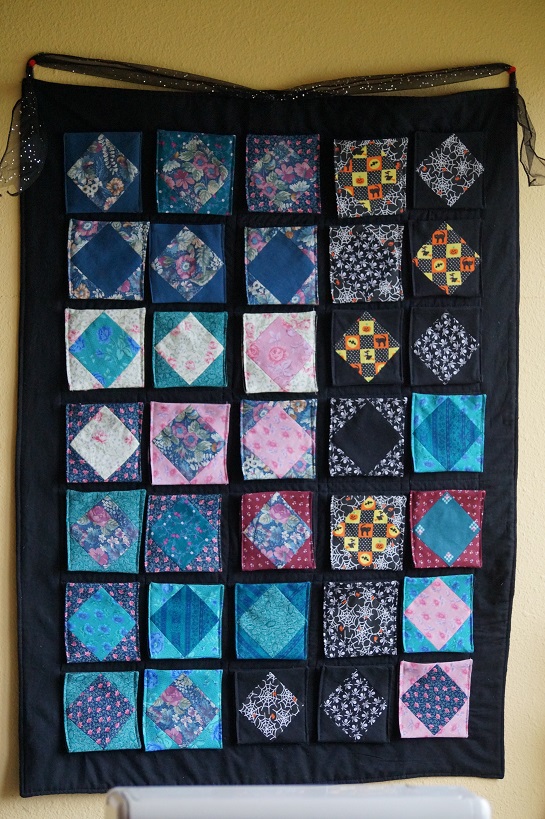
Last year, while working on motivation and changing habits, I made this quilt-pocket year-round advent calendar (the weeks go downward):
Each square is a pocket with velcro on the back, so I can switch out the squares and move them around. In each pocket, I put folded phrases like “Good job!” and “You’re reaching your goals” and some stickers or pieces of candy, and reward myself by picking something from the day’s pocket as a reward for reaching one of the day’s goals.
For this week’s quilt square, I finally made the jack-o-lantern pocket that I made a pattern for last year. I also finished a few more of the Halloween pockets I started last year but needed velcro. I took the velcro from an old jacket with a broken zipper, so I did some recycling as well. Here’s my happy jack-o-lantern:
After all these years, I’m still surprised how writing things in Experience Writing gets me to do them. Like I said, I’ve wanted to make this little pumpkin quilt square for a year, and because of coming up with the Sewtober Challenge, there he is. Thank you for motivating me, and playing along.
Welcome back for the sixth day of Writober. If you’re just finding us, Welcome. It’s never too late to join in. Since the month started on a Tuesday, it’s a day short of a week, but I want to make Sundays our review day, and start the next universal fear on Mondays. It’s the last day we’ll be exploring the universal fear of Ego death: the loss of subjective self-identity. Today we’ll look back at everything we’ve explored so far and look at imposter syndrome. It may also be a good catch-up day. I look forward to seeing what prompts from the week inspired you.
Imposter Syndrome by Maria L. Berg 2024
Imposter syndrome is the persistent inability to believe that one’s success is deserved or has been legitimately achieved as a result of one’s own efforts or skills. Not only do we fear failure, and success, once we achieve success we fear we don’t deserve it. Can’t we give ourselves a break? It all comes down to that mean inner-critic, the negative self-talk that convinces us we’re not good enough and never will be.
By looking back at this week’s fears, the aspects of the fear of ego death: embarrassment, shame, fear of failure, fear of success, and imposter syndrome have you gotten any closer to any of your core causes of these fears? What memories have come up for you that you may not have thought of since they happened?
Fighting Fear of the Blank Page: When we want to write, sometimes the blank page stares back like a judgemental enemy or a white-washed wall. But what if the page isn’t blank to start with?
Repeat one of this week’s techniques: Today’s a good day to try one of the techniques you didn’t try from this week, or think back through the techniques you’ve tried so far, was one of them really useful for you? Try it again. Have you found a technique that works for you? Or is the blank page not scary anymore? Either way, how wonderful.
*Quick Note about links in this post: I am an amazon associate, so most of the links in my post will take you to amazon products. If you buy from these links, I will make some pennies which will help me pay for this site and my creative endeavors.
OctPoWriMo
The challenge of OctPoWriMo is to write a poem every day in October. These tools and prompts are here to inform and inspire, but if you have a different poem in you, by all means get that poem down, and if you want to share it, please do.
Poetry Toolbox
These are quick exercises that I hope you’ll do every day. We will build on these exercises throughout the month.
Word list: Write down the first ten words you think of when you think of fear or shame. Any words at all. Anything that comes to mind. Do any of the words sound like what they describe?(Inspired by Frances Mayes’ list of a hundred favorite words in The Discovery of Poetry)
I created this Excel Spreadsheet for you to use to collect and explore your fear words.
Sensory Imagery: In your journal or a word processing file, fill in these lines as quickly as you can with something different from yesterday. You may want to revisit one or two in more detail if you’re inspired and have time.
Onomatopoeia is the term for words that sound like what they describe. Fun words like bang, crash, boom, pow, bark, meow, cough, hiccup, hum, and splash. These words can be very useful for bringing the sense of sound into your writing, but be careful to choose words that keep with the tone of your writing and subject.
Example Poem
Today’s example poem, copied here for educational purposes from poets.org, is Fear of the Future by John Koethe. I chose this poem as a poem about imposter syndrome not an example of onomatopoeia as you will see.
Fear of the Future
In the end one simply withdraws
From others and time, one's own time,
Becoming an imaginary Everyman
Inhabiting a few rooms, personifying
The urge to tend one's garden,
A character of no strong attachments
Who made nothing happen, and to whom
Nothing ever actually happened—a fictitious
Man whose life was over from the start,
Like a diary or a daybook whose poems
And stories told the same story over
And over again, or no story. The pictures
And paintings hang crooked on the walls,
The limbs beneath the sheets are frail and cold
And morning is an exercise in memory
Of a long failure, and of the years
Mirrored in the face of the immaculate
Child who can't believe he's old.
In this poem, Koethe speaks of becoming imaginary. He uses the words “personifying,” “character,” and “fictitious.” As I read through the poem after presenting onomatopoeia, I tried to imagine where a sound word might fit and what it would be. How would you add onomatopoeia to this poem?
Today’s poem: Write a poem about imposter syndrome (fear of being an imposter). Use as many of the techniques from this week’s poetry building section of the posts as you can, including one or two instances of onomatopoeia.
Form: If you’re looking for more of a challenge, write a Bop poem arguing whether or not the speaker is an imposter.
Write your poem and post it to your site (blog/ website/ other), then post a link in the chat. You may also post your poem in the chat if you do not have a place to post it. If you are posting as “someone” or “anonymous,” please put your name at the end of the poem. Throughout the day, please check back when you can to read and encourage other poets, to learn from each other, and enjoy each other’s efforts.
Writober Flash Fiction
The Writober challenge is to write a flash fiction story each day in October. Because it’s October, I’ve always taken it as a Halloween/Horror story, but it doesn’t have to be. You can write whatever you want.
Today’s prompt: Write a story with a beginning, middle, and end with conflict that leads to change in less than a thousand words (no minimal word count) inspired by one of the images in the Ego death folder of the Writober 2024 Pinterest board. How is your character an imposter? Why is your character afraid of being an imposter? If you want to share, link to your story in the chat. Or you can share a quick blurb of what your story’s about.
NaNo Prep
Now that your MC and AC have met, your MC needs to re-evaluate how to reach his or her goal. Is your MC thinking it would be better to just give up and go home? Why can’t s/he? What is at stake? Does knowing there’s someone in the way raise the stakes? What skills, knowledge, and or abilities does your MC have that make him/her the person that has to beat the antagonist to the goal?
Halloween Photography Challenge
Take a photograph that depicts the feeling of being an imposter, or the fear of being an imposter and link to your photo in the chat.
Tunetober
How did it go? Did you create an eerie melody in a minor key? I hope so. This week’s challenge is to create a creepy harmony or counter-melody, and add it to last week’s melody. Have fun.
Sewtober
This week, start thinking about a costume. What’s the simplest thing you can make that will get you started? A rolled hem on a square of cotton and you’ve got a bandana; on a rectangle of chiffon, a scarf; on satin, an ascot. Cut a half-circle of fabric, stitch bias tape to the top, leaving enough on each side to tie, and you’ve got a cape.
Simplest costume piece to get your costume ideas churning. Go!
All of these prompts are here to inspire creative action. Don’t worry about being “off prompt.” Any new work you create after reading this post meets the challenge. I look forward to seeing and reading what you come up with. And please come back to see how these prompts inspire me as well.
Get Moving
Sunday may be a day of rest, but we don’t want to be sedentary. Those brain cells still need oxygen. Now that you’ve read all these prompts and ideas are sparking. It’s time to get the body moving. Some suggestions:
A trip to the park to swing on the swings
A walk with a friend
A walk along a body of water
An Epsom salt bath
This has been a great week! And Writober is just beginning. Don’t forget to come back and post a link your work in the comments.
Each mile reached only rolls out another levels climbed reveal a higher plateau stars do not shine brighter twinkling echoes of light snuffed out long ago The only way to break the circle to loose the tail from the fang is to never aim or learn to play the game
Writober Flash Fiction
Fear of Success
“If we succeed, the world will never be the same,” Nala said as she stepped onto the platform.
“Nala stop! Don’t do it!”
She saw herself, black spots swirling over her orange and red panicked face, racing from the teleportation destination platform yelling, but she had already pressed the button.
Halloween Photography Challenge
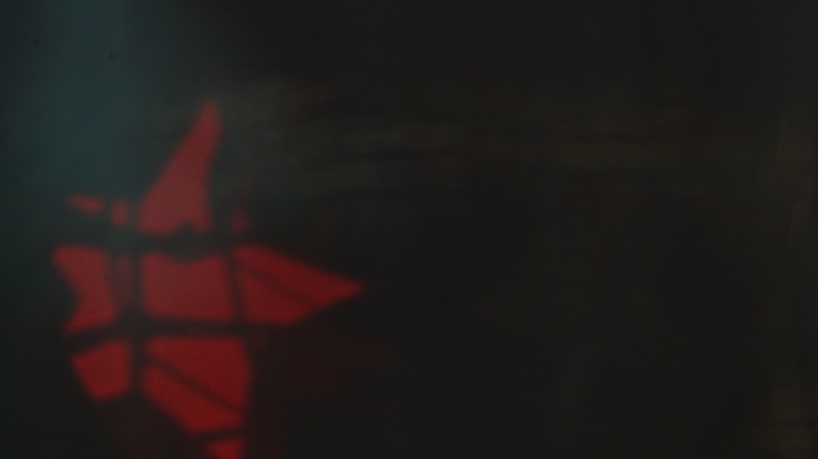
For today’s image I thought of success as a rising star and bright lights, so I used a star-shaped filter in the mirrorworld with a flash and camera movement.
Welcome back for the fifth day of Writober. Today, all our prompts will continue to explore the universal fear of Ego death: the loss of subjective self-identity by looking at fear of success.
Fear of Success by Maria L. Berg 2024
We are such complicated creatures. Not only are we afraid of failure, we’re also afraid of success. Success could lead to unforeseen changes, combining the fear of the unknown and the fear of change even into the prospect of reaching our goals and accomplishing our dreams.
Fighting Fear of the Blank Page: When we want to write, sometimes the blank page stares back like your inner critic is already judging or a giant void of nothingness ready to swallow you up. But what if the page isn’t blank to start with?
Erasure: Creative writing is the action of choosing words and how they join together. Why not start with a full page of words—any full page of text: a newspaper article, a page from your journal, a page from your favorite book, anything—then black out (erase) all the words you don’t want, leaving only the words you choose.
*Quick Note about links in this post: I am an amazon associate, so most of the links in my post will take you to amazon products. If you buy from these links, I will make some pennies which will help me pay for this site and my creative endeavors.
OctPoWriMo
Poetry Toolbox
These are quick exercises that I hope you’ll do every day. We will build on these exercises throughout the month.
Word list: Write down the first ten words you think of when you think of fear. Any words at all. Anything that comes to mind. Then choose your three favorite and say them aloud a few times until you hear the accented and unaccented syllables (if more than one syllable) and notice the duration of each syllable. Do any of them have beautiful, harmonious sounds? Do any of them flow together in a pleasing way? (Inspired by Frances Mayes’ list of a hundred favorite words in The Discovery of Poetry)
I created this Excel Spreadsheet for you to use to collect and explore your fear words.
Sensory Imagery: In your journal or a word processing file, fill in these lines as quickly as you can with something different from yesterday. You may want to revisit one or two in more detail if you’re inspired and have time.
Euphony is an agreeableness of sound, a combination of sounds that please the ear. In his book You Can Write Poetry, Jeff Mock gives the example, “Soft is the strain when Zephyr gently blows” from Alexander Pope’s long poem “An Essay on Criticism.”
So how do we create euphony? Not surprisingly, by using some tools we’ve been talking about:
Using vowel sounds – Vowel sounds are more euphonious than consonants. Longer vowels are especially melodious.
Using soft consonants – For fun, take a look back at our consonant chart from Day 1. Consonants like L, M, N, R, and W are considered euphonious, even when not next to each other. From our chart, it looks like we want to use liquids and nasals, but avoid mutes because they stop the flow of sound.
Repeating phrases – Repeating phrases can create a euphonious effect, especially when using sibilant sounds like “s” (consonance).
Using alliteration (also Day 1) and parallel phrases – Parallel phrases are phrases that use the same grammatical structure such as: “Mary likes hiking, swimming, and bicycling.” OR “Mary likes to hike, to swim, and to ride a bicycle.” Notice the forms of the verbs within each sentence stay consistent or “parallel.”
Writing sentences with many vowels – Sentences with many vowels can contribute to a pleasing rhythm and sameness. This could also be the repetition of the same vowel sound as in assonance from Day 3.
Listening and reading aloud – Developing an ear for melodious sentences.
Fun how these concepts all work together, right? As we continue through the month, I hope we’ll come to recognize which poems call for euphony, which poems demand cacophony, and which poems are best dramatized through a combination of both.
The Raven came up in my reading as an example of euphony, so let’s take a look at Edgar Allan Poe’s famous poem copied here from owleyes.com.
The Raven
Once upon a midnight dreary, while I pondered, weak and weary, Over many a quaint and curious volume of forgotten lore, While I nodded, nearly napping, suddenly there came a tapping, As of some one gently rapping, rapping at my chamber door. “ “’Tis some visitor,” I muttered, “tapping at my chamber door— Only this, and nothing more.”
Ah, distinctly I remember it was in the bleak December, And each separate dying ember wrought its ghost upon the floor. Eagerly I wished the morrow;—vainly I had sought to borrow From my books surcease of sorrow—sorrow for the lost Lenore— For the rare and radiant maiden whom the angels name Lenore— Nameless here for evermore.
And the silken sad uncertain rustling of each purple curtain Thrilled me—filled me with fantastic terrors never felt before; So that now, to still the beating of my heart, I stood repeating, “ “’Tis some visitor entreating entrance at my chamber door— Some late visitor entreating entrance at my chamber door;— This it is, and nothing more.”
Presently my soul grew stronger; hesitating then no longer, “Sir,” said I, “or Madam, truly your forgiveness I implore; But the fact is I was napping, and so gently you came rapping, And so faintly you came tapping, tapping at my chamber door, That I scarce was sure I heard you”—here I opened wide the door;— Darkness there, and nothing more.
Deep into that darkness peering, long I stood there wondering, fearing, Doubting, dreaming dreams no mortals ever dared to dream before; But the silence was unbroken, and the stillness gave no token, And the only word there spoken was the whispered word, “Lenore!” This I whispered, and an echo murmured back the word, “Lenore!”— Merely this, and nothing more.
Back into the chamber turning, all my soul within me burning, Soon again I heard a tapping somewhat louder than before. “Surely,” said I, “surely that is something at my window lattice, Let me see, then, what thereat is, and this mystery explore— Let my heart be still a moment and this mystery explore;— ‘Tis the wind and nothing more.”
Open here I flung the shutter, when, with many a flirt and flutter, In there stepped a stately raven of the saintly days of yore. Not the least obeisance made he; not a minute stopped or stayed he; But, with mien of lord or lady, perched above my chamber door— Perched upon a bust of Pallas just above my chamber door— Perched, and sat, and nothing more.
Then this ebony bird beguiling my sad fancy into smiling, By the grave and stern decorum of the countenance it wore. “Though thy crest be shorn and shaven, thou,” I said, “art sure no craven, Ghastly grim and ancient raven wandering from the Nightly shore— Tell me what thy lordly name is on the Night’s Plutonian shore!” Quoth the Raven, “Nevermore.”
Much I marvelled this ungainly fowl to hear discourse so plainly, Though its answer little meaning—little relevancy bore; For we cannot help agreeing that no living human being Ever yet was blest with seeing bird above his chamber door— Bird or beast upon the sculptured bust above his chamber door, With such name as “Nevermore.”
But the Raven, sitting lonely on the placid bust, spoke only That one word, as if his soul in that one word he did outpour. Nothing further then he uttered—not a feather then he fluttered— Till I scarcely more than muttered, “other friends have flown before— On the morrow he will leave me, as my hopes have flown before.” Then the bird said, “Nevermore.”
Startled at the stillness broken by reply so aptly spoken, “Doubtless,” said I, “what it utters is its only stock and store, Caught from some unhappy master whom unmerciful Disaster Followed fast and followed faster till his songs one burden bore— Till the dirges of his Hope that melancholy burden bore, Of ‘Never—nevermore’.”
But the Raven still beguiling my sad fancy into smiling, Straight I wheeled a cushioned seat in front of bird and bust and door; Then, upon the velvet sinking, I betook myself to linking Fancy unto fancy, thinking what this ominous bird of yore— What this grim, ungainly, ghastly, gaunt, and ominous bird of yore Meant in croaking “Nevermore.”
This I sat engaged in guessing, but no syllable expressing To the fowl whose fiery eyes now burned into my bosom’s core; This and more I sat divining, with my head at ease reclining On the cushion’s velvet lining that the lamplight gloated o’er, But whose velvet violet lining with the lamplight gloating o’er, She shall press, ah, nevermore!
Then, methought, the air grew denser, perfumed from an unseen censer Swung by Seraphim whose footfalls tinkled on the tufted floor. “Wretch,” I cried, “thy God hath lent thee—by these angels he hath sent thee Respite—respite and nepenthe, from thy memories of Lenore; Quaff, oh quaff this kind nepenthe and forget this lost Lenore!” Quoth the Raven, “Nevermore.”
“Prophet!” said I, “thing of evil!—prophet still, if bird or devil!— Whether Tempter sent, or whether tempest tossed thee here ashore, Desolate yet all undaunted, on this desert land enchanted— On this home by horror haunted—tell me truly, I implore— Is there—is there balm in Gilead?—tell me—tell me, I implore!” Quoth the Raven, “Nevermore.”
“Prophet!” said I, “thing of evil!—prophet still, if bird or devil! By that Heaven that bends above us—by that God we both adore— Tell this soul with sorrow laden if, within the distant Aidenn, It shall clasp a sainted maiden whom the angels name Lenore— Clasp a rare and radiant maiden whom the angels name Lenore.” Quoth the Raven, “Nevermore.”
“Be that word our sign in parting, bird or fiend!” I shrieked, upstarting— “Get thee back into the tempest and the Night’s Plutonian shore! Leave no black plume as a token of that lie thy soul hath spoken! Leave my loneliness unbroken!—quit the bust above my door! Take thy beak from out my heart, and take thy form from off my door!” Quoth the Raven, “Nevermore.”
And the Raven, never flitting, still is sitting, still is sitting On the pallid bust of Pallas just above my chamber door; And his eyes have all the seeming of a demon’s that is dreaming, And the lamplight o’er him streaming throws his shadow on the floor; And my soul from out that shadow that lies floating on the floor Shall be lifted—nevermore!
Do you agree that Poe’s poem is euphonious? Notice the assonance in the very first line with the long “ee” sounds. Then the use of long “o” sounds throughout the poem. Also notice the repetition of words and the use of repeating refrains to end each stanza. What sounds were most pleasing to you?
Today’s poem: Write a poem exploring the fear of success using the techniques for creating euphony.
Form: If you’re looking for more of a challenge, write a ballad. A ballad is a short narrative poem with stanzas of two to four lines with a repeating refrain.
Writober Flash Fiction
Write a story with a beginning, middle, and end with conflict that leads to change in less than a thousand words (no minimal word count) inspired by one of the images in the Ego death folder of the Writober 2024 Pinterest board. Is your character paralyzed by fear of success? How does that affect their actions when facing a life-changing decision?
NaNo Prep
Now that you have met your protagonist (your main character MC) and Antagonist (AC), let’s take a look at how they meet.
What is your MC doing when first thwarted by your AC? What is your AC doing when recognizing the need to stop the MC?
What is the MC’s goal when the AC gets in the way? What is the AC’s goal when the MC gets in the way?
Set a timer for 10 minutes and write this scene from your MC’s point of view. Then set your timer for another 10 minutes and write this scene from your AC’s point of view.
Halloween Photography Challenge
Take a photograph that depicts fear of success and link to your photo in the chat.
Get Moving
Now that you’ve read all the prompts and have all these ideas running around in your head, it’s time for motion. I’m really glad I added this motion section to the prompts because I’m following these prompts, too. After I read the prompt post and take notes in my journal, I get up, stretch and get moving, and while I walk, or bounce, I think about my story and poem and loosen up and feel good. I hope you are having the same experience. Some suggestions:
Free Weights – Anaerobic exercise as resistance training is as important as aerobic exercise to stay strong and healthy. You can use your own body weight for resistance when doing sit-ups, push-ups, planks, or squats but you may also want to pick up some hand weights. I use 2, 5, and eight pound weights. This dumbbell weight set would do the trick.
Resistance Bands – Some people prefer resistance bands. These can also be used during stretching.
Free Weight Exercise Videos – I was excited to find Full Body Every Day Workout on Amazon Prime. A woman does free weight exercises on the beach. Looks like the free weight workout video I’ve been looking for.
Don’t forget to come back and post a link your work in the comments.
I’m really getting into all the universal fear prompts for this week. I experienced some ego death in a dream last night that reminded me of a really embarrassing thing that happened to me in high school and then, I experienced upsetting ego death having to do with an imposter OctPoWriMo, but I realized my feelings only had to do with my ego.
Fear of failure is a huge stop for me. That’s why I loved pairing it with cacophony. These are my responses to the Writober prompt post Sounds of Words: Cacophony.
OctPoWriMo
During this year’s focus on poetry, I worked hard to find my poetic community. I looked for readings, critique groups, and generative writing groups.
While trying to make this a vibrant, fun, responsive event, I wasn’t sure I would have time to keep up with these things I like to do. But poetry is always inclusive and adaptive and full of experimentation. I am so glad I make time for Friday Gathering and Critique of the Week.
My poem today is the fourth quadrant of my Window poem, the quadrant Not Known by the Poet, and Not Known by Others.
A Window Into Fear of Failure
Fear stalks us all— like a panther in a sweaty subconscious dream-jungle ready to pounce, claws always sharp and barely tucked, fangs dripping, salivating for inevitable failures.
Those we admire, those who aspire, all smell the same to this invisible feline—like prey.
Writober Flash Fiction
Stalked, she wears all the scents and hides under layers. He is inside her.
Halloween Photography Challenge
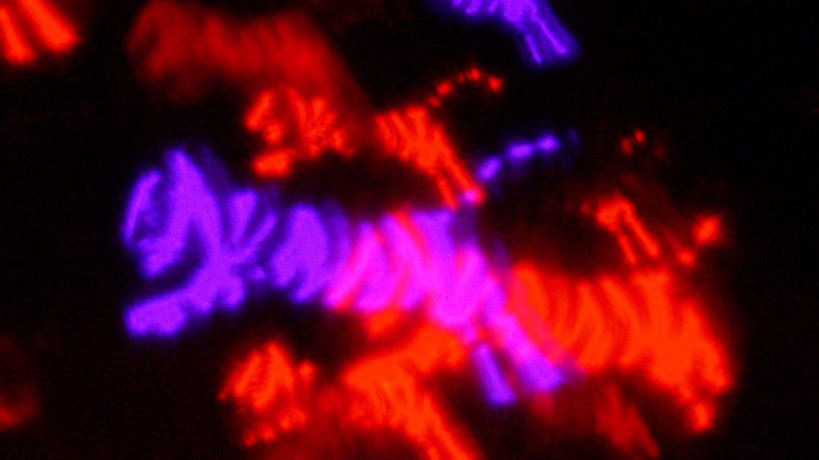
Today’s image was inspired by the appearance of both panther and jaguar during Friday Gathering. I used the tiger filter I created for this year’s Fourth of July fireworks with the lights I set up for “shame” yesterday, and started thinking about fear as predator, stalking.
Welcome back for the fourth day of Writober. Today, all our prompts will continue to explore the universal fear of Ego death: the loss of subjective self-identity by looking at fear of failure.
Fear of Failure by Maria L. Berg 2024
Fear of failure can stop us from even starting, which of course is failure in itself. A terrible cycle that can be completely debilitating. But, failure is a part of learning and growing. That’s why the saying, “Try. Fail. Try again. Fail again. Fail better.” (attributed to Samuel Beckett) is so well known.
Fighting Fear of the Blank Page: When we want to write, sometimes the blank page stares back like a judgemental enemy or a white-washed wall. But what if you set out to not write anything on the page?
Intend to fill the page with jibberish: Get to the page with the full intent to only write jibberish and nonsense. How long can you keep it up before you accidentally write something interesting?
*Quick Note about links in this post: I am an amazon associate, so most of the links in my post will take you to amazon products. If you buy from these links, I will make some pennies which will help me pay for this site and my creative endeavors.
OctPoWriMo
Poetry Toolbox
These are quick exercises that I hope you’ll do every day. We will build on these exercises throughout the month.
Word list: Write down the first ten words you think of when you think of fear or shame. Any words at all. Anything that comes to mind. Then choose your three favorite. Mark their stresses and duration. Say the words aloud. Do you notice any inharmonious sounds? (Inspired by Frances Mayes’ list of a hundred favorite words in The Discovery of Poetry)
I created this Excel Spreadsheet for you to use to collect and explore your fear words.
Sensory Imagery: In your journal or a word processing file, fill in these lines as quickly as you can with something different from yesterday. You may want to revisit one or two in more detail if you’re inspired and have time.
According to Jeff Mock in his book You Can Write Poetry, cacophony is “a combination of sounds that grate on the ear” like the harsh and jarring j, x and k sounds in “When Ajax strives some rock’s vast weight to throw” from Alexander Pope’s long poem,” An Essay on Criticism.” Cacophony can achieve dramatic results. Another example of cacophony Mock gives is the double k sound of “black flak.”
To achieve cacophony in your writing use explosive consonant sounds like “kuh” and “koff” close together. Other sounds to use include: “C”, “CH”, “Q”, and “X”.
Today’s example poem, copied here for educational purposes from hplovecraft.com, is Nemesis by H. P. Lovecraft.
Nemesis
Thro’ the ghoul-guarded gateways of slumber, Past the wan-moon’d abysses of night, I have liv’d o’er my lives without number, I have sounded all things with my sight; And I struggle and shriek ere the daybreak, being driven to madness with fright.
I have whirl’d with the earth at the dawning, When the sky was a vaporous flame; I have seen the dark universe yawning, Where the black planets roll without aim; Where they roll in their horror unheeded, without knowledge or lustre or name.
I had drifted o’er seas without ending, Under sinister grey-clouded skies That the many-fork’d lightning is rending, That resound with hysterical cries; With the moans of invisible daemons that out of the green waters rise.
I have plung’d like a deer thro’ the arches Of the hoary primordial grove, Where the oaks feel the presence that marches And stalks on where no spirit dares rove; And I flee from a thing that surrounds me, and leers thro’ dead branches above.
I have stumbled by cave-ridden mountains That rise barren and bleak from the plain, I have drunk of the fog-foetid fountains That ooze down to the marsh and the main; And in hot cursed tarns I have seen things I care not to gaze on again.
I have scann’d the vast ivy-clad palace, I have trod its untenanted hall, Where the moon writhing up from the valleys Shews the tapestried things on the wall; Strange figures discordantly woven, which I cannot endure to recall.
I have peer’d from the casement in wonder At the mouldering meadows around, At the many-roof’d village laid under The curse of a grave-girdled ground; And from rows of white urn-carven marble I listen intently for sound.
I have haunted the tombs of the ages, I have flown on the pinions of fear Where the smoke-belching Erebus rages, Where the jokulls loom snow-clad and drear: And in realms where the sun of the desert consumes what it never can cheer.
I was old when the Pharaohs first mounted The jewel-deck’d throne by the Nile; I was old in those epochs uncounted When I, and I only, was vile; And Man, yet untainted and happy, dwelt in bliss on the far Arctic isle.
Oh, great was the sin of my spirit, And great is the reach of its doom; Not the pity of Heaven can cheer it, Nor can respite be found in the tomb: Down the infinite aeons come beating the wings of unmerciful gloom.
Thro’ the ghoul-guarded gateways of slumber, Past the wan-moon’d abysses of night, I have liv’d o’er my lives without number, I have sounded all things with my sight; And I struggle and shriek ere the daybreak, being driven to madness with fright.
In this poem, Lovecraft’s speaker appears to be stuck in perpetual darkness. Is it due to fear of failure to to survive the light? 🎃 Notice the cacophony throughout: like cave-ridden/bleak/ fog-foetid/ooze/hot cursed tarns all in the fifth stanza.
Today’s poem: Write a poem that explores the fear of failure using cacophony.
Form: If you’re looking for more of a challenge, write a poem in as many five line stanzas as you would like where the first four lines are two rhyming couplets and the fifth line is a repeating refrain (aabbX, ccddX, eeffX, etc.).
Writober Flash Fiction
Write a story with a beginning, middle, and end with conflict that leads to change in less than a thousand words (no minimal word count) inspired by one of the images in the Ego death folder of the Writober 2024 Pinterest board. How does fear of failure affect your character?
NaNo Prep
Now that you have some ideas for your main character, it’s time to think about the opposition. The antagonist is the character whose goals are counter to your MC’s. The antagonist stops your MC from reaching his r her goals whenever possible, creating conflict and raising the stakes.
What is your antagonist’s goal? How is it in opposition with your MC’s mail goal?
What is your antagonist’s wound that warps her/his point of view? What happened? When did it happen? How does it show itself in the character’s behavior?
What is your antagonist’s strength? How can it become a flaw?
What is your antagonist’s deepest secret? The one he or she would do anything to keep hidden? What would happen if it ever came to light?
We’ll be working on our characters for a while, so just sit with your antagonist and brainstorm what would make him or her the most interesting to you.
You may want to set a timer for fifteen minutes and write as your character. Let him/her answer the questions above. Or you may want to imagine you’re interviewing your character.
Look for images of your character. For fun you can cut parts of people out of old magazines and make a collage of your character, or play around in photoshop or GIMP (free photo manipulation software) to create how your character looks.
Halloween Photography Challenge
Take a photograph that depicts failure, fear of failure, or how to deal with fear of failure and link to your photo in the chat.
Get Moving
Now that you’ve read all the prompts and have all these ideas running around in your head, it’s time for motion. It may seem counter-intuitive, but while you are moving, your mind will still be working on your ideas while you are busy doing something else. Write down some quick notes, your initial thoughts from the prompts and then get your body moving in any way you can that you enjoy. I’ve been a member of Masterclass for years. Masterclass has some movement classes I’ve enjoyed. I recommend:
These days are flying by. There’s never enough time for everything I want to do. What a shame. Here are my responses to the Writober Day 3 prompts in Sounds of Words: Assonance and Consonance.
OctPoWriMo
For today’s poem, I looked at my entire wordlist so far looking for assonance and consonance and found the “ea” sound of “fear” was dominant for assonance, and “r” and “s” sounds were dominant for consonance. So I focused on those for my pantoum.
No Shame In
Wilted flowers decaying in a vase terror-sharing death’s impression, reek like the streets after the flood recedes but don’t whimper or moan their shame.
Terror-sharing death’s impression, ripe tomatoes squirt seeds down your throat. They don’t whimper or moan their shame but whine of a red-rash abrasion.
Pierced tomatoes squirt seeds down your throat being obscene while fleeing. A healthy gag reflex is a sign of being evolved. Some say a bed of nails is comfortable.
Being obscene while fleeing a scene, may reek like the streets after the flood recedes. Some say a bed of nails is comfortable while wilted flowers decay in a vase.
Writober Flash Fiction
Filled With Shame
Janice threw down her pen. She paced the room then stared down at the street through the window. Each face that looked up was a friend she had been missing since the hurricane, but she was now on the other side of the country, and they were most likely dead. She wanted to yell down, see their smile of recognition, run down to them, hug and kiss them. But rationally, she knew. She knew it wasn’t anyone she knew.
Turning from the window, ashamed that she couldn’t move on, she picked up her pen and sat back at her desk which she had covered in a large sheet of butcher-paper. For months she had imagined her thoughts, any good or interesting thoughts, escaping out the top of her head before she could think them. For the last week she collected blackberry vines. Now, she wrapped the vines around her head. The pain of the thorn-pricks were at least something compared to the numbness she felt for so long. The thorns will catch those words that keep slipping her mind, and create a trap for her thoughts, she thought.
When she couldn’t get her words onto the page, she blamed her pens, started breaking them open and collecting their piddly drips of ink. It grew into a calming obsession. She took a piece of linen and dipped it in a bowl of black ink, then pressed the blindfold to her eyelids and tied it behind her head. The ink spread on her forehead and dripped down her cheeks. Her eyes would no longer betray her. Now she could really see.
For so long every breath had felt poisoned, her whole body full of a filthy black smog, like the smell of death lived inside her. “Something has to change, I can’t go on like this.”
Janice put her pen on the paper, and while she blindly wrote, she opened her mouth to let the black cloud of shame escape her lips.
It tasted like the smell of excrement. She gagged as the dark, smoke thickened and flowed. It smelled sickly sweet like dying roses in stagnant water. Janice wrote and wrote, words finally flowing as she emptied. Elated, impassioned, she tore off her blindfold, shook off her thorn cap, and jumped from her chair to dance in her ecstasy, but then she saw it.
The filthy black smoke had taken form and was sitting in the corner staring at her. It started saying everything she had been telling herself, but tried not to hear. “Why did you live when so many better people died? What good are you if you can’t even get back to work? You’re just a burden now.”
She could feel again, and each thing the shame said crescendoed an aching pain into a screaming agony. It would not stop. It followed her everywhere providing crueler and crueler judgment that she couldn’t refute because they were the things she believed.
Janice was back to work. Her critics raved that her art writhed with pain. Her blurbs said, “So relatable and full of feeling, I could not stop crying.” Every moment of every day, Janice wished she could be numb again.
Halloween Photography Challenge
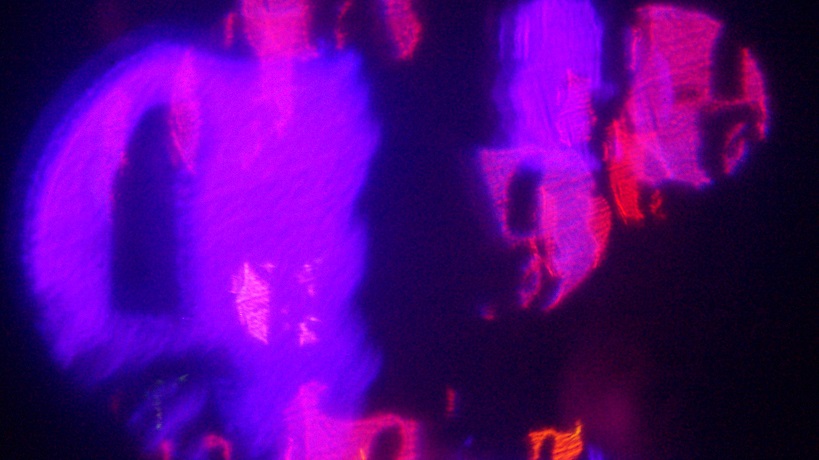
For today’s image, I used the colors that I thought of when I asked myself “What color is shame?” magenta and puce. To do this I set my fairy lights to a pinkish purple hue and draped my purple LEDs that my digital camera has trouble reading over them. Then I cut suggestive shapes out of the egg cut-out leftover from yesterday and pasted them onto iridescent clear plastic for my filter.
I’m really enjoying what you’re sharing. Congratulations on making it to day three. Keep up the good work/fun and come back tomorrow!
Welcome back for the third day of Writober. Today, all our prompts will continue to explore the universal fear of Ego death: the loss of subjective self-identity by looking at shame.
Shame by Maria L. Berg 2024
“According to philosopher Hilge Landweer of the Free University of Berlin, certain conditions must come together for someone to feel shame. Notably, the person must be aware of having transgressed a norm. He or she must also view the norm as desirable and binding because only then can the transgression make one feel truly uncomfortable. It is not even always necessary for a disapproving person to be present; we need only imagine another’s judgment.” (Scientific American)
Some people feel shame more readily than others, a trait that has been termed “shame-proneness.” There are two types of shame “State shame” and “Trait shame.” State shame is a temporary reaction to an event. Trait shame is a consistent feeling of shame often due to trauma.
To combat shame we need to learn to separate what we do from who we are. We can’t let our mistakes define how we see ourselves.
Fighting Fear of the Blank Page: When we want to write, sometimes the blank page stares back like a judgemental enemy or a white-washed wall. But what if the page isn’t blank to start with?
Write in different directions: Try crumpling up a piece of paper and flattening it back out. Write along all the lines created by the crumpling. Let your words flow all over the page in every direction.
*Quick Note about links in this post: I am an amazon associate, so most of the links in my post will take you to amazon products. If you buy from these links, I will make some pennies which will help me pay for this site and my creative endeavors.
OctPoWriMo
Poetry Toolbox
These are quick exercises that I hope you’ll do every day. We will build on these exercises throughout the month.
Word list: Write down the first ten words you think of when you think of fear or shame. Any words at all. Anything that comes to mind. Then choose your three favorite and say them aloud a few times until you hear the accented and unaccented syllables (if more than one syllable) and notice the duration of each syllable. Do any of the words have the same vowel sounds? (Assonance) or the same consonant sounds (Consonance)? (Inspired by Frances Mayes’ list of a hundred favorite words in The Discovery of Poetry)
I created this Excel Spreadsheet for you to use to collect and explore your fear words.
Sensory Imagery: In your journal or a word processing file, fill in these lines as quickly as you can with something different from yesterday. You may want to revisit one or two in more detail if you’re inspired and have time.
Assonance is the repetition of vowel sounds in words that are close to each other in a sentence or phrase. Example: “Who gave Newt and Scooter the blue tuna?” (from litcharts.com)
Consonance is the repetition of consonant sounds. Example: “”Zach sneezed when he heard jazz music.” (from litcharts.com)
Today’s example poem, copied here for educational purposes from Poem Hunter, is Being But Men by Dylan Thomas.
Being but men, we walked into the trees Afraid, letting our syllables be soft For fear of waking the rooks, For fear of coming Noiselessly into a world of wings and cries.
If we were children we might climb, Catch the rooks sleeping, and break no twig, And, after the soft ascent, Thrust out our heads above the branches To wonder at the unfailing stars.
Out of confusion, as the way is, And the wonder, that man knows, Out of the chaos would come bliss.
That, then, is loveliness, we said, Children in wonder watching the stars, Is the aim and the end.
Being but men, we walked into the trees.
In this poem, Thomas talks about fears of adults that children don’t have. How children are full of wonder while the men are afraid. Notice all the different “o” sounds in the third stanza. The assonance of confusion/wonder/chaos. And the consonance of way/wonder/would and confusion/chaos/come.
Today’s poem: Write a poem about what you would do if you had never known shame. What would you do as a child, that you won’t as an adult because you know it to be shameful?
Form: If you’re looking for more of a challenge, write a pantoum. “The pantoum is a poem of any length, composed of four-line stanzas in which the second and fourth lines of each stanza serve as the first and third lines of the next stanza. The last line of a pantoum is often the same as the first.” (poets.org) Use consonance and/or assonance in your repeating lines.
Writober Flash Fiction
Write a story with a beginning, middle, and end with conflict that leads to change in less than a thousand words (no minimal word count) inspired by one of the images in the Ego death folder of the Writober 2024 Pinterest board. How does shame skew your character(s)’s point of view (POV)?
NaNo Prep
Now that you have the idea for your novel, let’s start looking at the main character. This is a person you’ll be spending all your time with for a very long time, so make it someone you find fascinating. Your main character can be absolutely anyone, so give him or her traits that you admire. In Writing the Breakout Novel, Donald Maass recommends giving your MC characteristics of your personal heroes.
What is your character’s wound that warps her/his point of view? What happened? When did it happen? How does it show itself in the character’s behavior?
What is your character’s flaw? How can it become a strength.
What is your character’s deepest secret? The one he or she would do anything to keep hidden? What would happen if it ever came to light?
We’ll be working on our characters for a while, so just sit with your character and brainstorm what would make your character the most interesting to you.
You may want to set a timer for fifteen minutes and write as your character. Let him/her answer the questions above. Or you may want to imagine you’re interviewing your character.
Look for images of your character. For fun you can cut parts of people out of old magazines and make a collage of your character, or play around in photoshop or GIMP (free photo manipulation software) to create how your character looks.
Halloween Photography Challenge
Take a photograph that depicts shame, fear of shame, or how to deal with shame and link to your photo in the chat.
Get Moving
Now that you’ve read all the prompts and have all these ideas running around in your head, it’s time for motion. It may seem counter-intuitive, but while you are moving, your mind will still be working on your ideas while you are busy doing something else. Write down some quick notes, your initial thoughts from the prompts and then get your body moving in any way you can that you enjoy. This summer I got a lot of exercise playing sports on my Xbox 360 with my nephew. Some suggestions:
Kinect Sports. I really enjoy the bowling and boxing. I have these fun weighted gloves for boxing to give a little extra resistance. My nephew really enjoyed the volleyball, and we both like track and field.
Just Dance. There are so many songs to choose from and you forget you’re even exercising as you try to match the moves.
Don’t forget to come back and post a link your work in the comments.







 Experience Writing