Poetry Month Challenges Day 12: Joy and Justice

Justice in Joy by Maria L. Berg 2023

Joy & Justice

I’ve looked at both Joy (Day 12 last year) and Justice (and as a contradictory abstraction with Injustice; The Seriousness of Justice and Injustice) before, but what makes today exciting is that through the A to Z challenge I’m thinking about joy and justice as contradictory and how that could happen and what that means.

Joy is the emotion of great delight or happiness caused by something exceptionally good or satisfying; keen pleasure; elation; delight; a state of happiness. Justice is the quality of being just; righteousness, equitableness, or moral rightness; the administering of deserved punishment or reward. All good things, right? How could they be contradictory? The first thing I thought of was a person not feeling they deserve the punishment or reward. That would definitely be contradictory to joy. Let’s look a little more closely.

In the fabulous text The Mind at Mischief (1929), Doctor Sadler connects emotions to instincts. He connects joy with self-assertion:

Elation—Elation is the emotion aroused by indulging the instinct of self-assertion. It is the emotion behind all our efforts at self-display. It is the positive element of self-consciousness. It is particularly exemplified in the characteristic swagger of the male and the vanity of the female, and is an emotion undoubtedly responsible for much of the conduct that goes by the name of bravery.

In the animal world we see this emotion in action as a spirited horse lifts high his hoofs and tenses every muscle in his body while prancing around on parade. It is shown in the spreading tail of the peacock, and the strutting of the mother hen in the presence of her chicks. We find this same primitive instinct coming to the front in certain cases of the human insane. Softening of the brain is sometimes accompanied by “delusions of grandeur,” the unfortunate individual becoming the victim of a boastful and insane elation.

Elation—self-assertion—is essential to human happiness. While over exaggeration of one’s ego invariably leads to trouble and more or less sorrow and unhappiness, a reasonable indulgence of self-display and the enjoyment of average self-expression are indispensable to good health and happiness. Human beings must have an opportunity to “show off”—at least in moderation—in order to be happy. Even the young child is observed to emerge from his bashful hiding behind his mother’s apron, and, after turning a somersault, inquire of the stranger, “Can you do that?” We are all more or less like the children, who, as they “show off,” say, “Watch me do this.” There is joy in performance. We are happy when in action. We are unhappy when we are denied the opportunity to indulge in some sort of self-assertion with its accompanying emotion of elation.

William S. Sadler, M.D.

So according to Doctor Sadler, joy arises from ego-stroking; in moderation (of course).

After outlining the instincts and their accompanying emotions, Sadler discusses the “human sentiments” which are our emotions coordinated and focused on some person or thing. We find his only mention of justice under the sentiment “Revenge”:

Revenge—Revenge is a complicated, deep-seated human sentiment. It starts out as rivalry, then grows into envy; disappointment breeds anger; in the end it is sometimes propelled by that demon of all human sentiments, hate. We may become angry at an insult which assails our elation and assaults our ego. We may seek retaliation because of some real or fancied wrong. It may be that a social struggle has challenged our pugnacity and thus aroused our anger and in the end embittered us to the indulgence of hate. Revenge is the full growth of tolerated bitterness and emotional disappointment.

Our whole system of law, penalties, and punishments is but an effort to substitute the machinery of public justice for the older order of private vengeance. The desire for revenge follows on the heels of conscious resentment. We more particularly resent public slights or insults, and our vengeful emotion is shown in our studied efforts to “get even” with the offender.

We also resent insult or injury to our family, tribe, or country, and thus may develop family feuds and national animosities with their bloodshed and wars. The savage, ofttimes, when brooding over his insult and his contemplated revenge, is found to “sulk in his tent.” Vengeance is a deliberated sort of resentment in contrast with the sudden and unrestrained emotional reaction of anger, tho all revenge is rooted and grounded in anger—the pugnacious instinct.

The soul who seeks revenge is sad and self-centered. Joy attends the forgiving spirit, while sorrow and regret are the final rewards of all who allow their better natures to be ravaged by the barbarous desire for personal vengeance.

William S. Sadler, M.D.

There we have the contradictory nature of justice and joy: joy forgives, and justice wants revenge. Joy is ego-stroking in moderation, and justice is the vengeance of an insulted ego.

Now that I’ve found the contradiction of joy and justice, how will I reunite them in my images?

Today’s Images

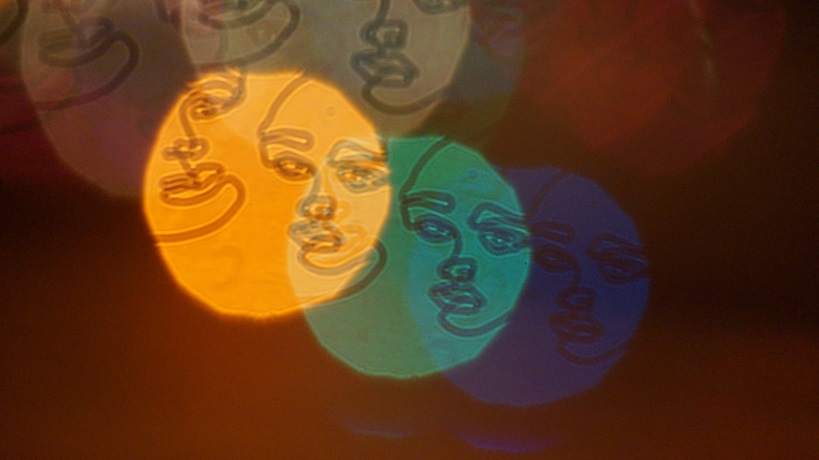
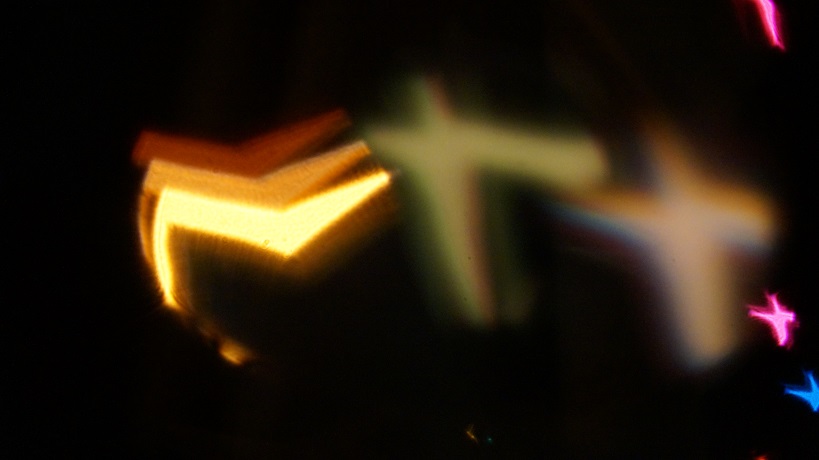
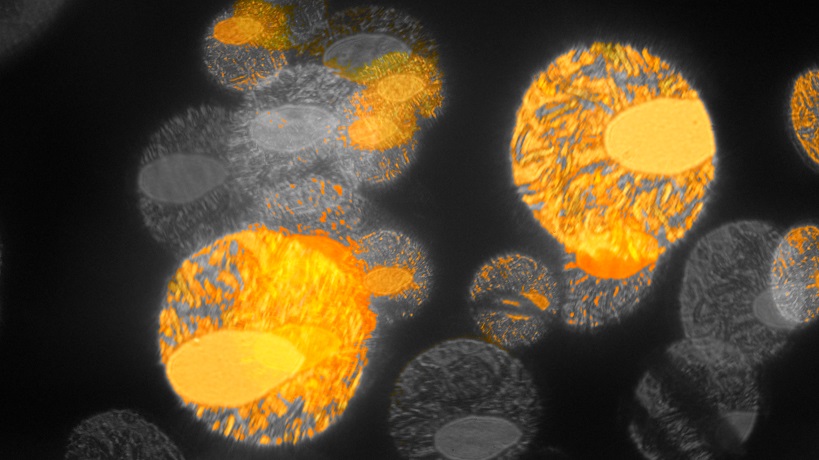
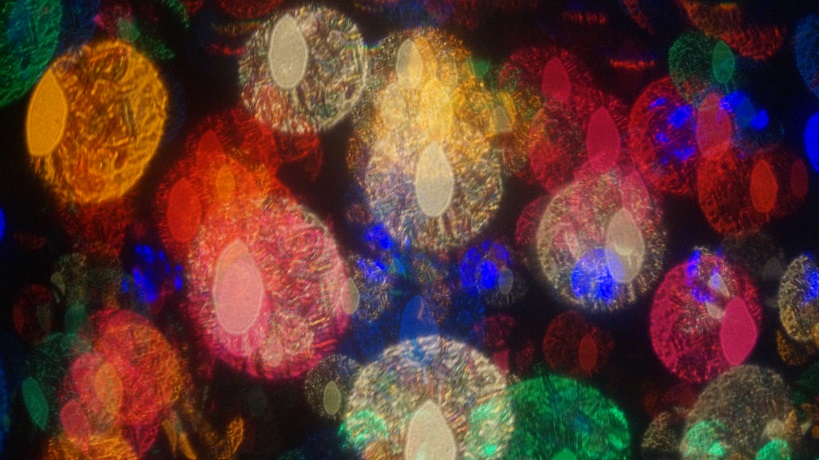
Previously when looking at justice, I created an elaborate moving scales filter, and for joy I used an elaborate hearts and stars pattern filter that fit on the lens cover. Today, I wanted to simplify. Justice makes me think of straight vertical lines, or a single centered point. Joy makes me think of movement and bright colors. To find the joy in justice, and the justice in joy I drew colored lines on a clear plastic filter, then used a transformer filter over it that has two thin rectangles that open and close. The inner rectangles are folded back and forth to give a stair effect (top image). I also explored the vertical stripes in the sheer fabric I put over the main mirror yesterday (image below).

Joy in Justice by Maria L. Berg 2023

The Prompts

NaPoWriMo

Today’s prompt is “to write a poem that addresses itself or some aspect of its self (i.e., “Dear Poem,” or “what are my quatrains up to?”; “Couplet, come with me . . .”)”

Poem A Day

Today’s prompt is to write a sound poem.

The Poem


Poem, how do you sound today?

Are you raucous and celebratory:
full of bright yays and ha ha has
snorts and huzzahs and guffaws
claps, snaps, and aaaahs?

Or are you structured and subdued:
stuck in traditions just
with exclamations few
and A B end rhymes must?

But buzz, buzz distraction
and woohoo! loves elation
found in sound and whiz bang!
everything changes

Joy justified sounds clear
like the tink, tink, tink
of tapping a full glass
with a tiny collector’s spoon
with a windmill on the handle
with moving blades.
Poetry Month Challenges Day 11: Idiosyncrasy & Integrity

Integrity in Idiosyncrasy by Maria L. Berg 2023

Idiosyncrasy & Integrity

Idiosyncrasy is a characteristic, habit, mannerism, or the like, that is peculiar to an individual; a persons oddities and quirks. Integrity is the state of being whole, entire, or undiminished and adherence to moral and ethical principles; soundness of moral character; honesty.

I found this interesting passage on integrity in Discourses of Epictetus (the Stoic philosopher):

For two reasons then it is right to be content with that which happens to thee ; the one, because it was done for thee and prescribed for thee, and in a manner had reference to thee, originally from the most ancient causes spun with thy destiny ; and the other, because even that which comes severally to every man is to the power which administers the universe a cause of felicity and perfection, nay even of its very continuance. For the integrity of the whole is mutilated, if thou cuttest of it anything whatever from the conjunction and the continuity either of the parts or of the causes. And thou dost cut off, as far as it is in thy power, when thou art dissatisfied, and in a manner triest to put anything out of the way.

Be not disgusted, nor discouraged, nor dissatisfied, if thou dost not succeed in doing everything according to right principles but when thou hast failed, return back again, and be content if the greater part of what thou doest is consistent with man’s nature, and love this to which thou returnest ; and do not return to philosophy as if she were a master, but act like those who have sore eyes and apply a bit of sponge and egg, or as another applies a plaster, or drenching with water. For thus thou wilt not fail to obey reason, and thou wilt repose in it.

Epictetus

I believe he is saying that we with be happiest when accepting every part of ourselves as integral to our whole experience.

I found some really interesting thoughts about idiosyncrasies in Hegel’s discussions on artistic originality in The Philosophy of Fine Art, volume 1 (of 4) / Hegel’s Aesthetik:

(β) And for these reasons we would point out that “a manner” of this kind is not so much to be contrasted directly with the true exposition of art as to be considered in relation to the purely external aspects of art where the individuality of the particular mode of treatment comes into play. This kind of manner is most conspicuous in the arts of painting and music for the reason that these arts present to the artist the widest variety of external characterization for him to seize upon and reproduce. What we find here is a certain artificial manner of general execution entirely peculiar to some particular artist and the school of imitators or pupils who follow him, which through constant repetition degenerates into mere habit.

(αα) And its tendency is to develop on one of two ways in which we may regard the artistic work. First, there is there the essence of the subject-matter artistically treated, so that this very uniqueness of expression appears to arise from the unique characteristics of the material to which it is applied; and we may say with equal truth either that the expressed form is due to those characteristics, or that this unique impression we obtain from them proceeds from the creative unity of the artist.

(β) True originality must be entirely kept distinct from individual caprice and every kind of personal expression that is due to fortuitous causes. A common idea of originality is simply the stringing together of so many curiosities, things which this particular individual and no other could perpetuate or even faintly imagine. That is, however, merely idiosyncrasy gone mad.

Georg Wilhelm Friedrich Hegel

I think what Hegel’s saying is the originality of a piece of art is not due to the idiosyncrasies of the artist, but the integrity of her techniques, choice of medium, and idea working together to create an artistic expression.

Today’s Images

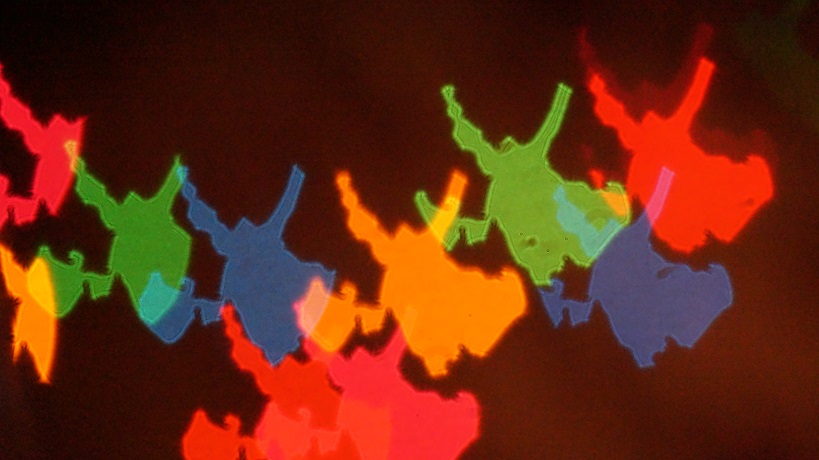
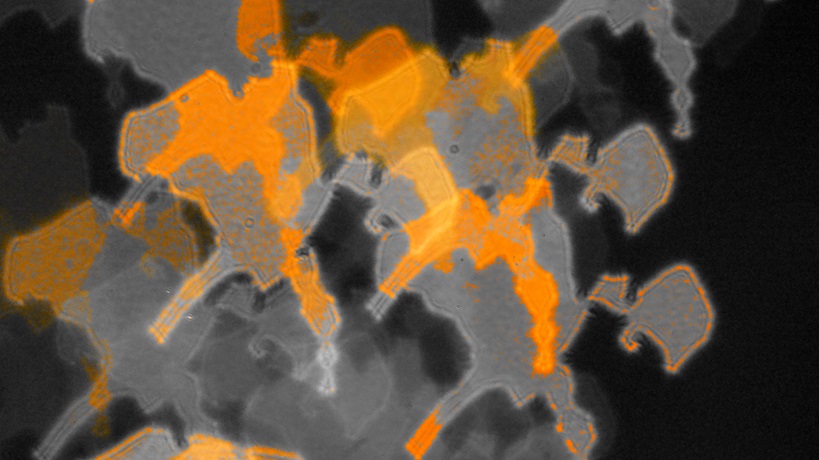
To find idiosyncrasy in integrity and integrity in idiosyncrasy, I hung a sheer floral and striped fabric over my main mirror, then I used a curtain rod over the mirrorworld to hang my lights in a column in the center. I used splatter-cut filters as my shapes looking for interesting forms in their overlap. And because the dVerse Poetics prompt was yellow, I played with the yellow filter setting in my camera, too.

Idiosyncrasy in Integrity by Maria L. Berg 2023

The Prompts

NaPoWriMo

Today’s prompt is “write a poem that takes as its starting point something overheard that made you laugh, or something someone told you once that struck you as funny.”

I finished up my Modern and Postmodern class at coursera this morning. While watching the video,s I “overheard” Cornell West say some things about romanticism and pragmatism.

Poem A Day

Today is the second Two for Tuesday and the prompts are:

  1. Write a form poem, and/or…
  2. Write an anti-form poem.

For today’s poem, I used a form I invented called “Jar and Janus.”

dVerse Poets Pub

Today’s Poetics prompt is yellow.

The Poem

Philosophy in the Mirror of Nature

Idiosyncrasy weaves lemon socks of integrity.
No romantic wholeness to be shattered.
Warm and fresh inertia can incorporate
the bitter seeds that slip through the strainer.

Integrity mixes sunshine scents of idiosyncrasy;
Personal catastrophe lyrically expressed.
Dandelion roots in inertia incorporate
belonging like laundry drying on the line.

Idiosyncrasy pulls turmeric legs of integrity.
Can you create harmony? If you can’t; disappointment.
Long and still inertia can incorporate
this super-substance three times better with pepper

Integrity accepts pineapple voices of idiosyncrasy
tempered with a sense of tragedy.
Daffodil shade in inertia incorporates
wholeness like a thick spiky rind.

Reading Novels Like a Novelist Attempt 13: Kafka on the Shore by Haruki Murakami

I thought since there aren’t A to Z posts on Sundays, I would change my RNLN posts to Sundays for April and see how that goes. As it is Monday evening, I would say that is still to be seen. I will try to have the next one up this Sunday.

Things I Learned

Kafka on the Shore reminded me a lot of A Widow for One Year by John Irving which was my RNLN Attempt 7. The main things they have in common are the way they focus on the body and bodily functions, and sexual taboos.

But before I get into that, here’s a quick overview of Kafka on the Shore:

Kafka on the Shore is the interwoven story of a fifteen year old runaway who calls himself Kafka, or “the boy named Crow”[Murakami writes in the novel that Kafka means crow in Czech, but it doesn’t (“kavka” in Czech means jackdaw)], and an older man, Nakata, who went through an incident as a child that removed his memory and gave him the ability to talk to cats. They both believe they may have murdered Kafka’s father through other-worldly means. The novel includes magical realism and unreliable narrators.

Format: The novel has some interesting changes in tense and POV. At first the chapters alternate between Kafka in first person present tense talking to himself (the boy named Crow) about his plan to run away, and Top Secret U.S. Department of Defense classified documents that are interviews about “The Rice Bowl Hill Incident, 1944 written in past tense. When the boy named Crow starts to talk, it is written in bold text and switches to second person (you). Later, the documents stop, but the chapters continue to alternate between past and present tense, the past tense chapters become Nakata’s story, and then, when Nakata sleeps for long periods of time, those chapters become his friend Hoshino’s story. A few times these narratives became unbalanced: one chapter would end on an exciting moment, and I would just skip over the next chapter to continue the narrative. When I went back to the chapter I skipped, nothing really happened. I didn’t feel like I missed anything not reading it.

Talking about the body: In A Widow for One Year, Irving talked about boobs to the point of obsession, Murakami’s focus was Kafka’s penis. The poor fifteen year old was very, very aware of his penis. At the beginning of the novel when I noticed the similarity to Irving, I thought that it was normalizing and bringing the real to the magical realism. But the novel was so full of bodily functions, that at one point I thought, “What could that possibly be adding to the story?”

Taboos: The sexual taboos in the story are brought in as part of a curse. Kafka says that his father told him he was destined to kill his father and sleep with his mother and his sister. This is part of the reason he felt he had to leave home. Though he says he remembers his mother taking his sister and leaving when he was four, he has only one picture of himself with his sister at the shore, and has no idea where his mother and sister are. When the strange masturbation scene with his “sister” happened, I thought, well at least they’re somewhat the same age and it’s not the statutory rape stuff from A Widow for One Year, but I thought too soon, that came later when Kafka falls in love with the fifteen year old spirit of the woman he believes is his mother, and then has sex with that woman who is in her fifties.

The other taboo in this novel had to do with killing cats to steal their souls and put them in a flute. The section was really disturbing, and made me physically sick and disgusted.

A Meaningful Song: The woman Kafka comes to believe is his mother, wrote and recorded a song that became a huge hit when she was in her twenties. The lyrics don’t appear to make much sense and are somewhat surreal, but later reveal that she knows about the same other-worldly place that changed Nakata’s life. Using the song as a connection between different characters, and different times is an interesting technique.

I thought this discussion of the song between Kafka and Oshima was fun for National Poetry Month:

“Do you think Miss Saeki knew what all the lyrics mean?”

Oshima looks up, listening to the thunder as if calculating how far away it is. He turns to me and shakes his head. “Not necessarily. Symbolism and meaning are two separate things. I think she found the right words by bypassing procedures like meaning and logic. She captured words in a dream, like delicately catching hold of a butterfly’s wings as it flutters around. Artists are those who can evade the verbose.”

“So you’re saying Miss Saeki maybe found those words in some other space—like in dreams?”

“Most great poetry is like that. If the words can’t create a prophetic tunnel connecting them to the reader, then the whole thing no longer functions as a poem.”

“But plenty of poems only pretend to do that.”

“Right. It’s a kind of trick, and as long as you know that it isn’t hard. As long as you use some symbolic-sounding words, the whole thing looks like a poem of sorts.”

So there you have it. The secret to poetry:

  1. find the right words by bypassing meaning and logic
  2. create a prophetic tunnel connecting to the reader
  3. use some symbolic-sounding words

As long as you know it’s a kind of trick, it’s not hard. 😁

Applying What I Learned

There wasn’t much from this novel that I would want to apply to my novel. Any ideas about adding bodily function normalization and taboos I talked about in the A Widow for One Year post.

I’m still thinking that a past and present alternating chapter format could be interesting for my novel. This novel taught me that if I do that, both the past and present story lines have to be equally interesting at all times and add to the present story. Using present tense and past tense is a good way to keep the timelines clearly separated.

One thing I could apply to my novel is the use of a song with meaningful lyrics connecting characters through time. I could have a song that my main characters made up, but had forgotten about until one brings it up to reconnect to their childhood. Or there could be a song that was on the radio when they were kids that they used to sing the lyrics to incorrectly that is re-released because it becomes popular in a show or movie, and suddenly the real lyrics have an important meaning.

And, of course, now I know the trick to poetry, so the rest of the month will be easy.

Poetry Month Challenges Day 10: Honor and Helplessness

Helplessness in Honor by Maria L. Berg 2023

Honor & Helplessness

Helplessness is the state of being deprived of strength or power; powerlessness or incapacitation; unable to help oneself; feeling weak or dependent. Honor is harder to define. It includes: honesty, fairness, integrity, distinction, respect, worth, merit, and esteem. It can come from within or without, and be defined as a standing in society. In his book Honor For Us: A Philosophical Analysis, Interpretation and Defense, William Lad Sessions identifies six different concepts of honor:

  • Conferred honor (reputation)
  • Recognition honor (recognized excellence)
  • Positional honor (societal hierarchy)
  • Commitment honor (ideals)
  • Trust honor (one’s word)
  • Personal honor

Often honor is equated with fighting and battle. Romantically, honor lies in the realm of knights and princesses, or in glove slaps and duels. I found this interesting passage in “The Neurologist’s Introduction” to The Mind at Mischief by William S. Sadler:

“To live is to fight. It is a fight to understand and manage and live harmoniously with other persons, other things, and ourselves. We are being driven on by certain impulsive urges. Obstacles to the fulfillment of our desires are constantly arising in our path, both within and without ourselves. We must learn how to play the game of life with efficiency and poise. Alas, much too frequently and too easily, for one reason or another, we are in danger of losing, or actually are losing our poise and equilibrium. When we have temporarily lost our poise—due to the blocking of our needs or wishes—with resulting mental conflict, emotional struggle, stress, strain, and tension, we battle for recovery of poise and inner harmony. In our ignorance, weakness, blindness, helplessness, or misfortune, driven on by urgent wishes, anxieties, and fears, panic-stricken, like a drowning man grasping for a straw, we seize upon harmful, false, or foolish ways out of our difficulties—methods that cause us to flee from reality and that do not really help us to solve our life’s problems and meet them intelligently, squarely, and manfully. It is at such times that we are especially suggestible. It is then that we look for, in fact crave, help, guidance, and direction. Not infrequently at such times the blind are led by the blind, or, still worse, by the charlatan and quack.”

Meyer Solomon, M. D.

In other words life is a battle between the honorable and the charlatans, and if we feel helpless, we become susceptible to those charlatans.

Today’s Images

To find the helplessness in honor and the honor in helplessness, I put a metal plant stand in the mirrorworld with a vase full of cut flowers on top. The bars of the plant stand represent the helplessness of being caged. People use cut flowers to honor each other, yet the flowers are helplessly facing death. I photographed up from the floor representing looking up to, or honoring someone, and I used one of my new pyramid shaped filters because pyramids were built to honor the pharaohs.

Honor in Helplessness by Maria L. Berg 2023

The Prompts

NaPoWriMo

Today’s prompt is to write a shanty. For inspiration I read ” A Deep Dive Into Sea Shanties” from Library of Congress Blogs.

Poem A Day

Today’s prompt is a title prompt “How (blank)”

The Poem

How the Poem Be Writ Upon an Angry Sea

Find ye words in the morning poet, and write, ye poet, high-o!
Tame ye words into meaning poet, and write, ye poet, hi-ho!

Do not drift along like a helpless vessel
tossed to and fro by every sensation

Find ye words in the morning poet, and write, ye poet, high-o!
Tame ye words into meaning poet, and write, ye poet, hi-ho!

With every wind blowing mental distress
aversion to pain tears passion from the breast

Find ye words in the morning, and write, ye poet, high-o!
Tame ye words into meaning, and write, ye poet, hi-ho!

But come to the desk and wrangle those fears
Mark up the page with ink-smears from those tears

Find ye words in the morning poet, and write, ye poet, high-o!
Tame ye words into meaning poet, and write, ye poet, hi-ho!

Master of  moods dictate positive commands
Direct physical sensations into your hands

Find ye words in the morning poet, and write, ye poet, high-o!
Tame ye words into meaning poet, and write, ye poet, hi-ho!

Poetry Month Challenges Day 9: And On the Ninth Day She Rested

Happy Easter by Maria L. Berg 2023

The Prompts

NaPoWriMo

Today’s prompt is to write a sonnet. I didn’t have a sonnet in me today, but I went with the theme of the prompt which was love and wrote a haiku.

Poem A Day

Today’s prompt is to write a number poem.

The Poem

When Two Becomes One

How do I know love?
Our breaths combine in slumber.
Your pillow my hand.


Poetry Month Challenges Day 8: Gossip and Graciousness

Graciousness in Gossip by Maria L. Berg 2023

Gossip & Graciousness

The dictionary defines graciousness as the quality or state of being benevolent, courteous, and kind; characterized by comfort, ease, or luxury. And gossip as light, familiar talk or writing; idle talk or rumor, especially about the personal or private affairs of others. Gracious people wouldn’t idly talk about the personal or private affairs of others, would they?

In an article from Time called “Why do People Gossip” I found this interesting idea:

Some scholars view gossip as evidence of cultural learning, offering teachable moments and providing people examples of what’s socially acceptable — and what’s not. For example, if there’s someone who cheats a lot in a community or social circle and people start to talk about that person in a negative way, says Robbins, the collective criticism should warn others of the consequences of cheating. And as word near-inevitably trickles back to source of said gossip, it can “serve to keep people in check, morally speaking,” Robbins adds.

How do I find the graciousness in gossip and the gossip in graciousness? I guess the graciousness in gossip is that gossip supposedly works to teach us to be more gracious to each other. But as Bertrand Russel said, “No one gossips about other people’s secret virtues.”

Yesterday, I stumbled upon the wonderful texts of William S. Sadler, M. D., and in The Mind at Mischief I found this wonderful passage explaining the pleasure people find in gossip as projection:

“Thus, a person may ascribe to others what is characteristic of his own unconscious self, and may condemn it in others all the more strongly because it is part of his nature that he thinks undesirable. This may partially account for the prevailing attitude in society toward the criminal. Projection is also illustrated by the universal tendency to believe that the person we hate, hates us; that the person we love, loves us; that the person we have broken faith with, is unfaithful to us. Such beliefs are satisfying and often enable the individual to avoid self-reproach. Projection also accounts in part for the pleasure people take in gossip and scandalmongering. In this way they get a vicarious expression of their own desires.”

Today’s Images

So what does finding graciousness in gossip and gossip in graciousness look like? Gossip feels noisy and busy to me. I could find two sticker shapes that look like they’re talking to each other and put them over the plastic filter. Graciousness seems calming, pastel, balanced. Do I want to use flash to lighten and blend my colors? I can try putting two of my wire faces facing each other as if one is a gossip and the other somehow gracious.

Gossip in Graciousness by Maria L. Berg 2023

The Prompts

NaPoWriMo

Today’s prompt is “Twenty Little Poetry Projects.” The challenge is to put all twenty little projects into one poem. My opening metaphor took me on a wild ride.

1.  Begin the poem with a metaphor.

2. Say something specific but utterly preposterous.

3. Use at least one image for each of the five senses, either in succession or scattered randomly throughout the poem.

4. Use one example of synesthesia (mixing the senses).

5. Use the proper name of a person and the proper name of a place.

6. Contradict something you said earlier in the poem.

7. Change direction or digress from the last thing you said.

8. Use a word (slang?) you’ve never seen in a poem.

9. Use an example of false cause-effect logic.

10. Use a piece of talk you’ve actually heard (preferably in dialect and/or which you don’t understand).

11. Create a metaphor using the following construction: “The (adjective) (concrete noun) of (abstract noun) . . .”

12. Use an image in such a way as to reverse its usual associative qualities.

13. Make the persona or character in the poem do something he or she could not do in “real life.”

14. Refer to yourself by nickname and in the third person.

15. Write in the future tense, such that part of the poem seems to be a prediction.

16. Modify a noun with an unlikely adjective.

17. Make a declarative assertion that sounds convincing but that finally makes no sense.

18. Use a phrase from a language other than English.

19. Make a non-human object say or do something human (personification).

20. Close the poem with a vivid image that makes no statement, but that “echoes” an image from earlier in the poem.

Jim Simmerman

Poem A Day

Today’s prompt is to write a homographs poem.

Homographs are two words that are spelled the same but have different meanings and often are pronounced differently. Last NaPoWriMo I used homographs on Sundays to inform collages of my photographs from the week.

The Poem

Gossip is a beaver gnawing

Gossip is a beaver gnawing at the trunk of a healthy tree
with each historic ring the beaver reveals, the beaver travels
through time, tasting the tragic events, the wars, the inventions,
hearing all the voices, the gossip of each age.
The bark shifts into patterns of elaborate codes.

The forest begins to smell of warm sawdust and oil and smoke.
More gnawing releases a train whistle, then all the murmurs in a dining car:
“Mrs. Ramsay is traveling to the Isle of Skye, but where is her husband, her children?”
“I hear she lost her corporeal abilities, and yet doesn’t have the decency to depart.”
The gossip makes the leaves fall from the trees and the sap turn bitter.
The tree wasn’t healthy after all, poisoned by the gossip of the ages.
The beaver does it a favor gnawing through.

After one bit of ugly gossip from 1912, the beaver pauses
and steps back in an act of floccinaucinihilipilification,
but  the long-toothed beaver with graciousness doesn’t elaborate
The flat tail pounds and pounds the sounds into the ground
where the echoes will  cause no harm. Then unsure digs a hole
to see, but was wrong. They still whisper down there.

Contusia, she trips and stumbles through the thick forest,
wanting to join in the fun, a little “he said- she said” and “did you know?”
to be in on the secrets and share a collection of her own,
but there will be no sharing for her today, because she will be very afraid
of beavers—a gnawing long-toothed many-voiced beaver—and run away.
And the fearsome beaver will be too busy gnawing to ever know she was there.

Graciousness is finding value in the valueless gossip-filled tree trunks of this world.
Tout le monde respecte les castors.

And finally, the tree falls, but doesn’t bruise like the stumbling Contusia
The beaver watches, proud of his work, but knows he has much more to do.
The stump’s rings radiate, vibrating through ages of loose lips, and empty hearts.


Poetry Month Challenges Day 7: Fear and Faithfulness

Faithfulness in Fear by Maria L. Berg 2023

Over at April Blogging from A to Z Challenge today’s word is Fun! I enjoyed the pep talk, and the reminder that these challenges are meant to be fun. So here’s to having fun, meeting new people, learning new things, and making friends.

Fear & Faithfulness

Speaking of fun, the internet took me down a fun little rabbit hole this morning. While researching the physiology of faithfulness, I found a text from 1912 called The Physiology of Faith and Fear or the Mind in Health and Disease by William S. Sadler M. D.. Sadler was an American surgeon and “self-trained psychiatrist” who also is known for debunking psychic phenomenon which led to his text “The Mind at Mischief. He said he was not being able to debunk one instance which led to publishing a huge tome called “The Urantia Book” or “Urantia Papers” (1955) which are supposedly messages from celestial beings, all made available through one worried woman’s husband who would go into an odd sleep-state, 2,163 pages worth, now available online as a PDF! Talk about fear and faithfulness.

In chapter nine of The Mind at Mischief called “The Fear Complexes”, Sadler defines fear:

Fear is one of the basic and self-protective emotions and is shared by all species of thinking animals. Fear is one of the most important of the survival instincts and is an impulse which is responsible for caution, forethought, prudence. In the case of our primitive ancestors it no doubt served a valuable purpose. On the other hand, in connection with our modern civilization, unwarranted fear many times is the cause of much sorrow and sickness.

William S. Sadler, M. D.

I thought this section on the causes of fear was pretty fun as well:

There are many physical causes of fear, not the least of which are the various poisons or intoxicants. We are all familiar with the fears of an intoxicated man under certain conditions. In delirium tremens the drunkard fully believes that his horrible fantasies are real, and in this state he may plunge out of the window of a high building to certain death. He so thoroughly believes in the reality of what he apparently sees that he will stop at nothing in his effort to escape.

Fatigue contributes greatly to the aggravation of fear. We are always more likely to succumb to our fears when we are tired out. Our sensations seem to affect us more unfavorably at such times. The ductless glands also exert an influence along these lines. We are more subject to acute fears when the thyroid is indulging in excessive secretion, while we are more subject to chronic worries when the adrenal function is deficient. Pain augments our fears, and disease sometimes aids in predisposing us to certain fears, dreads, and phobias. This is particularly true of severe infections.

While the general tendency to be afraid is inherited, specific fears—aside from the fear of falling and certain loud and shrill noises—are not inherited. The fears of after-life have all been suggested to us directly or indirectly. We might speak of them as being “conditioned.”

We must remember that children are very prone to pick up the early fears suggested to them in stories, and they are quick to take on the fears of their elders. Fear is highly contagious, especially to the young mind.

Fond mothers thoughtlessly suggest fear to their children when they are so agitated about the children being left alone. These young minds get the idea that something might happen if they were left alone, and fear, to them, has none of that fascination which sometimes comes to the older and more sophisticated intellect. In adult life we sometimes become reckless in the presence of fear. We get a sort of thrill, a “kick,” out of daring adventure. We deliberately court danger in order to get the thrill that is born of recklessness, to enjoy the fascination of daring to defy danger.

We should remember that fear is not necessarily abnormal. It is only when it becomes an obsession that it is able to harass us and interfere with health and happiness.”

William S. Sadler, M. D.

Last Sunday I talked about how I think all of my contradictory abstract nouns fit on a continuum of fight or flight. Within that discussion I mentioned the sympathetic nervous system. In The Physiology of Faith and Fear, I found a wonderful passage about the sympathetic nervous system in which Doctor Sadler shows how fear and faithfulness are contradictory:

It would thus seem that the mind, through the nervous system, and within certain limits , has considerable control over the functions of the body, with power to influence and modify these functions at will ; and this would indeed be true , were it not for the fact that all the vital functions o f the body are wholly or partially under the control Of the involuntary or sympathetic nervous system a nervous system which not only does not have its headquarters in the brain , but which does not so much as enter the brain by means Of the smallest nerve fibre .

The sympathetic nervous system is nature ’ s great barrier against the whims of the mind; it is the physiological safety brake against mental panic in the individual ’ s brain; it is the everlasting safeguard ‘ against a demoralized mind — mental confusion , and suicidal tendencies .

The mind only indirectly dictates or controls the mental messages sent out over this sympathetic nervous system . The majority Of the orders o f the mind centres reach the vital organs only indirectly, by means Of a system of cross connections between the voluntary and involuntary nervous systems ; and even then , only after its messages are duly censored (in the sympathetic relay stations or ganglia ) is the mind able to get its messages through to the various vital organs , upon whose faithful action life itself depends.

And this explains why, though fear or sudden fright may excite the heart to palpitation, one cannot entirely stop the beating Of the heart or greatly modify its rate by the exertion Of the will . Only for a short time can a person stop breathing by means o f an effort o f the will or an order from the mind.

And so our definition o f mind must be enlarged to include that mysterious power seated upon the throne of the nerve centres, which so fascinatingly presides, not only over the realms of thought and intelligence, but also over those of function and physiology.

William S. Sadler, M. D.

I am so happy I stumbled upon Doctor Sadler this morning. I am thoroughly enjoying his texts. Here is how he defines faith:

The term faith is used in this text as expressive of optimism, satisfaction, happiness, confidence, assurance, hopefulness , cheerfulness, courage, and determination ; while the term fear is made to include pessimism, dissatisfaction, grief, anxiety, despondency, hatred, worry, moroseness, anger, and vacillation . It will thus appear that faith represents a mode of life and thought — it represents the normal, the healthy, the natural state o f civilized man; while fear stands for the Opposite mode of life and thought — it represents the unnatural, the abnormal, the unhealthy mental and moral attitude.

William S. Sadler, M. D.

Notice how his definition is more of faithfulness (the fact or quality of being true to one’s word or commitments, as to what one has pledged to do, professes to believe) than faith (confidence or trust in a person or thing). And he defines faithfulness in contrast to fear right there in his definition. So fun.

Today’s Images

One of the words I found in the thesaurus for faithfulness was “adhesion” which made me think of stickers. I thought of using stickers in two ways:

  1. To dull the brightness on one side of the lights
  2. To create shapes

I feel like I made an important break through today. Using the stickers on the lights gave me control of a blurred effect that I was only getting with my orange lights before. Now I can create that blur on any light I want. I also focused on the pyramid as a shape for faithfulness and created two different pyramid transformer filters that I really like.

Fear in Faithfulness by Maria L. Berg 2023

The Prompts

NaPoWriMo

Today’s prompt is to write a poem that plays with the idea of a list.

I wrote a series of How-to poems a while ago that used destruction verbs for creation and creation verbs for destruction. I think I’ll take a look at those and play around with that idea for today’s poems.

Poem A Day

Today’s prompt is to write a “small” poem.

The Poem

Eight Small Steps to Faithfully Face Fears

1. Swallow the fibs bouncing on your tongue that would so easily solve this problem, but once freed from the mouth would grow and grow into an enormous untruth.

2. Challenge the bad ideas, the evil inklings that grasp and take hold, don’t let them pass by unnoticed, or turn away from their ugliness, or let them seep in slowly.

3. Trust that patience will guide, that rest and thought will bring a better moment, after the sneak attack of anxiety, after the deep breaths and hope prevail.

4. Risk the touch of fingers and palms to hold someone’s hand: though cold and clammy, or hot and sweaty, this connection and comfort makes fear disappear.

5. Endure the thorns of disappointment, the pain found within the beauty: do not stop searching through the thickets for fear of them, the discoveries are well worth the drops of blood.

6. Defy each name, every label given, make every word and symbol your own, don’t ignore or forget, learn and pay attention, but do not give away your power.

7. Withstand the pin pricks of rejection, and dare to be rejected again and again: make rejection a goal, a reward, a motivation, an inspiration, because then fear won’t arrive with the inevitable rejections.

8. Wait among the whispers listening, sort the truths from untruths in your calm safety. There is no reason to fear others’ fictional fears. Have faith in yourself.


Poetry Month Challenges Day 6: Expression and Ego

Expression in Ego by Maria L. Berg 2023

Expression & Ego

The dictionary says the ego is the “I” or self of any person; a person as thinking, feeling, and willing, and distinguishing itself from the selves of others and from objects of its thought. But reading through Freud’s Civilization and Its Discontents, I found this interesting explanation of ego:

“One comes to learn a procedure by which, through a deliberate direction of one’s sensory activities and through suitable muscular action, one can differentiate between what is internal—what belongs to the ego—and what is external—what emanates from the outer world. In this way one makes the first step towards the introduction of the reality principle which is to dominate future development. In order to fend off certain unpleasurable excitations arising from within, the ego can use no other methods than those which it uses against unpleasure coming from without, and this is the starting-point of important pathological disturbances.

In this way, then, the ego detaches itself from the external world. Or, to put it more correctly, originally the ego includes everything, later it separates off an external world from itself. Our present ego-feeling is, therefore, only a shrunken residue of a much more inclusive—indeed, an all-embracing—feeling which corresponded to a more intimate bond between the ego and the world about it. If we may assume hat there are many people in whose mental life this primary ego-feeling has persisted to a greater or less degree, it would exist in them side by side with the narrower and more sharply demarcated ego-feeling of maturity, like a kind of counterpart to it.”

Sigmund Freud

He’s saying that the only reason we learn we are separate from everything around us is because we innately seek pleasure and avoid pain. In avoiding pain or “unpleasure” we learn that things that aren’t us give us unpleasure so we are separate from that, and thus the individual’s ego is realized.

I found a really interesting passage in Art As Experience by John Dewey that talks about this self awareness through “unpleasure” as well: “Nor without resistance from surroundings would the self become aware of itself; it would have neither feeling nor interest, neither fear nor hope, neither disappointment nor elation. Mere opposition that completely thwarts, creates irritation and rage. But resistance that calls out thought generates curiosity and solicitous care, and , when it is overcome and utilized, eventuates in elation.”

Dewey believes that expression only comes from conflict and challenging life experiences:

“. . . provided that the adverse conditions bear intrinsic relation to what they obstruct instead of being arbitrary and extraneous. Yet what is evoked is not just quantitative, or just more energy, but is qualitative, a transformation of energy into thoughtful action, through assimilation of meanings from the background of past experiences. The junction of the new and old is not a mere composition of forces, but is a re-creation in which the present impulsion gets form and solidity while the old, the “stored,” material is literally revived, given new life and soul through having to meet a new situation.

It is this double change which converts an activity into an act of expression. Things in the environment that would otherwise be mere smooth channels or else blind obstructions become means, media. At the same time, things retained from past experience that would grow stale from routine or inert from lack of use, become coefficients in new adventures and put on a raiment of fresh meaning. Here are all the elements need to define expression. The definition will gin force if the traits mentioned are made explicit by contrast with alternative situations. Not all outgoing activity is of the nature of expression. At one extreme there are storms of passion that break through barriers and that sweep away whatever intervenes between a person and something he would destroy. There is activity, but not, from the standpoint of the one acting, expression. An onlooker may say ” What a magnificent expression of rage!” But the enraged being is only raging, quite a different matter from expressing rage. Or, again some spectator may say “How that man is expressing his own dominant character in what he is doing or saying.” But the last thing the man in question is thinking of is to express his character; he is only giving way to a fit of passion.

John Dewey

I really enjoy those examples of how the viewer sees expression in action that isn’t expression.

How then are ego and expression contradictory? Ego is realized through avoiding conflict, expression is realized through enduring and facing conflict. Ego is separate from the outer world, expression is manifested in the outer world.

Today’s Images

From all my reading, my understanding is that ego is the separation from the outer world, recognizing the self through avoidance of pain. Expression is using pain “squeezed” through a medium to show the self to the outer world, or perhaps re-connect the self to the outer world. I really connected to the yellow and gray effect I made yesterday. For today’s images I tried using that effect with some brush-stroke and splatter filters I created to see what I could paint with that effect that would express my ego. Turned out my ego meets expression with all the shiny colors.

Ego in Expression by Maria L. Berg 2023

The Prompts

NaPoWriMo

Today’s prompt is “Take a look around Poetry International for a poem in a language you don’t know. . . . Now, read the poem to yourself, thinking about the sound and shape of the words, and the degree to which they remind you of words in your own language. Use those correspondences as the basis for a new poem.

I enjoy this prompt. And wrote a poem I love to this prompt back in 2018 called “Contemplating the Other.” I got frustrated with Poetry International (the poems I wanted kept coming up blank), so inspired by Cris at The Scribbletorium‘s use of a Jorge Luis Borges poem for the opposites prompt the other day, I found this great post on Open Culture with Borges reading his poems: Hear Jorge Luis Borges Read 30 of His Poems (in the Original Spanish). I listened to Arte Poetica over and over and over until my poem sang to me.

Poem A Day

Today’s prompt is to “write a poem that smells. Or at least, write a poem that involves the act of smelling or a scent of some sort.”

DVerse Poets Pub

The Meeting the Bar prompt today is :

A.  Choose ONE of these paired opposites for your two poem’s theme whilst also including the chosen word somewhere in the body of each poem

  • admit – deny;
  • amuse – bore;
  • beg – offer;
  • condemn – praise;
  • fix – break;
  • mix – sort;
  • scatter – collect;

B. And with your chosen antonym pair, write your poem(s) in ONE of these poetry forms:

  1. THE CONTRAPUNTAL – 2 poems that are distinct from one another but together can be read as one poem. They can be adjacent columns or  fit alternately (italicised , boldened, indented to distinguish one from another  if desired)
    There are  lots of examples  HERE or read  Pauls’ MTB prompt in 2018 The Contrapuntal
  • THE CLEAVE  –so  similar to the above  to be almost indistinguishable – I’ve seen it defined as 3 poems but ‘the inventor’ only states 2!  Seems the poems blend together across each line to make one poem -see examples of CLEAVE POETRY HERE
  • The REVERSO – two poems in one with the 2nd one being read from the bottom to the top – see Frank’s 2018 MTB prompt or more examples HERE

The Poem

Ego or Expression

Me, I am real, in a real time I age
I record temperatures of the real
					scents of octopus and squid
sort and bear the problems of the real
					of eel and guano
and rot with the passage of coming age
					of dark mulberries squished 
					and boiled down to sauce
Send ears of healing and other swings
the swaying not sent here in cars somewhere
					a mix of horrors
a mess of somewhere and the notes 
					in the a fondue of peppers
can roam and sway and in the music
					a laundry of Swiss irons
I am fond of the page	
					a paste of tamarind,	
an art inappropriate for care	
					chamomile, and sweat	
in the dark where you will not find provisions	
					beware the purée's gone bad
irrational cares hone me
					and the yogurt is terrible

Poetry Month Challenges Day 5: Desire and Disdain

Desire in Disdain by Maria L. Berg 2023

“If I find in myself a desire which no experience in this world can satisfy, the most probable explanation is that I was made for another world. “

C. S. Lewis

Desire & Disdain

Desire is a longing or craving; as for something that brings satisfaction or enjoyment. Disdain is a feeling of contempt for anything regarded as unworthy; haughty contempt; scorn.

Desire can be a positive motivator, but it can also be harmful, making someone dissatisfied with what they already have, and thus desire can lead to unhappiness. Once a person decides they want something, it creates a realization that they don’t have it, which creates a little hole inside that grows. Desire is an ache, a lack.

How does disdain contradict desire? One is drawn to something that is desired and repulsed by feelings of disdain. One must also see oneself as better than another or others to feel disdain, and thus not lack  of anything and thus not feel desire. Of course, that’s not true, because disdain is projection. Those who look down on others, only do so because they feel inept. The ache of desire for approval, or love, or praise, has rotted them from the inside and made them unable to empathize, instead judging those they do not know as unworthy of compassion.

Today’s Images

How will I show the disdain in desire and the desire in disdain? For disdain, I stood on a step ladder to get the view of looking down on the mirrorworld. Thinking of the inner hole, the ache of both desire and disdain, I used the filter I created yesterday, for the calm in chaos, and used the Partial Color setting in my camera that makes everything gray scale except for one color. There are four color choices: red, green, blue, and yellow. I found it interesting that the colors on the plastic filter didn’t trigger the effect. I also love the interplay between the yellows and the gray.

Disdain in Desire by Maria L. Berg 2023

The Prompts

NaPoWriMo

Today’s prompt is “write a poem in which laughter comes at what might otherwise seem an inappropriate moment – or one that the poem invites the reader to think of as inappropriate.”

Poem A Day

Today’s prompt is a title prompt: “(noun) in (location).”

The Poem

Disdain in Desire

Desire is a dusty place with nothing much to offer
dry sunny day after sunny day discouraged life-giving waters
and the sunken-eyed stringy clingers are quick to let you know
“Hey, I ain’t much to look at! Even my Momma tells me so!”
Then smile wide and laugh and laugh, a strange little whistle laugh,
but don’t look too close to find the sound or you may fall into the gap
and don’t disdain, don’t judge their worth based on first impressions
because most desire holds a warm fire of good intentions
and those who have resilience to cling and not move on
still have hope, and that is worth more than what’s beyond.

Poetry Month Challenges Day 4: Calm and Chaos

Chaos in Calm by Maria L. Berg 2023

Art is the triumph over chaos.

John Cheever

In all chaos there is a cosmos, in all disorder a secret order.

Carl Jung

Calm & Chaos

Calm is defined as freedom from motion or disturbance; stillness. Chaos is a state of utter confusion or disorder; a total lack of organization or order. Calm is found through feeling safe which comes through order and expectation. When one’s expectations are met, one feels safe and thus calm. Chaos is the opposite of order and thus destroys all expectations and makes people feel unsafe and unstable.

While exploring the philosophies of calm and chaos, the Stoic philosophers kept coming up, so I found a source text Discourses of Epictetus, and I’m glad I did. I think it will have lots of interesting things to say about the contradictory nouns I’m exploring through out the month. But let’s start with the calm in chaos and chaos in calm:

Try how the life of the good man suits thee, the life of him who is satisfied with his portion out of the whole, and satisfied with his own just acts and benevolent disposition. Hast thou seen those things? Look also at these. Do not disturb thyself. Make thyself all simplicity. Does any one do wrong? Is it to himself that he does the wrong. Has anything happened to thee ? Well ; out of the universe from the beginning everything which happens has been apportioned and spun out of thee. In a word, thy life is short. Thou must turn to profit the present by the aid of reason and justice. Be sober in thy relaxation. Either it is a well arranged universe or a chaos huddled together, but still a universe. But can a certain order subsist in thee, and disorder in the All? And this too when all things are so separated and diffused and sympathethic.

From what I’ve read so far, he agrees with me that calm has to do with expectation. If one simplifies ones desires and looks inwardly rather than outwardly to fulfill them, one can stay calm in both an ordered universe and a chaotic one.

Today’s Images

Finding the calm in chaos and the chaos in calm made me think of reversing a clear plastic technique I created last year. I drew a random pattern of dots and lines with Sharpies, then cut out the center to represent a center of calm in the chaos. I added white lights to my palette so the original colors drawn on the clear plastic can shine through. I really like how the center shifts as if an eye looking to the right and left, up and down. I also really like how the frames of the mirrors create order in the chaos.

Calm in Chaos by Maria L. Berg 2023

The Prompts

NaPoWriMo

Today’s prompt is the first poetry form prompt of the challenge, a triolet. A triolet is an eight-line poem. Within a Triolet, the 1st, 4th, and 7th lines repeat, and the 2nd and 8th lines do as well. The rhyme scheme is ABaAabAB, capital letters representing the repeated lines. For this challenge, all the lines are in iambic tetrameter (for a total of eight syllables per line).

Poem A Day

It is two for Tuesday and today’s prompts are:

  1. Write a dream poem, and/or…
  2. Write a reality poem.

Dverse Poets Pub

For today’s Poetics prompt, Lisa gives us three choices to choose from:
1) Choose any animal and consider its nature and write a poem about the animal;
2) Choose a particular attribute of an animal and write a poem that is about the animal but also an attribute that humans exhibit;
3) Create your own myth or fable involving animals.

I chose number 2.

The Poem

Chaos Comes to Calm

beneath the surface shimmy scales
a rainbow wet and silent swims
in calming curves of unseen trails
beneath the surface shimmy scales
the loose lip hooked the body flails
in torrents of chaotic whims
beneath the surface shimmy scales
a rainbow wet and silent swims