Music was mentioned several times in the July/August 2019 Poets&Writers Magazine. In the Note from the editor, he writes, “So when you’re having that engaging conversation in a crowded restaurant, the babel of other voices, the music, the clatter all recede into the background. . . . In the poetry prompt, “Happy Babbling,” it says, “Language is a living being. . . .a kind of happy babbling for the sake of babbling, a kind of music.” And in the Trends section called “The Anthologist,” it presents an anthology called Other Musics: New Latina Poetry(assoc. link) which editor Cynthia Cruz introduces by writing, “What we have here is a new kind of music” (Ada Limón was a contributor).
This month Poetry in America, a PBS series from 2018, is available on Amazon prime. In the first episode they discuss Emily Dickinson’s “I Cannot Dance Opon My Toes.” Cynthia Nixon who played Emily in the film A Quiet Passion, poet Marie Howe, Yo Yo Ma with his cello, and dancer Jill Johnson explore the musicality of this poem with voice, instrument, and body. The line, “Till I was out of sight in sound,” resonated with me.
Have you read The Music Lover’s Poetry Anthology (assoc. link – less than ten dollars for the hardcover? That’s an amazing deal)? If not, I highly recommend it, and if so, it may be time to read it again. I think it’s my favorite poetry anthology I’ve ever read, filled with so many great poems about music. “Singing Back the World” by Dorianne Laux, “Sonnet” by Elizabeth Bishop, “The Composer” by W.H. Auden, and “Joy” by Lisel Mueller are but a few of the wonderful poems in the collection.
But poetry isn’t only musical when music is the subject. Poets use techniques of rhyme, meter, and repetition to create music within the poem. While looking for the Ada Limón poem I want to study for week three of my portable MFA(assoc link), I came across a couple of interviews in which she talks about the music of poetry:
“Unique Musicality”: An Interview with Ada Limón from Harpur Palate
A Celebration of Everything Alive and Whole from Chapter 16
She says, “For me, the poem always has to have a heightened sense of music—whatever that music might be—and it has to find a way to sing beyond its subject, beyond its story, and move through the air as sound as much as images and metaphorical language.”
She also says, “We don’t get to have the guitarist and the bass line and the drums. We have to make all of that on the page. And so the whole poem has to be the song, and it has to have all the instruments and all the harmonies and the melodies. And I feel like when I’m writing, I’m aware of that. There is a type of singing that’s happening, and the singing is spoken, of course.”
I had imagined this month culminating in a poetry video like I’ve done in the past: Pathways ; Hunting the Elusive Rest. I think this week I’ll work on writing and recording the music, while I explore the music of poetry.
The Prompts
NaPoWriMo : become inspired by the wide, wonderful, and sometimes wacky world of postage stamps.
I enjoyed exploring the Smithsonian’s National Postal Museum. I was surprised to find this Christmas Island Frigate Bird stamp:
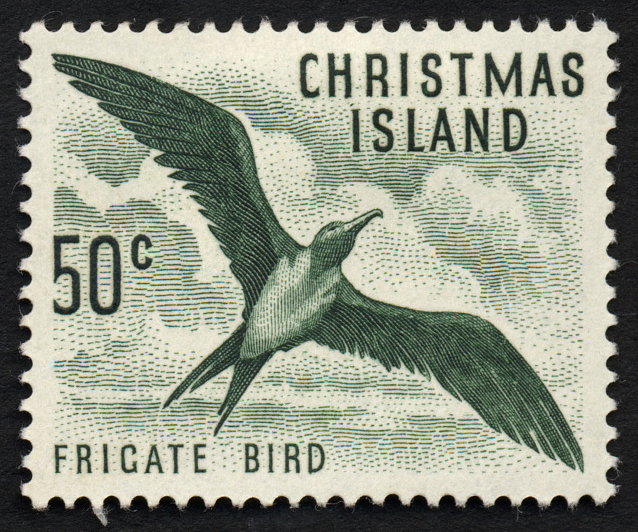
I think the Magnificent Frigate Bird is my totem animal now. Then I found this beautiful batik design stamp from St. Kitts:

Now I’m thinking this stamp prompt is leading me to another ekphrastic poem.
PAD Challenge : Write a middle poem
Poetry Non-stop : Write a poem about an aspect of yourself, employing rhyme.
Yesterday I found a list of prompts at Thought Purge. Today’s prompt is “What can I do?”
Hit Record is also celebrating National Poetry Month with Poem Every Day prompts. If we do them in order from the top of the list, today’s prompt is “mingle.”
Today’s Poem
Mingle in the Middle
Like me, this poem is the middle child
never first, always in the shadow,
tagging along in hand-me-downs,
having to measure up
No longer double but triple
expectations a riddle
every promise now brittle
Always compared
but no longer the cute one
The clear image of place but a scribble
Any attention now moved
to something needier
The world turned upside down and inside out
by screaming and crying new life
The middle’s needs drown in slobber and sick
as this squiggling blob wriggles
But then a tickle brings a giggle
There’s something sweet in the middle
like a pineapple brought to market
spiky, unique, a talking point,
held up for consideration
The middle is where we compromise,
come to terms, fiddle, and find solutions.
It’s where the cheese stands alone
the big cheese, the tasty, solid cheese
that the mouse salivates for
and it’s where the sun spins, burning
making the planets dance around
like children singing. Like me in my universe
with ideas in my gravity,
it’s in the middle
we mingle
Portable MFA Week Three:
This week’s focus is on exploring and expanding the use of detail.
Writing: The instructions provide seven prompts to explore in free-writing. I find it amusing that some of them have already come up in the daily prompts this month, like number 3. Write bout an article of clothing (Poetry Non-stop yesterday) and number 5. Choose one object nearby and describe it. Hey, a good prompt is a good prompt.
Reading: The example poem given was “Piano” by D.H. Lawrence which makes me think this whole week is about the music of poetry (not just today). For my third Ada Limόn poem to study, I chose the titular poem from her collection, Sharks in the Rivers(assoc. link). Right away I noticed some repetition and rhyme, and a circling back to the beginning, creating an appealing music.
The instructions say to focus on the details the poet uses, and asks: What feelings do the details call up inside you? Why do you think the poet chose one sensory detail over another?
 Experience Writing
Another tasty field of clover to browse, Maria.
LikeLiked by 1 person