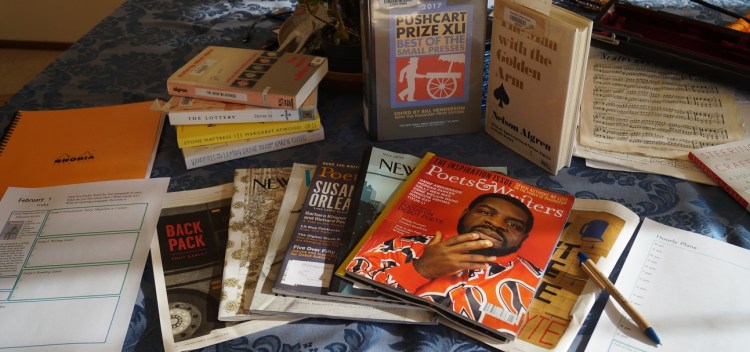
The Planner Experiment: #CallForSubmissions

Over 500 Followers!!

Thank you to each and every one of you who has chosen to follow Experience Writing. I hope you continue to enjoy this writing journey. This is exciting!

The Planner Experiment

How are your submissions going? Are the planner pages helping? Do you have any suggestions for this week’s pages?

I found some new places to find submissions and I’m surprised I didn’t know about this sooner. I just discovered a couple of active and helpful hashtags on Twitter:

#Callforsubmissions

#Submissions

I’ll scour these over the next few days and should have updated deadlines for Sunday.

The Writer’s Games

Writer’s Games 2019 start tomorrow with a practice event. I’m really excited. I hope you will wish me luck as I write through the challenges. Are any of you participating in the games this year? Have you done it before? Any advice?

Happy Reading, Writing, Planning and Submitting!


The First Week of March Planning Pages & March Reading Goals

Books through a fish eye lens

Here are the  pages to plan out this week:

2019 Planner March Week One

This week includes an interesting selection of literary magazines and a podcast along with original writing prompts.

March Reading Plan

I picked up a really fun selection of books from the library to read this month.

Novels

If on a Winter’s Night a Traveler (Everyman’s Library Classics) by Italo Calvino
Swing Time: A Novel by Zadie Smith

Short Story Collections

Flash Fiction International: Very Short Stories from Around the World
The Nameless Dark: A Collection by T. E. Grau

Poetry Collections

When My Brother Was an Aztec by Natalie Diaz
Wade in the Water: Poems by Tracy K. Smith
Night Sky with Exit Wounds by Ocean Vuong
Poems by Elizabeth Bishop

Graphic Novels

B.P.R.D.: Plague of Frogs Volume 1
Sabrina by Nick Drnaso
Home After Dark: A Novel by David Small

Craft Books/Non-Fiction

The Playful Way to Serious Writing by Roberta Allen
Writing Tools: 55 Essential Strategies for Every Writer by Roy Peter Clark
Telling True Stories: A Nonfiction Writers’ Guide from the Nieman Foundation at Harvard University

I hope you will join me in reading a wide variety of great writing. What have you planned to read this month?

Happy Reading, Writing, Planning and Submitting!

The Planner Experiment: Here Comes March

Here Comes March

I apologize for not getting this out yesterday as I intended, but I did get my story off to 3 Elements Review, so I’ll call that a win.

The Experiment So Far

So far, this experiment is doing exactly what I hoped it would do. I am aware of deadlines ahead of time and able to plan ahead for more opportunities and not feel caught off guard. I am becoming more familiar with hundreds of literary magazines both in print and online. I recognize the titles listed in other writers’ bios. I’m reading tons of short stories, poems and flash fiction and beginning to recognize the work of writers who are published often. It took the whole month for me to start using all of the elements of the daily pages. I was very concentrated on the submissions section at first. I was beginning to wonder if I needed the hourly table, but now that I’m using it, I think it is necessary. Thus, for my own purposes, this experiment is a smashing success so far.

The other aspect of the experiment which is to get feedback from you, my readers and use your feedback to make the daily pages better each week is not as successful. I have received some positive feedback on the design. Thank you. I hope as you use the pages, you will begin to let me know how to improve the pages for you.

Here is my February in review.

February goals met:

I submitted stories to literary magazines

I submitted poetry to literary magazines

I wrote and submitted new stories

I read a lot of short stories

I became familiar with many literary magazines

February goals not met:

The number of submissions was much lower than my goal, but still higher than every year’s submissions in the past. I hope to increase the amount of submissions each month.

The Numbers

Journal Submissions: 15

Other Submissions: 1 grant application, signed up for the writers games

Rejections: 5

Stories Written: 4- 1 short story, 1 flash, 2 micro

Books read: 10

novels 2

short story collections 3

poetry collections 3

craft books 2

short stories in literary magazines: did not keep track

Lessons Learned: a couple of the rejections I received said the work I sent wasn’t a good fit. Getting to know the journal better is the priority, not the deadline. If I really want to submit to a magazine with a deadline I may miss, it’s okay. I can submit next year, or during their next reading period.

Keeping Track Of Your Submissions

As you increase your story submissions, you will have stories submitted to multiple magazines at once. It is very important to track your submissions in a clear and organized way. When one of your stories is accepted for publication, you need to immediately withdraw that story from the other journals you submitted it to.

Create your own submissions tracker: I create tables in OneNote (microsoft office). I have a table for my stories and one for my poems My table has columns for the date of submission, name of the journal, name of the story, date of response, response and notes. I update it every time I submit or hear back from a magazine.

As my list of submissions grows, I may transfer this information to a Spreadsheet, so I can organize the data by story, or date, or response, etc. as needed.

Submittable

These days more and more journals are using the online submission portal Submittable for all of their submissions. Submittable automatically keeps track of all of your submissions through their portal. You can also save upcoming submissions that interest you.

Other Online options

Duotrope

Writers DB

Writer’s Digest Downloadable Spreadsheets

Sonar 3 free download

Triple Tracking Method from Writers Write

Here Comes March

This month is going to be hectic for me. I signed up for the Writers Games, so I will be writing a story a week to fulfill the challenges. I don’t know what I’ve gotten myself into, but it should be fun and rewarding. Expect to hear a lot about the Writers Games this month.

One thing I didn’t do last month was keep track of all of the short stories I read in literary magazines. At the end of February, I designed a story analysis sheet that I plan to fill out for each story I read. I should have a lot of data about stories and the magazines that publish them by the end of this month.

New Goals

My main goal for March is to write great short stories. Toward that end I will experiment with my story analysis worksheet, at least three stories every day, and look for  ways to improve my stories toward publication.

The Deadlines:

I’m playing around with a mix of deadlines and reading period openings. Which would you rather see in the month’s deadlines section? Deadlines coming in that month, or future deadlines you can plan for, reading period openings?

The Daily Pages

Please download the month overview pages and these first few pages of March:

2019 Planner March opening pages

I look forward to your feedback. I’ll post a week of pages on Sunday.

Reading

I have a stack of books on hold at the library that I’m going to pick up today. On Sunday, when I present the week’s planner pages, I will let you know about my reading goals for March.

Happy Reading, Writing, Planning and Submitting!


The Planner Project: Final Days of February

Feb final pages

Here we are at the end of the first full month of planner pages and looking toward the month of March. For these last few pages, I decided to try a background. I used a section of a painting I did for my niece for Christmas. I lightened it and set it as a graphic background in page format. What do you think? Is it too much? Do you like the white page better?

2019 Planner February Week Four

Please download the free planner pages and let me know what you think. Each page is full of valuable information and planning ideas. I look forward to your feedback, so I can implement your suggestions.

We still have five days left for you to submit. Here are the February and March 1st deadlines:

  • 3 Elements Review       2/28
  • New Myths                     2/28
  • Hinnom                          2/28
  • Black Heart Magazine 2/28
  • Crab Creek Review       2/28
  • Ninth Letter                   2/28
  • THEMA                             3/1
  • Gulf Coast                        3/1
  • The Idaho Review          3/1
  • Upstreet                            3/1
  • Copper Nickel                  3/1
  • The Cincinnati Review  3/1

Look at all those opportunities to find homes for your stories.

If you are new to The Planner Project, information about each of these literary magazines, including who the editors are, the reading dates, and whether they pay and take simultaneous submissions is available on the daily planner pages I’m designing. If you are interested in downloading the pages for free you can learn more about the project and find the pages in my previous posts:

See into the future: no more missed opportunities

Realistic Goal Setting vs. Creative Chaos

The Deadlines: Collecting and Organizing

Here Comes February- the first week of planner pages

Fantasy, Horror and Sci-Fi, Oh my! (week two)

The Planner Experiment: February week three planner pages

I hope you’ll join in my experiment to design a daily planner that helps writers get ahead of the game when it comes to submitting their stories and poetry for publication.

Next Steps

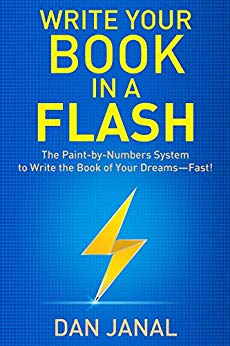
One of the tools I liked from Write Your Book in a Flash: The Paint-by-Numbers System to Write the Book of Your Dreams—FAST! by Dan Janal (my book review) was using charts, graphs and other info-graphics. I was excited to find them available in open office, but have yet to figure out how to put them in my design (so far, they don’t like to share the page). That’s something I’ll be playing around with in March. Since I feel like the magazine descriptions need the most improvement, maybe I can come up with a bar chart that gives you quick info about each magazine.

Toward this end, Julie Reeser of patreon/abetterjulie, inspired me again. She invited readers to follow her on patreon as she reads and analyzes 300 published short stories to get a better understanding of what magazines are publishing. As I am also reading in hopes to understand what each literary magazine is looking for and publishing, I tried to come up with how I could analyze the stories I’m reading to come up with the information I’m looking for.

Using some of the ideas from The Anatomy of Story: 22 Steps to Becoming a Master Storyteller by John Truby, which I am thoroughly enjoying, and other story analysis ideas, I created a one-sheet form, mostly of check-able boxes to fill out as I read. Hopefully, as I read a number of stories from one magazine, I will accumulate data that may eventually be worked into a bar graph of useful information about what that magazine publishes. I’ll be working with and fine tuning this story analysis sheet over the next month or so. If I think it’s useful for our purposes, I’ll share it with you and perhaps add it to the front-matter, or appendix of the planner.

In my continuing quest to be a consistent blogger, I will be posting on Sundays and Thursdays for the foreseeable future. Look for the February wrap-up and new pages for March this Thursday. I hope you are enjoying this experiment as much as I am and I look forward to hearing from you.

Happy Reading, Writing, Planning and Submitting!

Craft Book Review: Write Your Book In A Flash by Dan Janal

Cover to Write Your Book In A Flash by Dan JanalWrite Your Book In A Flash by Dan Janal published by TCK Publishing is intended to guide professionals through writing a business-oriented non-fiction book, but has many useful tips for fiction writers as well. I recommend this book for everyone who is thinking about writing a book.

Why I picked it up:
I received an email from Maria Inot of TCK Publishing asking if I would be interested in giving an honest review in exchange for a free copy. She said she liked the review I did for How to Write a Novel Using the Snowflake Method (Advanced Fiction Writing) (Volume 1) by Randy Ingermanson.  I’m always interested in books about writing, so I agreed.

My Expectations:
I didn’t know what to expect, but I hoped it would have information that would apply to fiction writing as well as non-fiction writing and provide me with new, actionable information. I was not disappointed.

Intended Audience:
Executives, consultants and entrepreneurs looking to broaden their audience and improve their marketing. He also gears it toward “thought leaders”, as in anyone who has an idea that they want to show or share with others.

What I liked:
I liked a lot of things about the book. First, was Mr. Janal’s voice. He came across as a self-help coach/salesman from the first page. It was the voice of someone who knew you came to him for something in particular and he couldn’t wait to help you find exactly what you wanted.

The structure of the book was (mostly) in a clear building order, so by following his example, you would have a finished product by the end. I liked how he created interactivity by providing free, downloadable worksheets to work along with each chapter and useful links to tools and examples.

I also enjoyed the meta aspect of using how he created this book as examples for how to created a book. Even the parts that were very specific to non-fiction, I found inspiring for ideas for this site, or other aspects of my writing.

What I didn’t like:
I didn’t think the Paint-by-Numbers system was anything more than creating a good outline, which in itself is a great thing to learn, so the metaphor may not have been necessary. In chapter fifteen Mr. Janal uses a different metaphor of bones, muscle and skin which made me think of the writer as Dr. Frankenstein building his monster. That definitely appeals to me more than a paint-by-numbers kit (could just be me).

I felt like a lot of the research section should have come much earlier. One should research the competition before choosing a title, for instance, and using reviews to find out what readers think is missing would be important to know, before writing your outline. Since this book and its worksheets are set up as a step-by-step how-to, I was surprised to find this useful, insightful information so out of place, in my opinion.

There were a couple things I thought could have been changed to make the book appeal to a wider audience. I thought using the story of Papa John’s could have been replaced with a different example and I wouldn’t have said “don’t be a pantser” as many writers identify as such. The explanation as to why was well explained, but finding a way to include pantsers would be more inclusive.

Rating: ♦♦♦♦ 4 out of 5

Overall, I found Mr. Janal knowledgeable and his technique clear and straightforward. I liked that he made the book interactive with downloadable worksheets and useful links. I thought the chapters on outlining could probably have been one chapter or needed more information, especially since his whole metaphor of a paint-by-numbers painting had to do with outlining. However, I really liked this book. I have already explored some of the tips and filled out the worksheets. It is full of useful information. I am going to keep this one on my bookshelf. I recommend it to all writers, bloggers, and people trying to reach a larger audience.

Happy Reading and Writing!

The Planner Experiment: February Week Three Planner Pages

Week three pages blue

As I write this, I’m listening to short stories from Asimov’s Science Fiction on their podcast. I also discovered and have been listening to The CryptoNaturalist. I hope to have stories on both of them some day. Earlier today I enjoyed listening to stories, some read by the authors, over at Three-Lobed Burning Eye. I submitted a story to them this morning.

I have very exciting news. Yesterday, I submitted to three different magazines. It was the first day I have reached that goal. This morning, I did it again. I’m on a roll, but today’s submissions made me aware of another problem with my plan: sometimes the magazine or journal that appears to be the best fit for my story doesn’t accept simultaneous submissions. That means I may need to wait months before I can submit it again.

But wait! If I submitted the story to a magazine that is a good fit, I may not need to submit it again because they will publish it. So the only  real problem is how I will come up with three submissions for tomorrow. There-in lies the importance of learning about all of the literary journals that I would like to publish stories in and learning when their reading windows are, so I can prioritize the magazines for which I’m willing wait.

For those of you who are hoping to achieve a three submissions a day habit, here are some tips for preparing your submissions:

Make submitting easier:

  • Have a short bio written that you can cut and paste into your cover letter or submittable form when requested.
  • Re-read, edit, and format (most journals ask for Shunn format, but you may also want to have a copy with no personal info on it because many journals ask for that) your stories so they are ready to go when you find a good fit.
  • Try to find interviews with the editor to learn what they’re looking for and read stories from the journal. Find something you like or a story that is somewhat like your story, so you can mention it in your cover letter.
  • Read and re-read the submission guidelines and follow them carefully.

The Planner Pages

I have yet to receive your feedback and fervently await some data other than my own for this experiment, but we are only two weeks into it and I’m already seeing personal results.

Positive results

  • I have already submitted more than I did all of last year
  • I have a new outlook on rejections as accomplishments to work toward and they already don’t sting as much as they did before.
  • I am becoming familiar with literary magazines so that I can choose the best fit for my stories and write personalized, informed cover letters.
  • I have read a ton of short stories and poetry
  • I have collected, reviewed and organized my poetry and very short stories.
  • I’ve written a lot of writing prompts and come up with a lot of story ideas.
  • I’m finding ways to improve my design in open office though this part of the project is time consuming and can be frustrating.

Not so positive results

  • I haven’t found a daily routine yet.
  • I’m obsessively researching the journals.
  • There isn’t enough time in the day to read all the stories and poems.
  • I’m not writing new drafts for my ideas, at least not as quickly as I would like.

These problems, I believe, will taper off soon. I did write a very short story rough draft this morning. I’ve gathered most of the journals that I plan to include in the planner. By the end of the month, I should have them organized into their planner months and be able to prioritize getting familiar with each one.

The Changes

I was getting frustrated with the tools I had in open office, so I looked up loading new fonts. You can download free public domain, commercial use fonts at 1001 fonts. Having a selection of fonts I like made a lot of difference, but then I wanted borders and frames for my sections instead of just lines. This led me to the clip-art gallery. I downloaded frames and borders from public domain vectors.

This endeavor was not as successful as downloading and applying the fonts. Loading the clip-art into the gallery wasn’t particularly hard, I was just impatient and kept accidentally shutting down the program. Once I got the frames and borders into the clip-art, they didn’t look great when I resized them, so we’ll see if I end up using them.

While putting this week’s pages into one file, I discovered that the background colors that I had put with each day did not come along when inserted into the file. All of the days would have to have the same background color, so I decided to leave that for now. I think I’ll play around with using my photography for backgrounds. I would have to choose one that works for an entire season, if I choose to use a background.

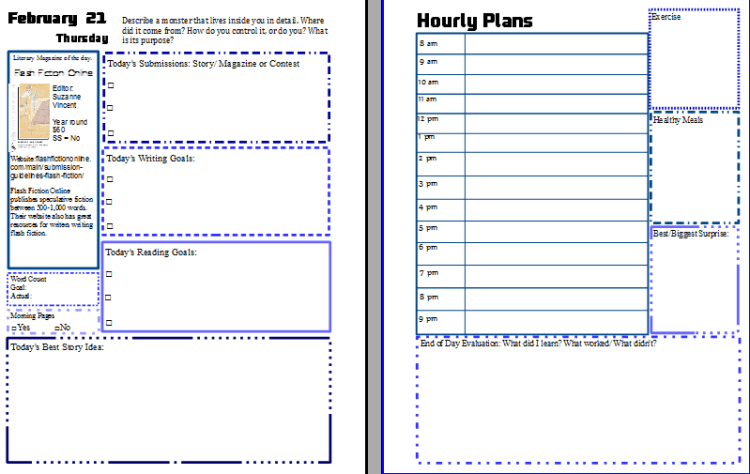
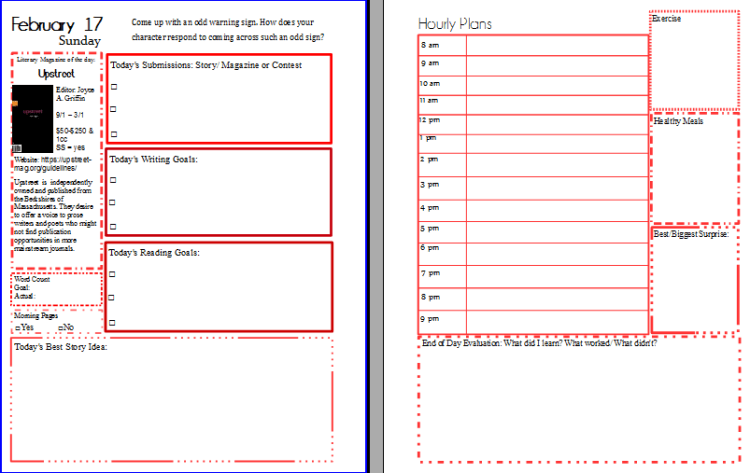
I also changed the layout of the magazine section a bit. I didn’t like how the space next to the image of the magazine looked, so I moved the web address below the image and added info about the reading dates, pay/fee and whether or not they accept simultaneous submissions.

Planner Pages Week Three

2019 Planner February Week Three

I hope you’ll click the link above and download the planner pages, so you can plan your week’s submissions along with me. I look forward to receiving your feedback and hearing about your journey to publication.

Happy Reading, Writing, Planning and Submitting!


The Planner Experiment: Micro-fiction

Snowmaggedon

This planner project is already working for me. This week I received my second rejection. The sting only lasted a moment this time. The rejection letter even suggested that I submit something to their next reading period, so I’ll keep that in mind for my deadlines. I edited and submitted two other stories to different magazines the same day. Now that I’m becoming familiar with so many paying and interesting markets, I feel confident that I will eventually find the best fit for my work. The only way to do that is to keep submitting and collecting rejections. This new mind-set is helping my confidence and productivity.

Micro-fiction, Nano-fiction, and Very Short Stories

This week I discovered another group of magazines to add to my spreadsheet, the wonderful world of micro-fiction. I enjoy writing flash fiction. Flash is usually a story that is less than 1,000 words. There is a market for a sub-section of flash which consists of very very short stories. These magazines look for stories as short as a 140 character tweet, or specific word counts of 50, 66 or 100 words. The range is up to 500 words.

Most of these ezines aren’t paying markets, but are a great writing challenge. Telling a story with a beginning, middle and end with so few words trains you to edit for economy of word choice. I have had stories published in Speculative 66 and The Drabble.

There are some paying markets looking for micro (or nano) fiction. I found two lists: The short list from D. L. Shirey and a useful table from Erica Verillo.

Like I did with my poetry last week, I went through and collected all of my very short stories in one file. Unlike my poetry, I wasn’t enthralled with the very short stories I wrote here on Experience Writing, but that was exciting to me. I was able to find some magazines that would take poetry from my blog, but micro-fiction is another story. They are only interested in unpublished work. Thus, I plan to take only the very best ideas from my very short stories and completely re-write/ re-imagine them before submitting. I also have a list of story ideas that I think will work well as micro-fiction and plan to tackle some drafts in my morning pages.

Reading Everything

Another way the planner experiment is working, is by guiding my reading. I try to focus on reading some stories from the Literary Journal of the day and maybe one other. That way I’m not sampling from all over the place, but learning as much as I can about one journal at a time. Getting a feel for a journal isn’t easy and when I’m trying to learn about hundreds of journals at once, it can get overwhelming. Exploring one or two journals a day is a great way to get to know them and figure out if I have a story that is a good fit.

As you may have heard, the Seattle area had unusual snowfall last weekend. It was beautiful. Being snowed in is the perfect time to read, all snug under a pile of blankets. My sweetie and I have been reading to each other since the beginning of the year and we ramped that up during the snow. We lit a fire in the fireplace, drank tea and cocoa and read a bit of everything. That is one of the fun things about reading a lot of short story collections at once, you can read a story by one writer and then move to a completely different genre or style by another. We skipped around between The Lottery and Other Stories (FSG Classics) by Shirley Jackson, The Neon Wilderness by Nelson Algren, The Shell Collector: Stories by Anthony Doerr, and The Doll-Master and Other Tales of Terror by Joyce Carol Oates interspersed with selections from The Pushcart Prize XLIII: Best of the Small Presses 2019 Edition (The Pushcart Prize). We ended up reading all of The Doll-Master and Other Tales of Terror and liking about half of it. She does tend to ramble and doesn’t seem to care about a satisfying ending, or that was our conclusion.

We also read Small Town: A Novel (Block, Lawrence). I’ve had this book for years and kept picking it up and putting it down, so I was glad we read it together and finally finished it, but I had no idea it would be so pornographic. I was much more interested in the murder mystery and found the “sexual artistry” annoying. However, it had a brilliant ending; little clues that made me re-read the beginning (since it had been a long time since I started it) to confirm.

As for the other reading goals I put in my planner, I finished The Carrying: Poems by Ada Limón. I enjoy her poems and liked the collection, but not as much as Bright Dead Things: Poems. I’m also reading a bunch of craft books. I’m especially enjoying The Anatomy of Story: 22 Steps to Becoming a Master Storyteller by John Truby.

The Planner Pages

I’ve been frustrated with the tools available to me in open office, so I did some work this week improving my font selection and line and border possibilities along with experimenting with backgrounds and colors. I also realized that I needed to put some planning for my novel edits in the planner as well, so I’m playing around with that.

I noticed I had a repeat prompt on the thirteenth. I apologize. I wrote and saved over 100 writing prompts the other day, so even without the prompt inspiration I get from the literary journals themselves, we won’t be running out of writing prompts any time soon.

Look for the new pages some time tomorrow evening, so you can plan out your week along with me on Sunday.

Feedback

I would love to hear from you. Are you using the planner pages? Do you use them on the computer, or print them out? Are you submitting your work? How could the pages be more useful and motivational?

Happy Reading, Writing, Planning and Submitting!

Fantasy, Horror and Sci-Fi. Oh my!

bokeh photography experiment with a wide angle attachment on a zoom lens
Galactic Unions photo by Maria L. Berg

Just when I thought I had run out of paying markets for the planner, I happened upon Locus, a journal that reviews speculative fiction journals which expanded my knowledge of available paying markets.

Speculative Fiction

Speculative fiction includes: Science Fiction, Fantasy, Adventure Fantasy, Dark Fantasy, Horror, Slipstream, Weird, Bizarro, and more. Curious what slipstream is? Here’s an article that coined the term: Slipstream by Bruce Sterling

And among all these genres and sub-genres there are markets for short stories, flash and poetry. Yes, that means I have a ton more short stories to read to get to know these magazines, but it also means that my weird monsters might find good homes.

Organizing Deadlines

One of the magazines in the speculative fiction genre, Neon, not only has a great incentive to get to know their magazine before you submit–pay what you can to download an issue, then mention you donated in your cover letter and get editorial feedback– they also turned me on to new listings of paying markets:

Literistic

Ralan.com

The Poetry Kit

Poetry

Most of the poetry I’ve written over the last couple of years is up on my blog. These poems were created in response to prompts from dVerse poets, NaPoWriMo, OctPoWriMo and MoSt poets. Imagine my disappointment when I found that literary magazines won’t accept any poetry that has been previously published, including on my blog. I understand that this only means I get to write new, better poems that I don’t put up here on Experience Writing, but I was still disappointed.

However, through my research, I have found a few magazines that will take poems that have been published on a blog, including Neon, so I am excitedly reading these magazines and scouring through to find my very best poems to submit to them.

I am incredibly happy to say that I’ve submitted my poetry to four different magazines.

The Planner Pages

I have been obsessively researching and collecting literary magazine deadlines for short stories, flash fiction and poetry. I have almost finished selecting the 365 for the planner. So I’ve updated the February deadline page. February plan page right

I made one major change to the pages for this second week. I thought the margins were a waste of space, so I changed to quarter inch margins and made the text larger.

Here are the pages for the second week (plus a few, I like to plan out the week on Sunday as I seem to energetically attack projects on Monday, so the next group of pages will start on Sunday). 2019 Planner February Week Two

I’m finding that the journal descriptions and themes influence my writing prompts. I think that’s fun, but what do you think? Are the writing prompts creative and fun, or too on the nose?

So far, the experiment is working for me. I am learning so much and reaching my goals. I am submitting to two magazines every other day, so my goal of starting out at one a day is kinda working.

Have you tried the planner pages? Did you print them out, or are you filling them out in your word processing program? I liked filling the planner out by hand.


Happy Reading, Writing, Planning and Submitting!


Here Comes February – The first week of planner pages

Today’s the day! I organized all of the pages of my planner that I’ve created so far into one file and am actually posting it for you when I said I would. Yay! I find it fitting and poetic that I also received my first rejection of the year this morning! How great is that? Only ninety-nine more to go.

The rejection was disappointing, of course, but today it only stung for a second. I wanted to read the pieces that the guest editor accepted, so I would have a better idea what to send in the future. I think this project is working already.

So here they are, the daily planning pages for the first week of February. I set it up to look right in the book view in open office. I think I’ll try to print it as a little book for myself, since I like to reward myself with little stickers sometimes, but I set it up so you can fill it in on the computer. I’ll probably do both.

plannercover

2019plannerfebruaryweekone

I’m still trying to figure out if three submissions a day is a reasonable goal. I’ll probably start out with one a day and try to increase over time. The most important thing for me is to not get overwhelmed because then I won’t do it at all. I also need to make sure submissions and reading all these journals doesn’t take time away from writing and editing. I hope you’ll experiment with the pages and let me know what works for you.

Trying to consume more short stories and poems

I’m trying out using audio books and radio shows/podcasts to listen to short stories and poetry while I’m working on these pages. Using Overdrive I was able to check out some Joyce Carol Oates, since she appears to have a story in every literary journal. I’ve been listening to The Corn Maiden and Other Nightmares: Novellas and Stories of Unspeakable Dread I also checked out some Ann Beattie. I have her book Park City: New and Selected Stories, but can’t seem to get through it, so I thought I’d try listening to her stories instead. I checked out The State We’re In: Maine Stories and The Accomplished Guest: Stories.

This morning, thanks to The Boynton Blog who brought this to my attention, I’m enjoying poetry read by poets in Spokane, Wa. on Spokane Public Radio.

Feedback

I hope you’ll download the planner pages and give feedback in the comments, so I can make changes for the second week’s pages. Each daily page includes a unique writing prompt (I’m making them up as I go), and an introduction to a literary magazine. I would like to know what type of information would be useful to you in the magazine descriptions. I included the editor’s name and the website address, but I think my descriptions could use some work.

I hope you’re enjoying the experiment and start getting some rejections soon. 😉

Happy Reading, Writing, Planning and Submitting!

The Deadlines: Collecting and organizing

short story submission planningI made a breakthrough over the weekend. I entered the information I’ve been collecting about different literary magazines and their reading windows into a spreadsheet. Now I can easily sort all of the reading periods by deadlines and what month I want to include them in my planner. I also added spreadsheet pages for contests, paying poetry markets, anthologies and community events.

Sifting Through

I found some more submission sources. Along with Newpages, Poets and Writers and Submittable listings, I’m using:

The Review Review

CLMP Community of Literary Magazines and Presses

As there are thousands of literary magazines and I only intend to introduce 365 in my planner, I decided to begin my exploration with magazines that pay their writers. I noticed that many journals are now using Submittable and charging a submission fee. I feel like it won’t be worth my time if I’m losing money for my efforts,  so my focus is on journals with no fees that pay writers anything at all upon publication. I was happy to discover that there were more paying markets than I thought and separating my spreadsheets into fiction and poetry revealed even more opportunities if I can muster enough courage to submit my poetry.

Proof of concept

The first month of the year isn’t over and I’ve already missed a ton of deadlines for both reading periods and contests. My research has revealed that the journals that pay the most have tiny reading periods of only days per year. I was also shocked to see that the The Pushcart Prize XLIII: Best of the Small Presses 2019 Edition (The Pushcart Prize) is already at my local library. How is that even possible?

I began to get frustrated and overwhelmed, but I reminded myself that the purpose of this research experiment is to be prepared for next year. The missed deadlines this month and the beginning of next only support my theory that a successful submission is planned well in advance.

A new problem

Journals charging submission fees and contest entry fees aren’t the only monetary issue I see with my heightened submission plan. Each journal expects submitting writers to become familiar with past issues before submitting. Many journals provide some stories to read online, but most suggest that one purchase an issue or get a subscription.

I understand that the journals need to make money and it’s important to read what the journal prints. I want to read as many literary magazines as possible, but if I was to purchase 365 magazines at fifteen to thirty dollars an issue, I would have to spend between $5,500 and $11,000 only to read one issue which isn’t really enough to get a feel for a publication as a whole .

I want to make money, not go into debt, so my submission goals are now limited to journals that have story samples available online, journals I can find through my library system and journals that have stories in collections that I can get from the library like The Pushcart Prize and The Best American Short Stories.

With all the time it takes to read enough short stories to familiarize oneself with literary journals, I don’t know when submitting writers find time to write. I’m hoping, through this experiment, it will all click by next year. I’ll be familiar with the journals, know the deadlines for the ones I want to submit to and have a year’s worth of stories to submit. Ah, I really am a dreamer.

Staying Flexible

Though I made some of my January goals, I changed my mind on others. I started writing the possession story for the Dark Regions contest, and I still like the idea, but I didn’t want to feel that dark right now, so I let that story go for the moment.

I read some of the winning stories from the Nelson Algren Short story contest in The Chicago Tribune archives, but I still want to read more of his work and write a story specifically toward that contest, so I put that off until next year. From learning about Nelson Algren, I’m also learning about Studs Terkel. I’ve noticed that there are literary magazines inspired by these gentlemen. I look forward to learning more about them.

Though Sixfold sounded interesting, with everything else I’m doing right now, I didn’t have time to read everyone’s entries, so I put that off for another time as well.

Through my deadline collection, I also found many February first deadlines that I will put on the January pages for next year, but not stress over for now. I want to have time to get familiar with each of the journals and not send stories out only because there are deadlines. Everything about this process is showing me that I’m on the right track. Submitting stories is for planners.

The Planner Pages

With February fast approaching, I’ve worked out some more rough draft pages. I want to start each quarter of the year with large goals for the three months. Then each month will have more specific goals and a list of specific deadlines for that month. Here’s what I’m going to try for the First Quarter and February:

first quarter planning page left                               first quarter planning page right

february plan page left                                             february plan page right

I hope you will download them and experiment along with me. I’ll be adding more deadlines to the February Deadlines page as they come up and will update accordingly. I look forward to your feedback about what you like and don’t like about the design and content as well as whether you find the format motivational.

If you know of any deadlines to add to February, please let me know in the comments.

The daily pages for the first week of February will be posted on Thursday.

Happy Reading, Writing, Planning and Submitting!