The opposite of love is not hate, it’s indifference. The opposite of beauty is not ugliness, it’s indifference. The opposite of faith is not heresy, it’s indifference. And the opposite of life is not death, but indifference between life and death.
ELIE WIESEL
Beauty & Barbarism
It was fun to see that “Beauty” was also the topic over at the April Blogging from A to Z Challenge site where they talk about the beauty of resilience.
Beauty is the quality present in a thing or person that gives intense pleasure or deep satisfaction to the mind, whether arising from sensory manifestations (as shape, color, sound, etc.), a meaningful design or pattern, or something else (as a personality in which high spiritual qualities are manifest).
This definition says beauty is present in the thing, and gives pleasure and satisfaction through shape, color, and meaningful design and pattern.
Barbarism is an uncivilized; wild; savage; crude state or condition, not conforming to classical standards or accepted usage
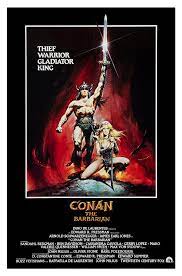
Due to Pop Culture when I hear the word “Barbarism” I think of:
Beautiful Barbarism
But if you look at the definition, barbarism is a state of not conforming to standards. In this way it contradicts with beauty which does conform to standards, especially standards of symmetry and balance.
Today’s Images
To find the beauty in barbarism, and the barbarism in beauty, I can replace sleek curves and lines with crude forms that don’t conform to classical standards. I can use motion to put beauty in the wild and claw at the picture plane.
I used a transformer filter I created last year with tiny brads so I can change the position of the torso and swivel the head. I think the curves created in the overlapping patterns are beautiful, and when I open up the cuts in the torso and head it creates an unconventional, alien barbarism
Today’s prompt is to find a shortish poem that you like, and rewrite each line, replacing each word (or as many words as you can) with words that mean the opposite.
I recently read Complete Poems of Marianne Moor and copied a few of my favorites. For today’s poem, I chose “When I Buy Pictures.”
and what will be further from deceit after you ignore this of which you won’t disregard yourself as the real giver, you break under what wouldn’t take your pain in your extreme hours: the serious essay about boredom out of which acquiring isn’t unknown any more than the blandness of the unfeeling and very much the same—the new place, the modern plain shoe box outside of which there are feral cats with guts growing like the face of a clock, and bucks and fish and standing beauties; they won’t be less than a circle of tile; the fantastical fiction, out of numbers lying together under a cedar-ish enclosure; a pomegranate in twelve copies of red; a fennec-armed book cipher whole; the gold free-ranging Eve alive, or Gabriel releasing Eve’s ankle. Not jovial enough, a physical gloss under that barbarism connects to the pain of many. They might promise to arm everything; and might the condemned lose, not recognized with difficulty— this which isn’t minuscule or the same thing that isn’t great. They move toward that: of specific connection they aren’t, they might not be “extinguished without dull sounds from the death of places”; they might ignore the scientific homeostasis which will destroy them.
As I mentioned yesterday, one of my ideas for my contradictory abstraction is that they are all part of the fight or flight response.
The fight or flight response is an automatic physiological reaction to an event that is perceived as stressful or frightening. The perception of threat activates the sympathetic nervous system and triggers an acute stress response that prepares the body to fight or flee. These responses are evolutionary adaptations to increase chances of survival in threatening situations.
The fight or flight response occurs when stressful or dangerous stimuli activate the Sympathetic Nervous System. Signals start in the spinal cord and travel along neurons to the eyes to enlarge the pupils and improve vision; the heart to increase heart rate and circulation; the lungs to relax airway muscles and improve oxygen levels; to the digestive tract to slow down digestion; and the liver to activate energy stores. These physical changes can improve eyesight, reflexes, endurance and strength. Psychologically it improves focus and attention to find the source of threat and identify paths of escape.
I’ve created this continuum of fight or flight to make a visual representation of where I think my contradictory abstract nouns fall between fight or flight, and homeostasis.
I hope to expand on this chart throughout the month and use it to find surprise connections and contradictions.
Today’s Images
Thinking of the nervous system, I thought it would be fun to play with neurons as an abstract design.
Today’s prompt is a little complicated, so I copied it here:
The Romanian-born poet Paul Celan once wrote a series of surrealist questions and answers. Here are a couple of examples:
What is forgetting?
An unripe apple stabbed by a spear.
What is a tear?
A scale awaiting a weight.
Today’s prompt asks you to begin by picking 5-10 words from the following list. Next, write out a question for each word that you’ve selected (e.g., what is seaweed?)
owl generator fog river clove miracle cyclops oyster mercurial seaweed gutter artillery salt elusive thunder ghost acorn cheese longing cowbird truffle quahog song
Now for each question, write a one-line answer. Try to make the answer an image, and don’t worry about strict logic. These are surrealist answers, after all!
After you’ve written out your series of questions and answers, place all the answers, without the questions, on a new page. See if you can make a poem of just the answers.
I had some fun putting these two prompts together. I chose owl, thunder, generator, longing, cheese, song, mercurial. “Generator” inspired me to use the Synaesthetic Metaphor Generator to inspire my answers. Then I used the thesaurus to find similar words that start with the letter “b” to turn my surreal poem into a B-movie soundtrack.
The Poem
This B-movie Soundtrack
A boisterous baritone beam of blahs balances on a bumpy berg, boasting the bad bleak blisters of baseless besprinkled bothers, blue bangs that blend blandly betwixt the beady burnished bumps, the buzz between the beach and the butte, beyond the backdrop, the bluster before beauty’s beard a bedraggled bang below the belt breaks baggily a bright, bouncy, burning, bold barrage of blows out of the blue, but the breakneck bouquets that breathe blushes buck buoyant baritones
Welcome to the first day of National Poetry Month! April is a busy month here at Experience Writing. There’s a lot to experience: the cherry plum trees are covered in their happy pink and white blossoms; daffodils bow their frilly heads in the flowerbeds; and I enjoy combining the daily writing challenges of blogging A to Z, the PAD (poem-a-day) challenge, and NaPoWriMo (National Poetry Writing Month) with my daily photography challenge. I created and thought I had posted my calendar of the A to Z contradictory abstract nouns I will be exploring this month in my A to Z announcement post, but I just noticed that somehow the calendar got into my media, but not into the post, so here’s my calendar for the month:
Aggression and Apathy
My study of abstract nouns started during NaPoWriMo last year. It evolved into a study of contradictory abstract nouns when I came across a piece of writing advice that said, “Find the hope in despair, and the despair in hope.”
This got me thinking that what one person takes as hope may only lead to another’s despair, and vice versa. Then I applied the idea to other contradictory abstract nouns. If you’re interested in looking at my progress in this study, it started July 19, 2022 with my post Contrasting Abstractions: The next phase in my study and has been my focus ever since.
How does the dictionary define aggression and apathy? Aggression is defined as any offensive action, attack or encroachment. The practice of making assaults or attacks; offensive action in general, and in Psychiatry it is defined as overt or suppressed hostility either innate or resulting from continued frustration and directed outward or against oneself. Apathy is defined as absence or suppression of passion, emotion, or excitement, lack of interest in or concern for things that others find moving or exciting.
Aggression is an angry inflamed passion, apathy is a complete absence of passion and emotion, anger or otherwise. But there’s more to it than that, isn’t there? Why do some people react to stimuli with aggression and others with apathy? I see aggression as a response to frustration because of a lack of understanding, an inability to empathize and compromise. Apathy is a similar response, but instead of acting out, one acts inwardly, running from any painful feelings by not feeling at all.
Today’s contradictory abstractions got me thinking about the human fight or flight response. In a way, aggression and apathy are two ends of the continuum of fear. I’ll talk more about fight or flight tomorrow since Sundays don’t have A to Z posts.
Today’s Images
For today’s images, I contemplated the colors of aggression (orange and red) and the colors of apathy (gray, beige). So to find the aggression in apathy and the apathy in aggression, I added my orange lights to the mirrorworld, and hung a fabric backdrop with beige and gray as the main colors.
The shapes and lines of aggression are jagged and triangular. Apathy lacks shape and line.
I found that using my flash and focus to attempt to pick up some of the beige and gray background also reflected some of the light expressing the tension between aggression and apathy (image at the top of the post). While capturing my images, I realized that aggression without opposition loses its power and emotion, blending into the apathy (image below).
Standing still she can ignore the sharp, sheer edges can feel safe in the nothing and not care Any unpleasant scents—her sweat, her waste, her rotting discarded—become commonplace and are no longer noticed. Any unpleasant sounds—alarms, horns, scraping, her screaming— become background noise, a droning hum no longer noticed as time drips the days.
But the world creeps in, poking and prodding until orange-red aggression pushes her to motion. Along the thin, jagged path she staggers, trying to resist, but once inertia can’t fight the pressure her pace accelerates past apathy’s border with obscurity.
It would be foolish to take her gaze from the path but the stars, the stars twinkling in the abyss tug her yellow attention from her blue fears and back again, and she wants to go back but she can’t because she doesn’t want to be seen as foolish, or smell the stale air and rotting discarded. Lacking options makes her angry. She wants to lash out, to hit and scratch and smash and destroy the world that crept in and made her feel fear again.
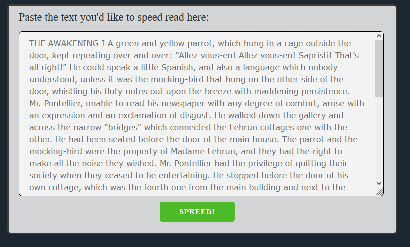
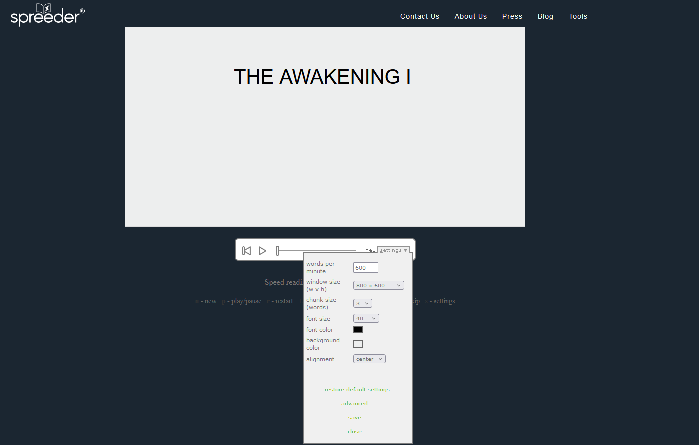
This week I tried a whole new way of reading. I used the free application Spreeder for my first read of The Awakening by Kate Chopin. Spreeder is an online speed reading application that flashes text at a central focal point. Its default is one word at a time at 300 words per minute (wpm), but the settings can be changed to increase the number of words and the speed.
I copied one chapter at a time from Kindle and pasted it into the text pane. After pressing the green Spreed! button, the first word of text appears in the reading pane. Under the reading pane is a play button, a pause button, a new button and settings.
I’ll admit, it was a very strange reading experience. It felt especially surreal to read one word at a time. I think I liked chunks of three words at a time. I didn’t think I was comprehending at all, but when I went back to the text to make notes and figure out what to talk about in this text, I recognized foreshadowing and knew the characters and events.
I don’t think I would read a novel only once with Spreeder, but as a tool to speed up a first read, it was an interesting experience.
Things I Learned
First, a little overview:
The Awakening was published in 1899. It was the first novel written by a woman that had passion as the plot. It is considered a precursor of American modernist literature, and is a landmark work of early feminism. It’s set in New Orleans and the Louisiana Gulf Coast and was the precursor to the Southern novel style. The story has similarities to Madame Bovary in that a romantic woman becomes unhappy with her life and believes she will find happiness through romantic trysts. Unlike Madame Bovary, The Awakening focuses on Mrs. Pontellier’s emotional journey.
Change and the Emotional Journey:
This novel fits perfectly with what I read in The Emotional Craft of Fiction yesterday.
The sense of movement in a story comes mostly from inside. It’s a tidal pull, an emotional tug. It says not just that things are going to change but that people are going to change. It’s ongoing. In life, change isn’t annual. It’s daily. We change constantly, maybe every hour. We are forever evolving in our understanding of self, others, and the world. We are awake, alert, and alive. We ponder. We learn. Life is what we do, certainly, but even more it’s what we take away from it. . . .
As in our real lives, the raw material of the inner journey is ever present. You only need recognize it, make space for it on the page, and treat it like it matters.
To fasten the inner and outer journey, you only need to start with one element: either a plot event or a step in the inner journey. In the first case, go inside your protagonist to pinpoint what an outer event means. In the second case, stop at any inner moment and make something outward happen, something that symbolizes what’s going on inside. Outer events lead inward. Inward struggles turn outward.
Donald Maass
Let’s take a look at how Kate Chopin fastens the inner and outer journey of Edna Pontellier.
Main Character Introduction:
The novel doesn’t start with the main character, but with her husband. At the beginning of the story Edna is Mrs. Pontellier. Her existence is defined by others: she is a wife and mother. The first mention of her is:
“The sunshade continued to approach slowly. Beneath its pink-lined shelter were his wife, Mrs. Pontellier, and young Robert Lebrun. When they reached the cottage, the two seated themselves with some appearance of fatigue upon the upper step of the porch, facing each other, each leaning against a supporting post.”
Her husband admonishes her and then sees her as his damaged object:
“You are burnt beyond recognition,” he added, looking at his wife as one looks at a valuable piece of personal property which has suffered some damage.
The first thing the reader knows about Mrs. Pontellier is that she has strong, shapely hands. Here is the first description of her:
“Mrs. Pontellier’s eyes were quick and bright; they were a yellowish brown, about the color of her hair. She had a way of turning them swiftly upon an object and holding them there as if lost in some inward maze of contemplation or thought.”
It starts with the basic, cliché eyes and hair, but adds something about what she does with those eyes that tie in with her inner journey.
How Others See the Main Character:
Mrs. Pontellier’s next interaction with her husband, he admonishes her again:
“He reproached his wife with her inattention, her habitual neglect of the children. If it was not a mother’s place to look after children, whose on earth was it?”
Mr. Pontellier admonish his wife for her poor mothering, but it goes deeper than that:
“It would have been a difficult matter for Mr. Pontellier to define to his own satisfaction or any one else’s wherein his wife failed in her duty toward their children. It was something which he felt rather than perceived, and he never voiced the feeling without subsequent regret and ample atonement. If one of the little Pontellier boys took a tumble whilst at play, he was not apt to rush crying to his mother’s arms for comfort; he would more likely pick himself up, wipe the water out of his eyes and the sand out of his mouth, and go on playing. . . . In short, Mrs. Pontellier was not a mother-woman.”
Mrs. Pontellier is then the opposite of “the mother-woman”:
“The mother-women seemed to prevail that summer at Grand Isle. It was easy to know them, fluttering about with extended, protecting wings when any harm, real or imaginary, threatened their precious brood. They were women who idolized their children, worshiped their husbands, and esteemed it a holy privilege to efface themselves as individuals and grow wings as ministering angels. Many of them were delicious in the role; one of them was the embodiment of every womanly grace and charm. If her husband did not adore her, he was a brute, deserving of death by slow torture.”
Her favorite “mother-woman,” Adèle Ratignolle, calls her “Pauvre chérie.” And when warning Robert to leave Mrs. Pontellier alone she says “She is not one of us; she is not like us. In response Robert says, “You made one mistake, Adèle,” he said, with a light smile; “there is no earthly possibility of Mrs. Pontellier ever taking me seriously.”
After Edna’s night swim people notice her romantic nature:
“Sometimes I am tempted to think that Mrs. Pontellier is capricious,” said Madame Lebrun, who was amusing herself immensely and feared that Edna’s abrupt departure might put an end to the pleasure.
“I know she is,” assented Mr. Pontellier; “sometimes, not often.”
I really like how her husband recognizes this part of her personality, a contained fancifulness.
After Edna returns to the city, her friends notice she has changed:
“How handsome Mrs. Pontellier looked!” said Madame Lebrun to her son.
“Ravishing!” he admitted. “The city atmosphere has improved her. Some way she doesn’t seem like the same woman.”
Having other characters talk about the main character is a technique for both showing and telling at the same time. Other characters are more likely to notice changes in the main character before she recognizes them herself.
Cultural Differences:
At Grand Isle she’s an outsider:
“Mrs. Pontellier, though she had married a Creole, was not thoroughly at home in the society of Creoles; never before had she been thrown so intimately among them. There were only Creoles that summer at Lebrun’s. They all knew each other, and felt like one large family, among whom existed the most amicable relations. A characteristic which distinguished them and which impressed Mrs. Pontellier most forcibly was their entire absence of prudery. Their freedom of expression was at first incomprehensible to her, though she had no difficulty in reconciling it with a lofty chastity which in the Creole woman seems to be inborn and unmistakable.”
This presents an interesting conflict in Creole women, both an absence of prudery and a lofty chastity. I’m not sure how that works.
“Mrs. Pontellier gave over being astonished, and concluded that wonders would never cease.”
Setting as a Catalyst for Change:
Chopin uses her two settings, the sea and the city to influence her character’s emotional change. At the beginning, the sea seduces:
“The voice of the sea is seductive; never ceasing, whispering, clamoring, murmuring, inviting the soul to wander for a spell in abysses of solitude; to lose itself in mazes of inward contemplation. The voice of the sea speaks to the soul. The touch of the sea is sensuous, enfolding the body in its soft, close embrace.”
She also combined the influence of the setting and the people in it as catalysts of change:
“That summer at Grand Isle she began to loosen a little the mantle of reserve that had always enveloped her. There may have been— there must have been— influences, both subtle and apparent, working in their several ways to induce her to do this; but the most obvious was the influence of Adèle Ratignolle. The excessive physical charm of the Creole had first attracted her, for Edna had a sensuous susceptibility to beauty. Then the candor of the woman’s whole existence, which every one might read, and which formed so striking a contrast to her own habitual reserve— this might have furnished a link. Who can tell what metals the gods use in forging the subtle bond which we call sympathy, which we might as well call love.”
Backstory:
In one talk on the beach with Mrs. Ratignolle, Mrs.Pontellier reveals her back and forth relationship with religion, her relationships with her family and childhood friends, and her romanticism about love.
“At a very early period she had apprehended instinctively the dual life— that outward existence which conforms, the inward life which questions.”
When talking about her love interests before her husband, she had an infatuation with a tragedian:
“a marriage with the tragedian, was not for her in this world. As the devoted wife of a man who worshiped her, she felt she would take her place with a certain dignity in the world of reality, closing the portals forever behind her upon the realm of romance and dreams.”
This comparison reveals her romanticism, and its conflict with reality. It is also in conflict with how her husband treats her now, showing a conflict with what she believes is reality and what her reality really is.
Foreshadowing:
After teasing Robert about his attentions, Mrs. Ratignolle takes him aside to warn him to stay away from Mrs. Pontellier:
“Do me a favor, Robert,” spoke the pretty woman at his side, almost as soon as she and Robert had started their slow, homeward way. She looked up in his face, leaning on his arm beneath the encircling shadow of the umbrella which he had lifted.
“Granted; as many as you like,” he returned, glancing down into her eyes that were full of thoughtfulness and some speculation.
“I only ask for one; let Mrs. Pontellier alone.”
“Tiens!” he exclaimed, with a sudden, boyish laugh. “Voilà que Madame Ratignolle est jalouse!”
“Nonsense! I’m in earnest; I mean what I say. Let Mrs. Pontellier alone.”
“Why?” he asked; himself growing serious at his companion’s solicitation.
“She is not one of us; she is not like us. She might make the unfortunate blunder of taking you seriously.”
His face flushed with annoyance, and taking off his soft hat he began to beat it impatiently against his leg as he walked. “Why shouldn’t she take me seriously?” he demanded sharply. “Am I a comedian, a clown, a jack-in-the-box? Why shouldn’t she? You Creoles! I have no patience with you! Am I always to be regarded as a feature of an amusing programme? I hope Mrs. Pontellier does take me seriously. I hope she has discernment enough to find in me something besides the blagueur. If I thought there was any doubt—”
“Oh, enough, Robert!” she broke into his heated outburst. “You are not thinking of what you are saying. You speak with about as little reflection as we might expect from one of those children down there playing in the sand. If your attentions to any married women here were ever offered with any intention of being convincing, you would not be the gentleman we all know you to be, and you would be unfit to associate with the wives and daughters of the people who trust you.”
Madame Ratignolle had spoken what she believed to be the law and the gospel. The young man shrugged his shoulders impatiently.
“Oh! well! That isn’t it,” slamming his hat down vehemently upon his head. “You ought to feel that such things are not flattering to say to a fellow.”
“Should our whole intercourse consist of an exchange of compliments? Ma foi!”
“It isn’t pleasant to have a woman tell you—” he went on, unheedingly, but breaking off suddenly: “Now if I were like Arobin— you remember Alcée Arobin and that story of the consul’s wife at Biloxi?” And he related the story of Alcée Arobin and the consul’s wife; and another about the tenor of the French Opera, who received letters which should never have been written;”
Within this exchange of warning which is itself foreshadowing of the problems to come, Robert says he’s not as bad as Arobin which is another foreshadowing of other problems to come. I like how she slipped foreshadowing inside foreshadowing inside an argument.
Chopin foreshadows the ending in connecting Edna’s passion with not being able to swim. After listening to Mademoiselle Reisz play Chopin on the piano which aroused “the very passions themselves . . .within her soul” a group went down to the ocean to bathe in the moonlight :
“Edna had attempted all summer to learn to swim. She had received instructions from both the men and women; in some instances from the children. Robert had pursued a system of lessons almost daily; and he was nearly at the point of discouragement in realizing the futility of his efforts. A certain ungovernable dread hung about her when in the water, unless there was a hand near by that might reach out and reassure her.
But that night she was like the little tottering, stumbling, clutching child, who of a sudden realizes its powers, and walks for the first time alone, boldly and with over-confidence. She could have shouted for joy. She did shout for joy, as with a sweeping stroke or two she lifted her body to the surface of the water. A feeling of exultation overtook her, as if some power of significant import had been given her to control the working of her body and her soul. She grew daring and reckless, overestimating her strength. She wanted to swim far out, where no woman had swum before. . . .
A quick vision of death smote her soul, and for a second of time appalled and enfeebled her senses. But by an effort she rallied her staggering faculties and managed to regain the land. She made no mention of her encounter with death and her flash of terror, except to say to her husband, “I thought I should have perished out there alone.”
“You were not so very far, my dear; I was watching you,” he told her.
Again, like the mosquitoes, her mood is challenged and dissipates. And yet, things have changed. This passage does double duty of foreshadowing and connecting inner change to an outer event.
Inner Change and Outer Event:
When Mr. Pontellier reproaches his wife with neglecting her children it leads to the first mention that she is changing:
” She could not have told why she was crying. Such experiences as the foregoing were not uncommon in her married life. They seemed never before to have weighed much against the abundance of her husband’s kindness and a uniform devotion which had come to be tacit and self-understood. . . .
It was strange and unfamiliar; it was a mood. She did not sit there inwardly upbraiding her husband, lamenting at Fate, which had directed her footsteps to the path which they had taken. She was just having a good cry all to herself. The mosquitoes made merry over her, biting her firm, round arms and nipping at her bare insteps.
The little stinging, buzzing imps succeeded in dispelling a mood which might have held her there in the darkness half a night longer.”
Her inner change starts with a change in their marriage. Her husband’s cruelty is now outweighing his kindness. The outer event is admonishment, the inner event is a dark mood and turning to herself for solace. However, this first mood is interrupted by mosquitos so it is only fleeting.
However, this change has primed her for experiencing the passion of music:
“The very first chords which Mademoiselle Reisz struck upon the piano sent a keen tremor down Mrs. Pontellier’s spinal column. It was not the first time she had heard an artist at the piano. Perhaps it was the first time she was ready, perhaps the first time her being was tempered to take an impress of the abiding truth.
She waited for the material pictures which she thought would gather and blaze before her imagination. She waited in vain. She saw no pictures of solitude, of hope, of longing, or of despair. But the very passions themselves were aroused within her soul, swaying it, lashing it, as the waves daily beat upon her splendid body. She trembled, she was choking, and the tears blinded her.”
And that experience led her to face her fears and swim. After her swim, she doesn’t want the night to end, but reality eventually overcomes her fantasy, that duality within herself is always struggling:
“Edna began to feel like one who awakens gradually out of a dream, a delicious, grotesque, impossible dream, to feel again the realities pressing into her soul.”
Edna is aware that she’s changing and the author makes the changes clear to the reader through Edna’s thoughts and yet, even in contemplating how she has changed, there is some foreshadowing that she has changed more than she realizes:
“She let her mind wander back over her stay at Grand Isle; and she tried to discover wherein this summer had been different from any and every other summer of her life. She could only realize that she herself— her present self— was in some way different from the other self. That she was seeing with different eyes and making the acquaintance of new conditions in herself that colored and changed her environment, she did not yet suspect.”
It takes Robert leaving for Mexico for Edna to face what’s really happening:
“Edna bit her handkerchief convulsively, striving to hold back and to hide, even from herself as she would have hidden from another, the emotion which was troubling— tearing— her. Her eyes were brimming with tears. For the first time she recognized the symptoms of infatuation which she had felt incipiently as a child, as a girl in her earliest teens, and later as a young woman. The recognition did not lessen the reality, the poignancy of the revelation by any suggestion or promise of instability. The past was nothing to her; offered no lesson which she was willing to heed. The future was a mystery which she never attempted to penetrate. The present alone was significant; was hers, to torture her as it was doing then with the biting conviction that she had lost that which she had held, that she had been denied that which her impassioned, newly awakened being demanded.”
This realization then changed her perception of her surroundings and her behavior:
“Robert’s going had some way taken the brightness, the color, the meaning out of everything. The conditions of her life were in no way changed, but her whole existence was dulled, like a faded garment which seems to be no longer worth wearing. She sought him everywhere— in others whom she induced to talk about him. She went up in the mornings to Madame Lebrun’s room, braving the clatter of the old sewing-machine. She sat there and chatted at intervals as Robert had done. She gazed around the room at the pictures and photographs hanging upon the wall, and discovered in some corner an old family album, which she examined with the keenest interest, appealing to Madame Lebrun for enlightenment concerning the many figures and faces which she discovered between its pages.”
When Mr. and Mrs. Pontellier returned to their house in New Orleans, Mrs. Pontellier didn’t return to her regular routine. This upset her husband, so he went out to eat at his club. She remembers how she used to react inwardly, then reacts outwardly:
“. . . and taking off her wedding ring, flung it upon the carpet. When she saw it lying there, she stamped her heel upon it, striving to crush it. But her small boot heel did not make an indenture, not a mark upon the little glittering circlet.
In a sweeping passion she seized a glass vase from the table and flung it upon the tiles of the hearth. She wanted to destroy something. The crash and clatter were what she wanted to hear.”
After visiting her friend Mrs. Ratignolle in the city, she feels depressed but not because she won’t have domestic bliss but because she feels sorry for her friend having it:
“Edna felt depressed rather than soothed after leaving them. The little glimpse of domestic harmony which had been offered her, gave her no regret, no longing. It was not a condition of life which fitted her, and she could see in it but an appalling and hopeless ennui. She was moved by a kind of commiseration for Madame Ratignolle,— a pity for that colorless existence which never uplifted its possessor beyond the region of blind contentment, in which no moment of anguish ever visited her soul, in which she would never have the taste of life’s delirium. Edna vaguely wondered what she meant by “life’s delirium.” It had crossed her thought like some unsought, extraneous impression.”
Her husband begins to worry about her mental state. And her own thoughts betray unexplainable mood swings:
“There were days when she was very happy without knowing why. She was happy to be alive and breathing, when her whole being seemed to be one with the sunlight, the color, the odors, the luxuriant warmth of some perfect Southern day. She liked then to wander alone into strange and unfamiliar places. She discovered many a sunny, sleepy corner, fashioned to dream in. And she found it good to dream and to be alone and unmolested.
There were days when she was unhappy, she did not know why,— when it did not seem worth while to be glad or sorry, to be alive or dead; when life appeared to her like a grotesque pandemonium and humanity like worms struggling blindly toward inevitable annihilation. She could not work on such a day, nor weave fancies to stir her pulses and warm her blood.”
Since Robert is gone to Mexico, he has replaced her husband in her mind as her idea of love:
“She felt somewhat like a woman who in a moment of passion is betrayed into an act of infidelity, and realizes the significance of the act without being wholly awakened from its glamour. The thought was passing vaguely through her mind, “What would he think?”
She did not mean her husband; she was thinking of Robert Lebrun. Her husband seemed to her now like a person whom she had married without love as an excuse.”
Once she has inwardly made this separation from her husband, she then moves from their house because she sees everything in their house as his, and wants a space of her own:
“Neither was it quite clear to Edna herself; but it unfolded itself as she sat for a while in silence. Instinct had prompted her to put away her husband’s bounty in
casting off her allegiance. She did not know how it would be when he returned. There would have to be an understanding, an explanation. Conditions would some way adjust themselves, she felt; but whatever came, she had resolved never again to belong to another than herself.”
And in this way, her inner journey from ,”beginning to realize her position in the universe as a human being, and to recognize her relations as an individual to the world within and about her” to becoming her own woman, an individual in the world is complete. She can then admit that she loves Robert, but that admission then leads to facing the truth of its impossibility.
As you can see, Kate Chopin’s novel The Awakening is a study in connecting the inner journey and the outer journey.
Awakening by Maria L. Berg 2021
Applying What I Learned
Anchoring Inner Change to Outer Events:
Following Kate Chopin’s example, to connect my main character’s inner journey and outer journey, I want to tie her introduction description to her inner journey.
Example:
I want to use what other character’s say about her to show change:
Example: In the draft, the first time people are talking about Verity, I wrote, “Verity heard two pops. Her hand went to her hip, disappointed to feel the awkward handle of her taser.The new cashier appeared from storage with her palms held out at her chest. “Sorry. Sorry,” she said , “stepped on some bubble wrap. No need to take me down.”Verity relaxed her arms. She didn’t mind her reputation as an excitable hard-ass, if it meant everyone was on their toes.”
I like this, but it doesn’t show that it affects her. What if I add a comparison to a time when people talking about her did affect her:
“She didn’t mind her reputation as an excitable hard-ass, if it meant everyone was on their toes. And it was better than the whispers that she was having a break-down when she was let go from the department.”
I want to use setting as a catalyst for change:
Example: In The Awakening the voice of the ocean is seductive. What about Verity’s setting is deceptive? When she goes on her daily run, she avoids her neighbors and their dogs. When Memphis goes on a walk with her, she greets the neighbors and pets the dogs, but this doesn’t change Verity’s feelings about her neighbors and their pets, she believes she knows the truth, that Memphis is being fooled by their pleasant facades.
I want to use backstory to show her dual nature. I want to use foreshadowing to hint at what will cause change. I want to put foreshadowing inside foreshadowing inside an argument. And I want to anchor each of my plot points to steps in Verity’s inner emotional journey.
I’m really glad I chose The Awakening by Kate Chopin this week. It is a great example for learning about character arc and emotional journey.
This week I finished reading Point and Line to Plane by Wassily Kandinsky. Though it’s a confusing read at times, he has many interesting ideas about how the elements of abstract art interact with the world to express and create emotion.
Last week I gave his great example of the point as silence. Moving the point from its logical, practical position reveals its inner tensions:
Today I am going to the movies. Today I am going. To the movies Today I. Am going to the movies
This week, I’m looking at how the point is forced from its position to become a line.
The Heart of Me by Maria L. Berg 2023
The Point and the Line
Here is how Kandinsky defines the line:
The geometric line is an invisible thing. It is the track made by the moving point; that is, its product. It is created by movement—specifically through the destruction of the intense self-contained repose of the point. Here, the leap out of the static into the dynamic occurs. The line is, therefore, the greatest antithesis to the pictorial protoelement—the point. Viewed in the strictest sense, it can be designated as a secondary element.
I really love this—the line being antithetical to the point, but also created by the movement and destruction of the repose of the point. Such a dramatic and complicated relationship. Then Kandinsky brings in another topic I love, “forces”:
There exists still another force which develops not within the point, but outside of it. This force hurls itself upon the point which is digging its way into the surface, tears it out and pushes it about the surface in one direction or another. The concentric tension of the point is thereby immediately destroyed and, as a result, it perishes and a new being arises out of it which leads a new, independent life in accordance with its own laws. This is the Line.
The forces coming from without which transform the point into a line, can be very diverse. The variation in lines depends upon the number of these forces and upon their combinations. In the final analysis, all line forms can be reduced to two cases: 1. application of one force and 2. application of two forces: a) single or repeated, alternate action of both forces, b) simultaneous action of both forces.
So an outside force tears a point out of a surface and pushes it in a certain direction which defines what kind of line it is. It’s the action-drama of line’s origin story. The point and its offspring-turned-adversary living together in constant tension. I had no idea point and line had such a difficult home-life.
Point and Line to Plane also has a wonderful discussion of the temperatures and sounds of different lines, and diagrams of the forces that act on the line. I highly recommend spending some time enjoying Kandinsky’s unique view on the elements of art.
Wordplay by Maria L. Berg 2023
Point, Line, and Code
The Meeting the Bar prompt at dVerse Poets Pub last Thursday was to create a poem with different kinds of wordplay. Though I didn’t write a poem, I created some visual poetry. Thinking about imagery to go with “wordplay” using points and lines, I thought of Morse Code.
Samuel Morse was an American artist. He worked with physicist Joseph Henry and mechanical engineer Alfred Vail to develop an electrical telegraph system to transmit language using electrical pulses and the silence between them. It began as graphic indentations on paper strips, but the telegraph operators learned the sound of the clicking noise of the receiver making the paper tape unnecessary. When Morse Code was adapted for radio communication these clicks became tone pulses.
What’s really fun about this idea is it connects visual patterns to words and sounds. Connecting to Kandinsky’s synesthesia in my own way.
I started my Morse Code wordplay with the word “WORD.” Interestingly each letter in WORD has three symbols. I created a filter with the Morse Code for WORD and played with it in my mirrorworld.
Then I played with the word “PLAY”:
Playplay by Maria L. Berg 2023
The two images at the top of this post play with two different filters of my initials.
I’m not sure where I’ll take this idea, but it opens up a whole new area of visual poetry, visual communication, and is my first step toward exploring synesthesia in my images. I look forward to hearing what sonification programs do with these images.
Learn the uses and share your knowledge using #WeedAppreciationDay on social media.
And I’ll add:
write poems about weeds
pick weeds and use them as negative space filters for photographs
Last year I discovered that I can put a small weed on clear plastic and use it as a shape filter for my images. I hadn’t tried it in a long time, so this morning I took a walk and finally found a couple of Early Blue Violets to use in my filters this morning.
Weeds by Maria L. Berg 2023
A Weed is a Flower in the Wild
My driveway is a testament to the futility of forcing nature to form.
High-pitched human wind of the leaf-blower may keep it at bay for about a day but that is all.
It is no match for nature’s howl.
This morning the lake flowed like a raging river as branches broke and scattered fir cones fell and skittered fir needles re-carpeted the pavement splattered white by appreciative bird-life.
The early blue violet boldly holds its symmetry against the chaos. The weed among the plants, its beauty confounds its label. A deep purple jewel against the gray and green misvalued and rejected yet persistent and free like truth and love only softer and more prevalent.
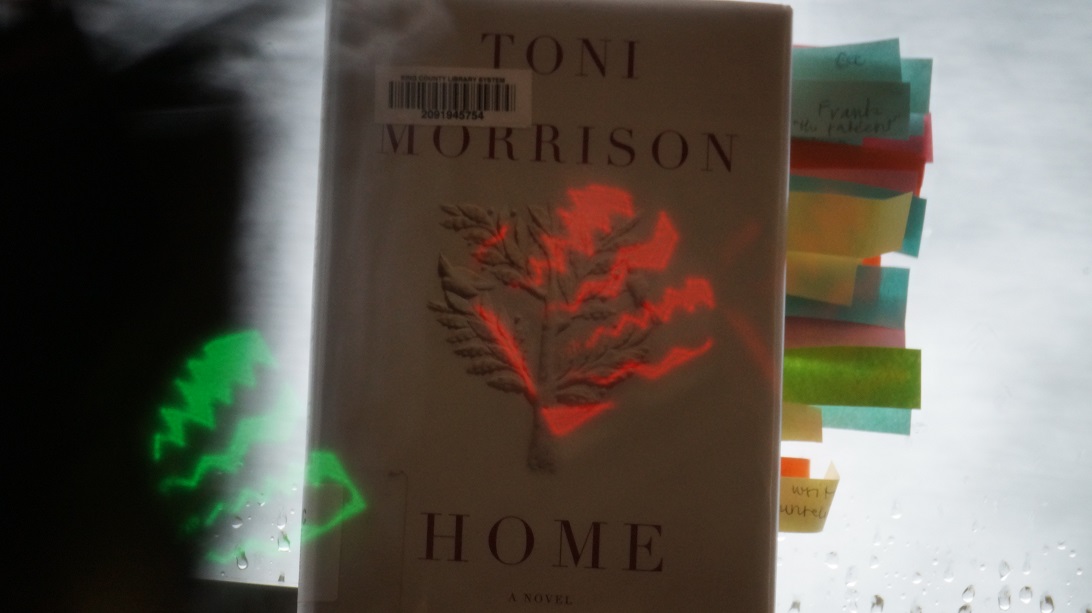
This week I read Home by Toni Morrison. Home is a compact novel of only one hundred and forty six pages. It has a great opening hook of a man trying to escape from a hospital and letting the reader in on his plans of deception and escape. He doesn’t remember what he did to get arrested or taken to the hospital which starts the story off with a mystery. However, the novel continues to surprise by changing POV characters. The reader, keeps expecting the story to return to the first character Frank, a Korean War veteran with PTSD, but the novel keeps moving from character to character through the women in Frank’s life before coming back to him.
What I Learned
Structure: For a short novel, it has a surprise multi-POV structure with chapters in italics talking to the author, or someone who might tell the MC’s story in the future.
The title does a lot of work for the novel. It presents the theme and dramatic question and argument. What is home? Is it a place, a feeling, a person? Is it true that you can’t ever go home again? Or is home the place you settle, find comfort, or just give up looking for anything better?
Opening hook: The novel starts with one of the italicized sections describing a childhood memory that is a mystery about witnessing a dead body being buried in a field and ends addressing “you” as the person “set on telling my story.”
The first opening scene. The opening sentence is one word: Breathing. The next sentence is, “How to do it so no one would know he was awake.” What an intriguing opening. The character is contemplating using the most basic controllable action necessary for life to create a deceit. Instantly the reader has a ton of questions. Who is he trying to deceive? Why? Whether our MC is a good guy or a bad guy, he is manipulative and deceitful at the most basic level. And yet the reader wants answers to why and thus there’s already an investment in the character at least until they find out why he’s in that situation.
Evoking emotion: The emotion this novel evoked for me was disgust. To do this, Morrison broached taboo topics like Eugenics, forced sterilization, the horrors of war, PTSD, and child prostitution. I talked about writing about taboos in my RNLN post about A Widow For One Year by John Irving. She used many different techniques to finally get the reader feel disgust.
1. An unreliable main character. The main character is a Korean War veteran with Post Traumatic stress. He signed up with two of his childhood best friends and watched them both die horrible deaths. Morrison’s descriptions of how he experiences PTSD make his actions and feelings both real and relatable.
2. Making the main character honorable, or giving him heroic attributes: the only thing he has is the medal he earned for valor, and the reason he escapes and heads to Georgia is to save his sister. Everything he does is because he received a letter that says his sister’s life is in danger.
3. Making the main character vulnerable and giving him faults: The main character keeps getting mugged and losing all his money. He has to rely on the kindness of strangers. He has to trust others when he can’t even trust himself.
4. Betrayal: Though Morrison has set up the MC as a person who can’t be trusted, through making him relatable, honorable, and vulnerable she tricks the reader into believing him, only to be betrayed by the horror of the truth of his actions during the war when he finally faces and shares his truth.
Ending: The ending circles back to the opening scene, finding closure for the children in that opening memory.
Character and Character arc:
By using multiple POVs, Morrison makes it possible to see the MC through the eyes of the women in his life. One of the chapters is through the eyes of the “evil step-grandmother” who his family lived with before he left for the war. From her point of view, she had just gotten what she wanted in life before her new husband’s destitute family showed up and took it all away. They not only took her space, they expected her to be responsible for their children who became the only ones for her to take her frustrations out on.
Near the end, Frank sums up his sister Cee’s character arc for the reader:
“This Cee was not the girl who trembled at the slightest touch of the real and vicious world. Nor was she the not-even-fifteen-year-ole who would run off with the first boy who asked her. And she was not the household help who believed whatever happened to her whole drugged was a good idea, good because a white coat said so. Frank didn’t know what took place during those weeks at Miss Ethel;s house surrounded by those women with seen-it-all eyes. Their low expectation of the world was always on display. Their devotion to Jesus and one another centered them and placed them high above their lot in life. They delivered unto him a Cee who would never again need his hand over her eyes or his arms to stop her murmuring bones. “
I think one of the things I’m learning through reading novels as a novelist is telling the reader what you want them to take away from the novel is something the great novelists do. What makes it different than just exposition or telling is that the statements are interesting and thought provoking. The rule “show don’t tell” appears to be a rule meant to be broken.
Description and time: When the main character, Frank (Smart) Money does finally go home to his parents’ house, “that had been empty since his father died,” he re-rents it for a few months and finds some treasures in a hole next to the stove. “Cee’s two baby teeth were so small next to his winning marbles: a bright blue one, an ebony one, and his favorite, a rainbow mix. The Bulova watch was still there. No stem, no hands—the way time functioned in Lotus, pure and subject to anybody’s interpretation.”
In that short description, she says so much. The most important things to the MCs young self were his sister’s baby teeth, his winning marbles and a broken watch. But she’s also described life in the town he grew up in, and time itself. Time is “pure” when it can’t be tracked or known.
Another way she uses description and time is right after Frank brings his sister Cee to a safe place. Her life is in danger. The reader doesn’t know if she will live and so the reader is hooked. Frank has done what he can do and now his sister’s well-being is out of his hands. So what does Toni Morrison do next? She writes two pages of description about the sun and heat. Current writing instruction would would most likely tell me that readers won’t put up with that much description anymore. They will get bored or scan over it, and yet, in this novel it works. She’s putting the reader in Frank’s shoes. He’s feeling the sun and the heat acutely as he walks to line up for work in the cotton field while no longer having anything he can do to help his sister but wait and stay away.
Thought provoking equivalencies: The thing that really makes this novel stand above to me are the statements about abstractions:
content=hopeless “My family was content or maybe just hopeless living that way. I understand. Having been run out of one town, any other that offered safety and the peace of sleeping through the night and not waking up with a rifle in your face was more than enough. But it was much less than enough for me. “
desire=disgust “Thinking back on it now, I think the guard felt more than disgust. I think he felt tempted and that is what he had to kill.”
violence=good “Once seated, Frank wondered at the excitement, the wild joy the fight had given him. It was unlike the rage that had accompanied killing in Korea. Those sprees were fierce but mindless, anonymous. This violence was personal in its delight. Good, he thought. He might need that thrill to claim his sister.”
I’ve reached an interesting and complicated point in my study. I want to create images that express contradictory abstract nouns and evoke emotion. But how will I photograph those images if everyone has different definitions for abstract nouns and everyone perceives images differently? How do points, lines, and colors on a two-dimensional surface evoke emotion at all?
This exploration will be ongoing, probably for a long time. I’ve been reading widely and while re-reading Abstract Art by Anna Moszynska noticed a reference to a text called Point and Line to Plane written by Wassily Kandinsky. I had recently looked at a picture book called The Noisy Paint Box by Barb Rosenstock which talks about Kandinsky having synesthesia. I’m glad I read that before Point and Line to Plane because it helps make sense of how Kandinsky talks about visual elements making sounds.
The Science of Art
In Point and Line to Plane which was first published in German in 1926, Kandinsky is attempting to create and explain a science of art. He sees every experience as a duality of external and internal.
Every phenomenon can be experienced in two ways. These two ways are not arbitrary, but are bound up with the phenomenon—developing out of its nature and characteristics: Externally—or—inwardly. . . . Aside from its scientific value, which depends upon an exact examination of the individual art elements, the analysis of the art elements forms a bridge to the inner pulsation of a work of art.
Wassily Kandinsky
When explaining his idea of an outer experience he titles the section “Shock.”
Sometimes an unusual shock is able to jolt us out of such a lifeless state into vigorous feeling. Frequently, however, the most thorough shaking fails to revitalize the deadly condition. The shocks which come from without (sickness, accident, sorrow, war, revolution) wrench us violently out of the circle of our customary habits for a shorter or a longer time, but such shocks are, as a rule, looked upon as a more or less violent “injustice.” Therefore, the desire to re-establish as soon as possible the traditional habits, temporarily abandoned, outweighs all other feelings.
And here’s his explanation of Inner experience:
Disturbances originating from within are of a different character; they are brought about by the human being himself and, therefore, find in him their appropriate foundation. . . . There, the receptive eye and the receptive ear transform the slightest vibrations into impressive experiences. Voices arise from all sides, and the world rings.
Kandinsky’s ideas of inner and outer experiences make me think of the emotions of the artist while making art and the emotions of the observer when experiencing the art. No matter how precisely an artist has used different elements in an attempt to evoke a specific emotion, or experience, the viewer may see something completely different.
I shall mention in passing that the theory of empathy has afflicted generations of aestheticians with a host of pseudoproblems. One asked : Are the feelings expressed in sights and sounds those of the artist who created them or those of the recipient? Does one have to be in a melancholy mood in order to produce, perform, or apprehend a melancholy composition? Can “emotions” be expressed in a Bach fugue or a painting by Mondrian? These and other similar questions become incomprehensible once one has understood that expression resides in perceptual qualities of the stimulus pattern.
He alone can appreciate the art, who could comprehend the conversation of the painter, and share in his emotion, in moments of his most fiery passion and most original thought. And whereas the true meaning and end of his art must thus be sealed to thousands, or misunderstood by them; so also, as he is sometimes obliged, in working out his own peculiar end, to set at defiance those constant laws which have arisen out of our lower and changeless desires, that whose purpose is unseen, is frequently in its means and parts displeasing.
So what is the relationship between the emotions of the artist and the emotions of the observer?
“Riegl emphasized an obvious but previously ignored psychological aspect of art: that art is incomplete without the perceptual and emotional involvement of the viewer. Not only do we collaborate with the artist in transforming a two-dimensional figurative image on a canvas into a three-dimensional depiction of the visual world, we interpret what we see on the canvas in personal terms, thereby adding meaning to the picture. Riegl called this phenomenon the “beholder’s involvement.” Based on ideas derived from Rigl’s work and on insights that began to emerge from cognitive psychology, the biology of visual perception, and psychoanalysis, Kris and Gombrich went on to develop a new view of this concept, which Gombrich referred to as the beholder’s share.
Kris, who later became a psychoanalyst, started things off by studying ambiguity in visual perception. He argued that every powerful image is inherently ambiguous because it arises from experiences and conflicts in the artist’s life. The viewer responds to this ambiguity in terms of his or her own experiences and conflicts, recapitulating in a modest way the experience of the artist in creating the image. For the artist, the creative process is also interpretative, and for the beholder the interpretative process is also creative. Because the extent of the viewer’s contribution depends on the degree of ambiguity in the image, a work of abstract art, with its lack off reference to identifiable forms, arguably puts greater demands on the beholder’s imagination than a figurative work does. Perhaps it is these demands that make abstract works seem difficult to some viewers, yet rewarding to those who find in them an expansive, transcendent experience.”
Outside the Box by Maria L. Berg 2023
The How-tos of Evoking Emotion
Searching for the actual how-to of evoking emotion with art, I found a couple of paragraphs in The Art of Photography by Bruce Barnbaum:
Let’s pause for a moment to consider the ramifications of lines, forms, and contrasts on the emotional content of an image. This is of the utmost importance because even the most technically perfect print is meaningless without emotion.
. . . jagged lines are far more active than curved lines, which themselves are more relaxed. High contrast is far more active than low contrast. Middle gray tonalities impart the quietest, most relaxed mood of all. So jagged, sharp lines or even tightly curving, twisted lines combined with high contrast will be intensely active and highly charged. Gently curved lines along with softly modulating tonalities will impart a quiet, relaxed mood.
Any thinking photographer will use this universal language to his or her advantage. If you want a quiet, reverential mood, you’ll do well to work with curved lines, rounded forms, and subdued contrast. Soft light, gray tones, and pastel colors on rounded hills impart the feeling of a gentle, pleasant, livable landscape, whereas strong sidelight on sharp, craggy rock spires imparts excitement and adventure, perhaps even a feeling of foreboding.
So certain lines and colors, tones of color and lighting can evoke calm or excitement. That’s a start.
Kandinsky begins his scientific study with the geometric point. But he quickly moves from the idea of a mark of a pen or a brush to a surface to the written word. He says the geometric point is “the ultimate and most singular union of silence and speech.”
The geometric point has, therefore, been given its material form, in the first instance, in writing. It belongs to language and signifies silence.
In the flow of speech, the point symbolizes interruption, non-existence (negative element), and at the same time it forms a bridge from one existence to another (positive element). In writing, this constitutes its inner significance.
Externally, it is merely a sign serving a useful end and carries with it the element of the “practical-useful,” with which we have been acquainted since childhood. The external sign becomes a thing of habit and veils the inner sound of the symbol.
The inner becomes walled-up through the outer.
Kandinsky
As you can see, even a point, the smallest visual (and written language and speech) element is itself a contradiction with both negative and positive elements of both inner and outer significance.
He says that by moving the point from where one would expect to see it, once can reveal its “inner tensions.” I absolutely love his examples and think it may be something to think about in the coming month of poetry:
Let the point be moved out of its practical-useful situation into an impractical, that is, an illogical, position.
Today I am going to the movies. Today I am going. To the movies Today I. Am going to the movies
It is apparent that it is possible to view the transposition of the point in the second sentence still as a useful one—emphasis upon the destination, stress upon the intention, loud fanfare. In the third sentence the illogical, in pure form, is at work. This may be explained as a typographical error—the inner value of the point flashes forth for a moment and is immediately extinguished.
Kandinsky
So how does this help me with my images? Kandinsky got me thinking about focusing on basic elements. I haven’t contemplated the point’s inner tensions before; its sounds and silences, its illogical positions.
This week is going to be a little different. Every time I look “Abstract Art” in my local library system’s catalogue, the novel Kaleidoscope by Brian Seznick comes up. The cover looks like an extreme close-up on a green eye with the white lettering across the pupil. I’ve been curious why that novel comes up with “abstract art” every time, so this week, I checked it out and read it.
Seznick explains the connection himself in an author’s note:
“During the first three months of the pandemic . . . I started making abstract art, perhaps because it felt like the world was shattering, so my art needed to do something similar. . . . I found myself ripping apart everything I’d already written. It was like the narrative was shattering along with everything else, and out of the shards a new book began to take shape. . . . That’s why I decided to call this new version of the book Kaleidoscope, because each of these elements, like bits of colored glass, turn and transform and rearrange themselves into something new.”
Brian Seznick
I also finished S. by Doug Dorst and J.J. Abrams. You may recall that I first encountered S., or The Ship of Theseus while looking at unusual formats during RNLN of The Woman in the Library. I was taking my time reading it, reading a couple of pages of the text, then reading all the marginalia. But then I saw that two people are waiting for it at the library, so it will be due soon, so I started reading the text about a half chapter at a time them going back to the marginalia and that worked a lot better for me to get me into the story, though I must admit, after initially loving the concept, I found the result rather dull.
Both of these novels were very unconventional and yet, to me, had a lot in common. They both found ways to manipulate time, to have the past, present, and future exist in the same space, and they both explored the concept of identity, of knowing one’s identity, of a person’s ever-changing identity. And they both explore the fluidity of relationship.
Time & Space, Identity, and Relationship
In the sixth story, “The Abandoned House,” Seznick addresses Kaleidoscope‘s approach to time and space directly when James says,
“Most people think time is a machine that needs to be oiled and wound with a key. They think it’s something you control and maintain. But maybe it’s more wild than that. Maybe it’s bigger and stranger. Maybe time is uncontrollable, and endless, and … dangerous. Like a forest eating a house.”
Brian Seznick
The order of the very short stories of the narrator and James moves like that: bigger and stranger and wild. In the first story James leaves and the narrator is accused of his murder, and in the second the narrator has become, or is a giant who can become invisible and James may be the name of a boy who gives him an apple. Later James is an imaginary friend, and in another story the narrator is a spirit.
Then how is this a novel?, you may ask. Or how are these the same characters?, you may wonder. Seznick does a great job of explaining this in “The Story of Mr. Gardner.” Mr. Gardner attempted to write the ultimate reference book. He started with defining an apple, and ended up with seventy-five thousand pieces of paper, still trying to finish his definition of an apple when he died.
“We had only a tiny fraction of everything he wrote in our possession, but the fragments included references to Greek myths, the origins of the universe, children’s fantasy novels, the quests of King Arthur’s knights, the creation of the periodic table, a man who found the entrance to a buried city behind a wall in his house, spaceships, ancient Egypt, mysterious castles, the invention of the kaleidoscope, and the knitted blankets of his childhood bed.
“It’s sad that Mr. Gardner died without finishing,” I said.
“I suppose,” said James. “But I think he may have discovered something interesting.”
I waited for James to continue. He gently placed his hand on top of the pile of papers, as if he was touching a living thing, and said, “The entire universe can be found inside an apple.”
Brian Seznick
The stories in this novel are like those fractions of everything that define the narrator and James.
In S. the physical space of the book, the text, the footnotes, the inserts, and different colors of ink show the past, present, and future, overlapping on the page. In the text of The Ship of Theseus which is the novel that S. revolves around, time behaves differently on the ship than it does on land. In the section of Ship of Theseus called “Interlude: Toccata and Fugue in Free Time,” the character S. moves between the ship and land many times, slipping between times and spaces.
“When S. is on the orlop, with the pen’s nib flying over paper, with ink spattering over skin, fabric, wood, what emerges on the paper are flashes of image, lightning-strikes of sense-memories, fragmented impressions of events. They refuse to be strung into coherent, linear narrative no matter how consciously he tries to arrange them so; in fact, the more he tries, the more the pieces resist his efforts. Many feel as if they belong to his past, but others almost certainly belong to the lives of others . . . he transcribes a captain’s log of voyages he has never taken on a ship he has never boarded; he chronicles (confesses?) his murderous skulkings on terra firma , although these accounts drift away from fact, toward distortion and grotesquerie as he—a dazed but rapt Hephaestus—sits and sweats in the greasy orange glow, watching his hands as if they were not his own.”
V. M. Straka
The marginalia references another of V. M. Straka’s fictional novels, but this can also be read as a description of S. as a whole.
At one point in The Ship of Theseus, the story addresses the philosophical question, or mental puzzle called “The Ship of Theseus.” S. finds a book that chronicles every change that has been made to the ship he is on, and poses the question to himself.
“On the first page is a charcoal drawing of his ship (no, he reminds himself, the ship on which I’ve been held)—or, rather, an earlier version of it, when it was a harmonious whole, a shipwright’s realization of a xebec that would fly across the main and leave sailors about other vessels dumbstruck with envy. With each page S. turns, he finds another drawing of the ship along with marginal notes cataloguing the changes it has undergone.
He flips forward, ten to twenty pages at a time. Again and again the ship sheds a feature and dons a new one, reinterpreted and remade. Some of these changes are noteworthy . . . each one seeming to widen the gap between what was intended and what turned out to be. . . .Are they the same ship? Intuition tells him they are, though perhaps he is being influenced by the fact that the pages are all held together within the same covers.”
V. M. Straka
This made me think of the short short stories that make up Kaleidoscope, and all the postcards, letters, and marginalia that make up S. Are they novels because they are held together and presented as such? I think it’s more than that. Each of the authors used moments within the novels to explain how to read and appreciate them as novels.
Attraction by Maria L. Berg 2023
Applying What I Learned
Though my novel is told chronologically, these novels got me thinking about all of the times in my MC’s life that affect what is happening in the present story and got me brainstorming.
Which times of Verity’s life play the largest roles in her present being?
Happy childhood, loving parents, happy home
Her dad gets shot in a random act of violence Meets Memphis because forced bussing Memphis uses Verity’s address so they can continue to go to same schools, Verity’s mom goes along with it when asked, but holds it over Memphis. Says if she ever gets called that Memphis is in trouble, she’ll tell them the truth. This starts Memphis’s resentment of Verity.
Middle School dramas / basketball / fascination with school shootings, random acts of violence High School dramas / basketball / fascination with school shootings, random acts of violence / parties / dances
College : left town for the first time / felt a little fame from basketball / aches, pains, injuries?
Good relationships/ Bad relationships
Her mother getting sick Leaving college to go to school closer to home to take care of mother Taking the job as a cop Becoming a detective Solving her first big case Pauline getting murdered The restraining order / getting fired Her mom dying
All of these things and more happen before the novel begins.
In Kaleidoscope, the two main characters—the first person narrator, and James take on many different personae.
I, the first person narrator is a boy, a giant, a man James is an imaginary friend, a boy, the king of the moon
What are my MC’s different identities?
She is the store detective working a nine to five, going home, eating dinner, watching tv, going to bed, doing it again tomorrow Verity of the first paragraph of this novel. She is the Verity of the present who goes through the events of the novel She is jogger Verity She is Memphis’s friend Verity She is Verity who pretends to be like Memphis to get attention She is daughter Verity, grieving for her mother She is jobless Verity, grieving for her future She is obsessive connection-making thinker Verity She is detective Verity She is police officer Verity She is uncomfortable in her body tall Verity She is in command of her body basketball player Verity She is not Malibu Verity
By the end there, I was thinking about Barbie and all her different personae.
How do the events I listed that formed how Verity is in the present interact with her different identities? I think I’ll try writing some of the big events in Verity’s life from her point of view as they happened, then as a memory from the POV of a present identity. Once I’ve done that, I may want to re-evaluate my chronological telling. Is there a stronger way to use time, identity, and relationship in the way I tell my story?
This Week’s Surprise Connection
I checked out a book called The Writer’s Library by Nancy Pearl and Jeff Schwager, in which they talk to authors about the books that “made them think, brought them joy, and changed their lives.” I thought this might have some interesting insight for this study.
In the Foreword by Susan Orlean she says, “In Senegal, when someone dies, you say that his or her library has burned.” (Having lived in Senegal, I did not ever hear that, and have trouble imagining it, said, but some people in Senegal could say it.) But that’s not this week’s surprise connection. Later she says, “At last, I understood how much we all are our books. Their meaning to us doesn’t end when we close the last page. What we glean from them alters us permanently; it becomes part of who we are for as long as we live.”
After reading that, I started reading Kaleidoscope and in the third story “The Library,” I read
“I found one other thing from the wreck,” I told him. “A locked chest.”
The boy sat up. “Where is it now?”
I brought him the chest, and he opened it with the key he wore around his neck.
As he lifted the lid, we saw the trunk was full of seawater stained black with ink and glue. One by one the boy pulled out soaking, ruined books. They dissolved in his hands and he collapsed on the floor in tears.
“Tell me what they were,” I asked. “My father’s books,” he said. “He was teaching me from them. I loved reading these books and discussing them with him. Now he is gone, and so are all the things he knew. Everything is lost.”
It was as if the two texts were talking to each other.
For today’s Poetics prompt at dVerse Poets Pub, Ingrid urged us to “write the poetry of the places and/or spaces which inspire you the most.” What a wonderful prompt for the first sunny spring day of 2023 here at Lake Tapps.
Once Upon a Lake Tapps Spring
Today the Mountain peeks from behind the clouds like a coquette behind a fan flirting with her eyes. She catches mine from across the still lake, reflecting clouds with slight ripples, offset like a panoramic image poorly seemed.
The sun shines so a saw blade growls, a fishing boat cuts the shallow water, and a dark-eyed junko atop a budding rhododendron announces spring.
I say hello to a fat, fuzzy, orange and yellow bumble bee on the purple heather. He chases me buzzing bigly. When he’s gone, I return to the heather and I’m surprised to smell licorice.
The lake is rising, fed by the river, fed by the melting mountain snow, but sits at the bottom of the ramp. The water is so clear. I can see every rock, every striation of every rock, fuzzy clumps of algae on and around the rocks. I put my fingers in.
The water’s cold but doesn’t bite. I smell my fingers expecting fish and decay, but smell nothing. I scoop the water in my palm, but still nothing. Fresh nothing like the air.
I pick up a large white feather from the grass. Its stiff stem is clear. I can see into it to another layer where the feather begins. Shed from an eagle’s tail, or the wing of a goose or a swan? I am never without bird possibilities.
The lake is choppy now. Sun glinting on the tiny waves is almost blinding, but I don’t want to look away. Strange yells pull my attention across the lake. A man bounds from his house, I think he is suffering, is panicking, but he returns to his house calmly, having chased the geese back to the lake. My eyes return to the blinding sparkles.























 Experience Writing