This poem is in response to Laura Bloomsbury’s MTB prompt at dVerse Poets Pub to write in the Parallelogram de Crystalline form about “the beauty of a (real or imaginary) lover as compared with and described in images of nature.”
Summer Fling
A love like A wild bunny gorging On juicy ripe garden strawberries
Grows brazen And bold with each red theft But darts from the gushing sprinkler’s drops
Greedy for The sweet rush of the fruit Fleeing any substance that feeds roots
Once all the Tasty nibbles are gone He’ll gnaw the leaves if not chased away
“If we approach reading mindfully, we’ll get more out of it.” ~Brian Jackson
One thing that came up in April’s exploration of Depth that I wanted to explore further was Deep Reading. In Madhu Bazaz Wangu’s Unblock Your Creative Flow(Amazon assoc. link), she says Deep Reading is “transformative reading that will help you grow in your writing and enrich your daily life.” She describes Deep Reading as reading hard books, and challenging texts, but also describes it as slowing down to absorb the texts at a deeper level: reading mindfully, with attention and awareness.
Dr. Maryann Wolf, author of Reader Come Home: The Reading Brain in a Digital World(Amazon assoc. link) equates Deep Reading with turning off your cell phone and devices and concentrating on the text. I would just call that reading, but I guess in today’s Short-Attention-Span Theater, people need to be reminded that reading takes concentration and attention.
In Mindful Writing by Brian Jackson, he talks about deep rhetorical reading. Like rhetorical writing, he promotes using different reading techniques for different types of text. I think his ideas are most in line with my thoughts on Deep Reading.
A Plan for a Deep Reading Practice
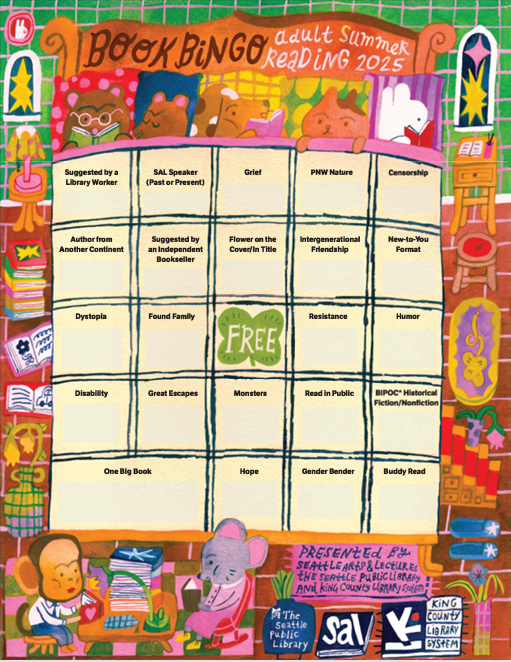
Today, let’s celebrate Summer Reading, and the library’s Summer Reading Bingo program. I got my Summer Reading Bingo card right when it came out. Usually I forget until summer’s half over and I have to rush through the books. But this year, I can take my time, savor the stories and insights, and practice Deep Reading.
I want my summer reading to keep with my depth theme: not only in content, but also in how I select the books, and how I experience them.
This Summer’s Deep Reading Plan
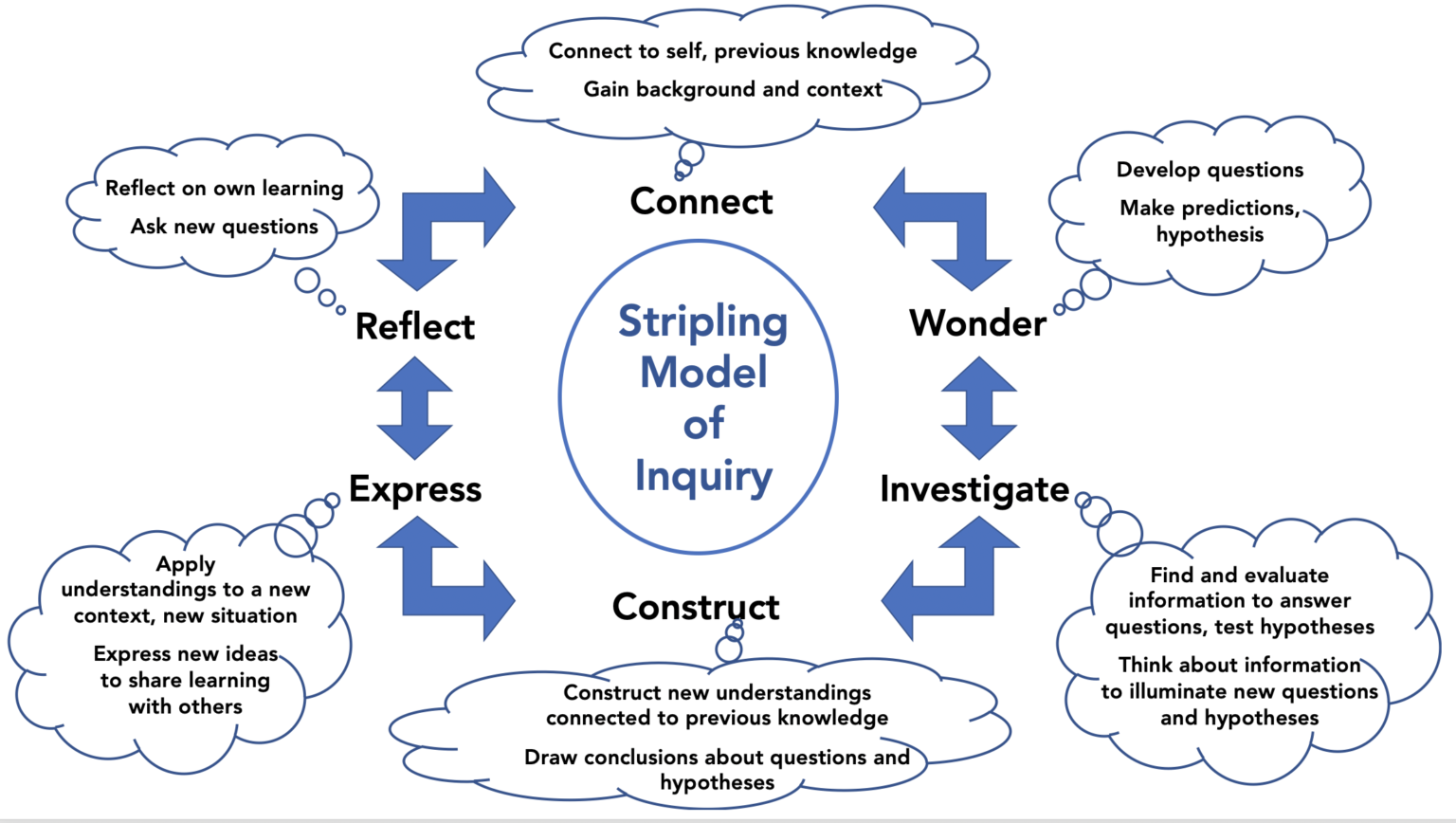
In deep rhetorical reading as well as the inquiry model, there’s some learning and thinking involved before even cracking open the book. I like this quote from Brian Jackson:
Reading, too, is a social act; as audience you complete a circuit and connect with another person’s intentions.
He says we should read with a mindful awareness of:
who writers are (rhetors)
why they wrote when they did [exigence (deep need) and kairos (timing)]
what they hoped readers will feel, think, or do (purpose)
what rhetorical strategies they use when they write
how they have constructed an experience for a specific kind of reader (audience)
So with all of that in mind, what actions can we take to read more deeply?
Choosing the books: In the past, I often read anything I thought would fit in the bingo square. But this year, I want each of my reading experiences to have positive personal value. How can I do this? First, I need to define the values I’m looking for:
I’m looking for books that will inform our depth study
I’m looking for books that will inform our Writober prompt posts
I’m looking for books that evoke emotions, so I can learn from example to write more deeply.
In other words, I want to learn something and feel something every time I read this summer.
Planning: Once we have chosen a book based on our values, it’s time to plan for deep reading.
Set an intention. Ask: Why am I reading this? What do I want to get from it?
Purpose. Ask: Do I need to remember what’s in the text? (content) Do I need to respond to this text? (conversation)
Research the author. Ask: Who wrote this text and why? What potential biases should I be aware of? (I especially like this question on bias) Who is the author’s intended reader?
Think about the books place in history. Ask: What conversation is this text joining or responding to? When was it written? Is it still timely?
Make the book personal. Start a conversation with the text. Ask: What do I already know about the topic?
Pre-reading: Quickly skim through the book. Look at the layout, chapters, headings and subheadings. Keep a journal handy while reading. Before starting, predict the answer to these questions:
What does this writer want me to feel, think, or do?
What kind of judgement am I being asked to make?
Reading: Don’t feel rushed. Take your time, and make sure you’re reading and understanding the words on the page.
Take notes: not only about the content, but also the reading experience.
Draw pictures: make your own infographics/concept maps, using contrast, development, or hierarchy to organize the material.
Self-regulating: While reading, we need to take breaks when our minds wander off. Also mixing up where and when we read can keep the experience fresh.
Review and Reflection: Don’t wait for the end of the book to contemplate what you’ve read. Choose points in the book, perhaps at the end of each chapter, to close the book, and summarize for yourself what you just read, or what you have learned so far. Have your questions been answered? Have new questions come to mind? While reading we are revising (also called calibration), checking to see if we need to adjust our understanding. Not only are we calibrating our understanding of the topic, but also our reading strategies and values.
During my summer reading, I will attempt to practice Deep Reading, and share my experiences here with you. I hope you’ll join me.
I want to answer the questions:
Does Deep Reading provide a different reading experience from how I was reading before? Do I think it’s better?
Am I having a deeper reading experience?
Do these techniques and ideas deepen my reading?
Happy Summer Reading. Here’s to Reading to New Depths!
This year, 2025, at the end of August, is the 20th Anniversary of Hurricane Katrina. It’s hard for us survivors to believe it has already been that long because we are still affected by it every day. Any survivor of traumatic events knows what anniversaries can do. So please be tender with any K-storm survivors you know, especially this late August and early September.
Opportunities by Maria L. Berg
When dVerse poets announced a coming anthology around Krisis, crossroads, I felt like it was directly in line with my depth theme, and everything I’m exploring about writing deeper this year. When I tried to write to it, I froze and avoided. I don’t like the idea of regrets, or imagining other possible lives. But yesterday’s prompt brought a memory to mind, and today, I couldn’t stop writing. Thank you, Punam of Paeansunplugged.
We Were Before Katrina
This took twice as many years as it took to build and break twice as many years more to stop faking I could take it But yesterday I remembered
when he turned to me and said I wish I had never met you which for me was an end of a prolonged fantasy of a prayer for love answered that I clung to way past its mold
I saw us in the car he shouldn’t have been driving taking us home when I had a place I wanted to be; a show I needed to see; and suddenly the truth was between us
truth we had been dusting gathered in clinging webs that would show up when light hit it in unexpected corners near the ceiling
And I was reeling so I went out and left him home I asked a friend for a space I could sleep alone, and in ‘Ren’s apartment to myself I fell on a comfortless couch
If I had gone with him inside, would we have continued and found space for those words to hide? The storm was still coming It was always coming.
Now that April’s busy challenges are over and we’ve had a couple days to breathe and calm down, let’s take some time to reflect on the month as a whole, and celebrate all we accomplished.
This year I really appreciated the array of content, and readers’ comments in conversation with my content. Here are some of my favorites: Favorite Sites I Visited: Deborah Weber: “A Logophile’s Ludic musings” Lightning Flash: Allison’s twisty-fun flash fiction inspired by Oxford Roald Dahl Dictionary Mainely Write: Donna Smith’s watercolors and poems Silvia Writes: comparing writing and running Tao Talk: Lisa’s tour of the plants in her yard
Where I learned something new: Deborah Weber’s new to me word, “Labdanum” inspired me to search out a candle with labdanum which I found in this Happiness candle on Amazon. I ordered it, and it smells nice.
I had never heard of The Earl Grey Orphan Scheme, and found Jennifer Jones’s posts at Jones Family History very interesting.
Favorite comments on my site: I loved the reactions to the Visuospatial Reasoning test: “I’ve always been so bad at spatial reasoning and that type of tests. And volume too, as shown when I try to fit X amount of leftovers into a container better suited for Y, haha. But now I’m inspired to really test myself. I already do word puzzles and riddles for my brain, so why not train myself in this way, too? It certainly has practical applications!”
“I found this fascinating. I’ve never met a spatial reasoning test I didn’t fail spectacularly. But now I’m wondering if I’ve literally just accepted I’m unredeemably bad, and that perhaps I could actually make some improvement.” ~Deborah Weber https://deborah-weber.com/blog/
“Actually, I got in an argument over a test such as this. Spanning three days. I brought in actual blocks (the wooden kind toddlers get, with the letters on them) to prove my point. The look on the administrator’s face was awesome. Nothing came from it, mind you. But at least I know I was right and I could prove it.” ~ J Lenni Dorner (he/him 👨🏽 or 🧑🏽 they/them) ~ Speculative Fiction & Reference Author and Co-host of the April Blogging #AtoZchallenge Blog of Author J Lenni Dorner
And Lisa from Tao Talk’s comment on Depth of Knowledge— “I’m thinking of areas where I feel there is depth of knowledge, and in all cases, it has been the mind and the physical doing of a thing the integrates depth into one’s being. I don’t think it can be only a cerebral exercise.” —resonated with me and motivated my organization of my posts into Mind, Body, and Soul in my Zenith post. Post I wrote with the most looks and likes (readers’ favorite): Most Views: Depth of Mary Oliver’s Poetry Most Likes: Depth Through Mindfulness Most Comments: Seeing Depth with X-rays
My favorite post I wrote: I really enjoyed writing most of my posts, but I think discovering The Topoi which led me to Excellence Cluster Topoi was my favorite. So Deep Questions would be my favorite post.
My favorite resources: I discovered so many great resources as I was exploring and learning. Here are some of my favorites that I will continue to reference as this year of depth continues. Favorite websites: Coursera course, Artful Practices for Well-being Excellence Cluster Topoi Matter Port: virtual tours of museums – this was a NaPoWriMo resource, I love 3-D virtual museum tours like these. JSTOR: I get really excited when I find original source material on JSTOR like the original Deep Image poets’ journals. Favorite books (all links are Amazon Assoc. links): Of all the books I referenced in my posts, my old Merriam Webster’s Dictionary (Tenth Edition) is my absolute favorite. I love that book. Online dictionaries are convenient, but just not the same. The Artist’s Way by Julia Cameron Man and his symbols (1964) conceived and edited by Carl G. Jung Books I bought inspired by my own posts(all links are Amazon Assoc. links): The Miracle of Mindfulness by Thich Nhat Hanh Fear by Thich Nhat Hanh Unblock Your Creative Flow by Madhu Bazaz Wangu
Though it feels good to focus on all the good and fun favorites, we find depth in the comparison of the good with the bad, so here’s a look at the least favorites:
There were tons of great R words I could have chosen, but Recondite was one of depth’s definitions, so I went with it. However, other than being a new-to-me word, I really didn’t have much to say about it. I liked the quote I found, but as a post overall, I didn’t find a lot to say. I really like the room in the video, but that doesn’t add to the meaning of recondite and it’s relation to depth. With more time and effort, I think I could have done better with Recondite. Or maybe it is what it is.
This year I did things differently than I have in the past. I downloaded the A to Z participants list and methodically clicked on every site, making notes of which ones were really participating, what the content was, and when I commented. I think this led to a stronger feeling of community and less frustration.
Unlike previous years where my focus was more on poetry and National Poetry Month, this year I felt more connected to the A to Z aspect of my posts. Both the Napowrimo and PAD Challenge sites use Disqus for posting and I don’t enjoy it. I like going to people’s personal sites to comment and interact.
I had been contemplating changing Writober to Disqus or something like it, but instead, I’m going to create a sign-up form like A to Z’s so we can all know who’s participating and interact that way.
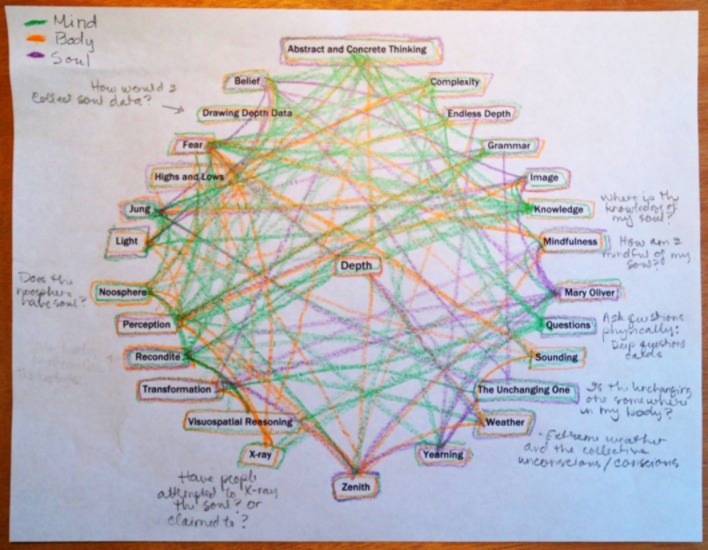
This morning as I reviewed and reflected I was reminded of an exercise I did for novel revision called a character web. I thought it would be fun to create a web of connection for my A to Z posts. Using the Mind, Body, and Soul categories I created in my Zenith post as color coding, I examined how I think the different aspects of depth I discussed from A to Z connect.
Wow was that an exercise in mindfulness. Staying with my content was like staying with the breath way past both feet falling asleep. I think and feel it was worth it. I discovered that almost every aspect of depth I wrote about connected with mind, body, and soul. The ones that didn’t inspired me to ask deep questions, I wouldn’t have thought to ask before.
Did any of my posts inspire your deep questions? Would you like to share them in the chat? This whole year (and maybe more) is about depth, so I would love to hear what resonated for you, and what you’re curious about.
Thank you everyone for reading and interacting with my posts this April. I didn’t feel like I was talking to the depths of the void; I felt like I was on a journey of discovery with the noosphere.
I’m still trying to figure out the best posting schedule when not posting every day. As I deepen, and explore more deeply, these posts will take more time, but I also want to provide content often, so I think twice a week is possible. What are your favorite days and times to read this kind of content? Or is once a week, or twice a month more your speed? Please let me know in the comments.
It’s our last day of NaPoWriMo (National /Global Poetry Writing Month) and the A-Z Challenge. We made it. Congratulations!!
from Wikipedia
Here we are at the zenith of our depth study. This is the culminating moment, the climactic and decisive point. Like depth, zenith both abstract and concrete meanings. The zenith is the point of the celestial sphere vertically overhead of the observer. The opposite of the zenith is the nadir, the point directly beneath the observer.
A Change of Perspective
When we lie on our backs and look up at the stars. The stars directly overhead are the zenith stars. When was the last time you took a blanket out to stare up at the stars long enough to observe their movement across the heavens?
Shadows are their shortest when the sun is at its zenith. How often do we observe the changing length of shadows?
When was the last time you watched the clouds, watched the birds circling overhead, stared up into the branches?
One thing I’ve learned about depth in my study so far is that depth is about slowing down, paying attention, and connecting present sensory information to our inner lives. Take a few minutes today to get down on the ground and look up. Observe the celestial zenith.
How to Reach Your Zenith
At HumanZenith.com they say that the human zenith is about optimizing Mind, Body, and Soul. They have products for sale in each area, and the emphasis appears to be on meditation and yoga, but they got me thinking: How can depth study help us optimize Mind, Body, and Soul to reach our zeniths? I’ve gone ahead and sorted each of this month’s posts into one of these three areas.
That was a fun exercise. The posts were more balanced than I expected. Many of the posts have overlap that isn’t shown here. I think this was a great way to start thinking about the posts for my reflections post. In my future depth exploration this year, I think I want to explore how my topics deepen mind, body, and soul.
Today’s Poem
Crossing Boundaries
You are the music from my walls the complete betrayal of the walls to keep me safe from grayscale paperdolls with toothless slit mouths chains and machinery to lift their monstrous weights hammering the whole day banging your voice on the wind is irresistible breath circling round and around always a hand in the sound singing of fun to misbehave you are the nest in my chair the complete betrayal of the chair to hold my weight you steal a little of the music from inside me then tell me I’m running out of time but music is everywhere misbehaving music splashes in the pool dream voices echo off the tiles symphonic splatter on the walls growing mindgames sing from shoulders betrayal’s notes flow like calmes in colored glass
Thank you so much for coming by and reading my post. Any thoughts or questions about the zenith? Now it’s time to celebrate April’s end. I hope you’ll come back soon.
It’s our last couple days of NaPoWriMo (National /Global Poetry Writing Month) and the A-Z Challenge. I hope you’re enjoying the A to Z of Depth.
Yearning by Maria L. Berg 2022
I really like the word yearning. It evokes longing and desire, but also has year in it and earning and is only one letter off from learning. I found a quote that expresses just that:
“A happy life is one spent in learning, earning, and yearning.”~ Lillian Gish
So why another post about yearning? Because when I looked up the difference between yearning and desire I read, “While “yearn” and “desire” both describe a longing for something, “yearn” typically implies a deeper, often more intense . . . longing. Yearning is a more powerful and profound longing. So yearning is in our definition of depth: “the quality of being profound.” Let’s look more deeply at yearning.
The word yearn originated from the Old High German gerōn, meaning desire, the Latin hortari to urge, encourage, and the Greek chairein to rejoice. And yet it has a negative connotation in its meaning: to long persistently, wistfully or sadly. Yearning is complicated that way: it’s positive in that it’s a deep-seated longing that motivates us, and yet it’s a longing for something unattainable that can discourage and frustrate us.
My attempts at a deeper exploration of yearning led me to Dr. Stephen Hayes, Acceptance & Commitment Therapy (ACT), and The Hexaflex Model of psychological flexibility.
ACT is a type of cognitive-behavioral therapy, that provides a set of skills for staying in the present moment while acting on long-term values. ACT uses mindfulness to help you stay in the moment because it is based on the idea that we cannot control our thoughts or emotions, but we can control our behavioral responses, and we can only do that in the present moment.
According to Jacob Martinez of the ACT Matrix, Stephen Hayes assigns six core yearnings to the six points of the Hexaflex model:
Yearning for Belonging
Yearning for Coherence
Yearning for Orientation
Yearning for Feeling
Yearning for Self Directed Meaning
Yearning for Competence
Since I’m just discovering ACT and the core yearnings, I’ll write another post after I’ve read Stephen Hayes’s books.
What Do I Yearn For? an exercise
I think discovering and identifying our deepest yearnings is a good place to start if we want to write and think more deeply, but how do we do that? I thought back to the fears exercise from the Deep-seated Belief post at the beginning of the month. Could we just switch the opening list from things we’re afraid of to things we yearn for? We can try it.
Then I thought of exercises in The Artist’s Way. It seems like Julia Cameron is always trying to get me to write what I yearn for in different ways. Let’s try it.
Here are some list prompts. I made these up inspired by exercises in The Artist’s Way. For each prompt list ten things as quickly as you can.
What did you love to do as a kid that you don’t do anymore?
If you had plenty of money what would you do that you don’t do now?
Imagine you could visit yourself through the multi-verse. What other fun lives would you be living?
What would you be doing if your dreams started coming true?
If you had had the perfect childhood, what would you have grown up to be?
List the skills or talents you wish you had.
Now take a look at your lists. Can you label the things you’ve listed with the six core yearnings? Is one yearning, or a pattern of yearning becoming clear? In the present moment is there one thing you can do to change that yearning into action? Do it.
Today’s Poem
Toccata
Some days you just want to pound the keys violent, loud
hammering sound the whole day banging through each finger
muscles tensed to mallets meeting resistance past exhaustion
He says you need to know your folk songs
near the end vibrating bodiless in energy’s hum blinded by inhuman luminescence the songs all join your oscillation
Thank you so much for coming by and reading my post. Any thoughts or questions about yearning? Come back tomorrow for more depth exploration and poetry.
X-rays are electromagnetic radiation outside the visible range with wavelengths between gamma rays and ultraviolet rays. X-rays have higher energy than visible light and can pass through most objects. Wilhelm Röntgen discovered X-rays accidentally while exploring light phenomena produced by discharging electrical current through vacuum tubes in 1895.
For medical x-rays that take images inside our bodies, x-rays are generated by an x-ray machine, pass through the body, and pass through an x-ray detector on the other side. The image represents the shadows of the forms inside the body. The captured images that result are called radiographs.
Look at some of these strange things x-rays have revealed in human bodies: X-Ray Oddities: the light bulb and the fir tree really creep me out.
Most of us don’t have an x-ray machine handy to check out our bodies, (and x-rays can also have harmful effects), but we can do our own body scan with a body scan meditation. I enjoyed John Kabat-Zinn’s body scan meditation in his Masterclass, so I found his body scan on Youtube to share with you.
Today’s Poem
Generational Celebration
When the cherry-plums burst into pink this spring, I thought they were early. Mom said they were late. Either way they lit up my windows with sugar-spun blush. Their quick burst of energetic joy short-lived like the jolt from Kool & the Gang’s Celebration at a reception. Everyone around the world, woo-hoo and then the song fades, and the petals fall as quickly as they arrive.
When I went out to look at the dark burgundy leaves of the now calm cherry-plums, birthing little balls of future fruit, it looked like the pink from past blossoms had dripped onto the rhodie below. Burgundy echoed in each flower’s heart, but the petals burst with springs blush again like a generational passing of pink.
Today being Sunday, there is no A to Z. Here is my poem in response to the prompts at NaPoWriMo and Writer’s Digest’s Poem a Day Challenge.
Sadko in the Underwater Kingdom by Ilya Repin 1876
New Depths
The frontman gets all the glory even here in the depths of the underwater kingdom where do they think the processional music is coming from as they parade their daughters before him?
Sadko, even you ignore me though I accompany you everywhere I see you there below in your thick coat that doesn’t even look soaked as I play this durge on my bubbling organ in this cave: only the goldfish looks my way.
How will you choose your prize and when you have will we finally rise to the surface or will the wedding march be our final reprise?
It’s our last full week of NaPoWriMo (National /Global Poetry Writing Month) and the A-Z Challenge. I hope you’re enjoying the A to Z of Depth.
from NOAA
When we talk about the weather, it’s usually small talk. The most shallow kind of talk with no emotional connection unless there’s been a severe weather event. However, one of our definitions of Deepen comes from Meteorology. Deepen can mean to decrease in atmospheric pressure. So let’s take a look and some deepening weather.
Weather is relative. It is not so much about atmospheric pressure, but change in pressure.
Definitions from the National Oceanic and Atmospheric Administration NOAA:
Deepening A decrease in the central pressure of a surface low pressure system. The storm is intensifying.
Explosive Deepening A decrease in the minimum sea-level pressure of a tropical cyclone of 2.5 mb/hr for at least 12 hours or 5 mb/hr for at least six hours.
Rapid Deepening A decrease in the minimum sea-level pressure of a tropical cyclone of 1.75 mb/hr or 42 mb for 24 hours
I like that term “Explosive Deepening.” It’s got me imagining sudden emotions as explosive deepening.
Today’s Poem
Explosive Deepening – A Sonnet
You tell me to respond on my own time I relax into how sublime that sounds Then you tell me I’m running out of time I bristle warm and nervous at the sound
Molecules collide in the container heating and vibrating between the sides Soon the building pressure won’t be contained and the cyclonic storm will not take sides
But the weather here is all relative only measured by atmospheric change All my responses are relational The constant—sea level—dares also change
We’re all in an intensifying storm that will dissipate until it reforms
Thank you so much for coming by and reading my post. Any thoughts or questions about Deepening Weather? Come back tomorrow for more depth exploration and poetry.
Did you ever take a test with images like the ones above? If so, you were asked to look at the image on the left and imagine it as a 3-D object, then turn it in your mind and choose what it would look like from the images on the right. This was a test of your Visuospatial reasoning.
There are several interesting videos in this Visuospatial reasoning section of this KBAI (Knowledge-based Artificial Intelligence) series from Georgia Tech and Udacity that was produced ten years ago, if you are interested in exploring further.
I found some really interesting information in “Human Pattern and Object Perception by P. C. Dodwell, Chapter 15 of Handbook of Sensory Physiology Volume VIII: Perception(amazon assoc. link), a book given to me by my professor in grad school.
Our visuospatial knowledge begins with stereoscopic depth perception. Each point on the retina has an intrinsic visual direction and we map the visual field into retinal coordinates. When seeing with both eyes, inter-ocular distance and convergence angle allow us to map the three-dimensional physical world onto our retinas which are a pair of two-dimensional surfaces. But this is not all of our visuospatial knowledge, we also experience “perceptual space” which is inferred from judgements we make about sizes, distances, and orientations. These judgements are made due to the context of what we see (monocular cues as well as stereoscopic). “Since the properties of perceptual space are inferred from such judgements, there can be no one perceptual space that is pure and immutable. No unitary comprehensive theory of perceptual space is thus possible.”
This made me think about Parmenides’s mistrust of sensual input from yesterday. If we believe there is one true underlying substance, then we can’t trust our visuospatial perception.
“The philosophical problem of spatial perception . . . has another important facet, and this has to do with the relationship between touch and vision. In Berkeley’s view touch was the modality to reveal the stable three-dimensional nature of space, to which the less reliable visual information has to be subordinated.” Reading this, in relation to spacial reasoning, really got me excited this morning. We focus so much on visual input, and here, in relation to visuospatial reasoning, I’m reading that there is research on whether touch educates vision, or vision educates touch. This research revealed an important connection between tactile exploration and visual-spatial development. I believe I’ve found another aspect of depth I will be exploring more deeply this year.
I’m pretty sure it was a Visuospatial reasoning test I took when I was a child that started a script in my head that says I’m not good at spatial reasoning. And yet, I’ve successfully designed, patterned, and made fitted clothing which requires visual-spatial ability. So can we improve our visuospatial reasoning? This next video seems to think we can. At least it posits that we can improve our performance on the assessments.
I still find that final test difficult. How about you?
Today’s Poem
Nine French Horns
Not a common choice this call evolved from those that spurred horses to gallop and dogs to run that warned the fox death would soon come
yet French horn was his love language and here it’s so clear with nine on stage in a line their coils of brass shine and surprise with one arrangement after another and we feel the awe of this rare event
Nine french horns, a pack of family and friends he guided and encouraged through pursed and vibrating lips breath circling round and around always a hand inside the sound now in divine purpose
nine cors de chasse hunt glimmers of him as they play as one his spirit embodied in the rich-mellow tones and we hear him.
Thank you so much for coming by and reading my post. Any thoughts or questions about visuospatial reasoning? Come back tomorrow for more depth exploration and poetry.











 Experience Writing