An Artist Date Drawing Depth Data

It’s already April, and at Experience Writing that means it’s time for NaPoWriMo (National (Global) Poetry Writing Month) and the A-Z Challenge.
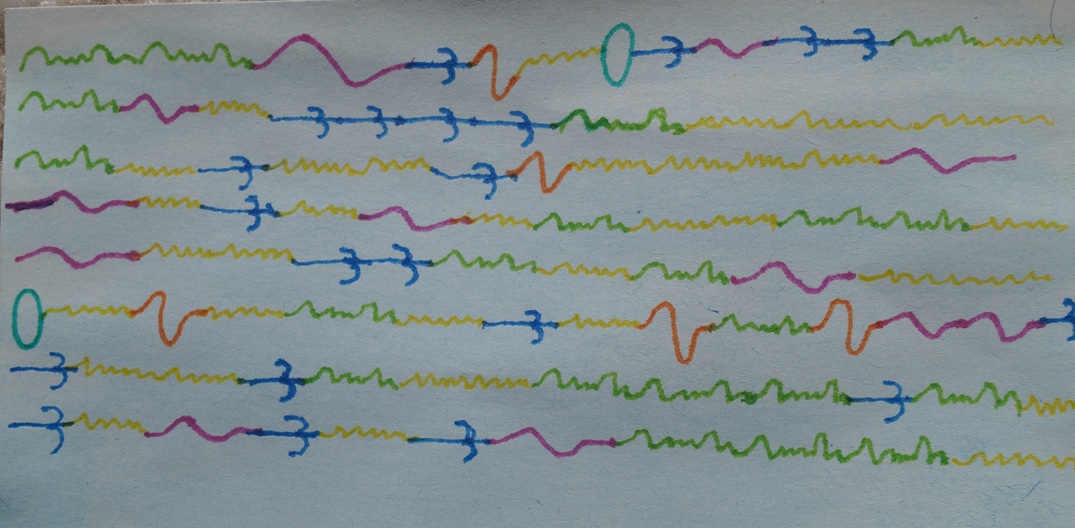
Depth Data Drawing by Maria L. Berg 2025

This year, I’m looking at the A-Z of Depth. I’ll leave the definitions up for the rest of this week for you to peruse.

Today, I’m talking about a specific artist date I enjoyed. As part of my depth study I have been working through The Artist’s Way by Julia Cameron (this is an amazon associate link to The Complete Artist’s Way which is the book I have. It includes three books with three twelve-week programs to keep us working, learning, and discovering. I recommend the hardback at this good price). The basic practice of The Artist’s Way is to come to the page first thing in the morning and write for three pages, read the week’s chapter and do tasks, and take yourself on a weekly artist date.

The Artist’s Way often asks if you’ve noticed any synchronicity, and when it came to figuring out what to do for my artist dates, I sure did. The weather was bad and I didn’t want to leave the house, and there in my email was an invitation from MoMA to take their new Coursera course, “Artful Practices for Well-being.” The course is free and I highly recommend it.

Each module has readings, videos, and creative prompts. In module two I found the creative prompt called “Dear Data Journaling” that led me on the little Artist Date journey I’m talking about today.

Drawing Your Data

The activity as presented in the course’s creative prompt is:

  • Choose some data to collect related to your experiences of emotions. 
  • Schedule some time to gather your data. 
  • Document it using paper and pens. 
  • Review your data and organize it into color groups
  • Experiment with presenting your data in different patterns and designs.

That first bullet point seems clear enough, right? But it stopped me in my tracks. What kind of data? How would I measure it? When would I measure it? How would I represent it? It took me a week just to come up with an idea for what kind of data I wanted to collect.

I wanted it to have something to do with depth, of course, but what data could I collect with my experience of depth and emotions. Here’s what I finally came up with:
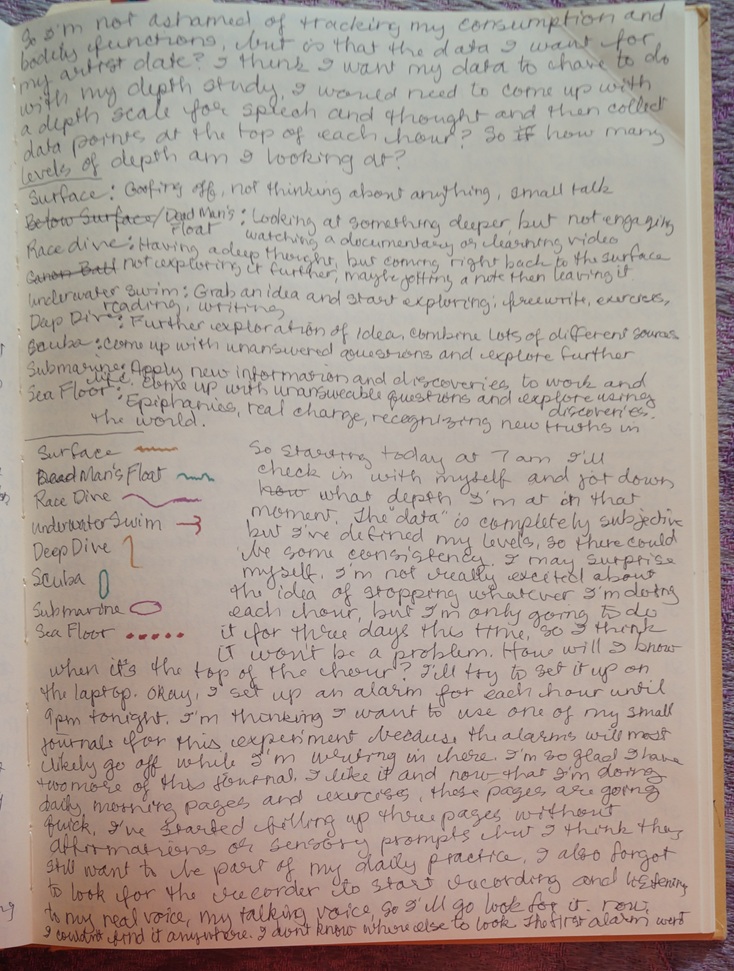
Personal Depth Data by Maria L. Berg 2025

I thought I would share this page from my journal so you can see some of my thought process. As you can see, I defined a scale of depth of thought:

Surface – Goofing off, not thinking about anything
Dead Man’s Float: Looking at something deeper, but not engaging
Race Dive: Having a deep thought, but coming right back to the surface
Underwater Swim: Grab an idea and start exploring: freewrite, writing exercises, reading, writing
Deep Dive: Further exploration of an idea, combine lots of different sources
Scuba: Come up with unanswered questions and explore further
Submarine: Apply new information and discoveries to work, explore using discoveries
Sea Floor: Epiphanies, real change, recognizing new truths

Then I assigned each level a color and symbol. I set alarms on my computer to go off each hour. When the alarm went off, I marked down where I was on my scale. I did this for eight days.

Depth Data Drawing by Maria L. Berg 2025

I had been avoiding doing the data drawing—silly perfectionist in me afraid to mess up—so today’s post was my impetus to do it. And it was really fun!! I kind of love this. I want to add some more days of data and play with other compositions.

Today’s Poem

Living with Peter Max’s Lady in Grey

She hung it in my room
said she bought it for me.
It mocked me with its pouty
anorexic pastel asymmetry
a mirror of my not enoughs:
not tall enough, not pretty enough
never skinny enough
yearning for stylized
impossible beauty.

Far from youth, I finally see her:
The surprise mess of abstract flowers
splashed from the vase to her dress
and chest, red as her blood rushing to blush
her neck and shoulders. A large pink flower
spilled across the burnt umber couch
leaving no room for her to sit. Her left side
tensely battles to protect her from the wild
flight of the flowers, but her right side
so tired of standing, droops. Her dress
can barely hang on.

Her pin-point black eyes stare at me
blankly as if to say, “You don’t see anything.
This isn’t happening.” But the flowers
won’t stay still, and the slant of her shoulders
is as steep as it gets. I wonder if she stares
so intently at me because she is ignoring
whoever is sitting at the unseen end
of the couch, trying to pull her attention
with his mind. She knows what he’s doing,
but won’t give in. A blue ribbon pulls a black
heart from the vase and is headed his way.
The flowers will get to him eventually.

This poem was inspired by today’s prompts at NaPoWriMo and Writer’s Digest’s April Poem a Day (PAD) Challenge.

Thank you for joining me on my artist date today. I appreciate your comments and interaction. Any thoughts or questions about Artist Dates? Are you trying the exercise? Come back to this post and tell me how it went when you finish. I would love to see your data drawings. Come back tomorrow for more depth exploration and poetry. Happy April.

Depth of Cognitive Complexity

It’s already April, and at Experience Writing that means it’s time for NaPoWriMo (National (Global) Poetry Writing Month) and the A-Z Challenge.

Complexity by Maria L. Berg 2025

This year, I’m looking at the A-Z of Depth. Have certain definitions of depth peaked your interest? When I first typed up all the definitions of depth, I was intrigued by “sounding.” Sounding is one of the concrete definitions. It is a technique for measuring depth. I’ll talk about it later in the month. I’ll leave the definitions up for the rest of this week for you to peruse.

Today, I’m talking about complexity. Complexity is the quality of being intricate or complicated. Why do we associate depth with complexity? Maybe because it adds a whole dimension to our world and that complicates things. When depth is involved we have to use visuospatial reasoning; we have to think about distance; and we might have to calculate volume, or learn how to draw a cube. 😁

Deeper understanding often requires paying attention to intricate details, multiple perspectives, and interconnected concepts. Back in January, when I was starting this depth study, I found an interesting framework of thinking called Depth & Complexity. It is made up of eleven modes of thinking to deepen one’s understanding of any subject. You can read all about it in my post “Our Depth Study Gets Meta with Depth & Complexity.”

Today, I’m going to talk about the aspects of complexity which are:
📚Across Disciplines: Relate the area of study to other subjects within, between, and across disciplines.
🎡Multiple Perspectives: How would others see the situation differently?
🔭Change Over Time: How are elements related in terms of the past, present and future? How and why do things change? What doesn’t change?

How would using these modes of thinking add depth to our writing? Let’s say we’re writing about our favorite movie: Instead of just summarizing the plot and what we like about it, we can think about why we feel this way. We can go deeper by exploring our own movie watching biases and tendencies and where they come from, but to add complexity, we need to look outside ourselves.

Looking across disciplines we can write about the camera work, costuming, acting techniques, directing, editing (quick cuts or smooth transitions), scene dressing and props, writing and screen adaptation, and other aspects of film creation. Then we can go further across disciplines and talk about the philosophy or psychology of the film, the history of the setting or the film itself, etc.

This has already taken our writing from a blurb to an essay, but we can get even more complex by writing about other people’s perspectives of the film. What do experts on the topic of the film think of it? What about people from different countries and cultures? Do different age groups have different opinions of the film? Then, for more complexity, we can compare this film to other films from different eras of film, and/or different eras of the topic. How have opinions on the film’s subject matter changed over time? Will the film hold up in the future? Are there noticeable trends with similar films over time?

As we add complexity to our writing in this way, we include many more people in our writing, and thus can create more interest for a broader audience.

Our world is full of complexity. Sometimes, when we think something is too complex, we get overwhelmed and avoid it or shut down. When that happens, it can help to break something down into its simplest parts and tackle them one at a time.

Making the complex simple and the simple complex

For today’s exercise, I made a tool for us to use (made with Canva):

Once you print it out, you can use it with the complex topic at the top, turn it on it’s side, or turn it upside down with the simple concepts at the top to build complexity.

You could also use this for top down and bottom up processing. Top down starting with prior knowledge and expectation and breaking it down to its sensory details, and Bottom up starting with sensory details and building to an abstract concept.

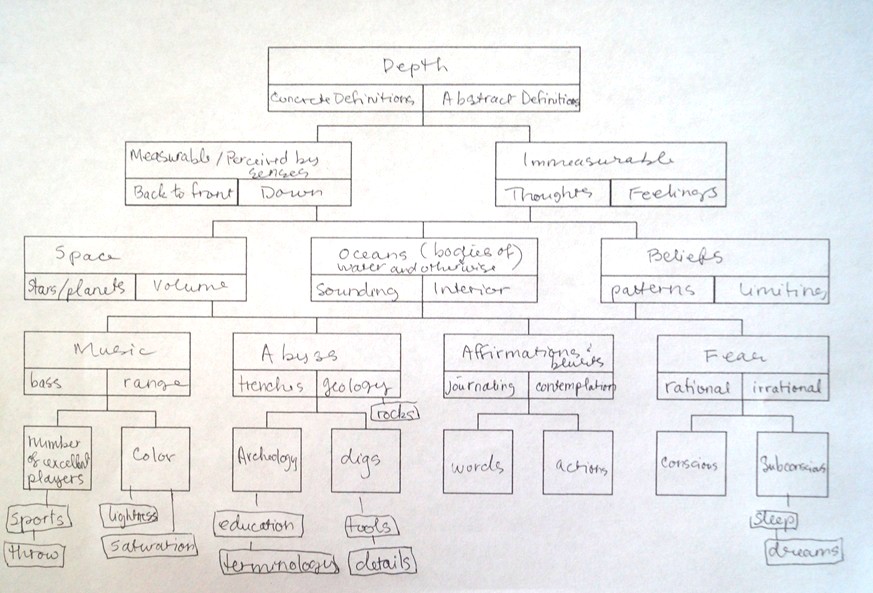
Let’s look at an example of breaking down a complex idea like depth into its simplest parts (just a quick brainstorm I did this morning):

That tool really worked for me. As you can see, it’s adaptable: I added more boxes where I wanted them. I think I’ll try another one and see if I can simplify the complexities of poetry. 🤞🤣

Today’s Poem

Word Sculpture

I am not a sculptor
but sometimes I would like
to make giants out of metal—
their patina changing in the baking
heat and monsoon rains—
like those growing leafing vines
from their hands, shoulders, or heads
in City Park that I loved to visit
on my bike when I first moved to New Orleans.
Silent mysteries
all my own
I was always alone with them
so never alone.

But I am not a sculptor
I am a poet. I can turn
those giants into short lines
simplified with underlying complexity
and pose them perpetually in that time;
call them from the past to the page;
show them to you without need
of chains and machinery to lift
their monstrous weights.
Examples of humanoid strength
being reclaimed by nature
you can look up into their lineless
faces and feel their endless peace.

This poem was inspired by today’s prompts at NaPoWriMo and Writer’s Digest’s April Poem a Day (PAD) Challenge.

Thank you so much for coming by and reading my post. I appreciate your comments and interaction. Any thoughts or questions about Complexity? Did you try the simplification/complexity tool? How did it go? Come back tomorrow for more depth exploration and poetry. Happy April.

Deep-seated Belief

It’s already April, and at Experience Writing that means it’s time for NaPoWriMo (National (Global) Poetry Writing Month) and the A-Z Challenge.

Depth of Belief by Maria L. Berg 2025

This year, I’m looking at the A-Z of Depth. Have you started noticing all the different ways depth, deep, and deepen are used? Have you started seeing the words depth, deep, and deepen everywhere? I definitely notice them a lot. I’ll leave the definitions up for a few days as a reference.

Today, I’m talking about an abstract concept of depth: belief. We often hear people say “seeing is believing,” but we also believe in things we can’t see. Like in my photograph above: I can’t see much of anything through that fog, but I believe the lake, houses and trees are still there.

I was curious as to why humans have beliefs, so I found the article “What Actually Is a Belief? And Why Is It So Hard to Change?” at Psychology Today. In the article, Ralph Lewis M.D. wrote that beliefs are mental representations of patterns our brains “expect the world to conform to.” He also wrote that we evolved these templates (beliefs) as short-cuts so our brains (prediction machines) can conserve energy. I like the idea that beliefs are pattern recognition and short-cuts for understanding the world.

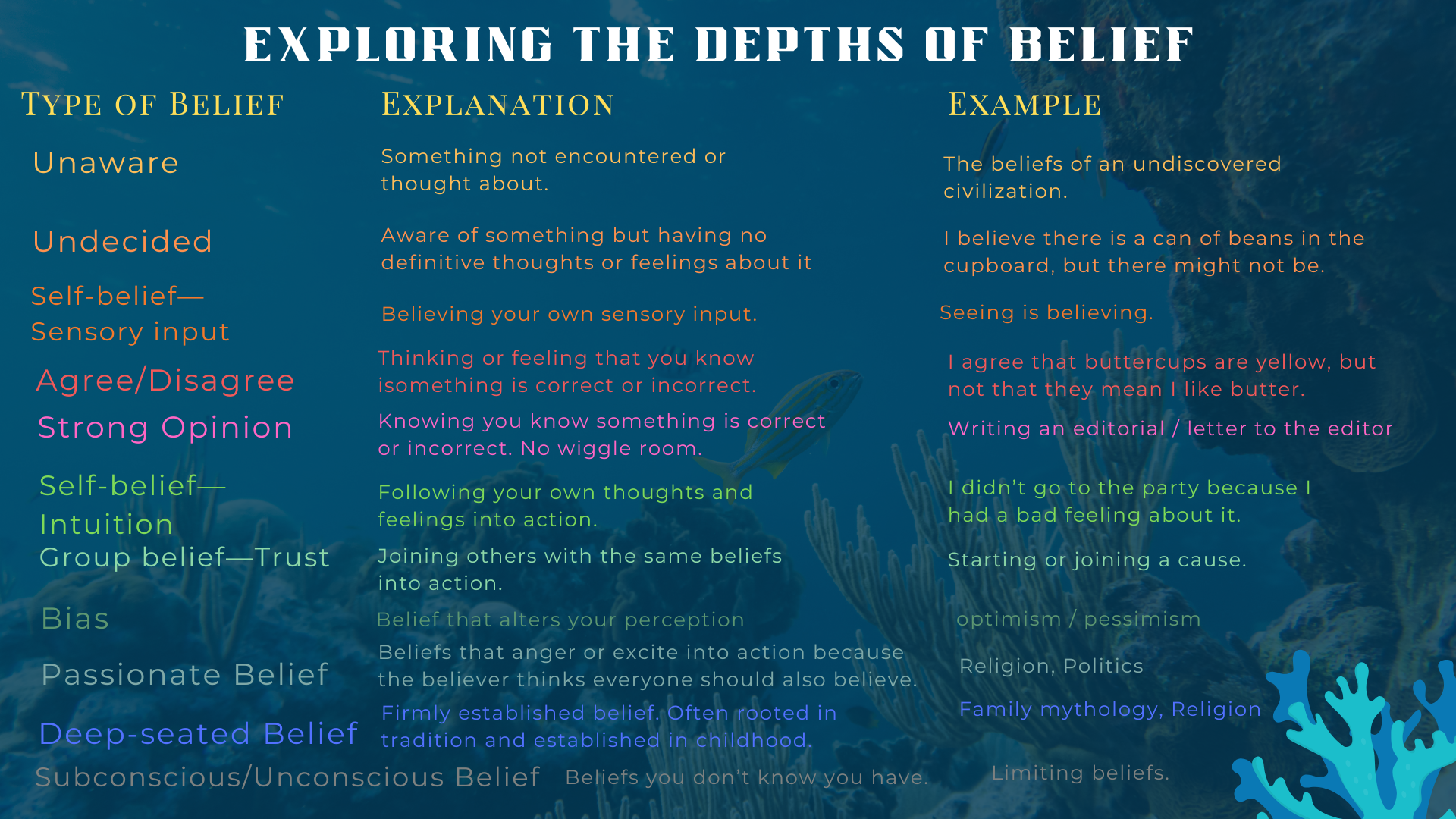
When people hear the word belief, they often think of religious belief, but there are different depths of belief. Let’s take a look:

Infographic created by Maria L. Berg 2025 (all ideas and info are my own thoughts)

Those deeper beliefs are often beliefs we don’t think about. Beliefs may have formed when we were children, before we really understood where they came from. We act on them as truths, and not always for our present benefit. These subconscious beliefs, called limiting beliefs, can stop us from doing things we want to do. But luckily, we can search them out and change them. I touched on this in my post 5 Steps to Deeper Discovery, but here’s another activity to try.

Identifying and Changing Beliefs (a short exercise to get started)

I adapted this exercise from Healing Through Words by Rupi Kaur ( this is an amazon associate link: There’s a really amazing price on the hard-cover of this book right now). This exercise has helped me identify my limiting beliefs. It took me a few tries to make a break through. It’s a tool I will continue to use as I work to change.

  1. List fifteen things you’re afraid of
  2. Prioritize your list and choose the top five
  3. Start with the number one fear on your list, set a timer for five minutes and answer these questions:
    Where does this fear come from?
    What specific incident is it connected to?
    How does it affect your life?
  4. Now, set your timer for another five minutes and write to the fear directly. Thank it for how it has protected you in the past, but let it know that it is no longer helpful.
  5. Read what you wrote, and ask yourself if this is really your greatest fear, or can you now identify your real fear, something that was lingering underneath.
  6. Repeat the exercise for your newly identified deepest fear, or if you haven’t identified a deeper fear, continue down your list to your next fear.

Today’s Poem

Two Simple Categories

“It would be relatively simple if every reader knew to which category he belonged.”—C. G. Jung

From my desk where
I write each morning
I can only see out one half of a window.
The seal-broken, fogged pane
like a cataract
blurs the world.

Mr. Jung, you identify
only two types of human nature:
the Plato or the Aristotle;
the introverted and the extroverted.

From where I sit
the types are: those who have clear glass
and those who have fogged.
The impatient-pink spring blossoms
fill both windows
but only one can admire the petals.

This poem was inspired by today’s prompts at NaPoWriMo and Writer’s Digest’s April Poem a Day (PAD) Challenge.

Thank you so much for coming by and reading my post. Any thoughts or questions about Belief? Did you try the exercise? How did it go? Come back tomorrow for more depth exploration and poetry. Happy April.
Abstract and Concrete Thinking

Here we are. It’s already April, and at Experience Writing that means it’s time for NaPoWriMo (National (Global) Poetry Writing Month) and the A-Z Challenge.

Abstracting the Concrete Maria L. Berg 2021

This year, I will be looking at the A-Z of Depth. Here is a chart I made of the meanings of Depth, Deep, and Deepen:

As you can see, depth has many meanings. Some of its meanings are concrete and some are abstract.

Concrete thinking is the focus on things that we perceive and can experience with our senses, things we can measure. Abstract thinking focuses on the intangible, the theoretical: creativity, thoughts, ideas, and symbols.

Let’s take a look at aspects of depth separated into the abstract and the concrete:

Infographic by Maria L. Berg 2025 using Canva

I came to this year’s study of depth because I want depth in my writing (abstract) and because I’m fascinated by visual depth perception, how we specifically see and experience depth (concrete).

The What if and What If Game

There are many ways to practice abstract thinking. Here’s a quick game to get us started.

  1. Start with something concrete. Find a small object you can hold in your hand. Note its size and shape, it’s color and texture. Does it make a sound? What does it smell like? Can you taste it?
  2. Now, ask yourself a what if question about your object. Something fun like what if this object sprouted legs or wings. Now picture it. Imagine it happening. What would happen next?
  3. Once you have imagined what would happen, ask yourself another what if. For example: When my object is flying around the room, what if it flew up the chimney, or what if it got caught in a spider’s web?

While engaged in abstract thinking, you can change every concrete aspect of your object—in your imagination.

Today’s Poem

The Principle of Polarity

“Everything is dual; everything has poles; everything has its pair of opposites . . . opposites are identical in nature, but different in degree . . .” —The Kybalion

In the best of times I feel like an abstraction
non-representational, not of this world
writing on the porch, warm in light’s beam
a body tingling thought into being

In the worst of times life lacks depth
like Arte concreto only line, shape, and color
Useless one-sided boxes house
grayscale paper-dolls with toothless slits for mouths

In the best of times life’s a Badinerie
light-hearted and teasing, a suite for flute and strings
Birdsong drowns out construction’s whine
Daffodils burst sunshine through blackberry vines

In the worst of times my world is verismo
operatic realism of the dregs in mundane conflict
A slip of the tongue is fodder for headlines
intended to induce fear in reactive minds

In the best of times I am a moto perpetuo
spinning wheels on an incline never to rest
In the worst of times I am like Urethane
useful and strong: I put a gloss on everything

This poem was inspired by today’s prompts at NaPoWriMo and Writer’s Digest’s April Poem a Day (PAD) Challenge.

Thank you so much for coming by and reading my post. Any thoughts or questions about Abstract and Concrete thought? Did you try the What If and What If Game? Come back tomorrow for more depth exploration and poetry. Happy April.

The A-Z of Depth

This year’s theme for everything I’m doing on Experience Writing is Depth, so for this year’s daily posts in April I’ll be exploring the A-Z of Depth, and writing daily poems for Poetry Month about the A-Z of Depth.

The word depth has many different and interesting meanings which I presented in my post “Our Depth Study Gets Meta with Depth & Complexity” , but what I am finding fascinating is how the words depth, deep, and deepen are used in our daily lives. Now that I’m focused on depth, I’ve become aware of how In-depth people say their studies are, and how many deep-dives into a subject people say they are taking. I’ve noticed when people present ideas of Jungian psychology, they call it Depth Psychology, and there was a group of poets in the sixties called Deep Image poets.

During April’s daily posts, I will be exploring the depths of self-discovery, the depths of the oceans and deep space, the science of depth perception, and the perception of deep writing and art, among all the other exciting depths I dive into along the way.

This will be my eighth year combining the April A-Z Challenge with the daily poetry prompts at NaPoWriMo.net . I like the theme this year:

Reflection is something I’m doing a lot more of while exploring the depths of my mind, body, and spirit.

There are also daily poetry prompts at Writer’s Digest for the April Poem-A-Day (PAD) Challenge. And Poetry Super Highway has daily prompts, too. If you have a poetry prompt that you would like to share, PSH has a submission form you can fill out.

Last year I also found poetry prompts during poetry month at Thought Purge, Quickly, and River Heron Review. So if you’re like me and like to combine lots of prompts, keep an eye on these sites.

I hope you’ll join me in April for a daily discussion of what depth is and what it isn’t. How we find depth and how we create it. Ah, the excitement of spring is in the air.

5 Steps to Deeper Discovery

Today we’re celebrating breaking through the barricades that stop us from deeper self-discovery.

A Yes in the Depths by Maria L. Berg 2025

In this year’s theme post I wrote, depth takes time. It isn’t forced or rushed. I am finding that to be the truth.

I had two books, Healing Through Words by Rupi Kaur and How to Write Poetry: A Guided Journal with Prompts by Christopher Salerno & Kelsea Habecker, that I planned to work through, one exercise from each every day. But after the first exercise in Healing Through Words, I could not get myself to do any more. I wasn’t even working on light-forming photography. I was blocked, and getting frustrated.

*Book links are all Amazon associate links. If you use my links to buy a book, it helps offset the cost of keeping Experience Writing available.

Then one morning while looking for depth on my bookshelf, I pulled out The Complete Artist’s Way by Julia Cameron and Writing for Self-Discovery by Myra Schneider & John Killick. I have had both of these books for a long time, but I guess I wasn’t ready for them until now.

The first step I took was taking my morning pages seriously. It took a couple days to finally roll out of bed straight to the page, and write three full pages in my journal, but I got there, and it helped focus my day.

The second step was to work with affirmations and blurts. I don’t think I ever really tried it before, not really. The idea is to choose an affirmation—I started with “I, Maria, am a brilliant and prolific poet” from the example in the book—and then write down all the negative thoughts that come into your head. Those are the blurts. I have some mean voices in my head, and they had a lot to say. After writing out my affirmation ten times, and all the mean things my own mind said in response, something inside of me started fighting back against the negativity, and I wrote a few lines defending myself. After that, I was ready to do the exercises I had been avoiding in the other books. The affirmation and blurts at the end of my morning pages broke through the barriers I was putting up to avoid the feelings I was afraid would come up while doing the exercises.

The third step was using positive statements and activities to reward myself. Back in February of 2022, I explored motivation and habit creation. At first I had trouble finding rewards that worked for me, but I found writing nice things to myself actually works. I took those same pieces of folded card stock I wrote on in 2022 and put them in the pockets of my calendar quilt. I pull one out after my morning pages, and each exercise I finish. After one particularly difficult exercise, my reward said, “You are worthy and deserving of success.” Reading it aloud as “I am worthy and deserving of success,” was just the reward I needed. I used “I am worthy and deserving of success” as my affirmation in my morning pages the next day.

The fourth step was to add a little every day. Once the initial block broke, and I was doing my morning pages and exercises each morning, I found that they became easier and easier. I wanted to do the work, and was no longer afraid of my emotional response. I also found that the exercises took less and less time. Each day, I thought about one small thing I could add to my work day. I’ve added another round of The Portable MFA’s poetry section. I’ve added daily light-forming photography. I’ve started submitting poems again, and I’m typing up my poetry drafts. Today, I’m adding writing this blog post, and poetry revision.

The fifth step was to celebrate and take care of myself. I was avoiding doing the exercises in Healing Through Words for a reason. The exercises bring up emotions that I haven’t wanted to feel. But facing my mean blurts helps me realize that this is the work I need to do to get to my Deep Voice (from Method Writing by Jack Grapes), my authentic voice, and deepen my writing and thinking which is the goal of this year’s theme. So when an exercise makes me cry, or feel things that upset me, I give myself time and extra treats. I recognize that I’m doing real work. I make myself a sweet, healthy, and soothing treat like pecan-date balls and a cup of cocoa. I take time for kitty hugs and purrs. I stretch and jump on the mini-trampoline, and/or take a long, hot shower. I don’t think I understood how important self-care was to the process. It’s making a huge difference.

What helps you when you’re feeling blocked?

Have you noticed depth, deep, or deepen coming up in your reading, watching, or listening? I sure have. Help celebrate going deeper by sharing your depth quotes in the chat.

Here’s one to get us started:

“By allowing ourselves to associate freely—that is to put down the first words that come into our heads, then to write down whatever these make us think of and to keep following the train of thought wherever it takes us—our deepest ideas and feelings begin to surface.” ~from Writing for Self-Discovery by Myra Schneider & John Killick

Depth of Mess from a New Perspective

Eagle Eye by Maria L. Berg 2025

Today, I am celebrating making a deep dent in the depths of papers stacked around my office, and hiding in the desk drawers. 🥳🎆🎉

At the start of this month, I gave myself the tiny goal of throwing away ten pieces of paper a day. That could be anything: receipts, ticket stubs, old mail, anything. The tiny goal got me started, and was on my mind, though it didn’t happen every day.

Today, that little goal was like melting snow meeting a crack that burst a dam. Those ten pieces of paper turned into hundreds. Old papers flowed from bins to garbage or binders. And once I cleared out a bin, I refilled it from desk drawers. I didn’t stop until my left-hand drawers were completely emptied of random stacks of paper and clutter.

Time, the great teacher, gave me a new perspective on what only months ago I was calling a mess. As I started going through the piles, and throwing out the garbage, I was surprised by the mass of work I was looking at. For someone who says she doesn’t revise, just moves on to the next idea, I saw story after story with revisions and edits written all over them. I saw pages and pages of notes for revisions of novel after novel, poem after poem.

I thought it would be fun, and good practice, to talk about today’s discoveries using the tools of Depth and Complexity that I celebrated in my last post.

🔑Language of the Discipline – I write notes on any piece of paper handy. It was fun to find pages and pages of scrap paper folded in half with word lists filling both sides. I found one with words that only have the vowel “o.” I found many with abstract nouns organized in different ways.

🔎Details – In many of the pages I chose to keep, I found interesting sensory details highlighted in yellow. I also found notes taken at meetings that I looked up before I threw the pieces of paper away. I think details is an area where I can work on depth.

🏁Patterns – I found the transparencies I made of my photographs to use as text-masks for blackout poetry. I found the further attempts at creating “Nets of Possibilities.” But deeper than seeing patterns on the papers, I recognized some patterns of my process:

  • I collect every resource I think will help me, but seldom fill in the things I print out (as if they are precious and limited, so I don’t want to use them up)
  • I revise and submit, but once a piece is rejected (more than once), I am slow to work on it more, or submit it again without revision
  • I get started on lots of ideas when it comes to poetry, especially creating my own forms, but don’t put the time in to really follow through

❓Unanswered Questions – As evidenced by the stacks of papers I chose to save, and those I threw away, the unanswered questions I’m still striving to explore are:
How do I turn all my novel drafts into finished novels that I’m proud of?
How do I improve each of my short stories?
How do I get in the flow and become more prolific?
What changes can I make so all of this work easier, more fun, and finished?
But the real, ❓unanswerable question is: Will all my effort and time have value to enough people for me to live well and continue to be able to create art?

📏Rules: From the papers that I kept and sorted, I concluded that I both like to follow the rules, and make up my own rules. Like painters who made sure they could copy the old masters and paint with visual realism, but chose to create something that can’t be recorded with a camera, I want my innovations to be extension of mastery. However, unlike photography where I’m having a blast breaking all the rules, I find fiction and poetry more challenging: both learning all the rules, and enjoying breaking them.

📈Trends: The trends I noticed going through my stacks of stories and poems were connected to events and challenges I became attached to. My short story drafts almost all happened in a short period of time around a contest. My poem drafts happened daily in April and October, but they were all posted online, so then I would print them all out and chop them up and see if there was anything interesting there, but didn’t go much further. I also discovered that I am somewhat organized in weird ways. The piles of things I’m not ready to be rid of yet, or work on again, clump together by project or idea, but then just sit there in their piles.

⚖️Ethics: The ethics of today’s adventure are about good/bad, value/worthless, and garbage ethics such as land fills vs. burning: If someone needs heat and could create warmth by burning all this paper would it be more ethical to drive somewhere to get it to them, or is paper degrading in a landfill mulch to help the earth work at breaking down garbage? These types of decisions are not easy. But today, filling a plastic garbage bag with paper and other things, cleaning up my office and ridding me of some unneeded past, made me feel so good I wanted to share joy and celebration with you. The plastic bag is still in the office and may end up creating heat for me later in the winter if it ever gets that cold.

🏛️Big Ideas: The big idea of today’s celebration of depth is: depth can be found through digging. If you have piles of paper like I do: Don’t be afraid, or tell yourself you don’t have time: Start digging (and discarding), you may be surprised by the work you’ve done and learn a lot about your process.

I have at least three more days like today to get through my stacks of paper in my office, just to find out what’s garbage, and what isn’t, but this made it a fun celebration of discovery. I can also see how taking the time to review everything I choose to keep is part of exploring depth.

What new depth have you reached today? Any depths you want to explore, but haven’t found a way in yet? I look forward to the depths of your comments.

Our Depth Study Gets Meta with Depth & Complexity

Depth Extension by Maria L. Berg 2025

While searching “depth” on the internet I came across a teaching tool called “Depth and Complexity.” Why did I title this Our Depth Study Gets Meta? Meta is an adjective meaning self-referencing, as in a book that references itself, or a joke about jokes. What could be more meta than learning about depth using a learning tool called “Depth and Complexity”?

“The Depth and Complexity Framework was originally developed in the mid 1990’s by Dr. Sandra Kaplan, Bette Gould, and Sheila Madsen. Its primary purpose was to push students towards thinking that is similar to professionals/experts. The creators sought to answer the question: How can educators prompt students to go beyond a basic understanding of content and elicit critical thinking at an expert level, regardless of topic/content?”—The Center for Depth and Complexity

Depth and Complexity consists of eleven modes of thinking to deepen one’s understanding of any subject. The official Depth and Complexity Framework includes using specific icons to signal which mode of thinking one is using and trigger certain thought processes. You can learn more about the history of Depth and Complexity and how teachers can use it in the classroom at The Center for Depth and Complexity.

For our study, I’m going to choose some symbols from available emojis, like Lisa Van Gemert did at Gifted Guru. I found her explanations of Depth and Complexity helpful.

The eleven aspects of Depth and Complexity are separated into eight depth and three complexity.

The eight depth modes are:

🔑Language of the Discipline: What vocabulary terms are specific to the discipline or content?
🔎Details: What are the defining features or characteristics? Find examples and evidence to support ideas.
🏁Patterns: What elements reoccur? What is the sequence or order of events? Make predictions based on past events.
Unanswered Questions: What information is unclear, missing, or unavailable? What evidence do you need? What has not yet been proven?
📏Rules: What structure underlies this subject? What guidelines or regulations affect it? What hierarchy or organizing principle is at work?
📈Trends: Note factors that cause events to occur (Political, Geographic, Socioeconomic, etc.). Identify patterns of change over time.
⚖️Ethics: What moral principles are involved in the subject? What controversies exist? What arguments could emerge from studying the topic?
🏛️Big Ideas: What theory or general statement applies to these ideas? How do these ideas relate to broad concepts such as change, systems, chaos vs. order, etc.? What is the main idea?

The three complexity modes are:

📚Across Disciplines: Relate the area of study to other subjects within, between, and across disciplines.
🎡Multiple Perspectives: How would others see the situation differently?
🔭Change Over Time: How are elements related in terms of the past, present and future? How and why do things change? What doesn’t change?

I like how this framework delineates ways of thinking. I recognize many of the ways I approach a topic. Naming and labeling thought processes could simplify and declutter. I think with practice, I will recognize which thought processes I’m using to explore depth, and identify how to deepen my study using other ways of thinking.

🔑Language of the Discipline : The first thing I did when I decided on depth as this year’s theme was look up the word in my Merriam Webster’s Collegiate Dictionary (Tenth Edition). I knew it would have many definitions, but I didn’t expect the labyrinth of letters and numbers and references to the word deep which also has a raging waterfall of meanings, so I separated out the meanings on a page in a way that was more clear to me.

This will be our main reference for our study this year, but we can approach 🔑Language of the Discipline in many more ways.

One of the first exercises in How to Write Poetry (amazon assoc. link) by Christopher Salerno & Kelsea Habecker, is to list terminology related to something you’re passionate about, then write an Ode about the subject. I chose to list vision science terminology for depth perception. 🚓Rules: I then looked up how to write an Ode and found there are three different types of Odes: the Pindaric (Greek), the Horatian (Roman), and the Irregular.

🔑The Pindaric Ode is made up of three parts: the strophe, antistrophe, and epode. These three parts of the Ode can be thought of as beginning, middle, and end, or statement, argument and summary.
Strophe, from the Greek, means turning. It can also be a synonym for stanza. It is the opening statement of the Ode.
Antistrophe means counter-turn. It responds to the strophe and follows the same rhyme, and/or meter.
Epode means said or sung after. It summarizes or concludes the piece and follows a different rhyme and/or meter.

Here’s my attempt at an ode using terminology:

Ode to Depth Perception

My two eyes receive different information
so many cues to find my place in space
I root for both teams
in this binocular rivalry
Thank goodness for stereopsis
visual stimuli in harmony
Because its the disparity of monocular fields
that brings depth to my vision

Parallel lines converge in the distance
this convergence defines egocentric relative size
like our correspondence needs
electrons from sea to sea
Here’s a wink to binocular parallax
and a toast to interposition and overlap
Because cues like Aerial perspective
and relative color make us more blue
when further away

From this momentary fixation point
in three-dimensional space
the unknowns of how we perceive depth
are as vast as voids of space
as dark and pressured as the ocean’s abyss
as mysterious as profundity
And yet, even with one eye
the mind finds a way

Let’s just call that an irregular ode, though I did attempt to respond to my strophe about stereopsis, with an antistrophe of monocular cues, and sum up with an epode of more abstract ideas of depth perception.

Thinking back to some of my previous posts, here are some ways I’ve explored 🔑Language of the Discipline (free downloads):

(free download) In Letters: Symbols of Sound from the first day of Writober 2024, I included a downloadable Excel spreadsheet to collect and study words that came up when thinking about fear. Starting today, I’m going to use it to collect words I think of when thinking about depth.

(free download) In Fear of Parasites from Writober 2024, I included a downloadable version of the form I created for myself to explore abstract nouns. I always start by looking at the word’s definitions. Thinking of the abstract noun aspects of depth, I can start filling in this form.

How to Read Novels Like a Novelist (RNLN) Kindle Edition – the search function in the kindle reader is great for finding how and where the words depth, deep, and deepen are used in any text you’re reading.

What do you think of “Depth & Complexity” as a learning tool? Had you ever heard of it before? What do you think of the symbols I chose for the different aspects? What would you have chosen differently? I think this is going to be a lot of fun.

This Year’s Theme: Depth

Looking Deeper by Maria L. Berg 2025

Depth is both a concrete noun—something we can measure like the depth of the lake from the surface to the bottom—and an abstract noun—something we can’t measure like the quality of being profound.

Depth takes time and distance. Depth isn’t forced or rushed. Depth is quiet and still, heavy with pressure and bio-electric. So I’m taking my time, taking small steps, and simplifying.

For years I’ve been trying to make Experience Writing not only a great resource, but also fun for me to write. Today, I realized that instead of making it a place of work, I want it to be a place to celebrate discovery. So this year, I will only be posting as a reward to myself for my hard work. In other words, every post will be a celebration of reaching a new depth of some kind.

I’ll be working with two main books to help me dig deeper:

(these links are my Amazon associate links, if you order using these links it will help support the cost of ExperienceWriting.com)

  1. My sister-in-law gave me an incredibly thoughtful gift for Christmas: Healing Through Words by Rupi Kaur.
  2. I bought How to Write Poetry: A Guided Journal with Prompts by Christopher Salerno & Kelsea Habecker last year, but didn’t use it at all. This year, I plan to use one exercise each day in my morning hand-written journal pages. In its resources section “A Poetry Library” I found Beauty is a Verb: The New Poetry of Disability, which I bought, and am reading.

What do you think of when you think of depth? How can you write deeper? How can you deepen your thinking?

I’m Thankful for Some Fun

The new issue of Gold Man Review is now available, and includes my poem “Taste of Temptation.” I really love the cover. That shark fin makes me so happy.

Yesterday, at my parents’ house after attending a family friend’s memorial, I glanced through a bookshelf in my childhood bedroom that my parents keep insisting was mine, but I say was my bother’s. Turns out there were books that were mine, my parents’, and my brother’s. I discovered a long, slim book from Instructor Curriculum Materials called Poetry for today’s child by Ruth Kearney Carlson published in 1968 and 1972.

In a section near the end called, “Symphonic tone poems in color,” I was introduced to “Frank Sinatra Conducts Tone Poems of Color.” I found it on YouTube and have been listening to colors all morning. What a great way to block out the construction that has started back up nextdoor.

To inspire the students the teacher in the book paired the music with color poems from Hailstones and Halibut Bones by Mary O’Neill. The poems have little drawings for every word which I found very interesting. Like in the poem Gray, it says some spring coats are gray, but the drawing of the coat is blue. I think I’m going to really enjoy exploring that book.

Then in a section called “Using a record with young children” I read about Dylan Thomas’s recording “A Child’s Christmas in Wales.” I found it on YouTube as well. It’s a humorous and vivid story with a poetry only Thomas could deliver.

So much fun from one little book I found on a mystery bookshelf in my childhood room. Here are a couple poems from the section “Poetry for the modern child” supplied for “pupil pleasure and help.”

Words
Words are such funny things,
They can be lovely or give bitter stings,
Think hard before you let them go–
You cannot get them back, you know!
~G. D. Davis

My Word
A noun is quite dependable;
It never leaves you in suspense!
But a participle may be dangling,
And a verb is always tense!
~W. Lowrie Kay

Every day can be a day of thanks if you’re looking on the right bookshelf.
I hope you find some fun to be thankful for.