Melinda curled into her knees, shivering on the floor in her shabby room. A cold wind whispered through the shredded curtains that tickled her neck exacerbating her nerves, but she couldn’t move. If she moved, it might see her, and the giant hand might not be blocked by the roof as she had hoped. If it found her it would reach down and squish her head. She regretted making fun of that goth chick that was so excited about finding her great grandma’s old book. The thing was gross. It looked like it was covered in skin all stitched together with some ugly dead face in it. But it must have been the real thing because she opened it and started chanting some language Melinda had never heard before, and then this giant black, cloudy hand came down from the sky, pinching its thumb and forefinger together. Pinching and pinching. Melinda ducked into the subway and it didn’t follow, but she was afraid to go out in the open. She felt safe in her room at first, but then began to worry about the leak in the roof, and the cloudiness of the giant hand. Then she felt it, the giant thumb on the side of her head, and the forefinger on her other cheek, then the pressure of the pinch.
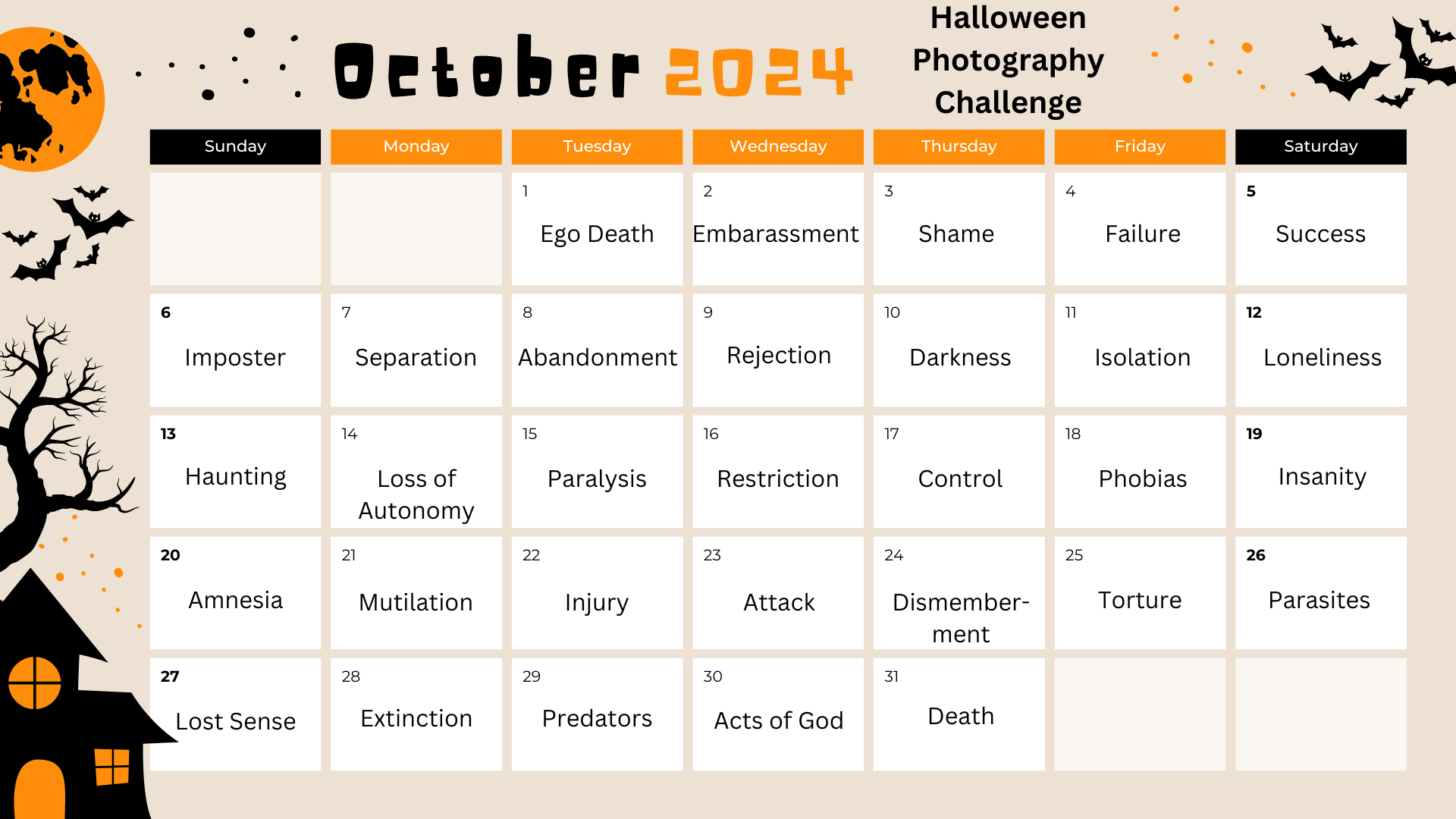
Halloween Photography Challenge
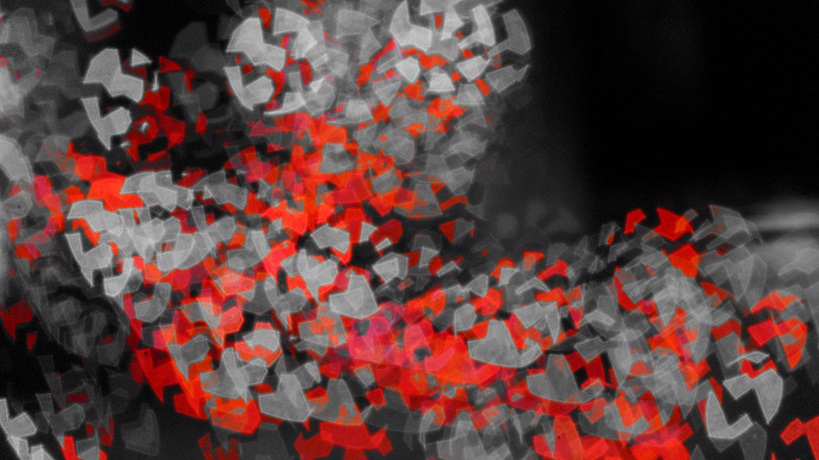
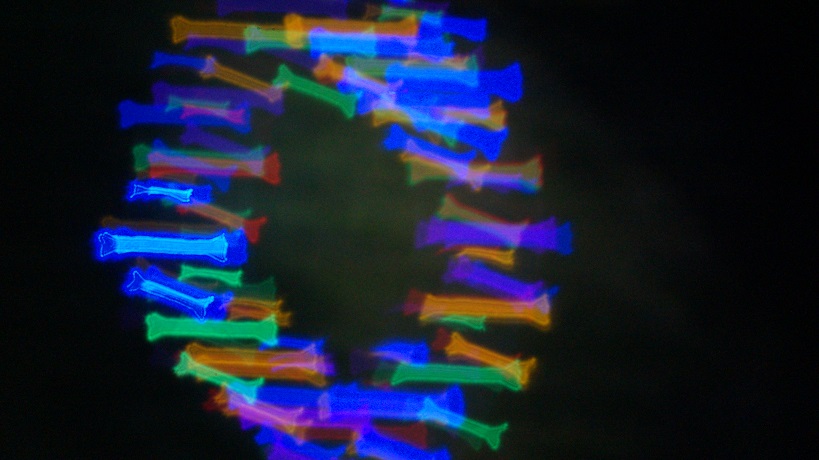
For today’s images, I layered filters thinking of a planet breaking apart, playing with the wind in the red leaves as fire or explosion. The image I chose is mostly the blur of the moving leaves.
Welcome back for the twenty-eighth day of Writober. The month has flown by like a ghost-witch on a rocket-powered broom, and here we are in our final days looking at the fifth universal fear: fear of extinction. The big fear, the fear that rules them all death, master of the fear of the unknown.
Fear of Extinction by Maria L. Berg 2024
Fear of extinction is not only the fear of death, but includes the fear of the end of ones species, the fear of the end of life on Earth, the fear of Armageddon, and fear of the end of all things. It’s the fear of fatality, and also the fear of what’s to come: the unknown.
Rhetorical Device: Metaphor
A metaphor is a figure of speech that, for rhetorical effect, directly refers to one thing by mentioning another, a thing regarded as representative or symbolic of something else, especially something abstract.
Fighting Fear of the Blank Page: How are you feeling about that blank page? Is it still taunting you? Start with a catalogue.
Catalogues of inspiration: Before writing, choose an old catalogue like reprints of the Sears Roebuck & Co. Catalogue from 1897 or 1923. Explore history, objects, and description all in one place. Could any of these objects be a metaphor for fear of extinction?
*Quick Note about links in this post: I am an amazon associate, so most of the links in my post will take you to amazon products. If you buy from these links, I will make some pennies which will help me pay for this site and my creative endeavors.
OctPoWriMo
Poetry Toolbox
These are quick exercises that I hope you’ll do every day. We will build on these exercises throughout the month.
Word list: Write down the first ten words you think of when you think of fear. Any words at all. Anything that comes to mind. Then choose your three favorite and say them aloud a few times until you hear the accented and unaccented syllables (if more than one syllable) and notice the duration of each syllable. (Inspired by Frances Mayes’ list of a hundred favorite words in The Discovery of Poetry)
I created this Excel Spreadsheet for you to use to collect and explore your fear words.
2. Sensory Imagery: In your journal or a word processing file, fill in these lines as quickly as you can. Notice they are slightly different from last week. You may want to revisit one or two in more detail if you’re inspired and have time.
3. More Sensory Imagery: Ask yourself sensory questions about fear of extinction.
4. Choose a poetry collection: If you’re ready, you can choose another poetry collection, or continue to study the one you chose last week.
Poetry Building
Metaphor is similar to simile, but instead of saying something is like something else, we say that something is something else. Extinction is a toothless viper, for example. Or Extinction is price of misuse. How many metaphors for fear of extinction can you think of?
Example poem: Today we’re looking at After by Leonora Speyer, copied here from poets.org for educational purposes.
I will not walk in the wood to-night, I will not stand by the water’s edge And see day lie on the dusk’s bright ledge Until it turn, a star at its breast, To rest.
I will not see the wide-flung hills Closing darkly about my grief, I wore a crown of their lightest leaf, But now they press like a cold, blue ring, Imprisoning.
I dare not meet that caroling blade, Jauntily drawn in the sunset pine, Stabbing me with its thrust divine, Knowing my naked, aching need, Till I bleed.
Sheathe your song, invincible bird, Strike not at me with that flashing note, Have pity, have pity, persistent throat, Deliver me not to your dread delight To-night!
I am afraid of the creeping wood, I am afraid of the furtive trees, Hiding behind them, memories, Ready to spring, to clutch, to tear, Wait for me there.
This poem is in the public domain. Published in Poem-a-Day on March 10, 2018, by the Academy of American Poets.
How does this poem make you feel? What stands out to you?
Today’s prompt: Write a poem exploring the fear of extinction using metaphor.
Form: If you’re looking for more of a challenge, write a narrative poem including metaphor.
Writober Flash Fiction
Write a story with a beginning, middle, and end with conflict that leads to change in less than a thousand words (no minimal word count) inspired by one of the images in the Extinction folder of the Writober 2024 Pinterest board. How does fear of extinction affect your character?
Novel Prep
These last few days are about finishing up our outlines. Brainstorm the scenes that lead to the final battle, your MC’s dark night of the soul, and any other scenes that we haven’t discussed so far.
Halloween Photography Challenge
Take a photograph that depicts extinction or fear of extinction and link to your photo in the chat.
Get Moving
Now that you’ve read all the prompts and have all these ideas running around in your head, it’s time for motion. Some suggestions:
Ever want to be a ballerina? How about working out like one with this barre workout:
If I couldn’t hear his purrs morning cuddles would be like mushy-mashed-peas-with-body- odor after three days
If I couldn’t feel his soft fur morning cuddles would be like car-horns-blaring-bitter- neon-green motor-oil
If I couldn’t see his green eyes and pink nose morning cuddles would be like rotten-cilantro-hot-sharp- whispered-unintelligible voices
If I couldn’t put my nose to his neck and smell his fur, morning cuddles would be like blue-speckled-quinoa in the rice cooker-crunching
But he would still do tricks for treats and I would still try to type around him and we would be like cocoa-super-soft warm blankets- quarter in the vibrating bed delicious
Writober Flash Fiction
Frank Knew What to Do
When Frank said he knew what to do, I never should have trusted him. But with my face splattered all over the news as a wanted terrorist, I couldn’t exactly go to a doctor. I was a victim of that bomb. The heat of it, the force, almost tore my face right off. It’s a miracle I lived long enough for Frank to do this to me. I didn’t make that bomb, or set it off.
But I could imagine why they think it’s me. I like to express my opinions online. And, well, I’ve got some pretty strong opinions, especially about this Barry Castinetta guy who’s buying up the whole city and kickin’ us out of our apartments. He’s a serious piece of work and now he thinks he’s a leader. Running for senate. I bet he thinks he can be president. So, maybe I said some things that people could say were inflammatory, like “I’m gonna come to your rally, and blow you to smithereens.”
I mean, I didn’t mean it. Not literally. I guess there’s not a lot of room for interpretation at this point, but I was just typin’ stuff. I wasn’t gonna do it. Sure, I did go to the rally, but just to make sure the media didn’t show me some deep fake. I wanted to see the pestilence for myself. So many people out there cheering for him. Clapping for every stupid word he said. I was getting hot, like really mad and then BOOM. I was thrown back. Like flying, and Frank was pulling me out of there.
Frank was my cell mate when I got sent up for that B&E that I also did not do. Anyway, we’re like brothers. So I passed out, and when I woke up, we were in this windowless black room with bright lights and all this medical equipment and Frank’s like “Hold still. I know what to do.” And I just sat there, thinkin’ since when does Frank know anything about doctorin’. And what did he do? He stuck a freakin’ cast, one of those hard plaster casts, all over my face. He covered everything. My ears, my hair, my mouth, my nose. The only things not covered in plaster is my eyes and my nostrils.
It’s hell. The itch is torture. I can’t hear nothin’. He’s feeding me through a tube in my arm. Who knows what kind of mangled mess is under there, and Frank won’t tell me if he shaved my head. I punched him a few times, but he still wouldn’t say. He just threatened to stop feedin’ me, so I stopped. I know he threatened me because he wrote it down and held it up for me to see. But I’m gettin’ pretty good at readin’ his lips.
He paces around and talks to himself a lot. I’m startin’ to think I didn’t know Frank as well as I thought I did. He seems to have been holdin’ a grudge for when his girl started bangin’ me, and then disappeared.
Damn this itchin’. When I was a kid, I broke my arm jumpin’ out of a tree on an unsuspecting kid, and I remember that saw they used to cut the cast off. I’m thinkin’ I don’t like the idea of Frankie doin’ that: that saw so close to my ears, my face. And all that dead skin, layers of face sloughin’ off. If I wasn’t hungry for a giant juicy steak and some bourbon, or just a damned beer. If I didn’t need to hear some traffic, or some shouting, anything; I might just keep this cast on. Who knows what’s under there. If he didn’t shave my head, won’t I get scalped when he pulls off the plaster?
Halloween Photography Challenge
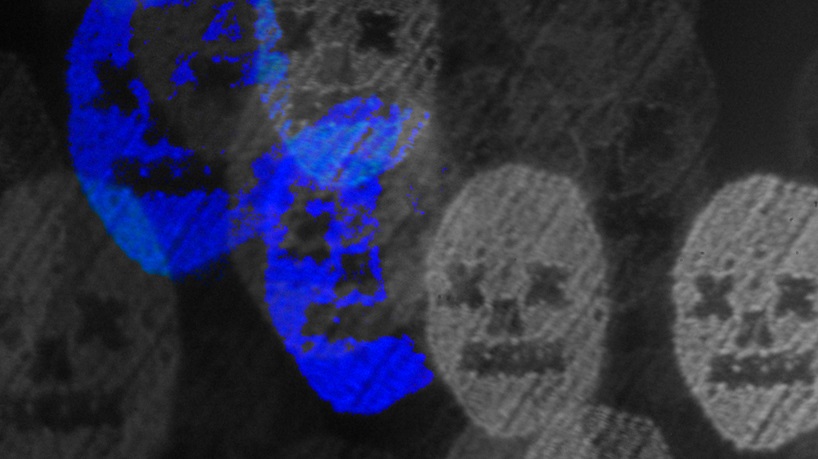
For today’s images, I took an earless headshape cut, over an iridescent plastic filter and drew the Xs for sewn-shut eyes and mouth, and the holes for the lost nose. Then I used the blue-only setting in my camera for the fear. I wondered if the blue only setting would work with the blue depth effect and it does, so that’s a new technique to think about during composition.
Tunetober
For this week’s challenge, I put my recorder next to my bed, and recorded kitty scratching at my bedroom window. He doesn’t believe I should sleep at night.
Sewtober
This week for my treat, I finished ten quilt pockets so I have a complete October for my calendar quilt. I’ll use it for November too.
I had no idea what a fun treat this would be until I had all the squares and started arranging them into possible patterns. I had a lot of fun.
My sewing trick is something I think I’ve known for a long time, but never really used. Now, I realize how much thread and time it saves.
Trick: When sewing several pieces at once, as in the ten pockets I made this week, finish off the first piece with a quick back-stitch, then shove the next piece up to the needle and keep sewing.
Piece after piece without cutting the thread
Make a string of all your pieces one after another. Then, when you’ve back-stitched your final piece, clip your thread close to the machine before pulling the pieces out.
Chain of quilt pockets to snip apart.
A quick snip separates each of your pieces. I love my small orange Fiskars for quick snips. Depending on how you usually pull your piece from your machine and snip your threads, this could save you about a foot of thread per piece.
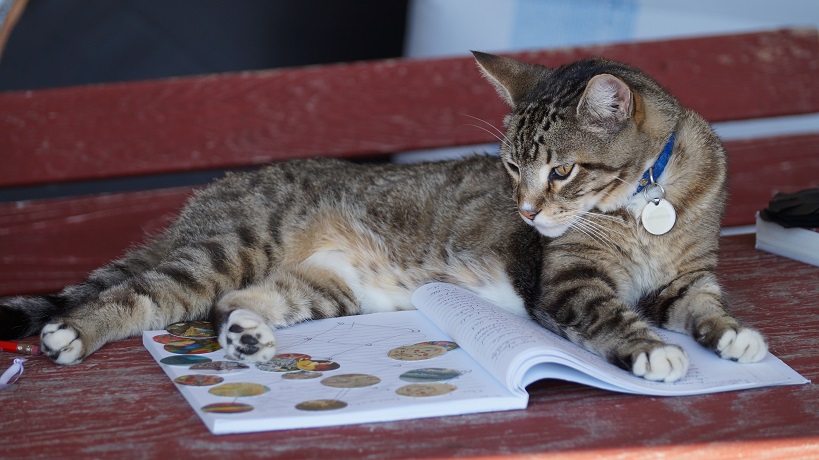
Another trick: The cat has taken to napping on my ironing board with his head on the iron (when it’s off 👻😼). It’s adorable, but he leaves a mess of shed, so I was really glad to have my lint roller handy.
Welcome back for the twenty-seventh day of Writober. It’s Sunday, and the last day we’ll be looking at the universal fear of loss of a sense.
Loss of Sense by Maria L. Berg 2024
Fear of loss of a sense to most, I think, would instantly be the fear of losing sight, but what about not being able to hear, or feel touch? My father lost his sense of smell, and can’t taste anything (a package deal). For him, this has its ups and downs. He doesn’t smell the terrible smells he makes working in his shop, or fixing the septic, but he also can’t taste the wonderful ways my mom cooks the salmon he catches.
By looking back at this week’s fears, the aspects of the fear of mutilation: injury, attack, dismemberment, torture, parasites, and loss of a sense, have you gotten any closer to any of your core causes of these fears? What memories have come up for you that you may not have thought of since they happened?
Rhetorical Device: Simile
A simile is a figure of speech comparing one thing to another, usually using like or as. Similes are important in all kinds of writing. However, be careful of cliché similes, the ones that are used all the time, and don’t use too many similes. There are some good tips for creating and using similes in this quick article:
Fighting Fear of the Blank Page: How’s your relationship with the page coming along? Which approaches have been your favorite so far?
Review this week’s techniques: Try one you didn’t try yet, or use your favorite from this week.
*Quick Note about links in this post: I am an amazon associate, so most of the links in my post will take you to amazon products. If you buy from these links, I will make some pennies which will help me pay for this site and my creative endeavors.
OctPoWriMo
Poetry Toolbox
These are quick exercises that I hope you’ll do every day. We will build on these exercises throughout the month.
Word list: Write down the first ten words you think of when you think of fear. Any words at all. Anything that comes to mind. Then choose your three favorite and say them aloud a few times until you hear the accented and unaccented syllables (if more than one syllable) and notice the duration of each syllable. Add the least connected exact rhyme, and the strangest slant rhyme. (Inspired by Frances Mayes’ list of a hundred favorite words in The Discovery of Poetry)
I created this Excel Spreadsheet for you to use to collect and explore your fear words.
2. Sensory Imagery: In your journal or a word processing file, fill in these lines as quickly as you can. Notice they are slightly different from last week. You may want to revisit one or two in more detail if you’re inspired and have time.
3. More Sensory Imagery: Answer sensory questions about fear of loss of a sense. This is a good exercise for coming up with similes.
4. Poetry collection study: Search the collection for similes. Are there any exciting, surprising, and unique comparisons? Which are your favorite? Which didn’t work for you?
Poetry Building
Simile: similes are often used in sensory description especially for taste and smell. Something smells like strawberries, or tastes like diesel fuel (shouldn’t be tasting that). Similes provide information by comparing something that isn’t familiar to something that is. Similes can be a great place to create surprise in your writing. Try comparing two things you have never compared before. How are they alike? Create a simile.
Example poem: Today we’re looking at Last Words by Mary Jo Salter, copied here from blog. bestamericanpoetry.com for educational purposes.
LAST WORDS
by Mary Jo Salter
Forgive me for not writing sober, I mean sooner, but I almost don’t dare see what I write, I keep mating mistakes, I mean making, and I’m wandering if I’ve inherited what my father’s got.
I first understood it when he tried to introduce me to somebunny: “This is my doctor,” he said, then didn’t say more, “my daughter.” The man kindly nodded out the door. I thought: is this dimension what I’m headed for?
I mean dementia.| Not Autheimer’s, but that kind he has, possessive aphasia: oh that’s good, I meant to say progressive. Talk about euthanasia! I mean euphemasia, nice words inside your head not there, and it’s not progress at all.
No, he’s up against the boil after years now of a sad, slow wall and he’s so hungry, I mean angry.
Me too. I need to get my rhymes in while I still mean. I mean can.
from Zoom Rooms by Mary Jo Salter ( Knopf, 2022).
How does this poem make you feel? How does Salter use language to explore fear?
Today’s prompt: Write a poem exploring the fear of losing a sense using simile.
Form: If you’re looking for more of a challenge, write your poem as an n+7. Use a poem you wrote this week and replace all the nouns. Or, try one of the other variations from woodlandpattern.org. Want to speed things up and force yourself to use the seventh word and not a different choice? Here’s an n+7 machine.
Write your poem and post it to your site (blog/ website/ other), then post a link in the chat. You may also post your poem in the chat if you do not have a place to post it. If you are posting as “someone” or “anonymous,” please put your name at the end of the poem. Throughout the day, please check back when you can to read and encourage other poets, to learn from each other, and enjoy each other’s efforts.
Writober Flash Fiction
Write a story with a beginning, middle, and end with conflict that leads to change in less than a thousand words (no minimal word count) inspired by one of the images in the Mutilation folder of the Writober 2024 Pinterest board. How could fear of loss of a sense play a role in your story?
Novel Prep
Now that we know more about our main characters, let’s revisit our main scenes and see if we can increase the stakes even more. What would be the worst thing that could happen to our character in each situation? Use this month’s study of universal fears to brainstorm scenes for each. What scene could have ego death be the worst thing that could happen to the MC or the Antagonist? Brainstorm a scene in which separation is the worst thing that could happen. You get the idea. Can you imagine a scene in which your MC loses one of his/her senses either permanently or temporarily?
Halloween Photography Challenge
Take a photograph that depicts loss of a sense or fear of loss of a sense and link to your photo in the chat.
Tunetober
How did it go? Is your tune getting scarier as it develops? This week, put all the pieces together and finish up your tune. Don’t forget to link it to the chat on Halloween.
Sewtober
This week, finish up your costume, and your decoration. Share your creation in the chat on Halloween.
Get Moving
Okay, this is just something I found that I think looks really fun, but it’s too expensive and I would probably break myself if I tried it, but Kangoo jumps jumping shoes are a real thing.
These are my responses to the Writober prompt post Fear of Parasites.
OctPoWriMo
I started a poem that grew with each line like a parasitic tapeworm, but I like the Clarity Pyramid form so much, I wrote one of those to share instead.
FEAR of all parasites
tiniest monsters slip into our systems feeding on us to our demise
“he says he recalls memory loss”
Writober Flash Fiction
Ayesha wasn’t afraid of any bathroom. She thought she had seen it all, even using a men’s room or two when the lines for the lady’s were down the hall and around the corner. Which was how she had expected the line for this bathroom to be. She had waited an hour to get into this Halloween bash of the century, and the haunted house alone was totally worth it, room after room of animatronics and actors, jump scares and crazed clowns. They really went all out. But that was just the beginning, there was a DJ in the main theater, and a band up on the roof. The place was packed, so why wasn’t there a line for this bathroom?
As she reached for the door handle wondering if it would be sticky, two barely dressed “witches” pushed past her as if she wasn’t there. The door was still closing behind them, and Ayesha was still assessing if she was more shocked or pissed, when they screamed and came running out. The follower witch looked back at Ayesha and said, “Don’t go in there. It’s horrible! So disgusting!” They ran off and disappeared up the stairs.
Disgusting, huh? Ayesha thought. She took it as a dare, imagining every disgusting place she had popped a squat, trying to remember the worst club, gas station, outhouse, and port-o-let. There had been so many.
As she opened the door, she got a strong whiff of sulfur, like giardia farts or a pile of rotten eggs. This bathroom was a claustrophobic closet with a mirror and sink to her right and one toilet straight ahead. The florescent light flickered over the mirror, and water slapped on rust-stained tiles under her feet. Moist, brown, wadded paper towels, and other disgusting discards clustered along the walls. Ayesha agreed this bathroom was definitely disgusting. But it was the toilet, or rather what was in the toilet that gained the bathroom the prize for most disgusting.
Ayesha walked right up to it, thinking it was another animatronic. The giant, oozing green, single cell with a gaping mouth and rows of eyes propped up in the toilet had wiggling tentacles reaching in every direction. “Not their best work,” Ayesha said aloud, reaching out to touch it, but then it shivered and spit out mini versions of itself. It shook and roared. It’s tentacles reached toward her as she backed away from the approaching hoard of mini-monsters swim-crawling toward to feet. She shuffled backward. She needed to run, but she couldn’t take her eyes off it’s eyes as a deep voice repeated her name swirling in her mind.
Ayesha figured she slipped and hit her head, because she didn’t remember the rest of the night when she woke up at home the next morning. She had slept in her clothes. Her stomach rumbled, gassy. The room smelled like sulphur. Her pants felt tight, and when she looked in the mirror, her stomach was distended. Her name echoed in her head. It was calling her. They were calling her. She had thought she was so tough, but she would never use a public toilet again.
Halloween Photography Challenge
Today’s filter cut was inspired by the public bathroom parasite image in this week’s Pinterest folder. I had fun playing with my camera’s single color effects in the mirrorworld. Then turned the security light into a parasite using an iridescent plastic filter while holding an umbrella. 🎃👻
Welcome back for the twenty-sixth day of Writober. During this fourth week we’re exploring the universal fear of mutilation. Today we’re looking at fear of parasites.
Fear of Parasites by Maria L. Berg 2021
A parasite is an organism that lives in or on an organism of another species (its host) and benefits by deriving nutrients at the other’s expense. Many great horror movies like the Alien franchise and The Thing grew from a fear of parasites.
When I was a Peace Corps Volunteer in West Africa fear of parasites was a part of daily life. Real life monsters like guinea worm maim and cripple, amoebas attacked my gut and broke down my immune system, malaria can kill and when survived can come out of dormancy and recur. And those are only a few examples.
Literary Device: Abstract and Concrete Nouns
An abstract noun represents an intangible idea. It can’t be measured or physically sensed. The most common abstract nouns are love, beauty, truth, happiness, and good/evil.
A concrete noun is a physical object. A person, place, or thing that can be detected by our sensory organs and can be measured.
Fighting Fear of the Blank Page: One way to fight fear of the blank page is to pre-write, and do some research.
The abstraction study sheet: I started my focus on abstractions three years ago, and it never gets old. During my study, I have created a study sheet for myself that helps me dive into an abstraction and gather lots of concrete nouns and ideas that I connect with the abstraction. So here is a writing tool exclusive for you Writober die-hards still playing along.
You’ll notice an expanded section of sensory details including “line” which means what kind of line is it? Is it jagged, straight, dotted, curved, etc. And animal, insect, weather are all asking what this abstract noun makes you think of in these categories. As for the fight or flight, control, and bias cues, here’s a post that explains that, actually it’s a progression of three posts from April of 2023 that explain it:
I also explore the psychology and philosophy of the abstract noun and look up any famous quotes that use it.
*Quick Note about links in this post: I am an amazon associate, so most of the links in my post will take you to amazon products. If you buy from these links, I will make some pennies which will help me pay for this site and my creative endeavors.
OctPoWriMo
Poetry Toolbox
These are quick exercises that I hope you’ll do every day. We will build on these exercises throughout the month.
Word list: Write down the first ten words you think of when you think of fear. Any words at all. Anything that comes to mind. Then choose your three favorite and say them aloud a few times until you hear the accented and unaccented syllables (if more than one syllable) and notice the duration of each syllable. Add the least connected exact rhyme, and the strangest slant rhyme. What abstract noun would you connect to your word? (Inspired by Frances Mayes’ list of a hundred favorite words in The Discovery of Poetry)
I created this Excel Spreadsheet for you to use to collect and explore your fear words.
2. Sensory Imagery: In your journal or a word processing file, fill in these lines as quickly as you can. Notice they are slightly different from last week. You may want to revisit one or two in more detail if you’re inspired and have time.
3. More Sensory Imagery: Ask yourself sensory questions about fear of parasites.
4. Choose a poetry collection: Looking through the collection, pick out the abstract nouns. How are they used? What concrete nouns are used to describe them? What imagery is used?
Poetry Building
Abstract and Concrete Nouns: Since the earliest poems, poets have used imagery, metaphor (we’ll get into metaphor next week) and rhetorical devices to express abstract concepts. Abstractions by themselves are vague and different people define them differently. That’s why it’s so important to explore concrete imagery with specific detail when exploring abstractions.
Example poem: Today we’re looking at Ghosts by Ella Wheeler Wilcox, copied here from poets.org for educational purposes.
There are ghosts in the room. As I sit here alone, from the dark corners there They come out of the gloom, And they stand at my side and they lean on my chair
There’s a ghost of a Hope That lighted my days with a fanciful glow, In her hand is the rope That strangled her life out. Hope was slain long ago.
But her ghost comes to-night With its skeleton face and expressionless eyes, And it stands in the light, And mocks me, and jeers me with sobs and with sighs.
There’s the ghost of a Joy, A frail, fragile thing, and I prized it too much, And the hands that destroy Clasped its close, and it died at the withering touch.
There’s the ghost of a Love, Born with joy, reared with hope, died in pain and unrest, But he towers above All the others—this ghost; yet a ghost at the best,
I am weary, and fain Would forget all these dead: but the gibbering host Make my struggle in vain— In each shadowy corner there lurketh a ghost.
This poem is in the public domain. Published in Poem-a-Day on October 19, 2024, by the Academy of American Poets.
How does this poem make you feel? What stands out to you? Notice how the poet personifies the abstractions.
Today’s prompt: Write a poem exploring the fear of parasites using both abstract and concrete nouns.
Form: If you’re looking for more of a challenge, write a clarity pyramid (or series of clarity pyramids) using an abstract noun as the title (first word).
Write your poem and post it to your site (blog/ website/ other), then post a link in the chat. You may also post your poem in the chat if you do not have a place to post it. If you are posting as “someone” or “anonymous,” please put your name at the end of the poem. Throughout the day, please check back when you can to read and encourage other poets, to learn from each other, and enjoy each other’s efforts.
Writober Flash Fiction
Write a story with a beginning, middle, and end with conflict that leads to change in less than a thousand words (no minimal word count) inspired by one of the images in the Mutilation folder of the Writober 2024 Pinterest board. How does fear of parasites affect your character?
Novel Prep
Now that we’ve looked at our MC and antagnoist’s daily routines. What is it that they dream about. What do they wish was different? What did they want to be and do when they were younger? Why didn’t it work out, or why haven’t they achieved it yet? If they could go back and change one thing, what would it be?
Halloween Photography Challenge
Take a photograph that depicts fear of parasites, and link to your photo in the chat.
Get Moving
Now that you’ve read all the prompts and have all these ideas running around in your head, it’s time for motion. Some suggestions:
Still looking for something different? How about this Prancercise video from 1989.
These are my responses to the Writober prompt post Fear of Torture.
OctPoWriMo
But to What Specific Purpose?
It’s broken, and I can’t fix it This complicated warning system meant to keep me from harm has too many switches stuck on firing and firing its alarms but like the broken light switch in the hall, they flicker, sending new jolts to the already excited
Hands tied, attempts at relief break other systems. Vicious cycles of deadening and strengthening until every sound is a threat and every touch is a cut.
The harness holds my eyes open, so I can’t look away. What is the question I haven’t answered? The secret I hold that can’t be pulled from my lips?
Electricity and water don’t mix, yet I am electricity in water. Strapped in contortions while every sharpened instrument on display is internalized and actively trying to carve a way out. The electric eel has its warning system it says Stay Away, but I can’t stay away from my own body, my captor, the deliverer of pain.
Writober Flash Fiction
Tipping
After his divorce, Darren started doing things he used to do before he was married. This night, as he drove past Hesher’s Farm, he remembered how funny he had thought it was to tip cows. He and his buddies, a bunch of beers, and some sleeping cows, had been a laugh-riot. Or so he remembered.
He parked on the side of the road, and started climbing the fence. chuckling as he sized up the closest cow, but then a bright light filled the sky like someone had switched on a spotlight from above . He felt a tug that became a yank. He held on tight to the fence as he was tipped upside down, his feet flying up over his head, but he couldn’t hang on. As he flailed higher and higher, his car and a few cows lifting up below him, all he could think about was the probing to come.
Why did everyone get probed? he wondered. Wouldn’t the first dozen or so probes reveal any useful information they wanted to know? Wouldn’t they have much more advanced ways to scan the human body without being anally intrusive? Could it be that he and the cow had more in common than just being Earth species? As the ship opened and pulled him in, Darren wondered at what age the aliens had their mid-life crises.
Halloween Photography Challenge
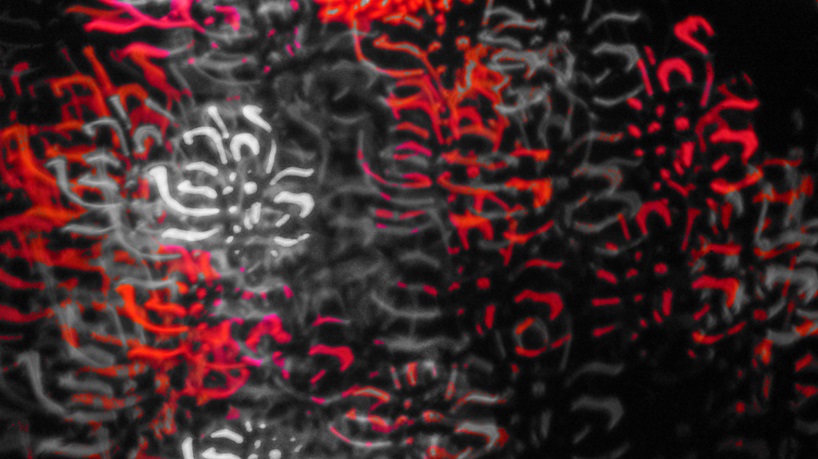
For today’s images I was thinking about how torture is using our own nerve endings against us, so I cut a new filter of what that looks like to me and played with it in the mirrorworld.
Welcome back for the twenty-fifth day of Writober. During this fourth week we’re exploring the universal fear of mutilation. Today we’re looking at fear of torture.
Though I find the title “Torture Animation” off-putting, the message about the reality of fear of torture fits today’s topic.
Rhetorical Devices: Pleonasm & Tautology
Pleonasm is using more words than are necessary, similar to redundancy. For example: “burning flame,” because a flame is already burning, and also burns.
For tautology I found this video from Grammar Monster:
Both tautology and pleonasm can be considered a fault in writing, but can be used for rhythm and emphasis.
Fighting Fear of the Blank Page: Fear of the blank page can be torture, but once we get past it, writing is so fun.
Net of possibilities: I created this technique as a way to use up some leftover puzzle tags with images on them. Draw a “net” on a sheet of paper:
Cut circles of images. I used sections from paintings, mostly famous old paintings, but you can use any images you like. Choose your images at random and put them on your net one at a time, noting down what sparks for you in each image and connections that come up between the images. I talk more about it in my post, Multiplicity: the dot that becomes a universe.
*Quick Note about links in this post: I am an amazon associate, so most of the links in my post will take you to amazon products. If you buy from these links, I will make some pennies which will help me pay for this site and my creative endeavors.
OctPoWriMo
Poetry Toolbox
These are quick exercises that I hope you’ll do every day. We will build on these exercises throughout the month.
Word list: Write down the first ten words you think of when you think of fear. Any words at all. Anything that comes to mind. Then choose your three favorite and say them aloud a few times until you hear the accented and unaccented syllables (if more than one syllable) and notice the duration of each syllable. Add the least connected exact rhyme, and the strangest slant rhyme. (Inspired by Frances Mayes’ list of a hundred favorite words in The Discovery of Poetry)
I created this Excel Spreadsheet for you to use to collect and explore your fear words.
2. Sensory Imagery: In your journal or a word processing file, fill in these lines as quickly as you can. Notice they are slightly different from last week. You may want to revisit one or two in more detail if you’re inspired and have time.
3. More Sensory Imagery: Ask yourself sensory questions about fear of torture.
4. Choose a poetry collection: After close reading some of the poems in the collection, are you seeing new themes, and ideas? Choose three more poems that you now think connect with the ones you studied, and explore the similarities and differences.
Poetry Building
Pleonasm and Tautology: As a poet, both of these rhetorical devices seem like things I would want to diligently cut out of my drafts, but for today, let’s play with ways that repeating what we say in other, yes redundant, ways can expand on what we want to say for emphasis.
Example poem: Today we’re looking at At the Retirement Home by Tony Barnstone, copied here from poets.org for educational purposes.
U.S. Soldier, 194th Armored Regiment, retired, Brainerd, Minnesota
I’ve had both knees replaced. I’ve got a steel pin in my hip. I don’t hear you so good, but I’m not stupid, son. How would you feel, surviving the Bataan Death March, no food for days, no water, and the ones who fell behind were bayoneted where they lay, and now you’re marching off to death? Real hell is not old age, though. No, taking away the rights we died for, saying torture’s right, that’s hell. Hand me the iron and those shirts, would you? Thanks, son. As long as I have fight in me I’ll love this country till it hurts. And it does. This is worse than what I saw overseas. Torture. In America.
How does this poem make you feel? What stands out to you?
Today’s prompt: Write a poem exploring the fear of torture using pleonasm and/or tautology.
Form: If you’re looking for more of a challenge, write your poem as a soliloquy in which the speaker uses pleonasm and tautology.
Write your poem and post it to your site (blog/ website/ other), then post a link in the chat. You may also post your poem in the chat if you do not have a place to post it. If you are posting as “someone” or “anonymous,” please put your name at the end of the poem. Throughout the day, please check back when you can to read and encourage other poets, to learn from each other, and enjoy each other’s efforts.
Writober Flash Fiction
Write a story with a beginning, middle, and end with conflict that leads to change in less than a thousand words (no minimal word count) inspired by one of the images in the Mutilation folder of the Writober 2024 Pinterest board. How does fear of torture affect your character?
Novel Prep
What is your MC’s daily routine? What, where, and how does s/he eat? How does s/he travel? Who does s/he interact with? Where does s/he work? What is a regular work day like? What irritates, excites, surprises, tires your MC during the day? What is daily home life like? Try to think of every minute detail. Then do the same for the antagonist.
Halloween Photography Challenge
Take a photograph that depicts fear of torture, and link to your photo in the chat.
Get Moving
Now that you’ve read all the prompts and have all these ideas running around in your head, it’s time for motion. Some suggestions:
Many people find exercise akin to torture, but I hope my movement suggestions have made getting moving fun. Choose the suggestion that has been least torturous and get moving. My favorite is my new twister disc. I absolutely love it.
It’s Open Link Night at dVerse Poets Pub, so head over and link up your poem and read and comment on the other dVerse poets’ offerings.
Dismemberment Arguments
I don’t want to write about dismemberment. I am afraid of dismemberment : a foot to guinea worm, an eye to a chemical spill, a finger or two to a bansaw, a breast or leg to cancer. Could there be a different definition of dismemberment? Like Diss member meant
I don’t say “Diss” for “this”, or use the word “diss” meaning put down, but if it keeps me from writing about dismemberment I’d say What diss member meant was our group is sharp and meaty Don’t diss what a member meant to diss group separating diss member meant we’re missing artichokes and slimy oysters diss member’s dismemberment left us one woman down for the fund raiser, one runner down for the three-legged race, one gambler down for the one-armed bandit
Doesn’t dimemberment save lives? Maybe diss member who got dismembered got severe frostbite which led to gangrene and amputation was the only thing to save her or diss member who wasn’t dismembered was trapped in a rock slide and was stuck where no one could get to him leaving a hand behind was the only way to get free
And these days prosthetics are so sci-fi they can even be controlled by your mind We can adapt and change. The brain compensates for new realities. But why the phantom limbs? I’m still afraid of dimemberment. I’m not going to write about dismemeberment.
Writober Flash Fiction
Crucial Limbs
Victor woke up shivering yet feeling like his blood was on fire, heart pulsing in his head, his neck, his wrists. A crash and high pitched squeaks made his skin crawl. Imagining rats crawling on him, he jumped up and looked around the dark alley, but didn’t recognize anything.
A hazy memory of Saffron, the exotic raven-haired, porcelain-skinned woman who was so eager last night, excited him all over again. Yet no blood rushed anywhere. Weak-kneed, he fell against a brick wall and felt thanks for its rough coolness against his cheek. His friend, the brick wall lead him out of the alley toward the sounds of morning: traffic, shopkeepers opening up spraying puke and piss from the sidewalk, people rushing to work talking on their cell-phones.
The alley’s shade felt like a separate world, as if he had woken up into a new dimension and was stumbling back toward the world he knew. As he stepped closer to the rectangle of light ahead, Victor suddenly felt afraid. Maybe he was worried who would see him. He couldn’t remember ever having a hangover this bad; he must be in an embarrassing state of dishevel. But he had to get home somehow, and that meant leaving this alley. He stepped out into the sunlight, squinting in the glare. The morning sun already hot and humid, hit him like a wall of fire.
He smelled smoke and looked all around before he realized that his arms were aflame. One of the shopkeepers turned his sidewalk spraying hose on him, and dialed 911. In the ambulance they covered him in wet wool blankets to stop the flames that kept erupting anywhere that sunlight hit him. After waking from the medically-induced coma, the doctor explained that they had removed his horribly burned arms, but were able to save his legs. Victor wasn’t really listening. All he could think about was the blood pulsing in the doctor’s neck. He was so hungry. As the doctor checked his vitals, Victor kept trying to sink his teeth in, but he couldn’t push himself up, or pull the doctor close enough.
Halloween Photography Challenge
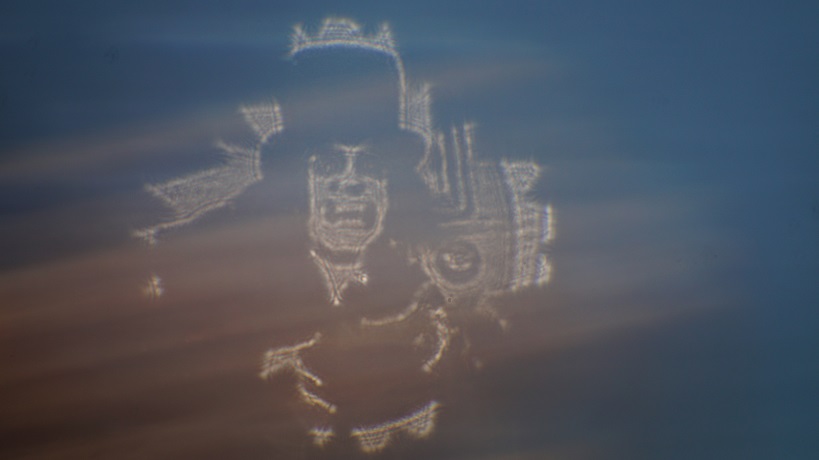
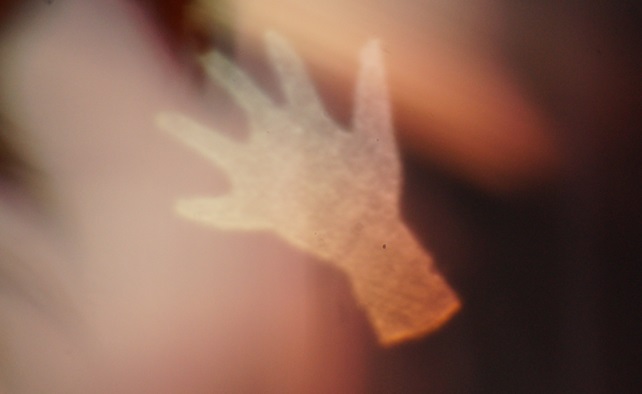
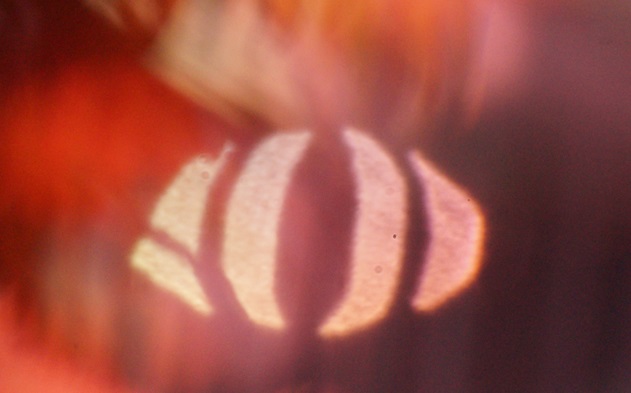
Inspired by today’s example poem and my answers to What color is dismemberment? I combined pink, yellow, and gray half-color filters, and used different body part filters I’ve cut over the years. I had fun incorporating some fall leaves into the photos or the security light across the street, then combined the photos into a gallery.
Welcome back for the twenty-fourth day of Writober. During this fourth week we’re exploring the universal fear of mutilation. Today we’re looking at fear of dismemberment.
Fear of Dismemberment by Maria L. Berg 2024
While looking at fear of dismemberment this morning, I came across something very scary and interesting. There is a rare mental condition called Body Integrity Dysphoria “where you feel that a limb or healthy body part shouldn’t be part of your body. You’re aware that this body part is healthy; you can still feel, use and move this body part, but you don’t believe it should be yours. You want to live life without the use of that limb. As a result, you might ask a healthcare provider for an amputation or attempt a self-amputation of your healthy limb.” (from clevelandclinic.org)
I find this fascinating. Dismemberment is so frightening, and yet there are some humans who crave it. Something to think about.
Rhetorical Device: Prolepsis
Prolepsis is a figure of speech in which the speaker raises an objection and then immediately answers it. Prolepsis comes from the Greek meaning preconception, anticipation. In literature it is also known as “flash forward” or “prophecy.”
The prolepsis of rhetoric is a speaker predicting objections to their argument and answering them before they can come up.
Fighting Fear of the Blank Page: What if you could dismember your inner critic?
Dismember the page: Take a sheet of paper and tear it into six or seven uneven pieces. Shuffle them around. Throw some on the floor. Then write on each piece, one at a time. When finished, tape the pieces back into the shape of the original sheet, or not.
*Quick Note about links in this post: I am an amazon associate, so most of the links in my post will take you to amazon products. If you buy from these links, I will make some pennies which will help me pay for this site and my creative endeavors.
OctPoWriMo
Poetry Toolbox
These are quick exercises that I hope you’ll do every day. We will build on these exercises throughout the month.
Word list: Write down the first ten words you think of when you think of fear. Any words at all. Anything that comes to mind. Then choose your three favorite and say them aloud a few times until you hear the accented and unaccented syllables (if more than one syllable) and notice the duration of each syllable. Add the least connected exact rhyme, and the strangest slant rhyme. (Inspired by Frances Mayes’ list of a hundred favorite words in The Discovery of Poetry)
I created this Excel Spreadsheet for you to use to collect and explore your fear words.
2. Sensory Imagery: In your journal or a word processing file, fill in these lines as quickly as you can. Notice they are slightly different from last week. You may want to revisit one or two in more detail if you’re inspired and have time.
Prolepsis can be a great tool for poetry as each poem is a form of argument. Using prolepsis you can imagine all the objections to your idea, and the answers you come up with can add depth to your poem.
Example poem: Today we’re looking at Dismemberment by Sinan Antoon, copied here from poets.org for educational purposes.
The body, or a voice impersonating it, said: Go! As of now, you are all free. The eyes flew far away, joining flocks of other eyes. which had filled the sky, almost blocking the sunlight. The lips parted company without a farewell; One searched for a new face, the other for a lip that would listen to its complaints. The tired tongue sought a mute man’s mouth to rest in. The hands clapped and waved to each other as they fled away. The right leg appeared frightened and hesitant, then rushed to catch up with the left leg. The nose fell on the ground. . . As for the heart, it kept beating alone until a stray foot crushed it.
How does this poem make you feel? What stands out to you? What is the purpose of this poem?
Today’s prompt: Write a poem exploring the fear of dismemberment using prolepsis.
Form: If you’re looking for more of a challenge, use prolepsis to write a Bop poem.
Write your poem and post it to your site (blog/ website/ other), then post a link in the chat. You may also post your poem in the chat if you do not have a place to post it. If you are posting as “someone” or “anonymous,” please put your name at the end of the poem. Throughout the day, please check back when you can to read and encourage other poets, to learn from each other, and enjoy each other’s efforts.
Writober Flash Fiction
Write a story with a beginning, middle, and end with conflict that leads to change in less than a thousand words (no minimal word count) inspired by one of the images in the Mutilation folder of the Writober 2024 Pinterest board. How does fear of dismemberment affect your character?
Novel Prep
Continuing to really get to know our characters, let’s look at how they move differently. When you really know a person, you know their walk, how they sit, how they stand, how they run. People move differently. Start exploring your MC’s physicality. Then compare it to your antagonist’s physicality. How are they different? How are they similar?
Halloween Photography Challenge
Take a photograph that depicts fear of dismemberment, and link to your photo in the chat.
Get Moving
Now that you’ve read all the prompts and have all these ideas running around in your head, it’s time for motion. Some suggestions:
Cardio drumming. Here’s something different. Turn your exercise ball into a drum. To hold the ball I use an old plastic garbage bin.









 Experience Writing