Exploring the Senses – Taste

Tasting sweet, sour, bitter, salty and savory

Smell and taste are frequently stimulated together. The smell of food, for instance, greatly enhances its flavor. However, taste is a distinct sense from smell and should not be overlooked when describing your characters’ sensory perceptions. There are five well recognized types of taste receptors. These sensations are categorized as sweet, bitter, salty, sour and savory (often referred to with the Japanese word Umami). While exploring taste, I recommend finding ways to experience all five even though some of the taste sensations are not completely pleasant.

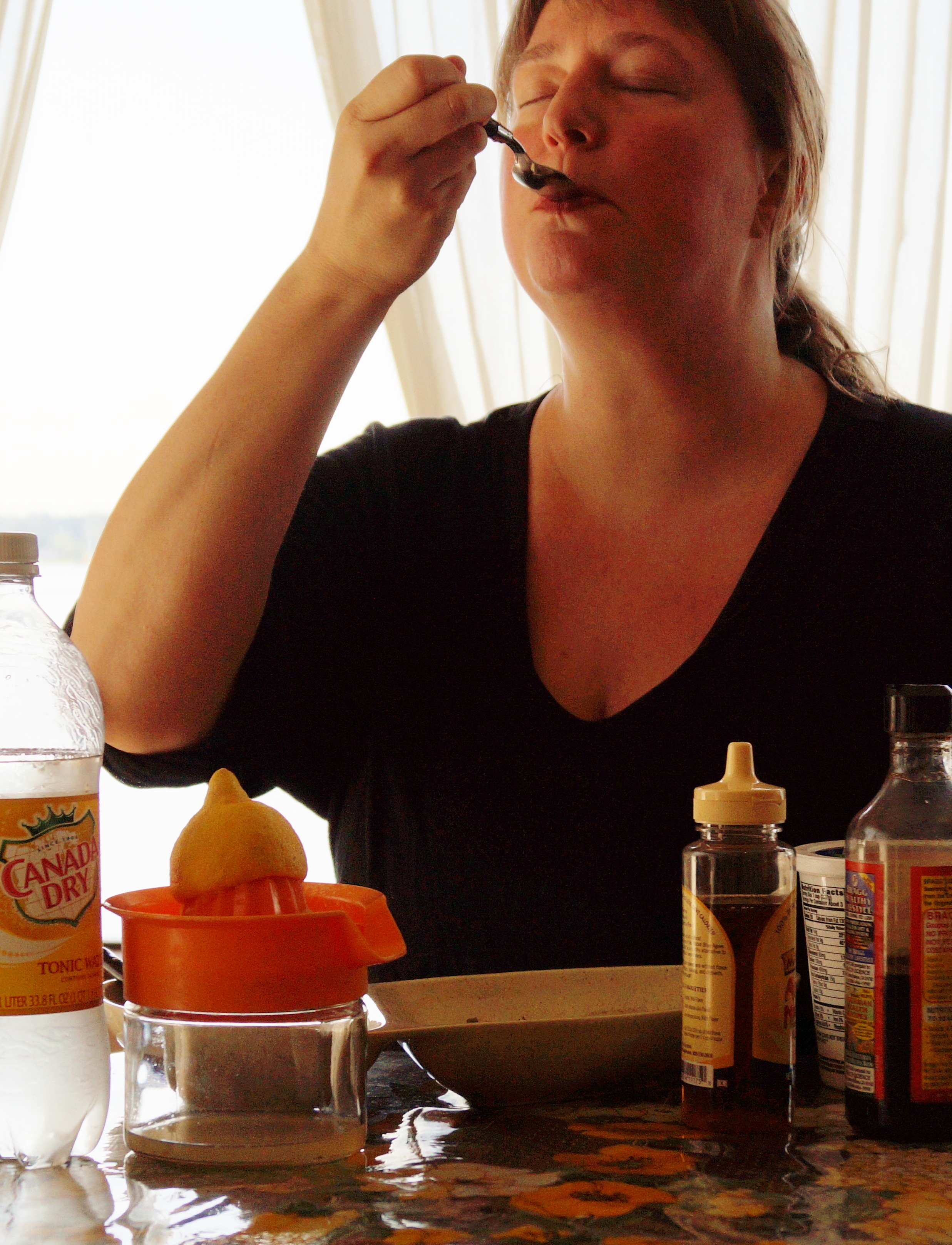
Exercise One: Gather things to taste that will activate all of the areas of your tongue. Also try some different textures. I tried soy sauce (Savory/Umami), lemon juice (sour), Agave nectar (sweet), Tonic water (bitter), pita chips (salty and crunchy) and plain Greek yoghurt for a smooth texture. Spend time moving each taste around your mouth and write down everything that comes to mind.

My example (Remember these are just notes. Forgive the incomplete sentences.):

Lemon Juice – More of a restrictive feeling on the tongue than a flavor, first on the right side then strongly at the back of the tongue. It stays in my throat and then I can feel it at the back of my sinuses.

Liquid Aminos (like soy sauce) – I feel it in the center top of my tongue. It is salty, but not from salt. It tastes brown like bear fur or the soft bark of a rotting tree.

Pita chips – do not taste as salty as the Liquid Aminos. The crunch is satisfying, makes me feel contented. My teeth feel sturdy and powerful. The bread flavor lingers as the crumbs liquefy and my tongue removes the leftovers from the bowls of my molars.

Tonic Water – Leaves a sour aftertaste at the top back of my mouth. All it is is sour aftertaste. It grabs the front of my tongue, but the bubbles carry it quickly to the top of my mouth where it lingers.

Agave Nectar – has a bit of a thick brown Molasses flavor though it is supposed to be the light neutral flavor. I don’t like it. I stick out my tongue and say “Eh.”

Greek yoghurt – It is cool on the tip and top of my tongue. Sour in aftertaste. A little vanilla or sweet at first. I feel the tang right at the top center of my mouth. I enjoy moving the thick silky texture around my mouth which I find odd because I hate the texture of pudding and it is very similar.

I was surprised that my notes were mostly physical descriptions of the feelings in my mouth. I did come up with a little bit of imagery that may be useful in my writing. I think I’ll try this exercise again sometime in the future with fruits and vegetables and also with a meal.

physical sensations on the tongue

Exercise Two: With your new insights and sensory awareness from exercise one, take your main character out to dinner. What is his or her favorite food or restaurant? Why? What foods, smells and textures does he or she hate? Why? Once you get to your table start taking notes. How does your character make menu choices? Did s/he know what to get before arrival, or are menu decisions difficult? When the food arrives try to perceive everything about the meal as your character. Remember that the smell, texture and taste are all part of the taste sensation. Take notes of everything that comes to mind. If you invite people to join you and your protagonist on your taste adventure, make sure to clue them in to what you’re doing. You wouldn’t want them to think you were being rude to them, taking notes about them, or just plain crazy.


Exploring the Senses – Olfaction: The Sense of Smell

The sense of smell triggers emotional memories

The sense of smell, more than any of the other senses, can trigger strong emotional memories. The olfactory system is physically wired for it. Unlike the other sensory pathways, the olfactory bulb has a direct connection to the amygdala (emotion) and hippocampus (memory consolidation). When you want to trigger your fictional character’s memory, you may want to figure out why s/he likes, or dislikes certain smells.

Preparing to explore the sense of smell was an exercise in itself. In the search for smells to trigger memories, I went scavenging at my childhood home. I started in the kitchen, looked around my old room, but hit serious pay dirt in my sister’s and my bathroom. I found small bottles of perfume I had received as gifts, lotion, an empty bottle of shampoo that still had a strong smell, and other forgotten stinky treasures. This adventure to my childhood home on the hunt for scents inspired a piece of writing before even doing the exercise.

Smells Like Home

She looked around the cold, empty kitchen. She wanted to make it feel like home again; warm and inviting as if they were all together staring at the TV in a tired, after school daze. She chose the French vanilla coffee from the ten different bags, in variable stages of use, in the freezer and started the pot. Her mother didn’t drink coffee and her dad drank instant. Did he drink instant because making coffee was woman’s work, or did he never bother to figure out the coffee pot? She didn’t know the answer. The only time there was coffee in the pot was for special occasions. Though her coffee was dripping in a regular plastic coffee pot, the sound of the coffee brewing reminded her of the tall silver percolator her mother set on the counter for every social gathering. She smelled the familiar earthy musk mixed with sweet and nutty aromas and she imagined everyone squeezing into the kitchen to help prepare the huge family meal. She thought of the Christmas get together with the lively white elephant gift exchange and smiled.

She went to the refrigerator and pulled out the huge block of orange medium cheddar which her mother always kept in the clear center drawer. The bread was on top of the fridge, though not in the stack of bowls like it used to be. They didn’t have the wonderful, hazelnut bread for her today, so wheat would have to do. She buttered the bread and started to slice the cheese. Remembering her mission to explore the smells of her youth, she held the slice up to her nose. Instantly, she pictured the cat that had been so crazy about cheese you could get him to walk on his hind legs and turn in a circle if you held cheese over him. He would be in the kitchen meowing loudly before you could even get the cheese out of the plastic wrap. He was the only one of Tatiana’s kittens they kept. What was his name? The smell of cheese didn’t bring that back. What a strange thing to forget.

Exercise: Gather a large selection of smelly objects that may trigger memories (I tried a sampling of gum and candy from my childhood along with the things I found in my childhood home). Don’t just look for good smells try some bad ones as well (I tried Witch Hazel, Noxema, and stinky perfume. Be creative. Try everything you can think of). In a group, smell the different objects and write down everything that comes to mind. Pick one smell that affected you the most and write about it for 5 minutes.

My example:

I had heard Ivory soap was invented to float, so I picked up a bar to clean myself in the lake while my septic was backed up—again. This was the second time in three years and when it happened the first time, I’d been without water for three months. At least this time it was warm. I got up before light and ripped open the plastic coated paper wrapper. The strong smell of the freshly opened bar of soap reminded me of the upstairs bathroom in my grandfather’s house. Specifically sitting and reading the wallpaper that looked like pages from a catalog from the old west. I remember the brown drawings of high button boots and a wood stove with prices a child collecting her pennies could afford. I don’t remember using Ivory soap during my annual week long summer visits. The soaps in the dish were small and shaped like flowers, but this was the smell of that bathroom. I decided I didn’t want to smell like grandpa’s bathroom. I didn’t care if the soap sank to the bottom of the lake. I hunted around the cupboard beneath the sink and found some old body wash. It was probably more environmentally friendly anyway.

I hope you try this exercise and enjoy exploring sensory description. I’d love to hear from you. Please leave comments and suggestions. Thank you.

Exploring the senses – Hearing

Auditory stimuli have the ability to trigger physical reactions. The calming sound of rolling waves, or the alarming jolt caused by a popped balloon can influence how we act and feel. Sounds, especially music, can also trigger memories.

Exercise: To explore hearing, each member of writing group brought a song to listen to. As we listened, we jotted down all of the thoughts that came to mind for the duration of the length of the song. I found that each song triggered personal memories and vivid imagery.

As with all of the sensory writing exercises I’ll describe, the results are twofold:

1. Sound triggers memories and writing ideas.

2. The exercise brings attention to how one’s fictional characters may react to sounds and music based on their histories and circumstances (perceptions).

Describing sounds, how they are perceived and their physical and emotional effects on the characters will add realism and depth to your writing.

Examples of my responses:

St. James Infirmary by Alan Toussaint

Railroad tracks

Otis playing piano in N.O. w/Kathleen on stand-up

I expect to hear Tom Waits start singing at any moment

The piano in that horrible apartment which I almost never played

La Belle Dame Sans Regrets by Sting

Ballroom classes at that weird dance studio in Metairie where I first met Bridget

The black and white checkerboard floor and the floor to ceiling mirrors in the middle of an empty club

Helping teach ballroom at Ruby Fruit Jungle

Drinking a tiny strong coffee at a café in Paris

The drawing Spencer did of his cousin Marie

The program from a Sting concert I thumbtacked to my wall over my desk

Like a Virgin by Madonna

Going to the record store with my gift certificate for winning the talent show and Mom making the clerk play every song on the Air Supply album, then saying it was too suggestive and making me get M.J.’s Thriller instead.

Buying Madonna’s tape from a friend at church because Mom wouldn’t let me get it

I hope this exercise triggers all sorts of ideas for you. I’d love to hear some of them. Also, if you have other sensory exercises you have found useful, please send them along. I love trying new things.

Exploring the Senses – Vision

I apologize for the neglect. I was hibernating. Now, with spring on my doorstep, I return to sharing my writing life with the world of internet content seekers.

Over the next five weeks I’ll share explorations and exercises I did with my writing group in an attempt to incorporate all five senses (vision, hearing, smell, taste and touch) into our writing. I found focusing on the senses enhanced my writing in two ways: it triggered memories and brought depth to character and scene descriptions.

Exercise-

For our vision exercise, each member of the writing group brought at least two pictures they found interesting. One of these pictures was then passed to the person on his or her left. We wrote for five minutes about the picture we received. After reading what we wrote, the exercise was repeated by giving a picture to the person on the right. Not knowing the context of the image triggered surprising memories as my brain attempted to find meaning and make connections to create a story around it.

Example-

Image

Where have I seen this before? I recognize it. She stared at the graffiti on the side of his apartment building. Usually the monochrome tags spray painted through the neighborhood were simplistic and boring, but this was a huge piece of art, a ten foot tall palm tree with a star over the top complete with light, shadow and coconuts. It reminded her of that Dos Equis Christmas commercial with all the lit up palm trees, but that wasn’t what was tugging at her memory. Maybe it was just déjà vu. She imagined the darkly clothed artist creating his image, a thief in the night, but with a compulsion to make, not take. How did he go unnoticed when he had to have used a tall ladder? Suddenly, she remembered. It had been carved into Léon’s left arm. Léon had been her liaison in Abidjan, Côte d’Ivoir. He was the only person whose facial scarification, hadn’t frightened or repulsed her, but had enhanced his features. Though the lines were shocking at first, she eventually found them attractive. Maybe the painting she was still staring at imposed a lot more significance than being impressively large graffiti. She had to find out what it meant.

Try it for yourself. Rummage through some old photos and see what you come up with. I hope my work with this exercise inspires.

First Story of the Lake Spirit

When she was younger, her favorite moments were swimming toward the full moon on a dark summer night. She would follow the trail the moon reflected on the lake, revealing another small part of the golden path after each smooth, silent stroke. She focused on the light, keeping her head above the water and moved slowly, trying not to make ripples on the surface. At these moments she felt one with the lake.

Once, she imagined following the moon so far that she could not turn back, eventually becoming exhausted and dying in its golden light. She welcomed this as a happy death and moved further along the path, but the lake suddenly changed. Surrounded by cold, she no longer felt welcome. Her nakedness was uncomfortable. The shore beckoned; her romantic longing to swim to the moon replaced by a need for carnal comforts: a hot shower; soft, thick blankets; and something warm to drink. Turning, she saw she hadn’t gone as far as she had imagined. She swam as quickly as she could, no longer caring about the waves and the noise she made. It felt like something was chasing her and about to grab her feet. Her burning muscles and searing lungs did not slow her. She bolted up the ladder and across the yard to the house. As she started to slide back the door, she heard a splash on the lake like the sound of a large fish jumping, making her pause to look back at the dark surface where circles of ripples moved out from the base of her ladder. Eventually, she realized that was the first time she met the lake spirit.

Creating Fictional Worlds: Not just Sci-Fi and Fantasy

Creating Fictional Worlds: Not just Sci-Fi and Fantasy
from empmuseum.org

I recently visited the Fantasy exhibit at the EMP museum in Seattle. In addition to the fun and inspirational drawings, costumes, and interactive computer exhibits, they displayed J.R.R. Tolkien’s hand written timeline. It was kind of him to reiterate the point of my previous post (Ha. Ha!). It also spoke to a related aspect of organizing one’s writing: World Creation.

Creating a world for the characters to walk around in is not just part of fantasy writing. Every story, even if it happens in present day down the street, is within a world created by the author. Any imagined world needs history, culture, language and architecture. And don’t forget the microcosms within this world: The symbols and colors, rituals, beliefs, or antitheses of set beliefs that influence and drive the inhabitants of this novel world. An author can leave a lot up to the reader, but everyone sees the world through his or her own perception. Defining everything in a unique world including its history, music, traditions and ceremonies, even if the setting is one’s own home, can help to close the gap between the author’s intentions and the reader’s perception.  Every genre, not just fantasy, is a place for world building. Spend some time creating a world for your characters. Draw it, paint it, and build dioramas if so inclined. Write, or listen to the music, research or create the traditions and ceremonies. I recently got excited about a microcosm in my story, leading me to think, for the first time, of the possibility of a spin-off series. The exhibit inspired me not only as a writer, but as a costumer and artist as well, so if you want to read more about it you can head over to the inspiration page of my creativity website mbercreations.com.
from art nerd seattle

Creating a world for the characters to walk around in is not just part of fantasy writing. Every story, even if it happens in present day down the street, is within a world created by the author. Any imagined world needs history, culture, language and architecture. And don’t forget the microcosms within this world: The symbols and colors, rituals, beliefs, or antitheses of set beliefs that influence and drive the inhabitants of this novel world. An author can leave a lot up to the reader, but everyone sees the world through his or her own perception. Defining everything in a unique world including its history, music, traditions and ceremonies, even if the setting is one’s own home, can help to close the gap between the author’s intentions and the reader’s perception.  Every genre, not just fantasy, is a place for world building. Spend some time creating a world for your characters. Draw it, paint it, and build dioramas if so inclined. Write, or listen to the music, research or create the traditions and ceremonies. I recently got excited about a microcosm in my story, leading me to think, for the first time, of the possibility of a spin-off series.

The exhibit inspired me not only as a writer, but as a costumer and artist as well, so if you want to read more about it you can head over to the inspiration page of my creativity website mbercreations.com.

Time Warp – recognizing flaws in the timeline

First, I want to thank Sherri Ann DeLost for inspiring me, by actually doing a storyboard. I hadn’t worried that my story timelines wouldn’t be securely matched in my mind as I wrote, until recently. One of my characters was lingering in his thoughts and being told he may have to spend some time in different behaviors than originally expected. That, in turn, would change the timeline from the perspective of the third character. Sherrie’s announcement of success with poster board reminded me that I needed to physically draw out my story’s timeline. My current work is telling a story from three perspectives and though I could wait to fix incongruities in a rewrite, it will be easier if the timeline meshes during my draft. I started my storyboard by cutting a couple pieces of butcher paper, and tacking the double layer (no marks or bleeds)to a well-lit wall. Then, I quickly reread my draft looking for the timeline, and took notes charting the story by weeks. I quickly found a flaw. The early part of my story was keeping to real events which no longer make sense in my fictional story. After reviewing the events week by week, it made a better story to reduce from fifteen weeks to thirteen weeks and change an event from week two to week six. The quick fix on the timeline, however, leads to a complete rewrite of the first point of view of the story. Luckily, with my new timeline poster on my wall, I can easily change  ‘two weeks passed’ to ‘one week and one day later’ and ‘the next week’ to ‘that weekend’ while I get my timeline to mesh. With my chart, I can now feel secure as I delve into each character’s point of view. Now, I have a tool to make notes where my new scenes fit and chart how they could interact for my next rewrite. The plot of a story exists within time. Physically plotting out a timeline early in the planning, or first draft process, can create an anchor for a writer to hold a story together as s/he reaches for larger risks. I had a roll of butcher paper, but you can use what you have ; broken down boxes;taped together scrap paper; recycle; just make it big.

From Shoebox to Rockets

From Shoebox to Rockets
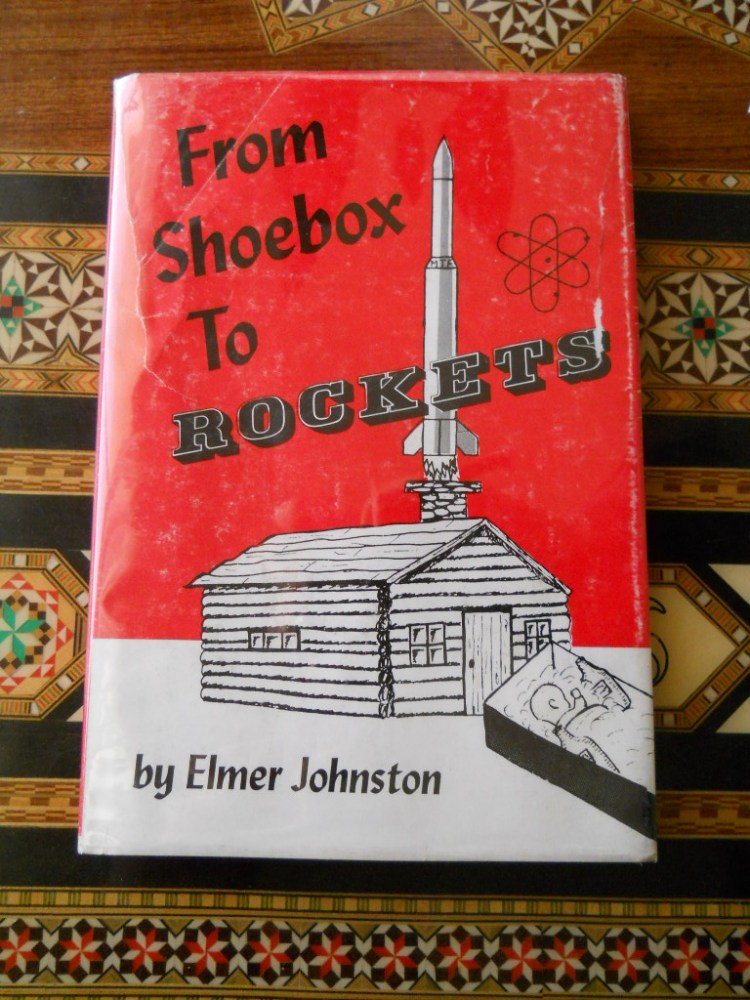
Today, I was going to post about my grandfather’s memoirs, including many pictures of him in uniform. He self-published, primarily for the family, the year before he died. I was researching a link to his work at the Smithsonian, when I was completely derailed by a signed copy of his book for sale online. Abebooks.com asked more than twice the original value for a signed copy from a library. At first I was excited to see the book for sale with a 5 star rating, but then I realized the five stars were for the condition quality which made me want to buy it and march it back to the library it came from and demand it was put back on the shelf.

Nobody’s Perfect

Want to make me not at all interested in a character? Describe him, or her as beautiful and rich. I gave up on Mary Higgins Clark’s mysteries in middle school because I just couldn’t care about the plight of the wealthy, beautiful people any more. Isn’t it enough that they cover the screens of our T.V.s and movie theaters; that they create enough scandals to fill tabloids week after week? Honestly, do they have to pollute our fiction as well? This last week, I read a novel which included a very beautiful woman planning her wedding. Her father was a billionaire, of course, who had two helicopters. She went to have a moment to herself in a bar, but she had to keep refusing drinks from strangers because she was so beautiful. Then when her fiancé saw her before the wedding she was even more beautiful. Really? There was more beautiful to go? What did that add? One thing Americans learned through the economic collapse was that only 1% of the population holds the wealth. Now think of how many of those people would be described as beautiful. I would say the fictional population is a pretty skewed subset of our population.  And the perfect character problem does not only reside among the beautiful that are wealthy. There are also the perfectly skilled. Why would I want to read a story about a person who went to battle school and never lost a battle from his first day? Why would he go to battle school when he had nothing to learn? These perfect characters have nowhere to go and nothing to overcome which makes for a boring story. But worse than that, there is just no relating to them. I realize that some people like to fantasize about being some mass produced beauty aesthetic with unlimited resources and adoration, but when those stories are over the reader is left with an empty feeling of ineptitude. As a writer, one wants to hook the reader by creating ways for the reader to relate to the characters. Give your character some adult acne, back pain, a car that breaks down when it is least convenient, bills that are always due and an out of work family member on the couch and your writing might resonate with the not as privileged 99.75%.

Reality T.V. as fuel for character development

How do I develop a villain without making him, or her, a cliché bad guy? Tips I’ve read say to try to make him less one dimensional by giving him quirks and something about him that could be loveable, if he hadn’t gone so wrong. Yes, these tips are good, but why was my villain behaving so badly, if he was a loveable guy with fun quirks? How could my reader relate to behaviors that seemed so strange to me? I wasn’t finding examples for my villain in my own life, or in the faces of my acquaintances and friends, so where could I look? My villain in progress was a sociopath who was able to live a double life with no remorse. At first I didn’t have a feel for what he was feeling, or how to understand his motivations, but then I stumbled upon the show Hard Core Pawn. I watched it because the inexplicably erratic behaviors of the pawn store customers made me laugh, but after watching a marathon of episodes, it dawned on me that the hysterical people the bouncers were walking, and sometimes carrying, out the door all had something in common: a sense of entitlement that I could not wrap my head around. Who would walk into a store and demand money for worthless objects and then throw a fit and threaten the owner when he said no?  From the show, I got the impression: everyone in Detroit. But then I started thinking, someone like my character; someone who felt that the world owed him and he was going to demand his due. This overreaching sense of entitlement brought a new dimension to my villain. I recently thought about adding a disillusioned young adult whose mom  put her in pageants as a child (Toddlers & Tiaras), or a hoarder who won’t let anyone come to her house because she lives in piles of possessions and piles of debt (Hoarding: Buried Alive). I am not recommending focusing on any one reality persona (for example Si Robertson (Duck Dynasty), or any one of the Kardashians), too closely, but when looking for inspiration for your characters with bad behavior, a dose of scripted reality can be inspiring.