I’m a little embarrassed that I didn’t present metric feet as clearly as I could this morning. While putting my words in my Excel Spreadsheet, I realized that I told you to count syllables in a line and divide by two, but that’s only correct in cases of disyllabic feet. Two of the three words I chose had three syllables and depending on how they are used, they might be anapaest or amphibrach, not iambs or trochees. But like I said, I only wanted to introduce the idea of the sounds of syllables and listening for stress and duration.
I’m also a little embarrassed that I ran into problems in my duration column of the spreadsheet trying to put in short and long dashes. The Excel program wanted those to be functions, so I changed to putting a small “s” for short and a capital “L” for long.
If I had taken the time to try out my posts before now, I could have caught these errors, but I also might not be having as much fun trying out the prompts now. A little embarrassment may be worth the discoveries along the way. And, lucky for me, I can go back and fix my errors in the prompt post, and I already did.
With No Embarrassment
I would dance in the bank parking lot on bubblegum-flavored days and sing loudly everywhere I am belting banana-peel-slippery tunes and wear a costume everywhere I go wings in the grocery store capes in the library a sequined collar, jabot, and spats to dinner not hearing backhanded compliments while bouncing through chemical-pine-air-freshener rooms.
Non-conformity takes effort. Am I done rebelling, or too tired? Not wanting to be uncomfortable. Not wanting to stand out anymore. I’m more comfortable being comfortable, and I’m comfortable staying unseen.
Writober Flash Fiction
Vanishing Embarrassment
Sabrina ran into the fog, holding the skirt of her damp, torn gown, the punch stain soaking into her chest. Laughter from the party followed her until the lights were only small fuzzy blurs behind her. She slowed down to catch her breath, and grabbed onto a branch to steady herself. The branch pulled away. A featureless face shaped from the fog. Her scream stopped in her throat as her lips appeared on the face before her. She whimpered as her finger appeared at the lips, signaling her to quiet. She couldn’t run as she saw her sparkling shoes step from the fog. Soon she wouldn’t feel embarrassed anymore. She wouldn’t feel anything at all.
Halloween Photography Challenge
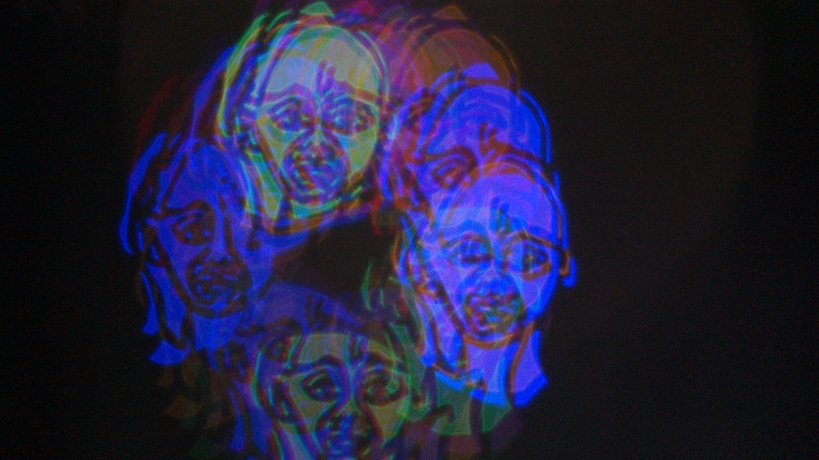
Today is overcast and the construction workers are back at it next door, so I decided to work in the mirrorworld today. For those of you who may not know, the mirrorworld is a closet where I have mirrors and string-lights set up. The mirrors create depth of field and the lights are what I photograph. Each light takes the shapes of my hand-cut paper filters, one of many techniques of my generative photography art form I call “Light-forming photography.”
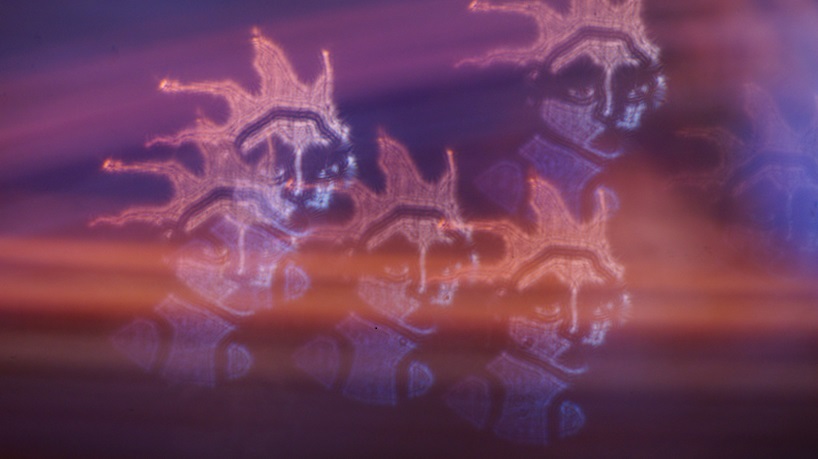
For today’s image, I started by exploring the phrase “egg on your face.” I made a sort-of egg-splattered shape, then I put a kaleidoscope over it while I took pictures to recreate a disembodied feel of ego death.
Welcome back for the second day of Writober. How did it go yesterday? Feeling inspired? Don’t forget to put your links in the chat to share what you wrote and made.
Today, all our prompts will continue to explore the universal fear of Ego death: the loss of subjective self-identity by looking at embarrassment.
Embarrassment by Maria L. Berg 2024
Embarrassment happens to everyone. It’s a sudden horrible feeling when we realize we’ve done something others judge negatively. It usually happens as a young child and can leave a lasting impression of a feeling we want to avoid. If that aversion is strong enough, it can stop us from sharing with others, being the focus of attention, public speaking, and even being in social situations. Embarrassment isn’t completely avoidable. It often occurs due to things that are out of our control. The human body does embarrassing things. People laugh at people who fall and hurt themselves in embarrassing ways: there are entire TV shows based on videos of people in embarrassing situations.
Embarrassment leads to fear of embarrassment. Try to remember the very first time you were embarrassed. What caused it? How did you react to that embarrassment? Think about the most recent time you were embarrassed. What was the same? What was different?
Fighting Fear of the Blank Page: Writing isn’t just about coming up with ideas for stories and poems, it’s about expressing those ideas on the page clearly with words. Sometimes the blank page stares back like a judgemental enemy or a white-washed wall. Every day this month we’ll explore techniques for pushing through this fear and turn it into excitement. What if the page isn’t blank to start with?
Change the color of the page or the text: If you write in a journal, try filling the page with color. I like making inkblots with watercolors. Just drip some paint on the page and fold it in half. Let it dry and then write on it. In The Triggering Town, Richard Hugo says to write with pencil on green, lined paper. I tried it. It didn’t work for me. During NaNoWriMo some writers recommend changing your type to white so you can’t see it as you type. That way you won’t see your mistakes and be tempted to go back and make corrections. This could also work by keeping your text black and changing the page to black.
Play around with page and text colors. What is your favorite combo? Does putting those colors together make you want to write?
*Quick Note about links in this post: I am an amazon associate, so most of the links in my post will take you to amazon products. If you buy from these links, I will make some pennies which will help me pay for this site and my creative endeavors.
OctPoWriMo
Poetry Toolbox
These are quick exercises that I hope you’ll do every day. We will build on these exercises throughout the month. I recommend creating a folder on your computer labeled “Poetry Toolbox” for collecting all the useful tools and references we’ll be working with this month.
Word list: Write down the first ten words you think of when you think of fear. Any words at all. Anything that comes to mind. Then choose your three favorite and say them aloud a few times until you hear the accented and unaccented syllables (if more than one syllable) and notice the duration of each syllable. Which syllable sounds short? Which syllable sounds longer?(Inspired by Frances Mayes’ list of a hundred favorite words in The Discovery of Poetry)
I created this Excel Spreadsheet for you to use to collect and explore your fear words.
Sensory Imagery: In your journal or a word processing file, fill in these lines as quickly as you can with something different from yesterday. You may want to revisit one or two in more detail if you’re inspired and have time.
When we start combining letters to make words, we make more complex sounds we know as syllables.
I started wondering what the difference between syllables and phonemes are. From what I read I found: “The phoneme is a minimal speech unit, represented by alphabetic letters in English,” and “A syllable is a cluster of sounds with at least one vowel.”
In poetry a “foot” consists of two syllables. When we say words aloud we place an accent or stress on certain syllables. If you say “afraid.” The first syllable “a” is unstressed and the second syllable “fraid” is stressed. These stresses can be represented as U / (unstressed stressed) This is an iambic foot.
Disyllables
Macron and breve notation: – = stressed/long syllable, ◡ = unstressed/short syllable
I was finally starting to hear and recognize the different metric feet in poetry when I read The Sounds of Poetry by Robert Pinsky and read about duration. Mind blown. Such an obvious part of words, but I just hadn’t thought about it.
Pinsky gives this example to think about how we stress words:
“Permit me to give you a permit.”
When it comes to duration, he gives the example “popcorn.” The first syllable is stressed, but the second syllable is longer. Then he uses the word “ocean” to demonstrate that the first syllable is both stressed and longer.
Go back to your three favorite words of your word list spreadsheet. Mark the stressed syllables with / for stressed and U for unstressed. Can you find the same stressed and unstressed pattern in the tables above? You can put that name in the “meter” column. You can use a small “s” for short duration and a capital “L” for long duration. And finally put the number of syllables in the “syllables” column.
We’ll talk more about stress and duration when we talk about rhythm. For now, just listen for the stress and duration of syllables as you read aloud.
Today’s example poem, copied here for educational purposes from Poem Hunter, is Fear No More by William Shakespeare.
Fear no more the heat o’ the sun; Nor the furious winter’s rages, Thou thy worldly task hast done, Home art gone, and ta’en thy wages; Golden lads and girls all must, As chimney sweepers come to dust.
Fear no more the frown of the great, Thou art past the tyrant’s stroke: Care no more to clothe and eat; To thee the reed is as the oak: The sceptre, learning, physic, must All follow this, and come to dust.
Fear no more the lightning-flash, Nor the all-dread thunder-stone; Fear not slander, censure rash; Thou hast finished joy and moan; All lovers young, all lovers must Consign to thee, and come to dust.
No exorciser harm thee! Nor no witchcraft charm thee! Ghost unlaid forbear thee! Nothing ill come near thee! Quiet consummation have; And renowned be thy grave!
In this poem, Shakespeare says there’s no need to fear when you know you’re going to die.
Marking the stresses (or accents) and identifying the feet (meter) of a poem is called scansion. Just for fun, print out or copy down the poem and mark the stresses of the syllables. Can you identify the meter of the poem? Is it consistent, or does it change line by line? Can you tell if the feet of the poem are disyllabic or trisyllabic? Listen for a repeating pattern.
How many feet are in each line?
one foot = monometer
two feet = dimeter
three feet = trimeter
four feet = tetrameter
five feet = pentameter
six feet = hexameter
seven feet = heptameter
eight feet = octameter
Today’s poem: Write a poem about what you wouldn’t fear if you didn’t get embarrassed.
Form: Want a little more challenge? Write a poem in blank verse. Blank verse is a poem in iambic pentameter that doesn’t rhyme.
Write your poem and post it to your site (blog/ website/ other), then post a link in the chat. You may also post your poem in the chat if you do not have a place to post it. If you are posting as “someone” or “anonymous,” please put your name at the end of the poem. Throughout the day, please check back when you can to read and encourage other poets, to learn from each other, and enjoy each other’s efforts.
Writober Flash Fiction
Write a story with a beginning, middle, and end with conflict that leads to change in less than a thousand words (no minimal word count) inspired by one of the images in the Ego death folder of the Writober 2024 Pinterest board. How does embarrassment affect your character(s)?
Post a link to your story, or tell us about your story idea in the chat.
NaNo Prep
Today is about clarifying the kernel of your novel idea. A tool for doing this is the elevator pitch. Imagine you’re in an elevator, and you only have a minute (or less) to tell the other person in the elevator your story, and try to get them to buy it. How would you do that? Sounds impossible, especially since you haven’t written it yet, right? No. There’s actually a bit of a formula to the one or two sentence pitch or logline:
Character + Conflict = Change
What is unique about your character? For some loglines it’s the character’s job, or occupation:
An artist finds a hand-drawn map in her garage with the words “shallow grave” written on it. When she begins to investigate, her curiosity puts her life in danger.
Another thing to think about when developing your idea is comps. Comps are other stories (novels, movies, shows, games) that inspired your ideas, or could be comparable in style to your work. If a character in Salem’s Lot by Stephen King and a plot line or setting in The Bad Weather Friend by Dean Koontz written in the style of Carl Hiaasen inspired your idea, you could add: “Readers of Carl Hiaasen will enjoy this meeting of Salem’s Lot and The Bad Weather Friend,” to your elevator pitch. Notice how adding that to the logline example could make you imagine it differently.
Give it a try. Tell me your novel idea in one or two sentences in the chat. And don’t forget to head over to NaNoWriMo.org, sign up, and put that logline in this year’s project description.
Halloween Photography Challenge
Take a photograph that depicts embarrassment, fear of embarrassment, or how to deal with embarrassment and link to your photo in the chat.
Get Moving
Now that you’ve read all the prompts and have all these ideas running around in your head, it’s time for motion. It may seem counter-intuitive, but while you are moving, your mind will still be working on your ideas while you are busy doing something else. Write down some quick notes, your initial thoughts from the prompts and then get your body moving in any way you can that you enjoy. I like to bounce. Some suggestions:
Exercise ball. An exercise ball is great for stretching your back after hunching over a computer for hours, and is also fun to bounce up and down on.
Mini-trampoline. I really enjoy some low-impact bouncing on my mini-trampoline. I keep it in my office to get some bounces in whenever I take a break.
Today’s Poetics prompt at dVerse Poets Pub is to write a poem about Harvest or Haunting, or a Haunted Harvest. Let’s see if I can fit that in with the prompt from the first day of Writober post Letters: Symbols of Sound.
Four of the ten words in my word list started with “s,” so I focused my alliteration with “s” words. And can you guess which letter I left out for my lipogram? 🎃
There’s No U in Harvest
Tender, brittle leaves cling as stranger-shaped shadows lengthen, and the light hides behind a choking cotton-ball cloak. Crows caw in the cornstalks, whispering warning with the wind while I shiver.
I’ve collected the last of my harvest, the green beans giant and crispy this year, yet something skitters in the wilted vines. It tsks my poor pickings, never ample, and spits its hate into the soil like an acid rain to make next year’s sowing even more severe.
He shames the soil. It has never been acceptable.
Maybe that’s why I try and try: we have many things in common my garden and I, and I am always astonished by what grows.
Writober Flash Fiction
He Always Had a Big Head
Stan licked his finger and smoothed a stray eyebrow hair. “Today’s the day,” he told himself in the mirror. “Stan. Stan. Superman.” He said this to himself all the time, and truly believed it. He rubbed his freshly shaven chin of his long, large head then smiled. All celebrities had large heads, and after this interview on Good Morning Cleveland, he would finally have the celebrity to fit what God gave him.
At the studio he was hurried into make-up. Of course they loved his style and said what he was wearing was fine, sending the wardrobe guy away in a huff. His torn jeans and Atari half-sleeve t-shirt made it clear to Stan that he couldn’t have dressed him anyway. When he asked the make-up girl for a coffee while she was trying to put lipstick on him, her sour lips said all she was thinking, but he didn’t care as long as the coffee was hot. She yelled, “coffee,” then looked him in the recently eye-lined eyes and snapped, “Don’t move.” By the time he was waiting at the back of the stage, Stan sensed hostility from everyone he had met. They are so jealous, he thought.
Suddenly, he felt a shove from behind. Someone yell-whispered, “Get out there.” His toe caught on the edge of something and he went tumbling out to the set. The host’s smile faded. He heard a gasp from the audience. It was as if a dimmer had turned down the whole show, but Stan caught himself and so did everyone else. The host stood, one giant smile, and the audience clapped and clapped. Stan took his seat in a plush, but uncomfortable chair that clashed with his suit. He watched the show every morning he could. They must have changed their guest chair just this morning. He looked around. The whole set seemed changed.
“So Stewart, I’m absolutely in love with . . .” the host began.
She got his name wrong. He couldn’t believe it. “It’s Stan,” he blurted out.
“Excuse me?”
“My name is Stan. I’m Stan. Stan. Superman. How could you get it wrong?”
The whole audience burst out laughing. Stan’s head was hot. It hurt: skin stretching tight, pulsing inside and out. The audience chanted “Stan. Stan. Superman.” and each time they said it, he felt like his head grew. It grew and grew until his chin was in his lap and he could barely hold its weight.
The room went silent. The host said, “Stan. I’m so sorry. What I was trying to say is I absolutely love your book, Big Heads Are Beautiful. It’s so obvious to me now that big heads are just better. And I’m excited about all your suggestions for how we can try to emulate those with larger heads. I’ve heard some people are already getting the surgeries you propose.”
Did she not see what was happening to him? Could none of them see? Stan felt something he had never felt before. Embarrassment? Shame? What had he been thinking, trying to convince people to change themselves to be more like him? Bigger head surgery? That’s insane.
The host was showing him off the set. He could barely walk using his thighs to help push the weight of his head in his hands forward one step at a time. In the green room one of the later guests, a celebrity, obviously from his large, oval face, handed him a bottled water. Stan looked for some recognition of his perilous situation in the other’s face, but the guest only said, “Great interview. You got one of your books you can sign for me?”
He did. He had a ton, but Stan couldn’t let go of his head, so he just moved his chin side to side.
The other guest smiled. “No worries. I get it. Being a success can be a humbling experience.”
Halloween Photography Challenge
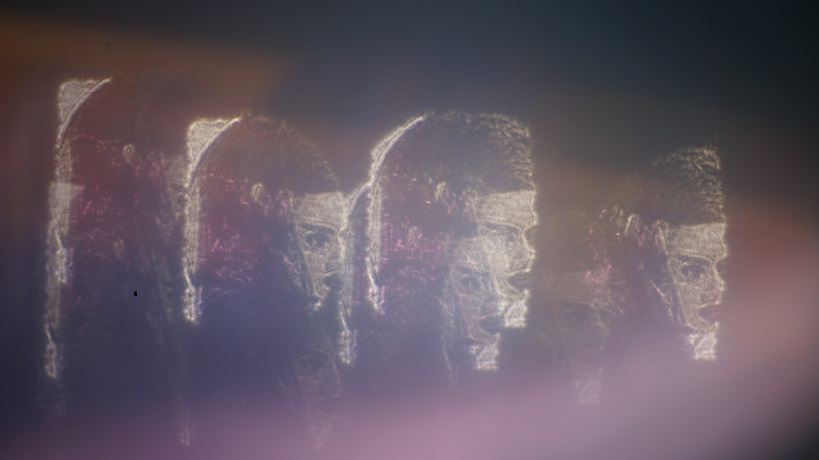
For today’s photo, “Ego Death – A New Persona” I drew from an image I made in my fashion design notebook many many years ago ( a couple lifetimes ago, really) and then cut out a filter and took pictures of my floating studio. While I was working, one of my mirrors fell to the bottom of the lake, so I got to go swimming too. Brisk and refreshing. Thank you, dysfunctional children’s floating bath mirror, for making up my mind to go for a swim.
I really had fun today. I followed all of my prompts and ideas in the Writober prompt post and went for a walk (in my comfy pants) and an unexpected swim to get moving. I put my ten words in my spreadsheet, and four of them made it into my poem. I thought about my persona, and she influenced my photo. And I had fun writing a flash fiction to an image in the Pinterest file. I love it when a plan comes together! (Yes, I get nostalgic for a little A-team TV show now and then).
Experience Writing has had an amazing number of visits and views yesterday and today. I hope that means you are creating and having fun. Please link to all your poems, stories, and photos in the Writober prompt post chat. I can’t wait to see what inspired you and what you created.
Welcome to the first day of Writober. Today, all our prompts will start to explore the universal fear of Ego death: the loss of subjective self-identity.
Ego Death by Maria L. Berg 2024
The fear of Ego Death encompasses all the fears of damage to one’s ego, one’s pride, such as embarrassment, shame, fear of failure, fear of success, and the feeling of being an imposter (imposter syndrome). These fears can lead to social anxiety and social phobias.
Exploring our fears isn’t easy, but your journal is a completely safe space. Try to get to the specifics of your experiences, not vague feelings. Write down specific objects, colors, smells, taste, and textures that you interacted with while afraid. Facing our fears can also be thrilling as long as we believe we won’t really get hurt like amusement park rides, horror movies, and Halloween.
Fighting Fear of the Blank Page: Writing isn’t just about coming up with ideas for stories and poems, it’s about expressing those ideas on the page clearly with words. Sometimes the blank page stares back like a judgemental enemy or a white-washed wall. Every day this month we’ll explore techniques for pushing through this fear and turn it into excitement, starting with writing as someone not afraid of the blank page at all.
Create a persona: When facing fears in our writing, it may be easier to create a persona, an imagined person, not ourselves, someone braver, stronger, more daring that’s doing the writing. What does that person look like? Smell like? Do you have a piece of clothing or a perfume/cologne you could wear to help you become the persona when you want to be more daring in your writing?
*Quick Note about links in this post: I am an amazon associate, so most of the links in my post will take you to amazon products. If you buy from these links, I will make some pennies which will help me pay for this site and my creative endeavors.
OctPoWriMo
Poetry Toolbox
These are quick exercises that I hope you’ll do every day. We will build on these exercises throughout the month. I recommend creating a folder on your computer labeled “Poetry Toolbox” for collecting all the useful tools and references we’ll be working with this month.
Word list: Write down the first ten words you think of when you think of fear. Any words at all. Anything that comes to mind. (Inspired by Frances Mayes’ list of a hundred favorite words in The Discovery of Poetry)
I created this Excel Spreadsheet for you to use to collect and explore your words. Don’t worry about all the columns today. Just type your ten words into the first column.
Sensory Imagery: In your journal or a word processing file, fill in these lines as quickly as you can with as much specific detail as you can. You may want to revisit one or two in more detail if you’re inspired and have time.
For this first day of October Poetry Writing Month, we’re going to look at the smallest building block we poets have, the letter. In A Poetry Handbook, Mary Oliver calls the alphabet our “raw material” and “Families of Sound.” Each letter is a symbol for sounds we make in combination to communicate meaning. All of the sounds of English are either vowels or consonants.
The Diphthongs are ae, au, ei, eu, oe, ui, and, in early Latin, ai, oi, ou. In the diphthongs both vowel sounds are heard, one following the other in the same syllable.
Consonants are either voiced (sonant) or voiceless (surd). Voiced consonants are pronounced with the same vocal murmur that is heard in vowels; voiceless consonants lack this murmur.
The voiced consonants are b, d, g, l, r, m, n, z, consonantal i, and v.
The voiceless consonants are p, t, c (k, q), f, h, s, and x.
Consonants are further classified as in the following table:
Say each of the sounds aloud. Feel where the sounds are in your mouth, how they move from the lips to the tongue and teeth to the throat as you read across the table. Fun, right?
Familial Rhyme
These letter groupings are also useful for rhythm and rhyme which we will come to later in the month. When you can’t, or don’t want to, come up with an exact rhyme, another letter from the sound family will make a close rhyme. Look at this familial rhyme chart from lyricist, teacher, and author, Pat Pattison. I enjoyed his course “Songwriting: Writing the Lyrics” on coursera, and his books, Writing Better Lyrics and Songwriting Without Boundaries.
image captured and edited from coursera course
Notice the similarities to the groupings in the consonant groupings chart?
Example Poem
Today’s example poem, copied here from poets.org for educational purposes, is “The Pleasures of Fear” by Judith Ortiz Cofer. Read it through how you normally would. Then read it again aloud, taking your time to look at the letters and feel the sounds in your mouth.
We played a hiding game, the son of my mother’s friend and I, until he chased me into the toolshed and bolted the door from outside. It was there, in the secret, moist dark, the child’s game changed to adventure. As I listened through the splintered wood to his ragged breath, his weight pressing down on the thin wood, making it groan, waiting while I stood on the other side, I was caught in time, thrilled and afraid by his power, by his power to strike, and mine to yield.
I crouched close to the ground inhaling the sour-sweet potpourri of rancid oil, rotting wood, old leather, and rust. I could have died right then and there, of anticipation, and become one with the molecules in the laden air. I was deliciously afraid of all the invisible creeping, crawling dangers inhabiting the luscious ground where I squatted to pee, allowing impulse and need to fully overtake me, inviting all the demons that reside in dark damp hiding places into my most secret self.
Not since then has pleasure and fear in the dark been so finely tuned in my mind, except perhaps in moments of passion when all we know is surrendered to the demands of skin and blood.
Then the pizzicato of the predictable afternoon shower on that half remembered island, rain every day at four, and her piercing voice, growing nearer, the cutting slash of light. She had caught the boy peeking through a crack at me doing what? She did not want to know.
I was sent straight to the bath, as if the delectable stink of danger I had discovered could ever be washed off with plain soap and water.
What did you notice? What stays with you? How did the poem make you feel? What images came to mind as you read? How does this poem explore fear? How does it explore fear of ego death?
Notice the sounds at the ends of the lines: lots of r, d, s, and n sounds. Where are they in our chart? They are all dentals, all where our tongue meets our teeth. Also, look at how she uses pairs and triplets of words that start with the same letter in the second stanza: “crouched/close,” “air/afraid/all,” “creepy/crawling,” “demons/dark/damp.” These are examples of the first rhetorical device we’re going to look at, alliteration.
Rhetorical device: A rhetorical device is a use of language that is intended to have an effect on its audience beyond the meaning of words. Alliteration is the same letter or sound at the beginning of adjacent or closely connected words.
Today’s Poetry Prompt
Write a poem exploring ego death using alliteration. Look at the ten fear words you jotted down. Do any start with the same letter? You may want to start with that letter for your alliteration. Notice the sounds that end and begin each word. Are they flowing together, or stopping and creating space? Are the sounds creating the feeling you want in your poem? Read your poem aloud. Where are the sounds in your mouth? Does your poem have nice mouth feel?
Form: Which letter of the alphabet is the scariest? If you are looking for a little more challenge, you can try a lipogram which is a poem in which a certain letter (or group of letters) of the alphabet has been completely excluded. Defeat that scary letter by not using it at all.
Write your poem and post it to your site (blog/ website/ other), then post a link in the chat. You may also post your poem in the chat if you do not have a place to post it. If you are posting as “someone” or “anonymous,” please put your name at the end of the poem. Throughout the day, please check back when you can to read and encourage other poets, to learn from each other, and enjoy each other’s efforts.
If you’re only here for OctPoWriMo, you may want to skip down to the end of this post to “Get Moving.”
Writober Flash Fiction
Write a story with a beginning, middle, and end with conflict that leads to change in less than a thousand words (no minimal word count) inspired by one of the images in the Ego death folder of the Writober 2024 Pinterest board. Post a link to your story in the chat.
If you are only here for the #Writober flash fiction challenge, you may want to jump down to “Get Moving.”
NaNo Prep
All this daily writing can also prepare for November’s National Novel Writing Month (NaNoWriMo). Poets, Flash Fiction/ Short Story Writers, and Novelists all use the same tools—sounds of language: letters, words, phrases, and sentences—to evoke a response from readers. Earlier this summer I had an idea for a literary fiction novel. This month I’ll be fleshing out my characters, settings, and stakes, and plotting a possible outline.
If you are participating in NaNoWriMo, or have thought about giving your novel a try, I hope you’ll join me for some Novel prep this month. I like worksheets and workbooks and recommend taking a look at:
Prompt: Set a timer for ten minutes. Write all of your ideas for this year’s novel as fast as you can. Don’t think, just write. Who are the characters? Where are they? What happens to them that changes their lives forever? Write it all down in any order it comes, just get as many ideas as you can onto the page.
Don’t have the idea for your novel yet? Think about a novel you want to read that hasn’t been written yet, answering the same questions as above.
Halloween Photography Challenge
This year, the prompt words are more abstract than in previous years. Take a picture of anything the word(s) inspires.
Today’s prompt: Take a photograph that depicts Ego death, fear of ego death, or an ego in peril. Post a link to your photo in the chat.
Tunetober
Create an eerie melody in a minor key on any instrument. Work on it during the week and share it on Sunday.
Sewtober
Create a Halloween quilt square. Share what you create on Sunday.
All of these prompts are here to inspire creative action. Don’t worry about being “off prompt.” Any new work you create after reading this post meets the challenge. I look forward to seeing and reading what you come up with. And please come back to see how these prompts inspire me today as well.
Get Moving
Now that you’ve read all the prompts and have all these ideas running around in your head, it’s time for motion. It may seem counter-intuitive, but while you are moving, your mind will still be working on your ideas while you are busy doing something else. Write down some quick notes, your initial thoughts from the prompts and then get your body moving in any way you can that you enjoy. Get some oxygen to your brain, relax your muscles, and distract your inner critic (that mean voice we all have that spends its time telling us what we’re doing is bad and wrong, and not good enough. That voice is only good for nit-picky final revisions, so we’ll turn it off as much as we can this month.) Some suggestions:
Go outside. Breathe deeply, and stretch. I very seldomly buy clothes, but I picked up these very comfy pants that are great for morning stretching. They are warm, so soft inside, and are tapered at the ankle so they stay in place while stretching and moving your body. I also really like having pockets, even in my stretch-pants.
Go for a brisk walk. Bring along something to record your voice. If you don’t have a cell phone (like me), you may want a pocket mp3 player to record any thoughts that pop up while you explore your neighborhood. I’ve been using this model for music, listening to audio books while I mow, and recording sounds and thoughts for many years now. Nothing fancy, but it’s all I need.
Take a hot shower. I got myself Aqua Notes Waterproof notepad and pencil for the shower, and I really love it. I often jot down words and rhymes or quick lines that pop into my mind once it’s warmed by hot water.
I know this has been a long post. Thank you for reading (or scrolling) to the end. You can expect more concise posts as we move through the month and become familiar with how all the different prompts work, and can work together.
The void slips through the cracks Disembodied strings vibrate a haunting tune Not unwelcoming
and yet, I shiver
My only fear is consciousness both having it and not having it once these lungs cease to consume and I no longer feel your calloused touch
Writober Flash Fiction
Kitty Gifts
Marnie thought she had seen the strangest of the little gifts her cat left near her door. She would never forget the claws and tail of a red squirrel or the entire pristine perch without any claw or fang marks. But this morning, when she sucked in the cool morning air on her way to check the mailbox, the dead body in her yard looked like a much larger animal. She couldn’t be sure because it was tucked under a sheet she didn’t recognize. The shape appeared human. And there were numbers strewn around the body as if the crime scene had been processed and many clues were found. And yet, the only sound was the frantic chirping of dark-eyed juncos and wrens in the firs overhead. Frozen in place, she stared at the body, expecting it to roll over, or jump up and yell surprise. She imagined it pulling out its cell phone to capture her shock and post some horrible picture to embarrass her on the internet. Her heart beat faster as her jaw clenched. She hurried back into the house. She wouldn’t be the brunt of a stranger’s joke. The cat brought her three fingers over the next week or so. She stopped going to the mailbox so the fingers were the only way she knew the body was still there. Like all his other gifts, she wondered what her cat thought she would do with them.
Halloween Photography Challenge
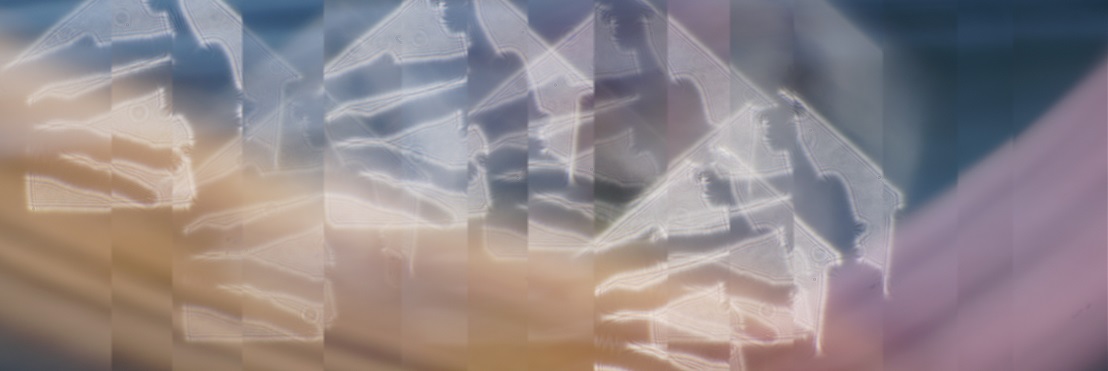
The photo at the top of the page, “Haunting Strings” represents the universal fears of separation and extinction. Disembodied sounds in the night of ghostly thieves separating me from beloved instruments. The panoramic glitch in my digital camera separating each slice of the image that it cannot stitch together.
Come back tomorrow to join in all the Writober fun!
Here we are. It’s already Writober Eve. This year I have lots of useful writing tools, and fun prompts to keep us inspired to write every day. You can take what inspires and leave the rest. You can come back to any post when you have more time. Or you can write whatever moves you and link to it in the chat. The challenge is to write every day in October. My job is to inspire, motivate, and encourage. Please let me know what is working and what isn’t. I am more than willing to adapt and look forward to lively discussion. Make sure to enjoy each others’ efforts by reading, “liking,” and commenting on each others’ work.
OctPoWriMo
For this first introductory prompt, lets take a look at John Keats’s “When I have fears that I may cease to be,” written in 1818 and published posthumously in 1848.
When I have fears that I may cease to be Before my pen has gleaned my teeming brain, Before high-pilèd books, in charactery, Hold like rich garners the full ripened grain; When I behold, upon the night’s starred face, Huge cloudy symbols of a high romance, And think that I may never live to trace Their shadows with the magic hand of chance; And when I feel, fair creature of an hour, That I shall never look upon thee more, Never have relish in the faery power Of unreflecting love—then on the shore Of the wide world I stand alone, and think Till love and fame to nothingness do sink.
This poem talks about a poet’s fears in the moments before death, but it could also speak to the other universal fears: moments before separation, ego death, loss of autonomy, or mutilation.
Prompt: Write a poem as someone in this state of urgency moments before nothingness. What would be your biggest fears? What would you be thinking about and need to express?
Form: This poem is a Shakespearean sonnet- iambic pentameter (second syllable stressed, ten syllables per line) that follows the rhyme scheme ababcdcdefefgg. If you are looking for more of a challenge, write your poem as a sonnet. There are many forms of sonnets, and many modern poets have changed the form to make it their own. I recently wrote about a sonnet in a different meter. Feel free to play with the form loosely.
Writober Flash Fiction
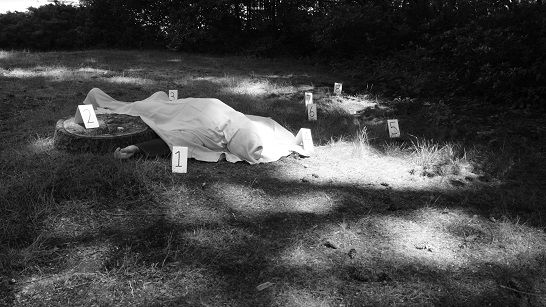
Under a Sheet by Maria L. Berg
Imagine if you or your character woke up and found this in the yard. Or you were taking a walk and just happened upon it, and no one else was around. Write a story with a beginning, middle, and end, with conflict that leads to change, in less than a thousand words (no minimal word count) about universal fears, inspired by this image.
Halloween Photography Challenge
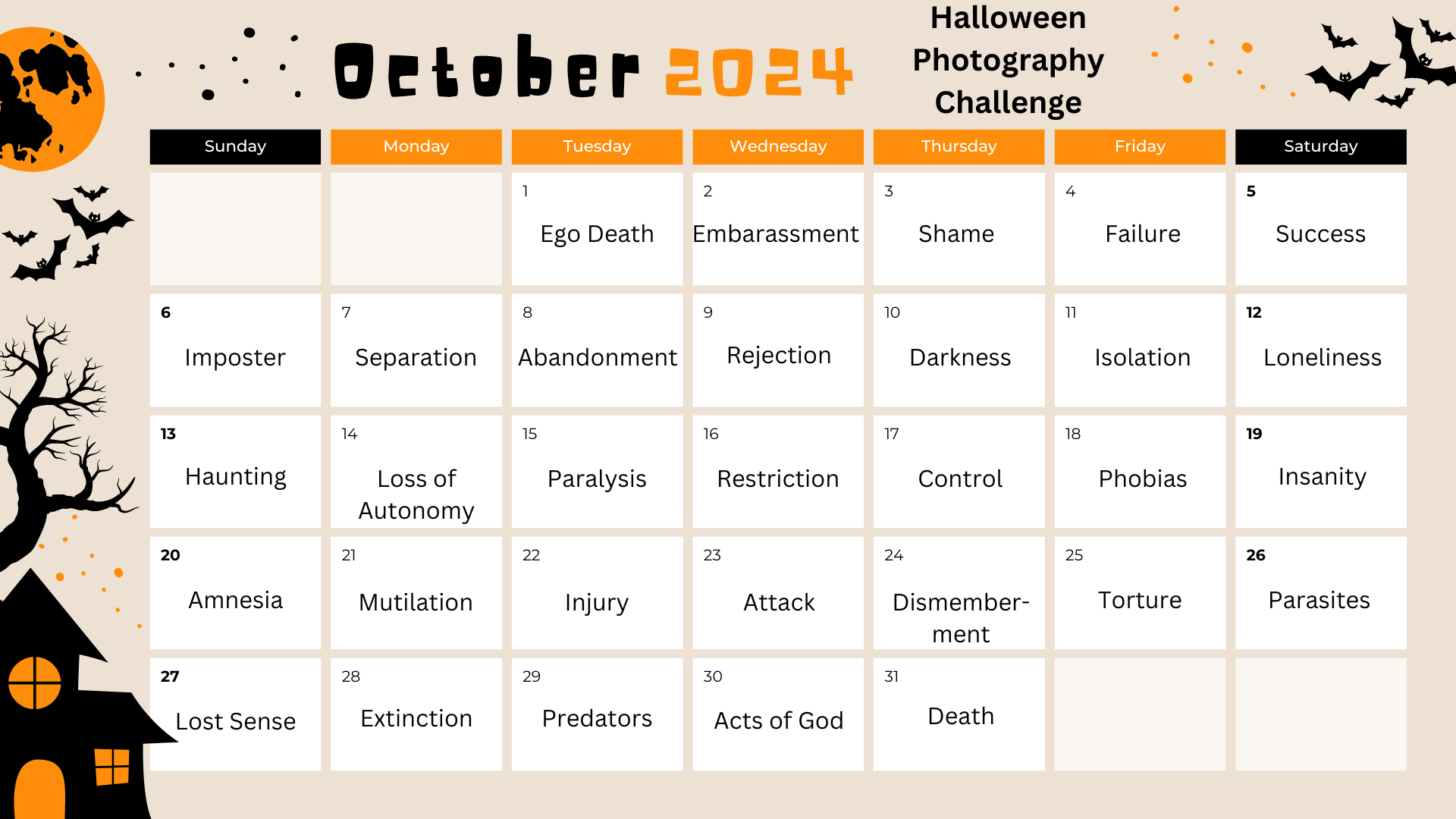
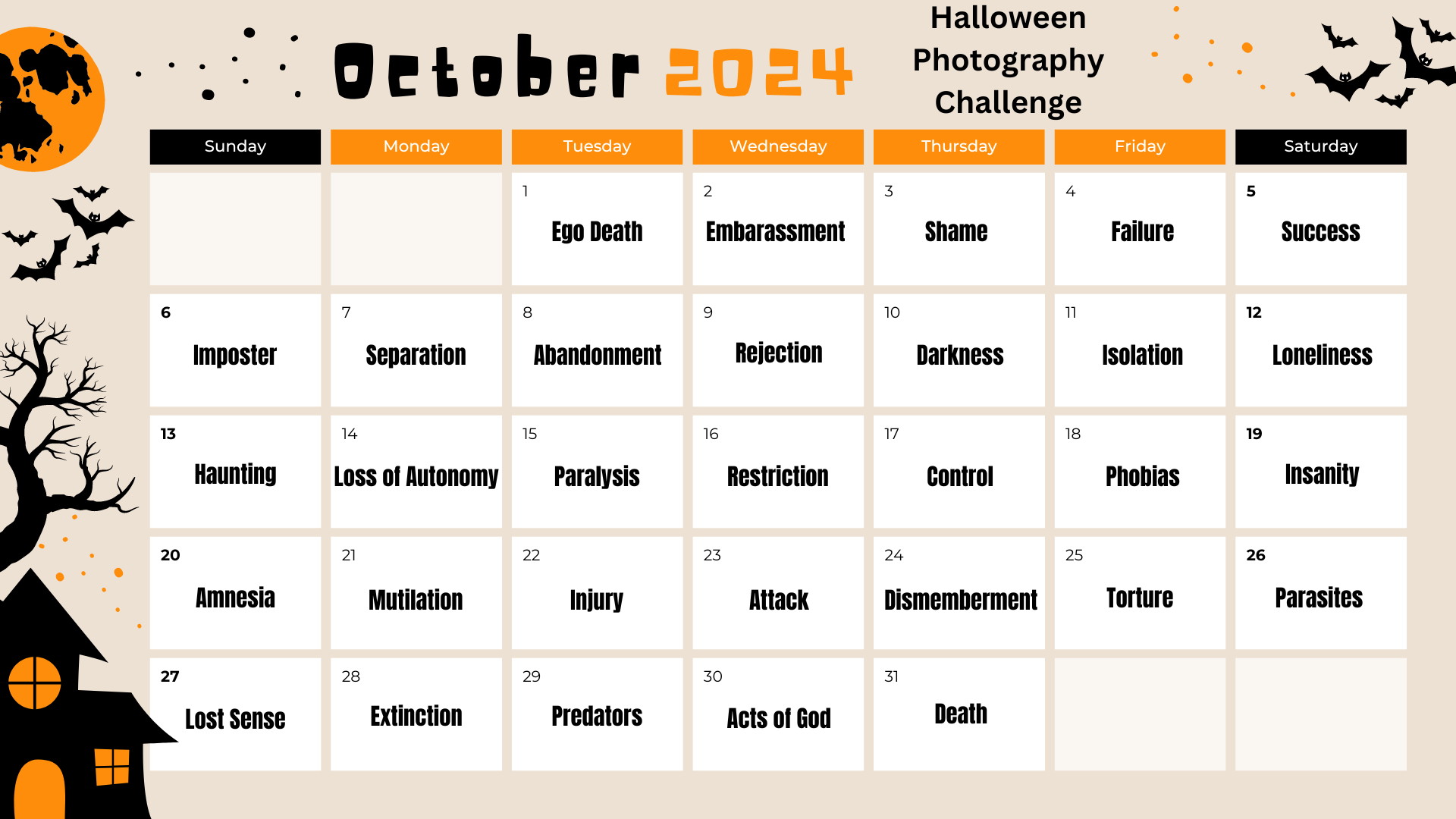
Here’s the calendar for October for those who like to start thinking ahead:
For today’s early-bird image, take a picture that represents Universal Fear.
October is a very busy month here at Experience Writing. It’s October Poetry Writing Month (OctPoWriMo), Writober daily flash fiction challenge, the daily Halloween Photography Challenge, and it’s the month of preparing to write a novel during November’s NaNoWriMo. Though Writober was the name of the flash fiction challenge, I’m using it as the name for the month here at Experiencing Writing, and all of the challenges during October.
Last year, I took on creating the prompts for OctPoWriMo along with the image prompts for Writober, and the daily word prompts for the photography challenge since each of my favorite challenges appeared to be abandoned, and I wanted them to continue. We explored our fears through our art and writing. It was fun and definitely challenging, but not exactly organized on my part.
This year, I’ve organized the prompts for all three events to work together in an exploration of the five universal fears: ego death, separation, loss of autonomy, mutilation, and extinction. We’ll spend almost a week with each universal fear, exploring and facing different aspects of each while studying the tools of writing from letters, to syllables, to words, to phrases, to sentences, lines, and stanzas and forms while looking at many rhetorical devices along the way.
I have also added a couple of weekly challenges. For musicians, I’ve come up with Tunetober: weekly sound and music prompts. And for fabric artists, I’ve come up with Sewtober: weekly prompts for sewing projects.
Some inspiration for everyone. I’ll have an early-bird prompt tomorrow for those of us excited to get started.
Today’s Poetics prompt at dVerse Poets Pub is to write an Autumn poem that includes colors or leaves. Since today couldn’t be less Autumnal here in Western Washington, my poem is about enjoying the moments before Autumn inevitably arrives.
Staying Autumn
Emerald-aqua hummingbirds pause by the wine-leaved plum tree. They frolic as if they can dart past autumn and winter into spring.
This day isn’t autumn.
One of the most golden days of summer, clinging. Screaming,
“Don’t waste a second. Your time is the most valuable weapon you possess, and you can’t save it up, or hide it away. Though you may feel it warp and bend, you can’t slow it down.”
I want to take each tiny wing beat frame by frame. Think how much time that could add to this day. What was but a whir, a blip, would curl the air. Each tiny feather shimmering its power.
I could jump in the lake a hundred more times dry off, get hot, and do it again. I could fill my camera’s memory, download it, and repeat to exhaustion while those tiny birds contemplate the last plum.
Silly Summer yelling at me in my reverie of slow flaps of hummingbird wings. Why come back for only one day, leaving tomorrow with a storm front on the way?
Would slo-mo only last as long as I observed it, or cease like an unheard tree falling in the forest when I plunge my head under the water’s surface? And would I arrive refreshed a hundred days older gasping for oxygen, breaking the blue barrier between under and above?
OctPoWriMo
Poets, I hope you’ll join me for October Poetry Writing Month this year. Last year, since it looked like this fun fall poetry challenge wasn’t going to happen, I took it on, and came up with daily prompts exploring fear.
This year, my main focus has been poetry. I’ve completed the eight-week self-guided poetry MFA section by Rita Gabis in The Portable MFA in Creative Writing, twice. I’ve joined online generative writing groups and critique groups, and read at my local poetry open mic. I’ve learned so much and can’t wait to share what I’ve learned with you.
This year we’ll be exploring the five universal fears: ego death; separation; loss of autonomy; mutilation; extinction; and the many fears they entail; with the tools of poetry from letters and sounds to rhetorical devices through example poems, and online resources, along with information from some of the great craft books I’ve been reading and collecting.
By the end of the month you should have a well-stocked tool-kit that you can continue to use in years to come. Even if you can’t commit to writing a poem every day in October, I hope you’ll stop by whenever you can to enjoy the poems that people are writing and give some encouragement.
Please tell your readers about OctPoWriMo and send them my way, so as many poets as want to can enjoy an October full of poetry, prompts, and creativity.
Today is Haibun Monday at dVerse Poets Pub and Frank Tassone inspires us to write about the equinox using the Haibun form.
Equinox
The sun bursts through the clouds when I’m looking for shade. Sweat drips down my jawline when all I want is to wrap myself in my new comfy sweatshirt. Autumn fell so quickly, yet summer teases, not wanting to change out of her party dress. We await death that didn’t arrive in the night while a cottontail bounds across the yard. The lemon cucumber has ripened, but it is the last. Its plant has shriveled.
Equal weights teeter- totter. No one’s feet touch the ground.
Writober
It’s hard to believe that September is already almost over. October is a very busy and exciting month here at Experience Writing. I’ll be providing prompts for my three favorite daily challenges again this year: daily poetry prompts for OctPoWriMo, daily image prompts for Writober Flash Fiction Challenge, and daily word prompts for the Halloween Photography Challenge. This year all three challenges will be exploring universal fears. This year, I’m also going to provide weekly music and sewing challenges. There will be something for everyone. I hope you’ll join me.
I have to admit, August was tough. The weather turned as if Summer took its ball and went home, leaving me with nothing to play with and only the constant banging from the construction next door to keep me company. However, the sun returned yesterday, bringing with it a will to get back to work, so here are new images and a new poem for OLN (open link night) at dVerse Poets Pub.
Summer Bursts Through the Blues by Maria L. Berg 2024
This morning, using Edna St. Vincent Millay’s poem “What Lips My Lips Have Kissed, and Where, and Why” as inspiration, I wrote two Sonnets in iambic pentameter. So when I saw today’s mini-prompt to write a sonnet in iambic tetrameter, I was actually in the mood. I had never heard of the Onegin stanza or Pushkin sonnet, and I’m excited to give it a try.
From Wikipedia: “Onegin stanza, sometimes ‘Pushkin sonnet,’ refers to the verse form popularized (or invented) by the Russian poet Alexander Pushkin . . . mostly written in verses of iambic tetrameter with the rhyme scheme aBaBccDDeFFeGG where the lowercase letters represent feminine rhymes (stressed on the penultimate syllable) and the uppercase representing masculine rhymes [stressed on the (only or) ultimate syllable].”
I’m glad I read that. It’s not often I read a form poem’s instructions that include feminine rhyme. What a fun extra challenge.
The Sweet Spot by Maria L. Berg 2024
New Forms of Light Pollution
Those dancing human silhouettes like neon palm trees of the night, a staring contest’s denouement, reflecting to the other side. Their flailing limbs of no regrets cast shadows on the fire beneath while signaling to all the stars celestial touch is not too far. Does the neon palm shout longing like invasive species will cling? Tightly they choke ’til there’s nothing to hold. Is bright light belonging’s cry, echoing across the lake, the song that goads, and dancers make?





 Experience Writing