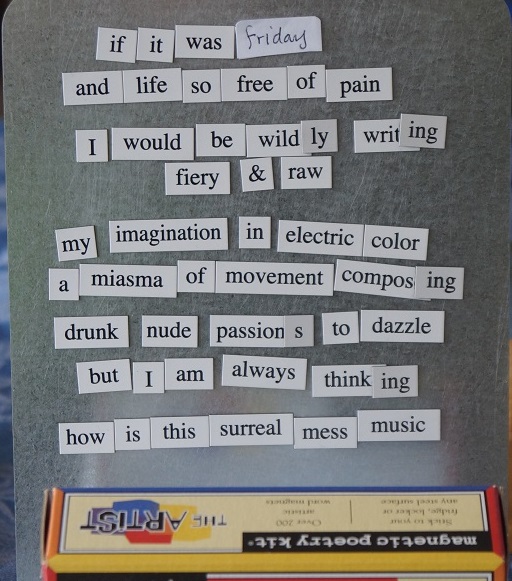
Whimzygizmo’s prompt for today’s Quadrille (a poem of exactly 44 words) at dVerse Poets Pub is “Friday.” For an extra challenge, I used my new The Artist Magnetic Poetry Kit(assoc link). I added the word Friday with part of a label sticker on one of the magnets. It was a very different Quadrille experience. Forty-four words is a lot when you’ve only got two hundred to choose from and you’re searching through them. Here’s what I came up with:
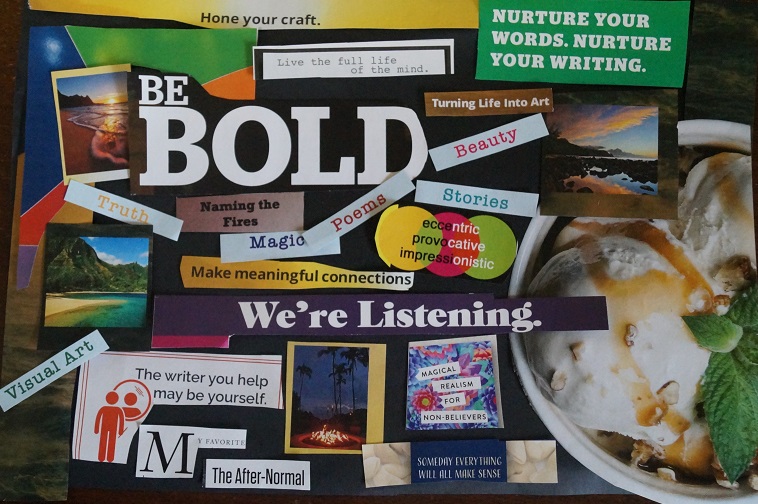
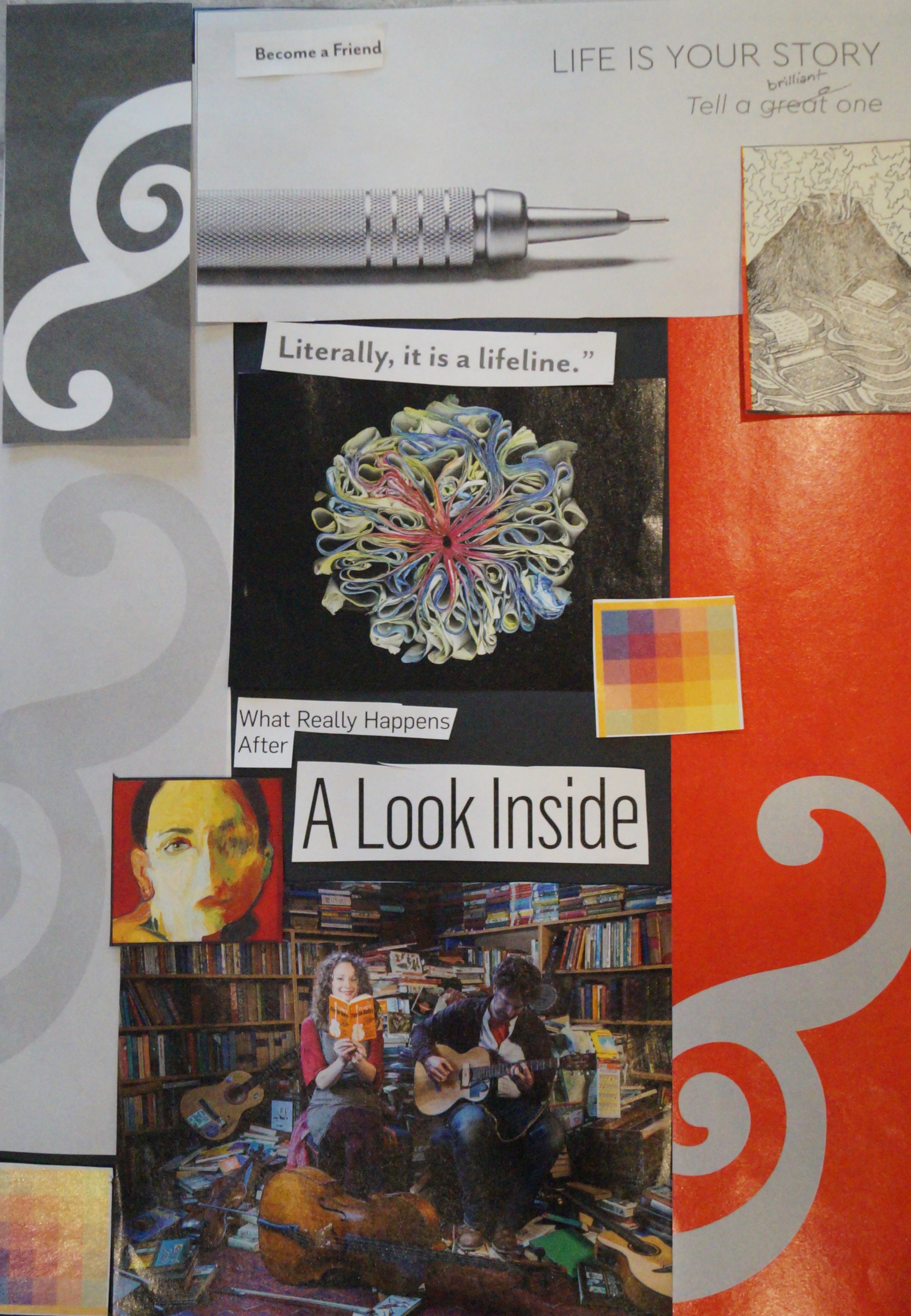
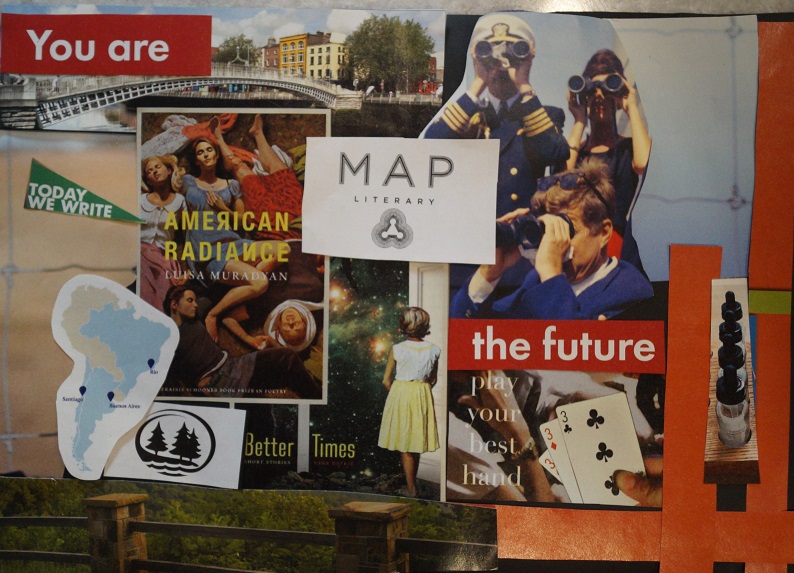
Music was mentioned several times in the July/August 2019 Poets&Writers Magazine. In the Note from the editor, he writes, “So when you’re having that engaging conversation in a crowded restaurant, the babel of other voices, the music, the clatter all recede into the background. . . . In the poetry prompt, “Happy Babbling,” it says, “Language is a living being. . . .a kind of happy babbling for the sake of babbling, a kind of music.” And in the Trends section called “The Anthologist,” it presents an anthology called Other Musics: New Latina Poetry(assoc. link) which editor Cynthia Cruz introduces by writing, “What we have here is a new kind of music” (Ada Limón was a contributor).
P&W Collage #13 – Music of Poetry
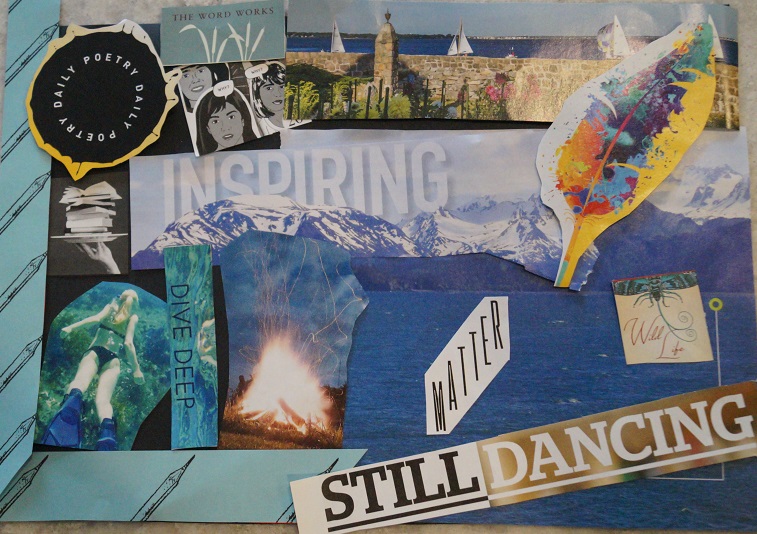
This month Poetry in America, a PBS series from 2018, is available on Amazon prime. In the first episode they discuss Emily Dickinson’s “I Cannot Dance Opon My Toes.” Cynthia Nixon who played Emily in the film A Quiet Passion, poet Marie Howe, Yo Yo Ma with his cello, and dancer Jill Johnson explore the musicality of this poem with voice, instrument, and body. The line, “Till I was out of sight in sound,” resonated with me.
Have you read The Music Lover’s Poetry Anthology(assoc. link – less than ten dollars for the hardcover? That’s an amazing deal)? If not, I highly recommend it, and if so, it may be time to read it again. I think it’s my favorite poetry anthology I’ve ever read, filled with so many great poems about music. “Singing Back the World” by Dorianne Laux, “Sonnet” by Elizabeth Bishop, “The Composer” by W.H. Auden, and “Joy” by Lisel Mueller are but a few of the wonderful poems in the collection.
But poetry isn’t only musical when music is the subject. Poets use techniques of rhyme, meter, and repetition to create music within the poem. While looking for the Ada Limón poem I want to study for week three of my portable MFA(assoc link), I came across a couple of interviews in which she talks about the music of poetry:
She says, “For me, the poem always has to have a heightened sense of music—whatever that music might be—and it has to find a way to sing beyond its subject, beyond its story, and move through the air as sound as much as images and metaphorical language.”
She also says, “We don’t get to have the guitarist and the bass line and the drums. We have to make all of that on the page. And so the whole poem has to be the song, and it has to have all the instruments and all the harmonies and the melodies. And I feel like when I’m writing, I’m aware of that. There is a type of singing that’s happening, and the singing is spoken, of course.”
I had imagined this month culminating in a poetry video like I’ve done in the past: Pathways ; Hunting the Elusive Rest. I think this week I’ll work on writing and recording the music, while I explore the music of poetry.
The Prompts
NaPoWriMo : become inspired by the wide, wonderful, and sometimes wacky world of postage stamps.
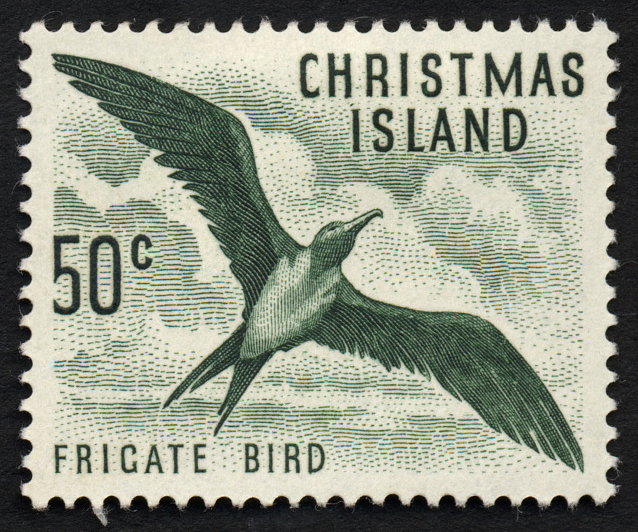
I enjoyed exploring the Smithsonian’s National Postal Museum. I was surprised to find this Christmas Island Frigate Bird stamp:
I think the Magnificent Frigate Bird is my totem animal now. Then I found this beautiful batik design stamp from St. Kitts:
Now I’m thinking this stamp prompt is leading me to another ekphrastic poem.
Hit Record is also celebrating National Poetry Month with Poem Every Day prompts. If we do them in order from the top of the list, today’s prompt is “mingle.”
Today’s Poem
Mingle in the Middle
Like me, this poem is the middle child never first, always in the shadow, tagging along in hand-me-downs, having to measure up No longer double but triple expectations a riddle every promise now brittle Always compared but no longer the cute one The clear image of place but a scribble Any attention now moved to something needier The world turned upside down and inside out by screaming and crying new life The middle’s needs drown in slobber and sick as this squiggling blob wriggles But then a tickle brings a giggle There’s something sweet in the middle like a pineapple brought to market spiky, unique, a talking point, held up for consideration The middle is where we compromise, come to terms, fiddle, and find solutions. It’s where the cheese stands alone the big cheese, the tasty, solid cheese that the mouse salivates for and it’s where the sun spins, burning making the planets dance around like children singing. Like me in my universe with ideas in my gravity, it’s in the middle we mingle
Portable MFA Week Three:
This week’s focus is on exploring and expanding the use of detail.
Writing: The instructions provide seven prompts to explore in free-writing. I find it amusing that some of them have already come up in the daily prompts this month, like number 3. Write bout an article of clothing (Poetry Non-stop yesterday) and number 5. Choose one object nearby and describe it. Hey, a good prompt is a good prompt.
Reading: The example poem given was “Piano” by D.H. Lawrence which makes me think this whole week is about the music of poetry (not just today). For my third Ada Limόn poem to study, I chose the titular poem from her collection, Sharks in the Rivers(assoc. link). Right away I noticed some repetition and rhyme, and a circling back to the beginning, creating an appealing music.
The instructions say to focus on the details the poet uses, and asks: What feelings do the details call up inside you? Why do you think the poet chose one sensory detail over another?
After my week went terribly wrong and I was feeling very down, I bought myself: (assoc. links) the Schylling Marblescope Kaleidoscope, and the The Artist Magnetic Poetry Kit, but in my haste to get it as soon as I could, I didn’t check the address, and sent it to my house instead of where I was staying. But now I’m home, and to my surprise no porch pirates had come my way, so I’m enjoying my new distractions and feeling a bit better.
I came across the work of Jan Pypers in the daily email I get from L’Oeil de la photographie. Here’s an interesting look at how he creates his images: The studio of . . . Jan Pypers. I chose this image from his Diorama series to inspire my ekphrastic poetry today.
The Artist #2
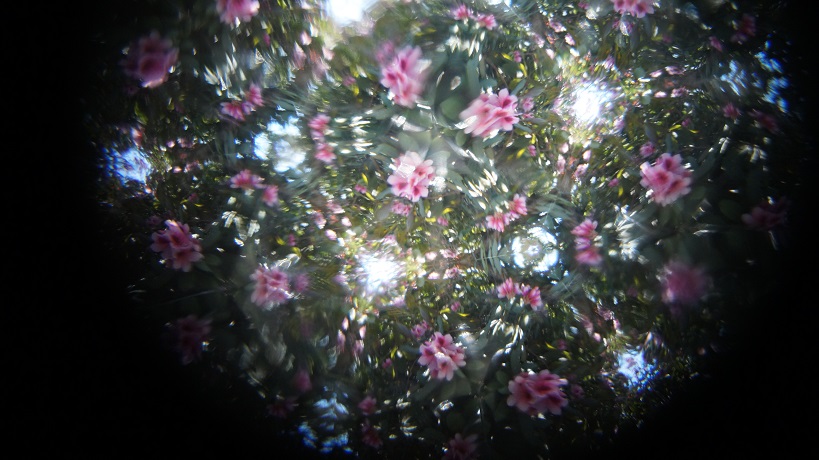
Rhododendrons through my Marblescope
The Prompts
NaPoWriMo: write a poem of at least ten lines in which each line begins with the same word (e.g., “Because,” “Forget,” “Not,” “If”). This technique of beginning multiple lines with the same word or phrase is called anaphora, and has long been used to give poems a driving rhythm and/or a sense of puzzlebox mystery.
Poetry Non-stop: Choose an item of clothing associated with a well-known figure, and use this as the focus of a poem about their character or activities.
Today’s Poem
Perfectly Framed
Because they wear speedos and caps Because one is blue and one is orange Because they must have been on opposite teams Because the viewer must have climbed the structure too Because he could be either orange or blue Because the yellow ball on the water is framed by the structure Because the rock is framed, and the girl on the rock is framed, and the person on the rock on the other side too. Because the whale breached in the center frame of the structure along with the hazy sun Because the viewer had such perfect timing and was perfectly positioned Because it would have been a miracle to capture that drama Is the image any less magic when you know it’s a diorama?
Poetry MFA Week 2 Review
Writing: I started this week’s assignment by finding something I wanted to write about in last week’s free-writes, and continued finding things in my writing to build on it on the second day, but I did not continue working on it each day I’m afraid. I think that’s what might have derailed me last time I attempted this Portable MFA program. But it won’t derail me this time. I got a lot of poetry drafts written this week, and other than the week-long poem, I wrote for at least forty-five minutes every day, and did this week’s work for Sharpened Visions poetry workshop. I did get myself o write at night one night before bed, and I noticed that my writing is different at night, looking back on the day instead of looking at the day ahead, so I think I’ll continue to try to get myself to write at night (though it’s not something that’s easy to do).
Reading: “The Magnificent Frigatebird” was an interesting poem to study. I found that trying to emulate it as I did with my poem The Cards Dealt Better on the tenth, really helped me understand the poem better. Ada Limón keeps coming up in the Poets & Writers Magazines I’m reading for the A to Z Blogging Challenge, so learning more about the poet I’m studying while I read her poems is happening all the time.
I’ll talk about the week three instructions and expectations tomorrow.
How’s your NaPoWriMo and/or A to Z Blogging Challenge going? Did you have a good week? I hope you’re having fun.
In another article in the News and Trends section of the May/June 2019 Poets&Writers Magazine, called “Sharing Poetry Chapbooks Online,” I discovered a fabulous resource library and place to listen to poets reading. Poets House has been digitizing rare chapbooks of the “Mimeo Revolution” a period stretching from the early 1960s through the mid-1980s when small-press publishing proliferated. I started with Loba, Part 1 by Diane di Prima because I recently enjoyed The Poetry Deal: a film with Diane di Prima on Kanopy.
P&W Collage #12 – Listening Library
Below the book on the screen, there is a tab that says AUDIO/VIDEO and when I click on it, I find a recording of Diane di Prima reading the text, so I can listen to the poet read as I read. Talk about poetry immersion.
On the home page of Poets House, under the site title, there is a MEDIA tab. When I click on it, I have options for AUDIO and VIDEO as well as the digital chapbook collection. When I click on AUDIO I find a selection of recorded readings and discussions with poets.
And under VIDEO I found Kwame Dawes reading a poem by his father Neville Dawes called “Acceptance” (A wink back to my A word on April first).
The Prompts
Today is Stream of Consciousness Saturday and Linda Hill’s prompt for today is “ends with “ound.” Find a word (or words) that ends with “ound” and use it any way you’d like.”
NaPoWriMo : Today’s prompt is about word collecting and it looks fun – “Start by creating a “word bank” of ten simple words. They should only have one or two syllables apiece. Five should correspond to each of the five senses (i.e., one word that is a thing you can see, one word that is a type of sound, one word that is a thing you can taste, etc). Three more should be concrete nouns of whatever character you choose (i.e., “bridge,” “sun,” “airplane,” “cat”), and the last two should be verbs. Now, come up with rhymes for each of your ten words. (If you’re having trouble coming up with rhymes, the wonderful Rhymezone is at your service). Use your expanded word-bank, with rhymes, as the seeds for your poem. Your effort doesn’t actually have to rhyme in the sense of having each line end with a rhymed word, but try to use as much soundplay in your poem as possible.”
The NaPoWriMo resource today is the Wild and Precious Life Reading Series on X. I don’t use X, so I couldn’t see the prompts, but on Instagram you can see the prompts without having an account. Today’s prompt is from the Poet’s Companion(assoc. link).
Yesterday I happened upon “Escapril” (also Instagram) and I love that word/concept. Escapril has a list of daily prompts. Today is “purr.”
Poetry Super Highway : Think of a smell you may have recently experienced that had the power to plunge you back into some experience in the distant past you had all but forgotten about. What is the smell? Where and when did you smell it? Who were you with?
Use your description of the smell and place and person to show the reader how it makes you feel to experience this scent again.
Hit Record is also celebrating National Poetry Month with Poem Every Day prompts. If we do them in order from the top of the list, today’s prompt is “date.”
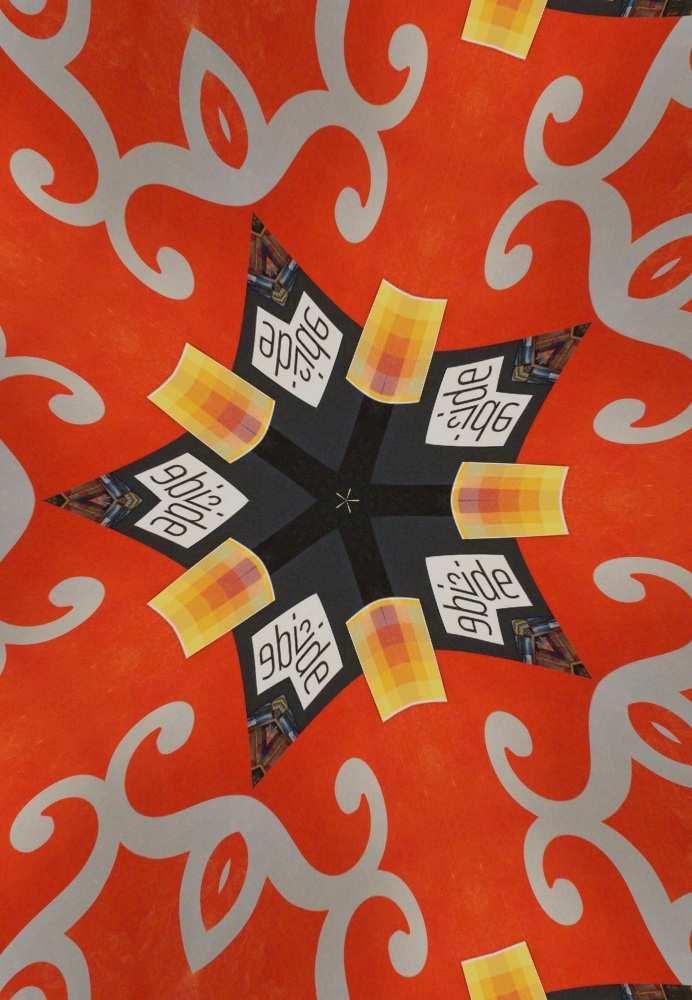
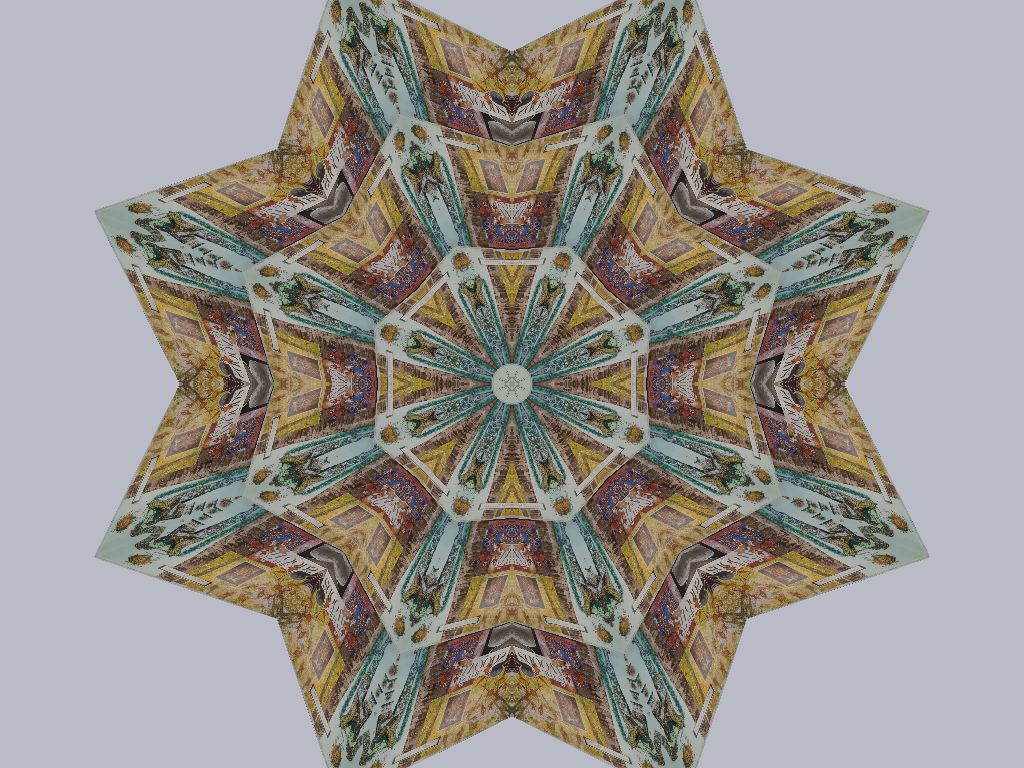
and then I found LunaPic where you can alter the kaleidoscope image by changing the number of sides.
Then I found 3Dthis Kaleidoscope and I’m hooked!! This program lets you adjust the facets (sides), reflection, offset, and volume(of the shape) and then you can animate it with control of the reflection, offset, rotation, and speed. This program is so cool!!
Today’s collage
collage #5
Stream of Consciousness
So now for today’s stream of consciousness: Ends with “ound.” Sound, Puget Sound, round, bound, hound, abound, found, pound, surround,
I went on rhymezone and looked up sound: browned, drowned, ground, mound, wound, around, astound, background, confound, compound, expound, foreground, campground, fairground, belowground, playground, underground, profound, rebound, renowned, resound, spellbound, homebound, housebound, inbound, surround, ultrasound, runaround, wraparound, merry-go-round
I’m surprised how many of these are compound words. The words for my NaPoWriMo word bank are supposed to be simple words. Those “ound” words don’t really work for my word bank of sensory words except sound itself, but my word is supposed to be a sound, not the word sound. I can taste a pound cake, I can taste something browned, feel a wound, I can smell the Sound, I can see that something’s round, but I don’t want to force the connection of the prompts if it’s not working. Resound might work for a sound “A resounding joy.”
resound: (of a sound, voice, etc.) fill a place with sound; be loud enough to echo.
“another scream resounded through the school”
Okay, so resound works. It also goes with the solitude prompt because it speaks to echoes.
What is the smell that has the power to plunge me back into an experience in the distant past? Ground can work for this. At first I thought of the smell of the ground, like dirt, and rotting leaves, but then I thought of a ground spice, like ground cinnamon or nutmeg. They might make me think of gingerbread, Or what other ground spice would trigger a memory? I think ground nutmeg is a fun one. What rhymes with nutmeg? bootleg, nest egg, and tent peg, beg, and powder keg. So that’s fun. I guess I’ll go look if I can find some ground nutmeg and see what it makes me think of. Once I do that, it should lead me to my sight, and touch, nutmeg is a smell and taste.
Today’s Poem
When a Memory Finds
In solitude it’s hard to astound. Attuned to one’s wound, marooned in memory silence resounds.
We sit on a powder keg surrounded by the found that at any moment could slip into the foreground
A whiff of ground nutmeg and a gingerbread man appears in my mind, but not a memory of baking or eating cookies,
or Christmas. No. I see the kind that runs and runs, and says “You can’t catch me. Maybe that’s why
I keep remembering sprinkling nutmeg in my coffee at your corner market we walked to when I needed you, when I walked to work
in those early days full of promise. I was always that spiced cookie running along the water, searching for a way to cross— without getting wet,
losing my legs, surrounded by water, drowned—so I could escape, never to be found.
In the News and Trends section of the May/June 2019 Poets&Writers Magazine, in an article called “The Bookshop Band” about an English band called The Bookshop Band that toured America, playing book-inspired music in libraries and bookstores, I read, America is such a huge place, and when you look at it from afar without really knowing it or experiencing it, you don’t expect to find such tight-knit communities around the bookshops.
This stuck with me for several reasons, but mostly for the contrast of looking at something from afar and really knowing something. Then also, once you really know something, you see unexpected connections. Both of these ideas apply to poetry.
P&W Collage #11 -Kaleidoscopic Knowing
But something else stuck with me too. In the profile on poet Paisley Rekdal, the editor of the Kenyon Review (in 2019), David Baker, was quoted as saying, “One of the things I find remarkable about Paisley’s work is the complexity and brightness of the questions—her ability to bring mythology into personal memory, science into family stories, trauma set alongside beauty and devastation alike. Nothing is ‘easy’ in her poems, whether that might be a polyphonic form or voice or a museum of battered skulls or the invention of the kaleidoscope.”
I looked up the invention of the kaleidoscope and read about the Scottish physicist Sir David Brewster (1781–1868) putting “several long mirrors in a narrow brass cylinder to reflect an image as it traveled from its source to the viewer’s eye” (Kaleidoscope, The Huntington). Then I found Sir David Brewster’s A Treatise on the Kaleidoscope from 1819.
I started wondering what Paisley Rekdal had to say about the invention of the kaleidoscope, and found that The Invention of the Kaleidoscope was the name of her collection of poems about failure. Sadly, my library system does not have a copy, but I was able to read the beginning of the titular poem on Barnes & Noble.
This got me thinking about kaleidoscope poetry and found a prompt from Adele Kenny’s Poetry Blog that she posted in 2012. She includes eight great kaleidoscope questions to ask yourself while attempting a poem using a kaleidoscope as a metaphor for life.
I found this quote from, Kaleidoscope: Poetic Forms and Collective Histories, a discussion from last year’s PEN World Voices Festival.
“When we hear “kaleidoscope,” we imaginea lensed instrument revealing striking, mesmeric patterns. But the word kaleidoscope itself, derived from the Greek kalos, “beautiful,” + eidos, “form,” reminds us that poems too are a lens through which we see patterns, both beautiful and not, of the world around us.”
The discussion was led by Douglas Kearney who is also the instructor of Sharpened Visions: A Poetry Workshop the free online poetry workshop on Coursera I’m enjoying (for the third time).
It was a dark and stormy night when he invented the instrument that changed how the whole world sees
He was a physicist experimenting but never judge a book by its cover He was on a search for beauty and he was unrelenting
You don’t have to read between the lines You will believe your own eyes the grass is no longer greener on the other side
because David Brewster was born for greatness he removed all limitations to degrees of perfection to provide the highest service in all art’s ornateness
if you play your cards right like a bolt from the blue all will be clear with your first sight
The Royal Academy gave him a medal as plain as the nose on your face because he was first though so many raced to pedal
his instrument of scientific visual study as a bit of child’s play the secret out, his patent ownership got muddy
Like a thief in the night lower than a snake’s belly he lost his first manufacturing rights
But feast your eyes on this he wrote his own treatise so the masses would not miss
the potential of the instrument they held he explained the math like a broken record making plain the kaleidoscope’s spell
But when swirling in color and shapes the beauty of form to see ignorance is bliss no sour grapes
At the end of the Editor’s Note in the March/April 2019 Poets&Writers Magazine, Kevin Larimer writes, “I hope this issue provides a little inspiration, a bit of insight, and maybe even some companionship for what can feel like a long, lonely journey. Never give up.”
P&W Collage #10 – Journey
He’s talking about the writer’s life as a journey, but a poem can also be a journey. Like in the Ada Limόn poem “The Magnificent Frigatebird” that I am studying all week, she takes the reader to Rio where she first saw a Magnificent Frigatebird before she knew what it was called. She takes us on a journey of discovery and then wonder and imagination, all in one poem.
When writing a poem, I want to be more open to letting my poem take me on a journey. I felt that starting to happen in yesterday’s poem. Letting the poem take control and go where it wants to go felt a little uncomfortable, which I take as a sign that I’m getting somewhere.
The Prompts
NaPoWriMo : Write either a monostich, which is a one-line poem, or a poem made up of one-liner style jokes/sentiments.
It’s open link night (OLN) at dVerse Poets Pub, so head on over and link up your poem, and read, enjoy, and comment on the poems by poets from around the world.
Today’s Poem
Lines From Fleeting Memories
I think I remember it was blue, wasn’t it? That time when you didn’t turn left. We ended up at that one spot, don’t you remember? You know. That guy was there with the thing. There were three parrots, I’m pretty sure; could have been five. And a tiger. Remember that tiger? I remember a mariachi band playing, because you had just said . . . Oh, and our table was right there in the sand. No wait. That was another time. But now I’m sure. The sky was blue that day I knew. I just knew.
The Fiction prompt in the March/April 2019 Poets&Writers Magazine is called “Family Recipe.” The prompt uses (assoc. link)Gingerbread by Helen Oyeyemi as inspiration and says, “a mysteriously powerful homemade gingerbread wends its way like a spell through multiple generations of friendships and familial relationships. At times it plays an integral role in the alienating forces that drive characters painfully apart, and at other times it proves to be a tie that reinvigorates the complex bonds between mothers and daughters, as well as between friends. Taking inspiration from an ingredient, dish, or recipe that has meaning for your own family, write a short story that revolves around food and how the sharing of it can be both nurturing and disruptive.”
Inspiration would have been the obvious choice for today’s I word, but what makes something inspiring? What is the integral ingredient?
P&W Collage #9 – Integral Ingredients
Though the ingredient in the prompt has to do with cooking, an ingredient can be a constituent element of anything; a component.
Integral is such an interesting word. It is a Janus word or contronym, a word that means something and its opposite. It means: of, relating to, or belonging as a part of the whole; constituent or component; a necessary part of a whole, a constituent. What is a constituent? An element, material, etc. that is part of something else; component; serving to compose or make up a thing. So integral means a necessary part of a whole, but it also means entire; complete; whole.
Integral math: Integration, the process of computing an integral, is a way of adding slices to find the whole. Integration can be used to find areas, volumes, central points and many useful things.
That makes me think of a phrase I really like, “A whole that sums more than its parts.” I think that’s a great definition for a poem, and also a collection of poems. And that is making me think of fractals. A fractal is a never-ending pattern. Fractals are infinitely complex patterns that are self-similar across different scales. In mathematics, a fractal is a geometric shape containing detailed structure at arbitrarily small scales, usually having a fractal dimension strictly exceeding the topological dimension. Many fractals appear similar at various scales, as illustrated in successive magnifications of the Mandelbrot set. Fractals are often found in nature like broccoli and ferns. The integral ingredient repeats in larger and larger iterations to compose the whole.
I like this idea that the integral ingredient of a poem (or a collection of poems) is like a fractal, something that repeats in iterations of different sizes, working together to create the whole.
The Prompts
NaPoWriMo : write a poem based on one of the curious headlines, cartoons, and other journalistic tidbits featured at Yesterday’s Print. To go with the other prompts talking about what you can’t do, I chose:
Poetry Non-stop : from Casey Garfield “write a nature poem about something you wouldn’t normally write a nature poem about: something humans built; something humans do; something a little more urban that you’ll treat with the same beauty, respect, and reverence that a nature poet would give to clouds, mountains, rolling treescapes . . .”
Poetry Super Highway : from Joanne Durham “write a poem about something someone has told you that you shouldn’t write about. You might want to title it, “You can’t put ___ in a poem” or “You can’t write about ___ in a poem.” Then go on to explain why you’re not supposed to include it, and use it anyway.”
Joanne Durham’s prompt goes well with the Ada Limόn poem I’m studying this week, “The Magnificent Frigatebird.” In the second couplet she writes, “A mentor once said, You can’t start a poem with a man looking out a window. Too may men looking out a window.” So many people telling poets what they can’t write about. What a strange way to spend time.
Today’s Poem
The Cards Dealt Better ~after Ada Limόn
Aren’t humans part of nature? I sucked air walking uphill. Isn’t it natural to point out the mistakes in the grand design?
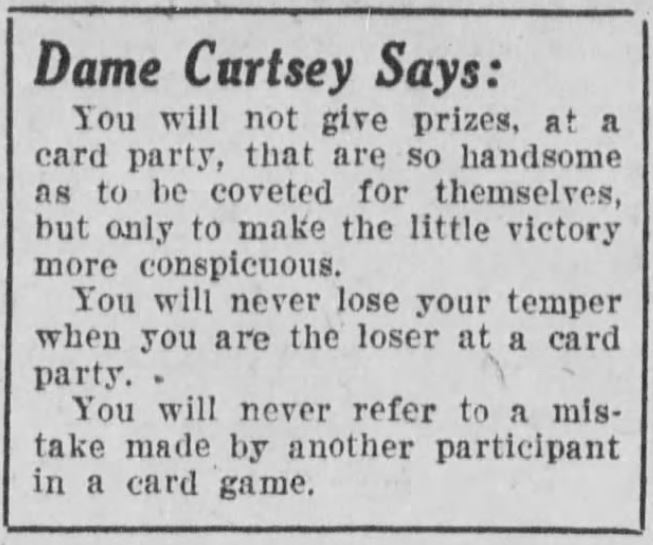
Dame Curtsey said, You can’t write a poem that refers to a mistake made by another participant in a card game
But isn’t this life a card game? We all are participants making mistakes. One last hand to fold, after going all in.
Once, in New Orleans, six women sat around my table in the upstairs apartment of the identical boxes that were once military housing
Good bluffers all, stony-faced, emotionless, chatting as if they held no cards at all, as if it wasn’t food money in the pot.
Then purses opened, and three players set down their cards and held guns out to compare. The game changed now that I was aware
that people brought guns to our friendly card games. Is that the mistake to which I must not refer? It had not occurred to me
that these women in nature, around my table, in my apartment keep guns hidden in their pouches to display like brown pelicans gular sacs turn red.
I am far from the Big Easy now. I am not sweating and no cockroaches threaten to crawl across the cards if I put them down. But
I stay away from card games and the mistakes that lurk in the pouches of purses.
The Jan/Feb 2019 Poets&Writers Magazine has an article called “The Hour Between Dog and Wolf” by Melissa Burkley that talks about hypnagogia, a term for the “mental twilight” during the first few minutes of sleep and when we’re just waking up when we experience dream imagery and enough conscious control to remember it.
P&W Collage #8 – Hypnagogic
Edison was said to nap with a spoon in his hand over a metal bowl so that the moment he fell asleep the spoon would drop with a clang and wake him. In the article, Burkley describes the artist Dalί holding a key over an upside-down plate. She calls this a vertical nap.
I’ve tried this technique, and it worked for an odd Christmas poem in 2021, The Red Candle. It feels strange that it has been so long. I remember that imagery and writing that poem so vividly. I’m also surprised that I don’t use such a fun technique more often. I’ll have to work it into my writing practice. Maybe make time for it once or twice a week for an afternoon writing session.
The Prompts
NaPoWriMo : Write an ode celebrating an every day object.
PAD Challenge : Two for Tuesday – 1. Write a love poem 2. Write an anti-love poem
dVerse Poets Pub : Today’s poetics prompt is to write a poem after “My Box” by Gillian Clarke. “write a poem about your own metaphorical box. It doesn’t necessarily have to be about a relationship, but I would like it to be autobiographical, free verse, and in three stanzas similar to those in Clarke’s poem: the first stanza describes the box; the second what is in it; and the third where you keep it, with a summarizing list in the final two lines.”
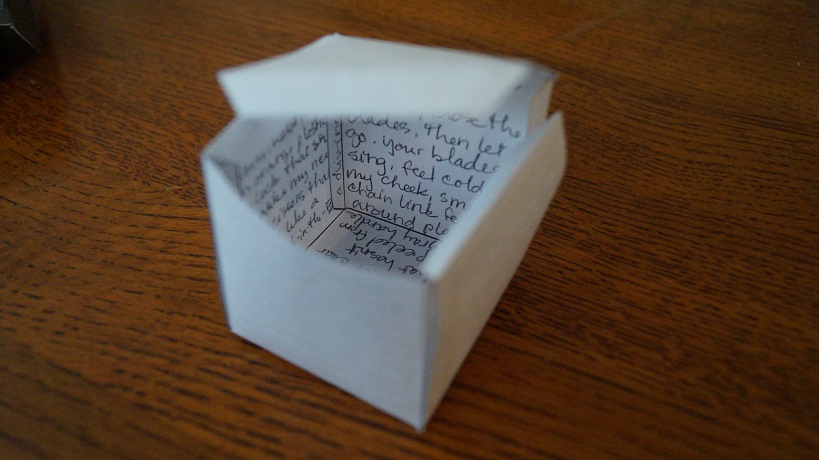
I used this as an opportunity to explore my paper cube poetry writing tool from April 2nd: Poetry as Boxes.
Today’s Poem
Ode to My Scissors by Maria L. Berg 2024
A Paper Box with Scissors Inside
My box is made of paper cut with the scissors my words put inside. I made it out of the many-sided possibilities of entering a poem.
I stuffed my box with all the words to write an ode to my scissors the sounds they make, how they feel on my face and how they look like a diving bird when held upside down. I closed my ode inside my box so I only see blank sides with no clue to what I’ll see when entering the poem.
I hold my box in my hand and turn it many times then opening the side I face I read I was right; they’re stains Close my box, turn, and open again The dark gray handle mottled and worn by skin oils then one more turn and I open to read Marked as mine with a single piece of clear tape This is a box full of words, age-stained blades, diving birds, and love entering a poem.
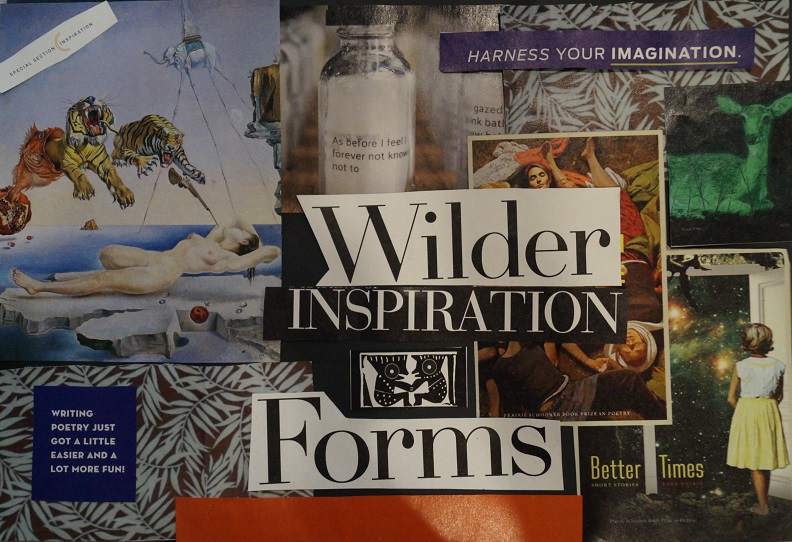
In the fourteenth annual look at debut poets called “Wilder Forms” in the Jan/Feb 2019 Poets&Writers Magazine I read, “For all the gravity of the poets’ concerns, though, there is also a sense of play and invention throughout their work.” The idea of a poem—a poet’s concerns—having gravity, holding things to it, creating orbits stuck with me.
P&W Collage #7 – Gravity
Though the author of the introduction to the special section, Dana Isokawa, was using gravity in reference to subject matter being solemn, serious, and/or critical, I’m now thinking of the force of attraction by which terrestrial bodies tend to fall toward the center of the earth; heaviness or weight; the acceleration of gravity. And there’s another definition: lowness in pitch, as of sounds.
This makes me think that using the contrast of high pitched sounds (birdsong, a flute, water pouring, a baby’s cry) in contrast with low pitched sounds (a cow lowing, a hand drum, thunder, a bass voice) can help express conflicting emotions.
Different speech sounds also have pitches: o-o-o and m-m-m have low pitch; e-e-e is a medium pitch; and s-s-s and f-f-f have a high pitch. Another thing to keep in mind while exploring the gravity of a poem.
The Prompts
NaPoWriMo : “write a poem that centers around an encounter or relationship between two people (or things) that shouldn’t really have ever met – whether due to time, space, age, the differences in their nature, or for any other reason.”
April Blogging from A to Z Challenge: The G word on the main site today is Gathering. I thought that would make a good poetry prompt today: What am I gathering?
The Argos catalogues from the 1980s turned out to be an inspiring resource that worked well with the NaPoWriMo prompt and the PAD prompt to find things that shouldn’t meet, but when they do, create a major event.
Today’s Poem
Proof of the Paranormal
The world all covered in gray makes for an ideal day to stay home and play. If you’re six or over, we have Ghost Castle where you’ll enter the gloom at peril of doom, while avoiding the creepy traps that loom in the shadowy rooms, and lay the ghost to rest when you win by closing the lid of the coffin in the tomb.
But if you’re still five and you’re in the mood, you can play Shark Alert with a randomly programmed shark that swims around the surface attempting to catch the players who are racing for the lifeboats, and with each chomping bite blood will bloom in the churning water and the players will perish soon and move to the castle I assume.
I’ll grab my Polaroid to capture all the souls. What a momentous day. Automatic electric eye exposure control. Ultra-sonic beam adjusted focus to achieve pin-sharp pictures. Each auto-focused instant picture proof of the paranormal. Dry prints delivered, developed in my hand. Proof of the loss of innocence. Evidence that birth is the first step to death. The poisonous knowledge, killing wonder and mystery. Soon scoffed and forgotten. No batteries needed.
Portable MFA Week Two:
This week’s opening instructions says “commitment is the best antidote to fear. Commit to another week of hard work and delight in language. Make yourself accountable.” So this is me, telling you that I’m committed to all eight weeks of this program, and asking you to hold me to it.
Writing: This week I’ll continue to write at least forty-five minutes a day. However, the goal is to find the best time and place for my creativity and then write in one forty-five minute session of extended focus. I will try to build up to that for the end of the week since I still want to try writing at night, and want to explore more options to find my optimal writing space and time.
The goal for this week is to generate a poem from something I wrote in my free-writes last week. The instructions say to slow down, and work on one poem all week. Begin by reading my free-writing from last week; start with something I find there that contains energy and deserves further exploration, and each successive day expand on the poem I begin today, and continue even when I think the poem is done.
Reading: For my second Ada Limόn poem to study, I chose another from her collection, The Hurting Kind(assoc. link). I was excited to see her poem “The Magnificent Frigatebird” because while I was in Puerto Vallarta I kept asking everyone what the large bird flying overhead was called and no one could tell me. My first online search I couldn’t find it. It became an obsession to find out what that bird was called. Finally, near the end of the trip I found it online, and I will now never forget the Magnificent Frigatebird.
The instructions recommend that if I find any sections of the poem frustrating or daunting I should copy two lines and keep them in my pocket and read them every chance I get for two days, and then read the entire poem again.
I also set up a new mirrorworld, and played with simple shapes to create the expression of psycho kitties:
Psycho Kitties by Maria L. Berg 2024
The Prompts
NaPoWriMo: “write a poem titled “Wish You Were Here” that takes its inspiration from the idea of a postcard. Consistent with the abbreviated format of a postcard, your poem should be short, and should play with the idea of travel, distance, or sightseeing.
These prompts are great for today. Though I’m still not feeling 100%, tonight at midnight is the end of my fiftieth year, so today feels like a good day to look at my trip pictures and read what I wrote in Puerto Vallarta.
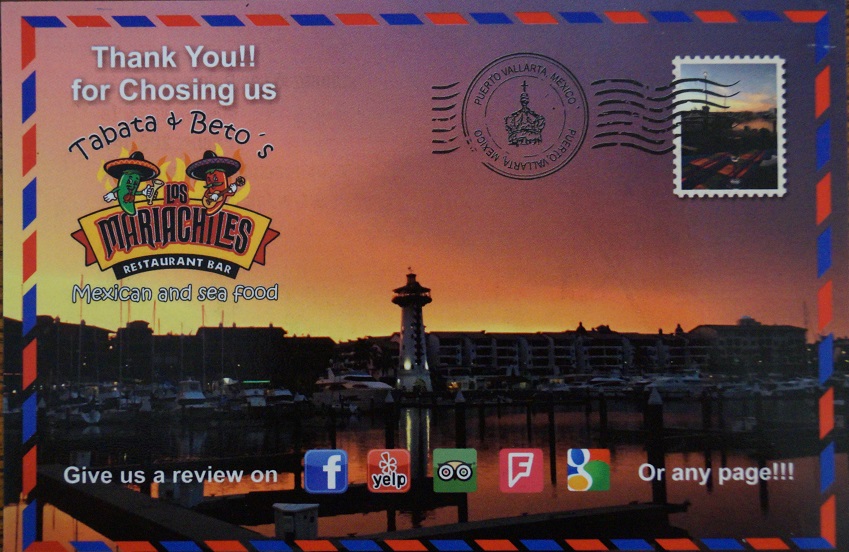
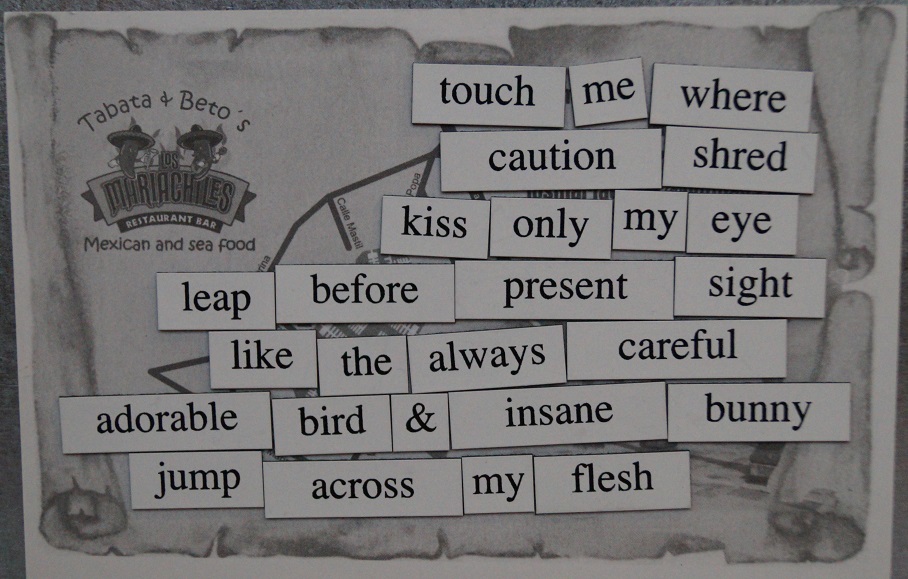
I received this faux postcard with my bill at a restaurant at Marina Vallarta. I thought it was a clever reminder and ask for a review. So I used this with my magnet poetry to make my poem today. The poem is a luck poem through the word selection of the magnets from the box.
Today’s Poem
Wish You Were Here
Poetry MFA Week 1 Review
Writing: So far, so good. I’ve definitely been writing at least forty-five minutes a day. I’ve been journaling, doing writing exercises, and writing poem drafts. I’ve been trying writing in different places at different times. One thing I wanted to try that I haven’t done is writing right before bed. I’ve done most of my writing first thing in the morning, and in the afternoon, so I’ll focus on writing before bed this coming week.
Reading: It was fun that the second Poets&Writers issue I studied had an interview with Ada Limόn about her collection the Carrying(assoc. link), so the A to Z Challenge fit into getting to know some background of my chosen poet. I read my selected poem, “Anticipation,” aloud many different ways, exploring the poet’s choice to break the poem into very short lines.
I’ll talk about the week two instructions and expectations tomorrow.
How’s your NaPoWriMo and/or A to Z Blogging Challenge going? Did you have a good week? Have some challenges creep up that tested your resolve like my day two internet outage? If so I hope it was short-lived, and you didn’t get derailed.







 Experience Writing