Today’s Meeting the Bar prompt at dVerse Poets Pub is to create kennings and use them in your poem. Kennings are compound expressions with metaphorical meaning, like “oar-steed” for ship, or “whale’s road” for sea. I think that hyperbole and kennings will work well together.
Fear of Losing Control
The thinline-alarm through the speaker-muffle prisonguard-voice announcing the closest anyone had ever been to toppling into oblivion was so metronomic, I thought I would die.
Motion-stealer thought-constrictor lassos pulling us from the steepest cliff in the world saved us from the apocalypse. Idea-thief glue-gears keep the puppets dancing.
Writober Flash Fiction
Nightmare’s Puppet
Jeremy Bridle lost control slowly. It started with a recurring nightmare. A dark figure, a shadowy evil puppeteer looming over his unconscious body. At first it was easy to laugh off the dream. He had forgotten how terrifying he found the animated Pinocchio movie as a child until he took a blind date to Guillermo del Toro’s Pinocchio and he left the theater without her, just ran out and never talked to her again. But the thirteenth time he had the dream, the figure attached a string to his left hand. It was one of those horrible dreams that’s so real you try to scream, and nothing comes out. When he woke up his hand really hurt right in the middle of the palm. At first, being right handed, it was only an annoyance, but then it felt like something was tugging on his left hand, like he had to fight against it as he walked, had to fight it to keep it at his side. Then it started waving at people while he walked down the street. He became concerned when it was raised above his head during a meeting, and people became irritated when he didn’t have anything to say.
The next week, the dream figure strung his right hand. Everything Jeremy wanted to do became a fight against an unseen force. Terrified, he tried to stop sleeping. Fired the next week, staying awake became even harder. He played video games all day and all night, all the lights blazing, and loud music playing. Ignoring the pounding on his floor, his ceiling, and both walls only kept the figure away for a few days. After the string attached to his head nightmare, Jeremy knew the puppeteer was in every shadow, his own shadow. Exhausted, he couldn’t fight anymore. He even became grateful for his strings. Once he gave in, he could sleep. He could sleep all the time. His dream was like watching a first person shooter.
Halloween Photography Challenge
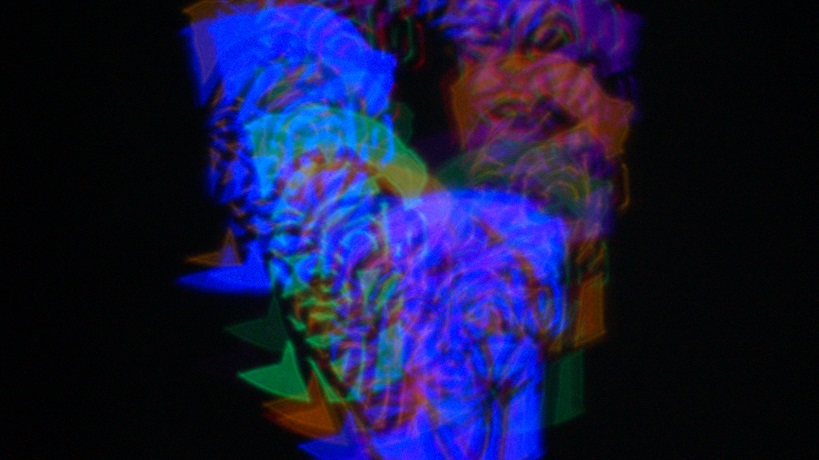
Fear of control brought up many ideas for me. For today’s image I went with fear of mind control and thought of swirling spiral imagery. I took my favorite spiral filter outside using red and orange glass lens filters. And used the red only filter in my camera.
Welcome back for the seventeenth day of Writober. Today we’re exploring our third universal fear: loss of autonomy through fear of control.
Loss of Control by Maria L. Berg 2024
Fear of control could mean many things: fear of losing control of oneself, fear of losing control to another, fear of being controlled physically or mentally. What other fear of control can you think of?
Rhetorical Device: Hyperbole
Hyperbole is the use of exaggerated statements or claims not meant to be taken literally. It is also sometimes known as auxesis, the Greek word for “growth” or “increase.”
Fighting Fear of the Blank Page: For the last couple days we explored some of Kerouac’s beliefs and techniques.
Continue with Kerouac’s list: Come to the page like a true beatnik: First thought, best thought. Let it flow.
*Quick Note about links in this post: I am an amazon associate, so most of the links in my post will take you to amazon products. If you buy from these links, I will make some pennies which will help me pay for this site and my creative endeavors.
OctPoWriMo
Poetry Toolbox
These are quick exercises that I hope you’ll do every day. We will build on these exercises throughout the month.
Word list: Write down the first ten words you think of when you think of fear. Any words at all. Anything that comes to mind. Then choose your three favorite and say them aloud a few times until you hear the accented and unaccented syllables (if more than one syllable) and notice the duration of each syllable. (Inspired by Frances Mayes’ list of a hundred favorite words in The Discovery of Poetry)
I created this Excel Spreadsheet for you to use to collect and explore your fear words.
2. Sensory Imagery: In your journal or a word processing file, fill in these lines as quickly as you can. Notice they are slightly different from last week. You may want to revisit one or two in more detail if you’re inspired and have time.
3. More Sensory Imagery: Ask yourself sensory questions about fear of control.
4. Choose one poem to study all week: Read your chosen poem again. Read it aloud. Journal about your thoughts on the poem. Has your understanding changed in any way? Have new questions come up? Look up the poem online. Are there any interviews with the poet? Has anyone else written insights about the poem?
Poetry Building
Hyperbole is the use of exaggeration. How could you use grandiose claims to emphasize your point and evoke emotion?
Example poem: Today we’re looking at “I’m afraid of death” by Kathleen Ossip, copied here from poets.org for educational purposes.
I’m afraid of death because it inflates the definition of what a person is, or love, until they become the same, love, the beloved, immaterial.
I’m afraid of death because it invents a different kind of time, a stopped clock that can’t be reset, only repurchased, an antiquity.
I’m afraid of death, the magician who makes vanish and who makes odd things appear in odd places—your name engraves itself on a stranger’s chest in letters of char.
What stands out to you in this poem? Would you consider these statements hyperbole?
Today’s prompt: Write a poem exploring the fear of control using hyperbole.
Form: If you’re looking for more of a challenge, write your poem an Ode to loss of control using hyperbole.
Writober Flash Fiction
Write a story with a beginning, middle, and end with conflict that leads to change in less than a thousand words (no minimal word count) inspired by one of the images in the Loss of Autonomy folder of the Writober 2024 Pinterest board. How does fear of control control your character?
NaNo Prep
There’s a section I really like in Novel Writing Blueprint Workbook: A Storyteller’s Journal by Jill Harris where she talks about creating movement in Act 2 of a four act outline. Over the next few days we’ll take a look at some of these ideas.
Once your MC has encountered the inciting incident and realized there’s no returning to how life was before, the MC needs to plan next steps. How does your MC plan? What does your MC discover needs to be done to reach his/her goal?
While planning, what skills does your MC realize s/he is lacking? How does s/he train? Does the trainer become an ally? An interesting character whose words can inspire in the final battle? Or someone who comes to the MC’s aid when all is lost?
Halloween Photography Challenge
Take a photograph that depicts control or fear of control and link to your photo in the chat.
Get Moving
Now that you’ve read all the prompts and have all these ideas running around in your head, it’s time for motion. Some suggestions:
This room is not the smallest room This wood chair is not the hardest I don’t know what I’m doing here The rules won’t be too restrictive
It’s not the strangest rope I’ve felt Not the tightest knot ever tied I’ll wriggle out eventually The rules won’t be too restrictive
Not the scariest scream I’ve heart Not the stinkiest breath I’ve smelled So once I know what’s going on the rules won’t be too restrictive
Writober Flash Fiction
She Couldn’t Play by the Rules
Oscar had never paid much attention to his wife Sasha’s rebellious nature until he was voted in as president of their home owner’s association. Sure, she watched Real Housewives instead of cooking dinner, but she had never been much of a cook. And he paid their live-in-nanny extra to clean because Sasha couldn’t abide restriction. She said her free spirit needed to follow her whims. Those whims turned out to be mostly shopping, drinking, and clubbing, at any and all hours, but Oscar didn’t know that because he was always working, taking on as much work as he could to keep up with their bills. But his son was thriving and his wife was happy, so Oscar was content. Until Bob had to go and retire as president of the HOA.
As if Sasha took each rule as a dare, she started with plastic pink flamingos in the middle of the front yard. Then, she surrounded those with ceramic gnomes. When the neighbors’ complaints started flooding in, she added large political signs for every candidate and cause. When Oscar confronted her with the first fine, she laughed, full-throated, head back, boobs jiggling. She grabbed the notice from Oscar, tore it up, and flung it at him like confetti.
“You’re try to stifle me,” she yelled. “I can’t breathe with all your restrictions!”
Something snapped in Oscar. He heard it as if a dry branch was tromped on between hi ears. “Restrictions!” he yelled back. “I’ll show you restrictions!”
After clearing everything from the yard and placing the garbage and recycling bins at his designated spot by the curb, he planted a board-approved pink azalea bush of the correct size in remembrance. He waved to a neighbor walking his leashed cat on the sidewalk. Patting the dirt, he could barely feel her pounding the lid of her restrictive pine box under his feet.
Halloween Photography Challenge
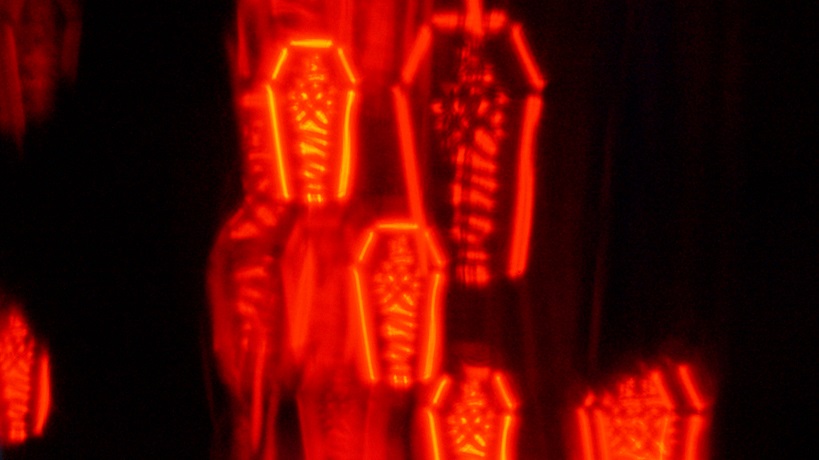
For today’s image, I took my new mummy filter outside and shot in black and white.
Welcome back for the sixteenth day of Writober. Today we’re exploring our third universal fear: loss of autonomy through fear of restriction.
Restriction by Maria L. Berg 2024
Fear of restriction is a fear of being confined. This could be a fear of being bound, of small spaces, or even tight clothing.
Rhetorical Device: Litotes
Litotes is an ironic understatement in which an affirmative is expressed by the negative of its contrary. Example: “It’s not the worst movie I’ve seen” or “You won’t be sorry.”
Fighting Fear of the Blank Page: Last week was the beat poets’ week at ModPo. Another of the resources was Jack Kerouac’s “Belief & Technique for Modern Prose”:
Belief & Technique for Modern Prose
by Jack Kerouac
Scribbled secret notebooks, and wild typewritten pages, for yr own joy
Submissive to everything, open, listening
Try never get drunk outside yr own house
Be in love with yr life
Something that you feel will find its own form
Be crazy dumbsaint of the mind
Blow as deep as you want to blow
Write what you want bottomless from bottom of mind
The unspeakable visions of the individual
No time for poetry but exactly what is
Visionary tics shivering in the chest
In tranced fixation dreaming upon object before you
Remove literary, grammatical and syntactical inhibition
Like Proust be an old teahead of time
Telling the true story of the world in interior monolog
The jewel center of interest is the eye within the eye
Write in recollection and amazement for yourself
Work from pithy middle eye out, swimming in language sea
Accept loss forever
Believe in the holy contour of life
Struggle to sketch the flow that already exists intact in mind
Dont think of words when you stop but to see picture better
Keep track of every day the date emblazoned in yr morning
No fear or shame in the dignity of yr experience, language & knowledge
Write for the world to read and see yr exact pictures of it
Bookmovie is the movie in words, the visual American form
In Praise of Character in the Bleak inhuman Loneliness
Composing wild, undisciplined, pure, coming in from under, crazier the better
Youre a Genius all the time
Writer-Director of Earthly movies Sponsored & Angeled in Heaven
As ever, Jack [Kerouac]
Jack Kerouac, “Belief & Technique For Modern Prose: List of Essentials,” from a 1958 letter to Donald Allen, published in Heaven & Other Poems, Grey Fox Press, 1958, 1977, 1983. This was also published in the spring 1959 issue of Evergreen Review.
Choose from Kerouac’s list: What resonates with you? Try to write from one of these beliefs and or techniques.
*Quick Note about links in this post: I am an amazon associate, so most of the links in my post will take you to amazon products. If you buy from these links, I will make some pennies which will help me pay for this site and my creative endeavors.
OctPoWriMo
Poetry Toolbox
These are quick exercises that I hope you’ll do every day. We will build on these exercises throughout the month.
Word list: Write down the first ten words you think of when you think of fear. Any words at all. Anything that comes to mind. Then choose your three favorite and say them aloud a few times until you hear the accented and unaccented syllables (if more than one syllable) and notice the duration of each syllable. (Inspired by Frances Mayes’ list of a hundred favorite words in The Discovery of Poetry)
I created this Excel Spreadsheet for you to use to collect and explore your fear words.
2. Sensory Imagery: In your journal or a word processing file, fill in these lines as quickly as you can. Notice they are slightly different from last week. You may want to revisit one or two in more detail if you’re inspired and have time.
3. More Sensory Imagery: Ask yourself sensory questions about fear of restriction.
4. Choose one poem to study all week: Read your chosen poem again. Look at one stanza at a time. Any new ideas? Learn more about the poet. Read some other poems by the poet. Are any lines still giving you trouble? Write about it in your journal.
Poetry Building
Litotes uses understatement and negative language. How can litotes help to express a fear of restriction?
Example poem: Today we’re looking at Fear by Liv Mammone, copied here from poets.org for educational purposes.
If the pain doesn’t come back, what will I write about? Will the poems have tendon and teeth? I didn’t get right the sonnet of all its colors. I did not find the exact dagger of phrase about the long loss of my life.
Hope is all I do and am. I don’t think I’m poet enough to make you taste this mango; or see that sutured sunset unless from a hospital bed. I was good for carving.
There will be kisses, music, street names. Loved ones will go where the gone do. What if I don’t want to (write it: can’t) write about these things. What if I would rather feel than create feeling? What then? Go ahead.
How does this poem make you feel? How did Liv Mammone express the fear of restriction?
Today’s prompt: Write a poem exploring the fear of restriction using litotes.
Form: If you’re looking for more of a challenge, write your poem as a Kyrielle, using litotes in your repeating line.
Writober Flash Fiction
Write a story with a beginning, middle, and end with conflict that leads to change in less than a thousand words (no minimal word count) inspired by one of the images in the Loss of Autonomy folder of the Writober 2024 Pinterest board. How does fear of restriction affect your character?
NaNo Prep
Time to start thinking about some important scenes for the middle of our novel. By now we should have a pretty good idea of what genre we’ll be writing in, but if you’re not sure, head over to Story Grid and look at the articles on Genre.
Once you’ve figured out what genre you’ll be writing in, Story Grid has great cheatsheets for each genre that outline the conventions and obligatory scenes. I also recommend picking up the book The Story Grid by Shawn Coyne.
Halloween Photography Challenge
Take a photograph that depicts restriction or fear of restriction and link to your photo in the chat.
Get Moving
Now that you’ve read all the prompts and have all these ideas running around in your head, it’s time for motion. Some suggestions:
Play: Chase after and pop some evil spirits taking form as bubbles from this Halloween Bubble Machine.
These are my responses to the Writober prompt post Fear of Paralysis.
OctPoWriMo
Paralysis
She wears a tangy-sweet perfume the orange blossom tree in spring her voice a nightingale— unanimously accepted to be the sweetest birdsong— sings a funeral dirge chanting: if only, if only a flutter, flutter, flutter
If I could speak I would tell her I’m here and I’m trying I’m telling my eyes to move, Move, MOVE
Her silk blouse brushes my lifeless arm hairs fabric stained from wiping tears from her cheeks streaming, streaming, streaming streaming, but I don’t feel it She cries: If only, If only a twitch, a twitch, a twitch
I focus on my right pointer finger, the finger she used to hold as we walked so neither of us would ever get lost and I’m telling that finger to move move, damn it, move move, move, move, Move, MOVE
Writober Flash Fiction
Self Preservation
Dizzy, lungs burning, before taking what could be her last breath, Cora realized her mistake.
Ever since she fell out of the tree and broke her arm when she was three, she had been extra-careful, anxious of breaking her neck. Her parents loved extreme sports and believed that kids need to take risks, learn from their mistakes. They died chasing a tornado when she was five, or that’s what her grandma told her. Their truck was never found. Cora liked to believe they were in Oz.
When her favorite ski-jumper had a horrible accident, and was paralyzed from the neck down, Cora’s only solace was her memories of canning with her grandmother, preserving fruits and vegetables for the winter. She loved those sealed jars all lined up on the shelves in the basement. The textured glass holding those green beans, golden apricots, pickles, and jams safe from age and decay. She wanted that kind of safety.
It became an obsession; the only thing she wanted and needed. Finally, she befriended a glass blower, and convinced him that a human-sized canning jar would make the type of statement he was working toward. She volunteered for a collaboration, a piece of performance art, explaining how a live human inside his glass jar was social commentary. It would push people to see that they were never safe, no matter what they did. Cora demanded that the canning jar be exactly like the ones her grandmother had used. She climbed in, curled up, holding her knees, and when she heard the lid screw on, all her anxiety disappeared. She felt so safe. But like all preserves, it was only safe if there was no air in the jar.
Halloween Photography Challenge
For fear of paralysis I thought of not being able to move, which led me to mummification, a mummy awake but trapped in a sarcophagus. For today’s image, I cut a mummy filter and took photos in the mirrorworld.
Welcome back for the fifteenth day of Writober. Today we’re exploring our third universal fear: loss of autonomy through fear of paralysis.
Fear of Paralysis by Maria L. Berg 2024
Fear of paralysis is the fear of losing control of your body, but as I looked into it, I also found “fear paralysis” which is becoming paralyzed or frozen by fear. So this could also be about the fear of fear paralysis. That repetition of the word “fear” could be an example of epizeuxis.
Rhetorical Device: Epizeuxis
Epizeuxis, also known as palilogia, is repeating a word or phrase in quick succession to create emphasis or emotional appeal.
Fighting Fear of the Blank Page: Last week was the beat poets’ week at ModPo. One of the resources was Jack Kerouac’s “Essentials of Spontaneous Prose”:
“Essentials of Spontaneous Prose”
by Jack Kerouac
SET-UP The object is set before the mind, either in reality. as in sketching (before a landscape or teacup or old face) or is set in the memory wherein it becomes the sketching from memory of a definite image-object.
PROCEDURE Time being of the essence in the purity of speech, sketching language is undisturbed flow from the mind of personal secret idea-words, blowing (as per jazz musician) on subject of image.
METHOD No periods separating sentence-structures already arbitrarily riddled by false colons and timid usually needless
SCOPING Not “selectivity’ of expression but following free deviation (association) of mind into limitless blow-on-subject seas of thought, swimming in sea of English with no discipline other than rhythms of rhetorical exhalation and expostulated statement, like a fist coming down on a table with each complete utterance, bang! (the space dash)-Blow as deep as you want-write as deeply, fish as far down as you want, satisfy yourself first, then reader cannot fail to receive telepathic shock and meaning-excitement by same laws operating in his own human mind.
LAG IN PROCEDURE No pause to think of proper word but the infantile pileup of scatological buildup words till satisfaction is gained, which will turn out to be a great appending rhythm to a thought and be in accordance with Great Law of timing.
TIMING Nothing is muddy that runs in time and to laws of time-Shakespearian stress of dramatic need to speak now in own unalterable way or forever hold tongue-no revisions (except obvious rational mistakes, such as names or calculated insertions in act of not writing but inserting).
CENTER OF INTEREST Begin not from preconceived idea of what to say about image but from jewel center of interest in subject of image at moment of writing, and write outwards swimming in sea of language to peripheral release and exhaustion-Do not afterthink except for poetic or P. S. reasons. Never afterthink to “improve” or defray impressions, as, the best writing is always the most painful personal wrung-out tossed from cradle warm protective mind-tap from yourself the song of yourself, blow!-now!-your way is your only way-“good”-or “bad”-always honest (“ludi- crous”), spontaneous, “confessionals’ interesting, because not “crafted.” Craft is craft.
STRUCTURE OF WORK Modern bizarre structures (science fiction, etc.) arise from language being dead, “different” themes give illusion of “new” life. Follow roughly outlines in outfanning movement over subject, as river rock, so mindflow over jewel-center need (run your mind over it, once) arriving at pivot, where what was dim-formed “beginning” becomes sharp-necessitating “ending” and language shortens in race to wire of time-race of work, following laws of Deep Form, to conclusion, last words, last trickle–Night is The End.
MENTAL STATE If possible write “without consciousness” in semi-trance (as Yeats’ later “trance writing”) allowing subconscious to admit in own uninhibited interesting necessary and so “modern” language what conscious art would censor, and write excitedly, swiftly, with writing-or-typing-cramps, in accordance (as from center to periphery) with laws of orgasm, Reich’s “beclouding of consciousness.” Come from within, out–to relaxed and said.
Follow Kerouac’s Essentials: Write like a jazz musician in a trance state, allowing your subconscious to be uninhibited, allowing free association in undisturbed flow.
*Quick Note about links in this post: I am an amazon associate, so most of the links in my post will take you to amazon products. If you buy from these links, I will make some pennies which will help me pay for this site and my creative endeavors.
OctPoWriMo
Poetry Toolbox
These are quick exercises that I hope you’ll do every day. We will build on these exercises throughout the month.
Word list: Write down the first ten words you think of when you think of fear. Any words at all. Anything that comes to mind. Then choose your three favorite and say them aloud a few times until you hear the accented and unaccented syllables (if more than one syllable) and notice the duration of each syllable. (Inspired by Frances Mayes’ list of a hundred favorite words in The Discovery of Poetry)
I created this Excel Spreadsheet for you to use to collect and explore your fear words.
2. Sensory Imagery: In your journal or a word processing file, fill in these lines as quickly as you can. Notice they are slightly different from last week. You may want to revisit one or two in more detail if you’re inspired and have time.
3. More Sensory Imagery: Ask yourself sensory questions about fear of paralysis.
4. Choose one poem to study all week: Read your chosen poem again. Read it aloud. Journal about your thoughts on the poem. Has your understanding changed in any way? Have new questions come up? Look up the poem online. Are there any interviews with the poet? Has anyone else written insights about the poem?
Poetry Building
Epizeuxis creates a rhythm in its repetition of sounds. Are there sounds in your favorite words from your word list today that when repeated over and over make you think of fear of paralysis?
Example poem: Today we’re looking at The Bells by Edgar Allan Poe, copied here from poets.org for educational purposes.
Hear the sledges with the bells— Silver bells! What a world of merriment their melody foretells! How they tinkle, tinkle, tinkle, In the icy air of night! While the stars that oversprinkle All the heavens, seem to twinkle With a crystalline delight; Keeping time, time, time, In a sort of Runic rhyme, To the tintinabulation that so musically wells From the bells, bells, bells, bells, Bells, bells, bells— From the jingling and the tinkling of the bells.
II.
Hear the mellow wedding bells, Golden bells! What a world of happiness their harmony foretells! Through the balmy air of night How they ring out their delight! From the molten-golden notes, And all in tune, What a liquid ditty floats To the turtle-dove that listens, while she gloats On the moon! Oh, from out the sounding cells, What a gush of euphony voluminously wells! How it swells! How it dwells On the Future! how it tells Of the rapture that impels To the swinging and the ringing Of the bells, bells, bells, Of the bells, bells, bells, bells, Bells, bells, bells— To the rhyming and the chiming of the bells!
III.
Hear the loud alarum bells— Brazen bells! What tale of terror, now, their turbulency tells! In the startled ear of night How they scream out their affright! Too much horrified to speak, They can only shriek, shriek, Out of tune, In a clamorous appealing to the mercy of the fire, In a mad expostulation with the deaf and frantic fire, Leaping higher, higher, higher, With a desperate desire, And a resolute endeavor Now—now to sit or never, By the side of the pale-faced moon. Oh, the bells, bells, bells! What a tale their terror tells Of Despair! How they clang, and clash, and roar! What a horror they outpour On the bosom of the palpitating air! Yet the ear it fully knows, By the twanging, And the clanging, How the danger ebbs and flows; Yet the ear distinctly tells, In the jangling, And the wrangling. How the danger sinks and swells, By the sinking or the swelling in the anger of the bells— Of the bells— Of the bells, bells, bells, bells, Bells, bells, bells— In the clamor and the clangor of the bells!
IV.
Hear the tolling of the bells— Iron bells! What a world of solemn thought their monody compels! In the silence of the night, How we shiver with affright At the melancholy menace of their tone! For every sound that floats From the rust within their throats Is a groan. And the people—ah, the people— They that dwell up in the steeple, All alone, And who tolling, tolling, tolling, In that muffled monotone, Feel a glory in so rolling On the human heart a stone— They are neither man nor woman— They are neither brute nor human— They are Ghouls: And their king it is who tolls; And he rolls, rolls, rolls, Rolls A pæan from the bells! And his merry bosom swells With the pæan of the bells! And he dances, and he yells; Keeping time, time, time, In a sort of Runic rhyme, To the pæan of the bells— Of the bells: Keeping time, time, time, In a sort of Runic rhyme, To the throbbing of the bells— Of the bells, bells, bells— To the sobbing of the bells; Keeping time, time, time, As he knells, knells, knells, In a happy Runic rhyme, To the rolling of the bells— Of the bells, bells, bells— To the tolling of the bells, Of the bells, bells, bells, bells— Bells, bells, bells— To the moaning and the groaning of the bells.
From The Works of the Late Edgar Allan Poe, vol. II, 1850. For other versions, please visit The Edgar Allan Poe Society of Baltimore site: http://www.eapoe.org/works/poems/index.htm#B.
How does this poem make you feel? What is the effect of the extensive use of epizeuxis in this poem?
Today’s prompt: Write a poem exploring the fear of paralysis using epizeuxis.
Form: If you’re looking for more of a challenge, write your poem as an alouette. The alouette, created by Jan Turner, consists of two or more stanzas of 6 lines each, with the syllabic sequence: 5, 5, 7, 5, 5, 7 and the rhyme scheme: a, a, b, c, c, b.
Writober Flash Fiction
Write a story with a beginning, middle, and end with conflict that leads to change in less than a thousand words (no minimal word count) inspired by one of the images in the Loss of Autonomy folder of the Writober 2024 Pinterest board. How does fear of paralysis affect your character?
NaNo Prep
Yesterday we started thinking about our novel’s ending. Did any of your ideas have a twist?
Identity Twist – one of the main characters turns out to be someone or something other than they seem.
Death Twist – one of the main characters is killed off in a surprising way.
Motive Twist – A character is revealed to want the opposite of what they had appeared to desire.
Perception Twist – The main character realizes that they had perceived their surroundings incorrectly (Example: The Truman Show).
Fortune Twist – The character is given something at the beginning that is taken away at the end: a twist of fate.
Fulfillment Twist – The character gets what they want but it turns out to be a disaster.
Brainstorm as many ideas as you can for each of these twists then explore your favorites to see how they create the most surprising and fulfilling ending to your story.
Halloween Photography Challenge
Take a photograph that depicts paralysis or fear of paralysis and link to your photo in the chat.
Get Moving
Now that you’ve read all the prompts and have all these ideas running around in your head, it’s time for motion. What better way to fight fear of paralysis than getting moving? How about some scary walks in Sweden? Use your imagination. Some suggestions:
Today is Quadrille Monday at dVerse Poets Pub and the prompt word is “light.”
For today’s poem, I was sure that my Artist Magnetic Poetry Kit would have the word “light,” but to my shock and horror, it did not. So I wrote “light” on seven stickers and got to work. My new “light” magnets inspired me to create new hyphenated light words.
Breaking Through the Fear of Loss of Autonomy
I paint with light I color and form raw white light compose as wild silhouettes appear smear passion like deep water-light explore bold, abstract metaphor-light suffer absurd dazzle & shimmer to capture movement by life-light investigate surreal-light, breaking the monument of the red light
Writober Flash Fiction
Screams All the Way Down
I don’t know where I am or how I got here, but I can’t move. My eyes blink. I breathe. But nothing acts under my control. I tried to breathe more deeply, but nothing happened. The air smells antiseptic, chemical. People walk by me in loose cotton pants, my eyes at knee level. I must be squatting. My muscles ache like I’m in a state of permanent cramp that will never release. It’s like I’m the human equivalent of a charlie horse, one big calf muscle locked in intense pain. I try to scream, but the scream just grows and grows in my head until its a swirl of screams within screams, gaping maws of teeth and tongues inside teeth and tongues. It’s all I can see, all I can hear. All I am is screams all the way down.
Halloween Photography Challenge
For today’s photos, I thought about the feeling of fear of loss of autonomy as a headless torso. I took that shape into the mirrorworld, and also outside, taking pictures of the security light, and light shining off the old antenna on the roof.
Welcome back for the fourteenth day of Writober. Hard to believe we’re already in week three and exploring our third universal fear: loss of autonomy.
Loss of Autonomy by Maria L. Berg 2024
Fear of loss of autonomy is the fear of losing the ability to do things for yourself, to physically or mentally lose control of your own faculties. This could happen in so many different ways, suddenly due to injury, or slowly due to disease, or decline. Loss of autonomy makes a prison of the self.
Rhetorical Device: Apposition
Yesterday we talked about expanding past the line with enjambment. Today, we’re looking at extending our lines using appositions. There’s a great chapter in The Poet’s Companion by Kim Addonizio and Dorianne Laux called, “A Grammatical Excursion,” in which they explain different forms of appositions with examples and exercises.
The definition of apposition is “the act of placing together or bringing into proximity; juxtaposition.” In grammar, apposition is “a syntactic relation between expressions, usually consecutive, that have the same function and the same relation to other elements in the sentence, the second expression identifying or supplementing the first.” Appositions are how we give the reader more information. The example in The Poet’s Companion is starting with “My grandmother.” If you add her name, and write “My grandmother, Stella,” you’ve added a noun appositive. If you add a description like, “My grandmother, a tiny woman with long white hair,” you’ve added a noun phrase appositive.
Fighting Fear of the Blank Page: How are you feeling about that blank page? Is it still taunting you? What if you give that page a face?
Origami jack-o-lantern: Before writing, fold your page into a jack-o-lantern. Open it back up and put your words inside. Then fold it back into a jack-o-lantern.
Or you could try this origami skull that bites!
*Quick Note about links in this post: I am an amazon associate, so most of the links in my post will take you to amazon products. If you buy from these links, I will make some pennies which will help me pay for this site and my creative endeavors.
OctPoWriMo
Poetry Toolbox
These are quick exercises that I hope you’ll do every day. We will build on these exercises throughout the month.
Word list: Write down the first ten words you think of when you think of fear. Any words at all. Anything that comes to mind. Then choose your three favorite and say them aloud a few times until you hear the accented and unaccented syllables (if more than one syllable) and notice the duration of each syllable. (Inspired by Frances Mayes’ list of a hundred favorite words in The Discovery of Poetry)
I created this Excel Spreadsheet for you to use to collect and explore your fear words.
2. Sensory Imagery: In your journal or a word processing file, fill in these lines as quickly as you can. Notice they are slightly different from last week. You may want to revisit one or two in more detail if you’re inspired and have time.
3. More Sensory Imagery: Ask yourself sensory questions about loss of autonomy.
4. Choose one poem to study all week: Choose a new poem to study this week. It may be another by the same poet, or you may choose another poem that you find challenging.
Poetry Building
Apposition isn’t only for nouns, you can add appositives to verbs, adjectives or propositions. An example of a verb phrase appositive (from The Poet’s Companion) is: “The child spins in circles, whirls around until the world spins with her.”
Example poem: Today we’re looking at Variations on the Word Sleep by Margaret Atwood, copied here from poets.org for educational purposes.
I would like to watch you sleeping, which may not happen. I would like to watch you, sleeping. I would like to sleep with you, to enter your sleep as its smooth dark wave slides over my head
and walk with you through that lucent wavering forest of bluegreen leaves with its watery sun & three moons towards the cave where you must descend, towards your worst fear
I would like to give you the silver branch, the small white flower, the one word that will protect you from the grief at the center of your dream, from the grief at the center. I would like to follow you up the long stairway again & become the boat that would row you back carefully, a flame in two cupped hands to where your body lies beside me, and you enter it as easily as breathing in
I would like to be the air that inhabits you for a moment only. I would like to be that unnoticed & that necessary.
How does this poem make you feel? What stands out to you? Can you identify appositives in the poem?
Today’s prompt: Write a poem exploring the fear of loss of autonomy using apposition.
Form: If you’re looking for more of a challenge, read Projective Verse by Charles Olson. Want more? Look at Mind, Mouth and Page from the allen ginsberg project. Approach your poem as projective verse.
Writober Flash Fiction
Write a story with a beginning, middle, and end with conflict that leads to change in less than a thousand words (no minimal word count) inspired by one of the images in the Loss of Autonomy folder of the Writober 2024 Pinterest board. How does fear of loss of autonomy affect your character?
NaNo Prep
How’s your outline coming? Let’s start thinking about possible endings. Brainstorm as many different endings as you can. Choose your favorite and do a quick write of that ending. Knowing how the story begins and how it ends, we can start imagining the main events that need to happen in between.
Halloween Photography Challenge
Take a photograph that depicts loss of autonomy or fear of loss of autonomy and link to your photo in the chat.
Get Moving
Now that you’ve read all the prompts and have all these ideas running around in your head, it’s time for motion. How about some fun Halloween workout clothes to motivate some motion? Some suggestions:
These are my responses to the Writober prompt post Fear of Haunting.
OctPoWriMo
Writober Flash Fiction
A Jail Behind My Face
It started with a hard, itchy spot on the side of my right cheek near my earlobe. I couldn’t help but scratch at it, even when it would bleed. I must have even been scratching it in my sleep because I noticed blood stains on my pillow cases. Then, one morning, while standing at the bathroom mirror, it just opened like a curtain, my whole face, and behind my right cheek a small me, jailed, holding the bars. We screamed at the same time. Our screams were an octave apart. She wouldn’t stop screaming until I let go of my cheek curtain and it fell back into place.
You have no idea how hard it is to go on as if everything’s okay: to go to work and not tell everyone there’s an imprisoned tiny me in my face. Or go to dinner with my parents and not tell them they have another daughter imprisoned in my right cheek, a strange, little conjoined twin, or something. Since hearing it, I can’t get her scream out of my head. I’m so curious, and want to watch her, but that crease in my cheek healed. I can’t get it to open again. I want to let her out, set her free, but I don’t know how.
Halloween Photography Challenge
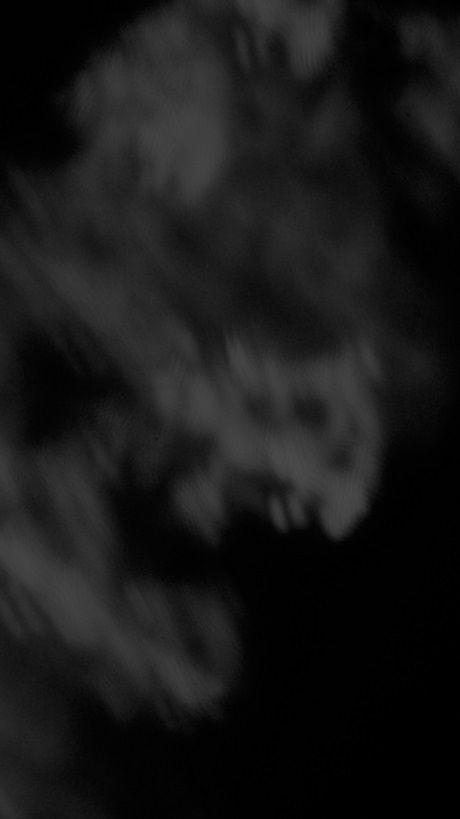
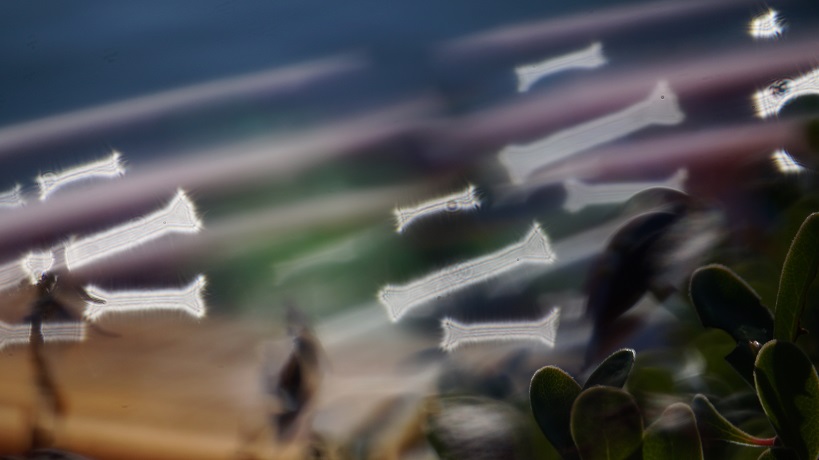
For today’s photos, I remembered a ghostly image I created using a pin-prick filter. I really like how the light bends and spreads through these designs of small holes, so I thought I would try that today.
Fear of Haunting by Maria L. Berg
Tunetober
This week I added a simple counter-melody to last week’s spooky tune.
Sewtober
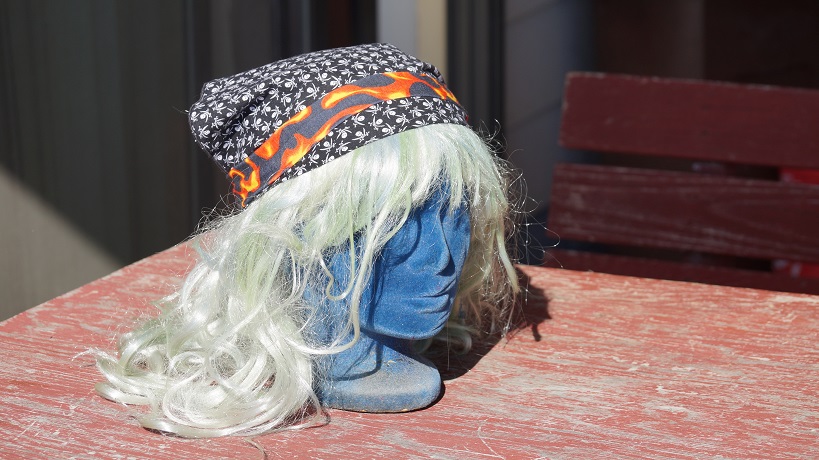
This week’s simplest costume pieces were inspired by my summer short haircut starting to grow out, and finding these Halloween Headbands on Amazon. I found some fire-print stretch fabric and made a headband. Then, I decided to finally make the pirate bandanas I bought fabric for many years ago.
And since my serger made such a nice rolled hem on the bandana, I made a second one, so they could also be Halloween dinner napkins.
This was a fun week. Though the time is flying by, I’m motivated and feeling productive. Thanks to everyone reading and joining in. There’s so much more fun to come.
Welcome back for the thirteenth day of Writober. It’s Sunday, and the last day we’ll be looking at the universal fear of separation.
Haunting by Maria L. Berg 2024
Fear of haunting isn’t only the fear of lingering spirits taking physical form, it’s a fear of lingering thoughts and feelings, memories and regrets.
By looking back at this week’s fears, the aspects of the fear of separation: abandonment, rejection, darkness, isolation, loneliness, and haunting have you gotten any closer to any of your core causes of these fears? What memories have come up for you that you may not have thought of since they happened? What’s still haunting you?
Line: Enjambment
Now that we’ve built up our tools to creating phrases and lines, today we’re looking at enjambment, continuing past the line. Enjambment means there is not a stop at the end of the line, but a continuation of a sentence onto the next line.
Fighting Fear of the Blank Page: How’s your relationship with the page coming along? Which approaches have been your favorite so far?
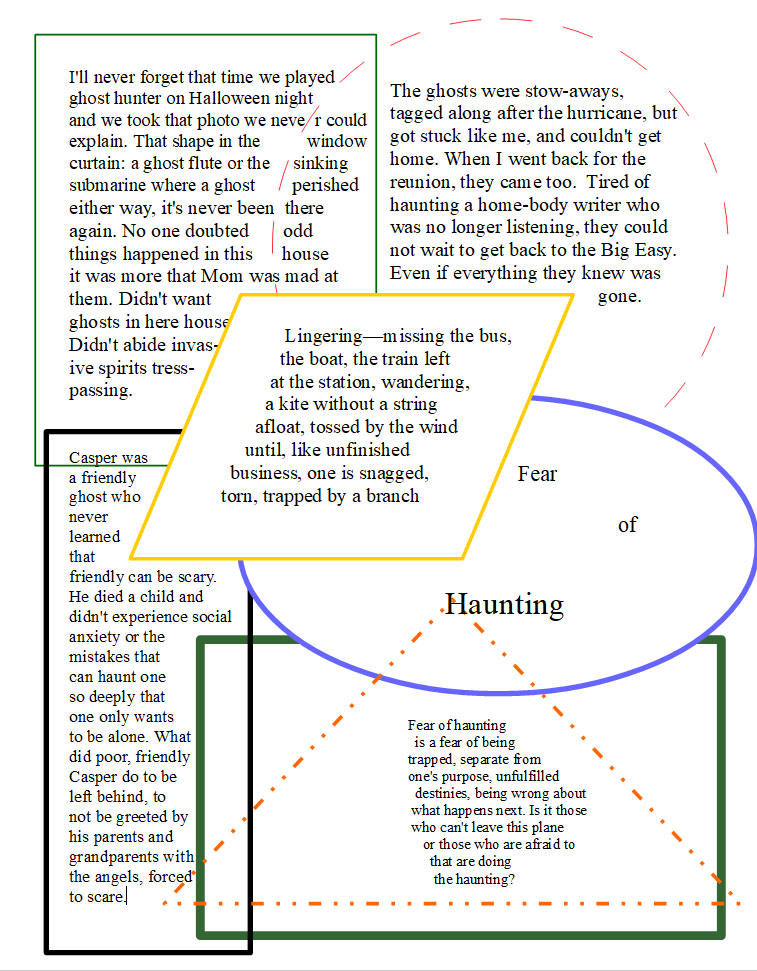
Segment the page with shapes and boxes: Try using the draw functions to put shapes on the page, overlapping boxes, circles, triangles, etc. Then write in the different shapes.
*Quick Note about links in this post: I am an amazon associate, so most of the links in my post will take you to amazon products. If you buy from these links, I will make some pennies which will help me pay for this site and my creative endeavors.
OctPoWriMo
Poetry Toolbox
These are quick exercises that I hope you’ll do every day. We will build on these exercises throughout the month.
Word list: Write down the first ten words you think of when you think of fear. Any words at all. Anything that comes to mind. Then choose your three favorite and say them aloud a few times until you hear the accented and unaccented syllables (if more than one syllable) and notice the duration of each syllable. (Inspired by Frances Mayes’ list of a hundred favorite words in The Discovery of Poetry)
I created this Excel Spreadsheet for you to use to collect and explore your fear words.
2. Sensory Imagery: In your journal or a word processing file, fill in these lines as quickly as you can. Notice they are slightly different from last week. You may want to revisit one or two in more detail if you’re inspired and have time.
3. More Sensory Imagery: I find a great place to start when exploring abstract ideas, is to brainstorm sensory imagery. Write down the first few things you think of to answer these questions:
What does isolation smell like?
What does isolation taste like?
What texture is isolation? What does it feel like to the touch? What temperature is isolation? Where do you feel it?
What does isolation sound like?
What color(s) is isolation? What is a symbol of isolation? What does it look like?
4. Choose one poem to study all week: Read your chosen poem again. Read it aloud. Are there parts of it you’ve memorized? Can you recite the whole thing? Are there rhymes and rhythms that make it easy to remember? How do you see the poem differently now? Do you still like and dislike the same things? What has changed? Write about it in your journal.
Poetry Building
Enjambment is breaking the line before the end of a sentence, continuing onto the next line.
Example poem: Today we’re looking at The Haunted Palace by Edgar Alan Poe, copied here from poetryfoundation.org for educational purposes.
In the greenest of our valleys By good angels tenanted, Once a fair and stately palace— Radiant palace—reared its head. In the monarch Thought’s dominion, It stood there! Never seraph spread a pinion Over fabric half so fair!
Banners yellow, glorious, golden, On its roof did float and flow (This—all this—was in the olden Time long ago) And every gentle air that dallied, In that sweet day, the ramparts plumed and pallid, A wingèd odor went away.
Wanderers in that happy valley, Through two luminous windows, saw Spirits moving musically To a lute’s well-tunèd law, Round about a throne where, sitting, Porphyrogene! In state his glory well befitting, The ruler of the realm was seen.
And all with pearl and ruby glowing Was the fair palace door, Through which came flowing, flowing, flowing And sparkling evermore, A troop of Echoes, whose sweet duty Was but to sing, In voices of surpassing beauty, The wit and wisdom of their king.
But evil things, in robes of sorrow, Assailed the monarch’s high estate; (Ah, let us mourn!—for never morrow Shall dawn upon him, desolate!) And round about his home the glory That blushed and bloomed Is but a dim-remembered story Of the old time entombed.
And travellers, now, within that valley, the red-litten windows see Vast forms that move fantastically To a discordant melody; While, like a ghastly rapid river, Through the pale door A hideous throng rush out forever, And laugh—but smile no more.
How does Poe use enjambment in this haunting poem? How might you break the lines differently? Try writing out one or two stanzas as sentences, and try breaking the lines in different places.
Today’s prompt: Write a poem exploring haunting using enjambment.
Form: If you’re looking for more of a challenge, write your poem as an Elegy.
Writober Flash Fiction
Write a story with a beginning, middle, and end with conflict that leads to change in less than a thousand words (no minimal word count) inspired by one of the images in the Separation folder of the Writober 2024 Pinterest board. What haunts your character(s)?
NaNo Prep
Time to explore some backstory. What happened in your MC’s past that still haunts today? What haunts your antagonist? How do they try to fight it? How does it show up and when?
Halloween Photography Challenge
Take a photograph that depicts haunting or fear of haunting and link to your photo in the chat.
Tunetober
How did it go? Did you come up with a haunting harmony, or counter melody? I hope so. This week’s challenge is to create some rhythm chords and/or a bass line, and add it to last week’s melody and harmony. Have fun.
Sewtober
This week, let’s make a fun Halloween decoration. You could make a stuffed pumpkin, a door banner or wreath, ornaments to hang in your trees, or anything else you can think of. Here are 30 ideas from gathered. And some fun ideas from We All Sew.
Get Moving
Now that you’ve read all the prompts and have all these ideas running around in your head, it’s time for motion. I found this comedy video, but I think the moves will get the blood pumping, and laughter’s good for you too.









 Experience Writing