After looking at everyone’s Reflections posts, I realized that even though I tried to visit everyone’s A to Z posts as much as I could, I missed out on a lot. Now that the rush to get my posts written every day is over, I can spend some time enjoying all the posts written in April, so I joined the A to Z Road Trip.
So far along my Road Trip I’ve made some interesting stops. I stopped at Lady in Read Writes and learned some Neologisms, and at Whatever I Think Of I learned about Shani, a Barbie from the early nineties with some interesting videos.
This morning on my Road Trip, I pulled over at Hdhstory.net and read a poem called “Message for Truth.” Truth was one of the first Big 5 contradictory abstract nouns I studied, paired with fiction, then later deceit. So this stop on my road trip had a scenic view of the next pairs of contradictory abstract nouns I’ll be studying.
Contradictory Abstract Nouns: The Next Big 5
Following my idea from my what’s coming in May post, I looked for abstract nouns I would find least connection to and had not found compelling to date. I came up with:
Disturbance or Trouble / Harmony or Tranquility or Order
Disregard / attention
Horror / Delight
Betrayal / Loyalty or Faithfulness
Cowardice / Bravery
Timing / tardiness, untimeliness
Luxury/austerity, poverty
Sophistication / uncouthness
Friendship / animosity
Fact / fiction or lie
Talent / clumsiness
Music / silence or quiet
Relief / Distress or Pain
Favoritism / neutrality or impartiality or indifference
Argument / agreement or accord
The problem is they all interest me, so how do I choose? I continued to look through my list above and remove the ones I was most drawn to until I had only five. Here are my next Big 5 Contradictory Abstract Nouns I’ll be exploring.
Favoritism / Impartiality
Betrayal / Loyalty
Argument / Agreement
Sophistication / Uncouthness
Disturbance / Tranquility
As I continue my study, I’ll be exploring definitions, philosophy, and psychology. I’ll be using what I learn to write poetry and make abstract photographs with the goal of creating a poem and an image that represents each pair.
Then on my Road Trip I stopped at How Would You Know . . . and after reading about the history of rubber, I learned about the Rhyme Royal poetry form that is in iambic pentameter, a line on the map that leads to this week’s Portable MFA review.
Poetry MFA Week 5 Review
This was a big week. NaPoWriMo ended on Tuesday. I went to the local poetry reading on Wednesday, and read a poem for the open mic. I started studying Louise Glück. And it was line and meter week for my assignments.
Writing: This week’s assignment for Portable MFA was fun. After reading it aloud many, many times, I took the Louise Glück poem, “Moonless Night” from Meadowlands(assoc. link) and typed it as it is. Then I typed it as a paragraph with no line breaks. Then I proceeded to break the lines in many different ways. Through this exercise, I saw that I would have broken one of the lines differently. The “What’s” in the fourth stanza, sticking out there by itself, could go to the next line, in my opinion. I enjoyed that this exercise helped me see what was bothering me in that fourth stanza.
The assignments for Doug Kearney’s workshop this week were more challenging. I had to study and write blank verse. Blank verse is unrhymed iambic pentameter. According to Mary Oliver in A Poetry Handbook(assoc link), iambic pentameter is the most natural for English speech because the stresses of English are iambic and our speaking breath is the length of a pentameter (five feet, or ten beats). I, however, have never found this natural at all.
For the first assignment of writing nonsense over another poet’s Blank Verse to get the feel of the rhythm, I chose “Lines Composed a Few Miles above Tintern Abbey” by William Wordsworth. It’s four pages long, so I thought it would provide plenty of practice.
I was listening to my old childhood record of Horton Hatches the Egg and Horton Hears a Who and recognized some anapest feet, so I thought I would listen to the Wordsworth and see if that helped. I found this great video on Youtube:
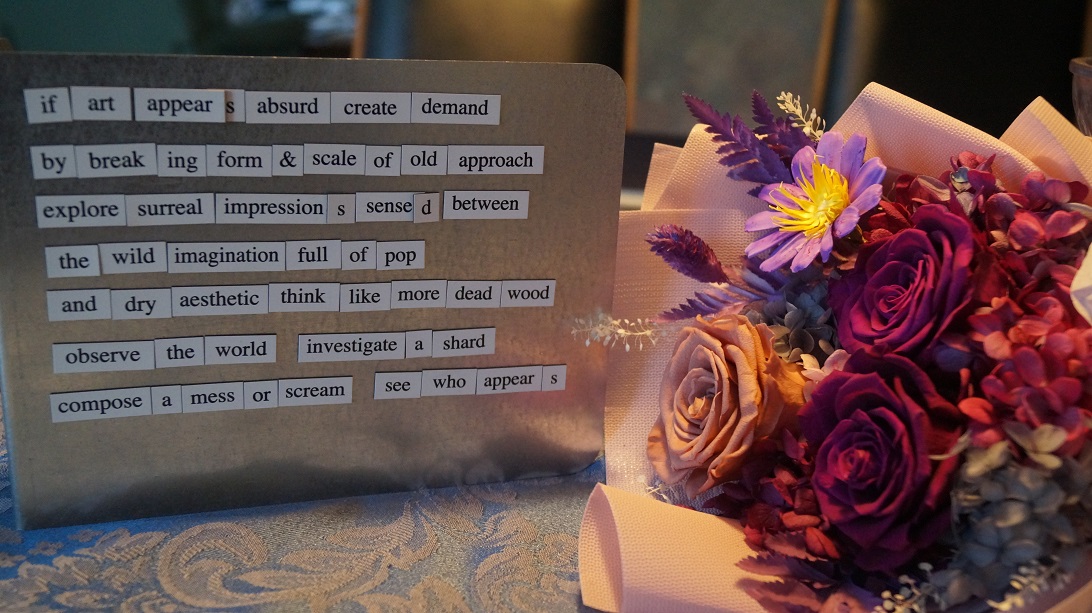
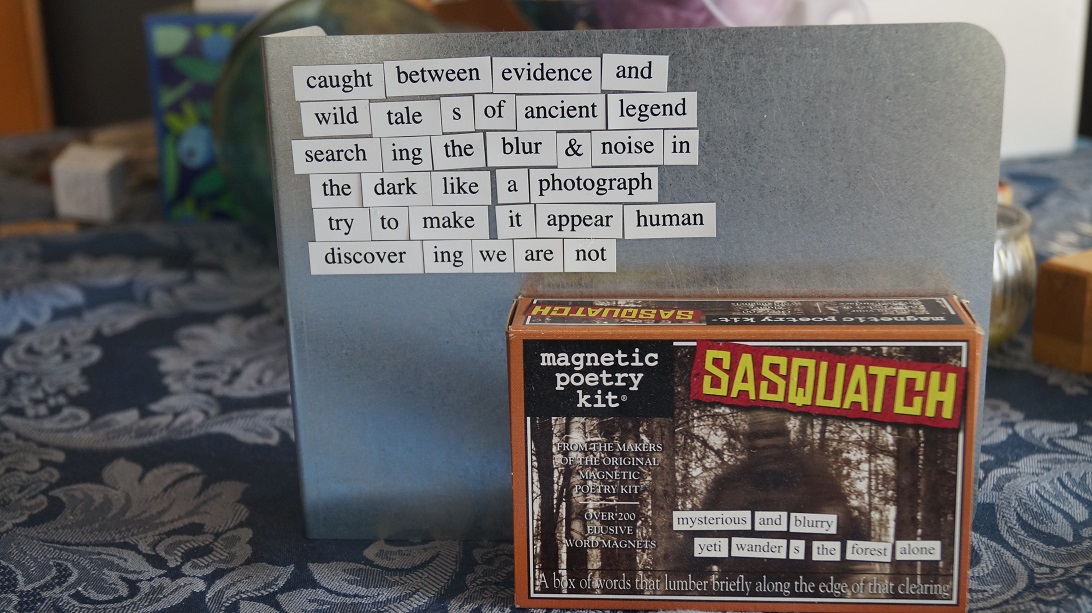
For the second assignment of writing my own blank verse, I used The Artist(assoc link) magnetic poetry kit. I found the experience interesting. I started grouping the magnets by the words’ syllabic stresses, and actually had some fun with it.
Reading: As I mentioned above, I found that listening was the most helpful this week, and I’ll continue to attempt meter training through listening. I did, however, do some reading as well for my line and meter work. Mary Oliver’s chapter “The Line” in A Poetry Handbook(assoc link) is very clear and insightful, and I also read “The Music of the Line” in The Poet’s Companion(assoc link) by Kim Addonizio and Dorianne Laux.
I’ll talk about the week six MFA instructions and expectations tomorrow.
Time is precious, and I appreciate that you spend some of your time here at Experience Writing reading and learning along with me. I set up a buy me a coffee account, so you can now buy me a beverage. It will help a lot.









 Experience Writing