This year’s Writer’s Games are over. I’m happy to say that one of my stories placed third in its event, so it will be published in the anthology. My first publication this year. Woohoo! This is the first Saturday I’m not working on a story, and am excited to have a Stream of Consciousness Saturday. The theme for today is Luck. Here’s a sample of my stream of consciousness writing on luck in my journal this morning:
“I’m still in disbelief of how unlucky, and lucky, I was yesterday. A simple act of gravity could have been a complete tragedy, but turned out fine. Talk about drama: hot water pouring over a frozen banana in the sink, I step out to get mint, and not wanting bugs to get in, close the sliding door behind me, but the house and gravity conspired, and the hinged bar fell. The door wouldn’t budge. At least I know that little bar does its job keeping people out, but I lock all my doors and windows at all times, so I was screwed. But luck was on my side. I still can’t believe how lucky I felt when the shop door opened. Maybe I wasn’t sure kitty wanted to stay in, so I didn’t lock it after I watered, or if he opened it telepathically, but somehow his recent choice to spend these hot, smoky days in the shop saved me, and the house. It was such a bit of luck, it felt spiritual, supernatural. Luck favors the prepared, but I was not prepared. Once I was back in the house, and had taken many deep breaths, I made the connection that it was Friday the 13th. It had never been a date I paid much attention to before. I wonder if I will take notice and act differently the next time.”
Maria L. Berg
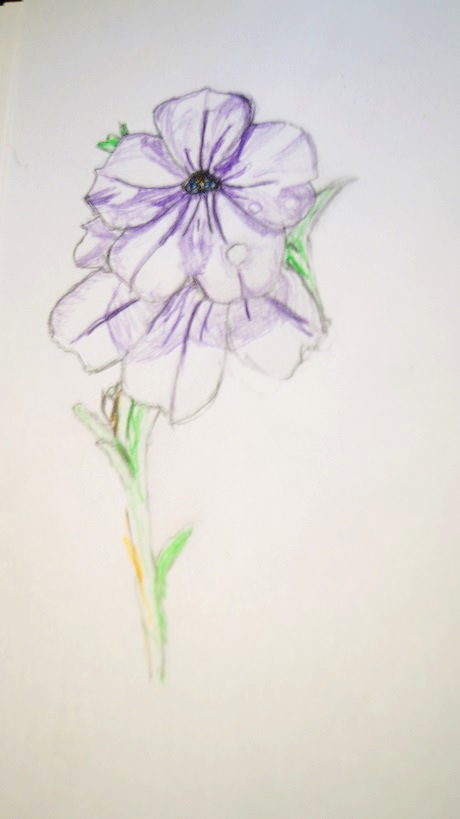
Looking through my WordPress Reader, I lucked into a cluster of Flower of the Day posts: Zombie Flamingos’ black and white response to Cee’s Flower a Day challenge, inspired me to go out and try a black and white flower photo. I love it! And lalalaMonique has a flower a day challenge in which she draws a flower each day. I think I’ll combine all three (though I ignored Cee’s dahlia prompt).
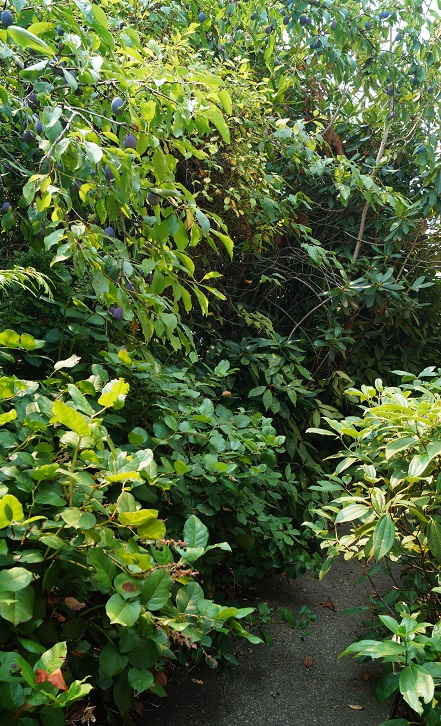
Stumbling upon Cee’s flower-a-day was also lucky because the site has lists of all sorts of challenges. Because I want to focus on recording music on the weekends, I took a look at her list of Music Challenges. I like the blogging challenge idea at wRightingMyLife because it combines writing, photography, and music which is something I want to do. The theme this month is “Pathways.” Luck and pathways go together well.
My overgrown path almost plum-ripe
Mindlovemisery’s Menagerie has something called Lucky Dip which today is a poetry prompt to write a Nonet which is a nine line diminishing syllables poem.
Fickle Luck
When all is shiny and bright as gold the path ahead clearly unfolds a gentle ease fills the day no blockades in the way birdsong fills the air not a blister or ache. We call it luck
When all is dark, and hope has run out everything tried fails, leaving doubt dare not ask what could go wrong dread makes the day too long chainsaws scream a dirge the next turn will be worse. We call it luck
And talk about lucky! I made the last of my quinoa, not sure what to eat with it, and just before I threw out the bag, I noticed a recipe on the back for Blueberry and Feta Quinoa Salad. And I had all the ingredients (except for cucumber). Delicious!
The Dverse Poets Pub’s challenge today is to try the Mirrored Refrain form created by Stephanie Repnyek. It looks like a fun challenge of rhyme and repetition. Here goes:
A Needed Rest
Fireflies’ sparks among the murmur, relief within the monotonous slop, illuminate the eighth-note rest, thrust of syncopation, surprise stop.
A small puncture to the drone, the point of the carving knife presses, thrust of syncopation, surprise stop. Illuminate the eighth-note rest.
Spaces of magnetic balance where attraction and repulsion lock illuminate the eighth-note rest, thrust of syncopation, surprise stop.
A skip that jolts the battered heart with the sharp, invigorating sting of zest, Thrust of syncopation, surprise stop, illuminate the eighth-note rest.
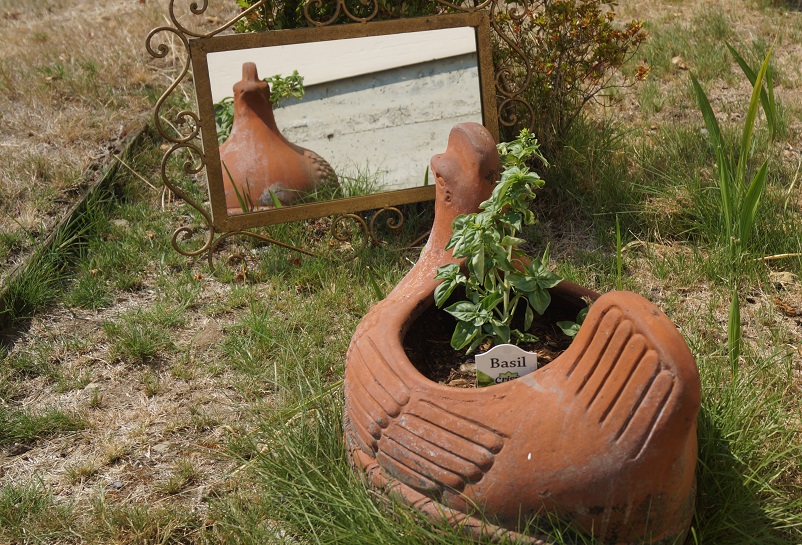
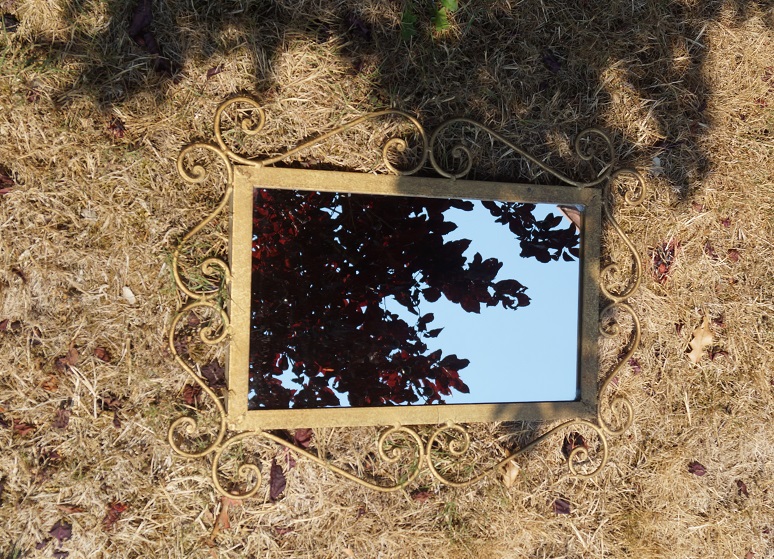
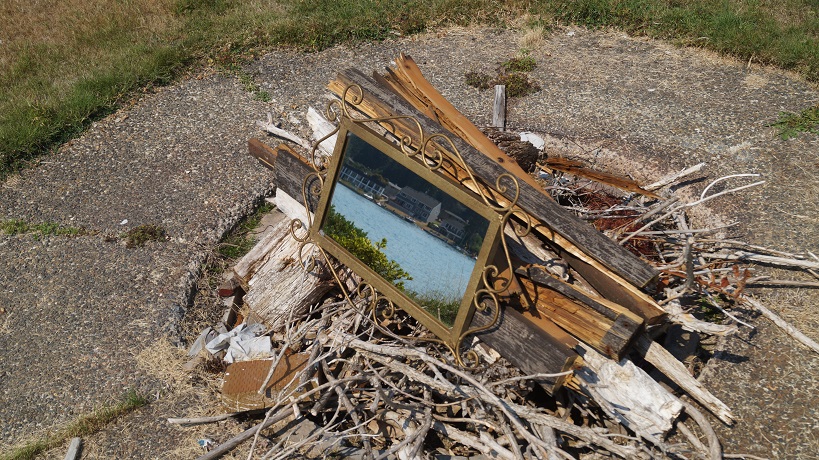
The poetry form inspired me to go out and take some fun mirror pictures. I almost melted, but got some nice pictures. Thank you for the inspiration.
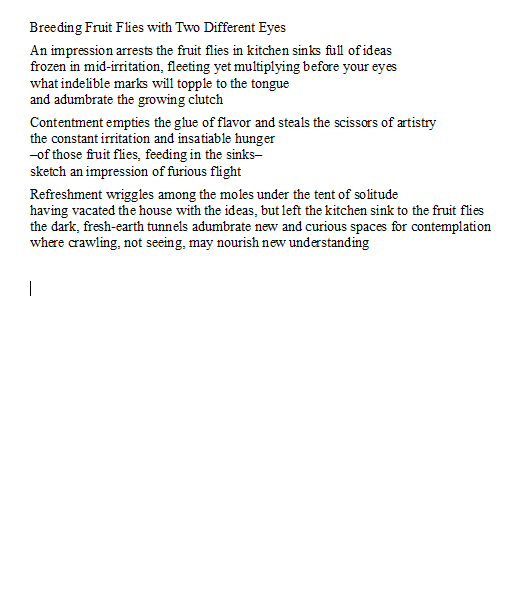
After looking at all my redrafts, I made a few more changes to my poem and was about to upload it to Scribophile, when I saw that in this version the poem read in couplets. Here is the version I uploaded to Scribophile for critique:
Cleaning All the Dirty Dishes
An impression arrests fruit flies in kitchen sinks full of ideas frozen mid-irritation, like tinnitus introducing dizzying, swirling vertigo
after the ground falls away, my arms and my dress fly above my head my pinky toe the stoical point, stepping out of the spiral my view telescopes
to his sweat on her body behind the bale as if finally finding the source of wafting, permeating decay
Contentment empties glue of flavor and steals scissors of artistry but constant irritation and itching desire keep me in motion
juggling stomach stones, insatiable hunger clacks and clicks what indelible marks will topple to the tongue?
With nothing I’ve left, clean of any sticky coating the bridge burner can’t choose to turn around
Refreshment wriggles among the moles under the tent of solitude having vacated the house with ideas, but left the kitchen sink to fruit flies
fleeing obscures crackling and smoke, suffering the charred frame his erasable touches won’t last past the first rain
the dark, fresh-earth tunnels adumbrate curious spaces for thought where scraping, not smoothing, may nourish new understanding
The Feedback
The first two critiques I received said I should work on the punctuation in the poem. Though I disagreed with the example suggestions, I did find the suggestion interesting. So playing with some more punctuation is a note for the next revision.
I was also offered an interesting word replacement. A reader suggested using “inducing” instead of “introducing” vertigo. My original idea was that tinnitus is like the arresting impression because it acts like an announcer, an MC at an event introducing the next act, announcing the star entertainer, Vertigo, hushing, stilling the crowd in expectation and respect. Though I like the word “inducing,” tinnitus doesn’t exactly “induce” vertigo, they are both separate symptoms. Maybe I want to play around with MC Tennitus and capitalize Vertigo, or look for a different word than “introducing” to clarify my idea.
One critique suggested that the flow from the kitchen to the tent of solitude is unclear which opened my eyes to re-arranging stanzas. And another critique mentioned the distance of the point of view at the beginning not drawing the reader in.
Revise Again
Based on the encouraging and constructive feedback I received from readers on Scribophile, my revision plan is:
Read aloud, paying close attention to pauses and breaks thinking about punctuation
weigh each word and ask if there’s a better one
try the stanzas in different orders for narrative flow
Try more intimate, closer opening
The Final Comparison
Original / Final (revised after critique)
Conclusions
This series of posts on revising poetry has been a great experience for me. I finally got my head around meter and its vocabulary after trying many times before. I love the tools and resources I collected and all of the poems and poets I discovered along the way.
Exploring my poetry revision process with you has opened my eyes to the endless possibilities for redrafts. One of the important revision steps after reviewing a poem is to decide which redrafting techniques will most improve the poem.
I found this great article by Suzanne Langlois: Poetry Revision Bingo, and designed a bingo card for myself with my redrafting techniques in the squares.
Next Steps
Inspired by The Practicing Poet: Writing Beyond the Basics edited by Diane Lockward, I have turned my attention to creating a poetry collection. I hope you will join me on my adventure as I explore my themes, and share what I learn, as I put together and submit a poetry manuscript.
Today’s Poetics prompt at dVerse Poets Pub is to use a movie quote in a poem. Mish provided a list to choose from. When I saw “It’s alive! It’s alive!” from Frankenstein (1931), the repetition reminded me of a poetry form. I looked back through my poems from last OctPoWriMo and found it in my post from October 6, 2020 Following Desire. The form is Monotetra.
The instructions for the Monotetra are a little confusing because it talks about number of feet and also number of syllables. If you look at my poem in that post, “Desire is the ear at the curtain,” I was counting syllables (eight), and rhyming, but wasn’t paying attention to meter. The instructions for the Monotetra form assume a poetic metrical foot to have two syllables, but a poetic foot can have more than two syllables: like the dactyl (stressed, unstressed, unstressed) I used in my last post, and the anapest (unstressed, unstressed, stressed) which is how I read “It’s alive!”
Since I want to play with anapestic meter instead of 8 syllables this will be an alternate form of a Monotetra. It will still be made of rhyming quatrains, and the fourth line will repeat, but each line will be in anapestic dimeter.
Revival
When a song with a drive brings the bees to the hive and the throng into thrive “It’s alive! It’s alive!”
like a wrong she deprives and with love to connive and belong she can strive Hope’s alive! It’s alive!
on the path to revive when the depth of the dive meets the wrath she archived Hope’s alive! It’s alive!
like a storm will arrive hear the clap, count to five stay informed to survive “It’s alive! It’s alive!”
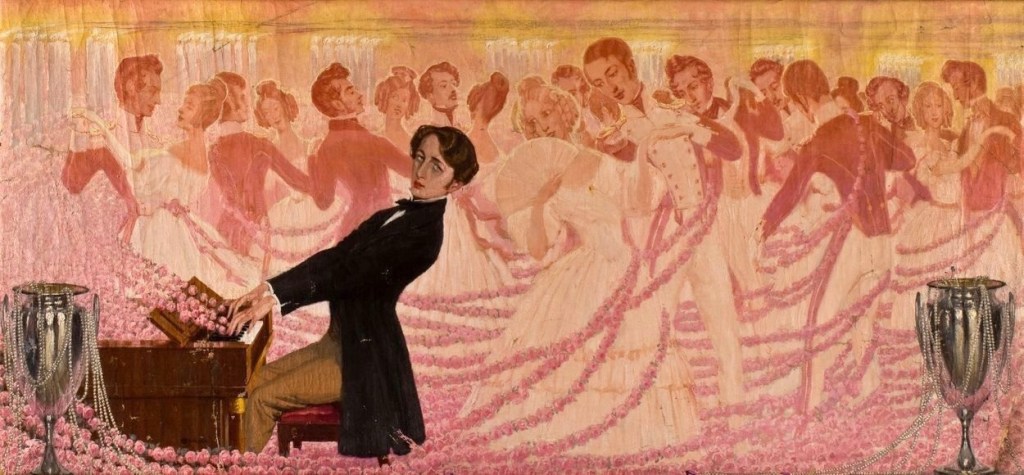
dance to the, dance to the music of Chopin and waltz with me, waltz with me round a nice fantasy keep up appearances sentimentalities backhanded compliments blacking out promises
dance with me, dance with me turning me endlessly waltz to the, waltz to the mockingbird murmuring visitors’ vanities blushing with jealousy echoing, echoing over the wonderful fantasy
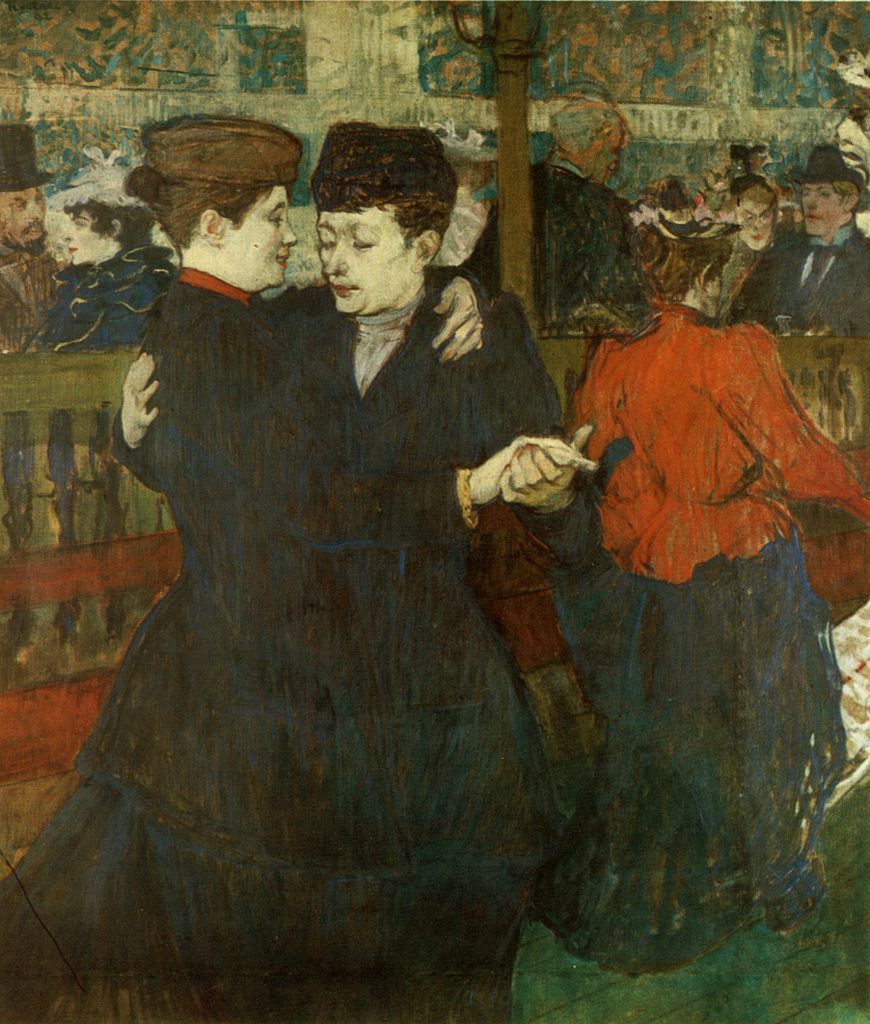
At the Moulin Rouge: Two women waltzing by Toulouse-Lautrec (Wikimedia Commons)
Today’s Meet the bar prompt at dVerse Poets Pub is to take a look at the waltz. I took this as inspiration to attempt a poem in dactylic meter. Dactyls are feet that are three syllables with the first syllable stressed, or long short short like a waltz.
My previous post, the last in my redrafting demonstration, was about emulating a poem or poet. Today, the Poetics prompt at dVerse Poets Pub takes that to a whole new level. Laura challenges us to write a poem either about one of our favorite poets, or addressing a poet in direct voice. I think I’ll take a look at a couple lessons of the How Writers Write Poetry MOOC and see if one of the poets inspires me to write about or to them.
A Temporary Respite with James Galvin
May I share in your antidote? I’ll approach with pleasure pleasure of the somatosensory alphabet that provides temporary respite from knowing we’re going to die
It will be delicious delighting our senses five We’ll get to hear beautiful musics I won’t want just one I’ll want another one I’ll bring passion
I’ll drag it, pulling against a leash like a dog you don’t believe knows or fears death giving us something to survive for giving us a chance to stay alive better
both poems from Poetry Foundation move the center line to the right or left
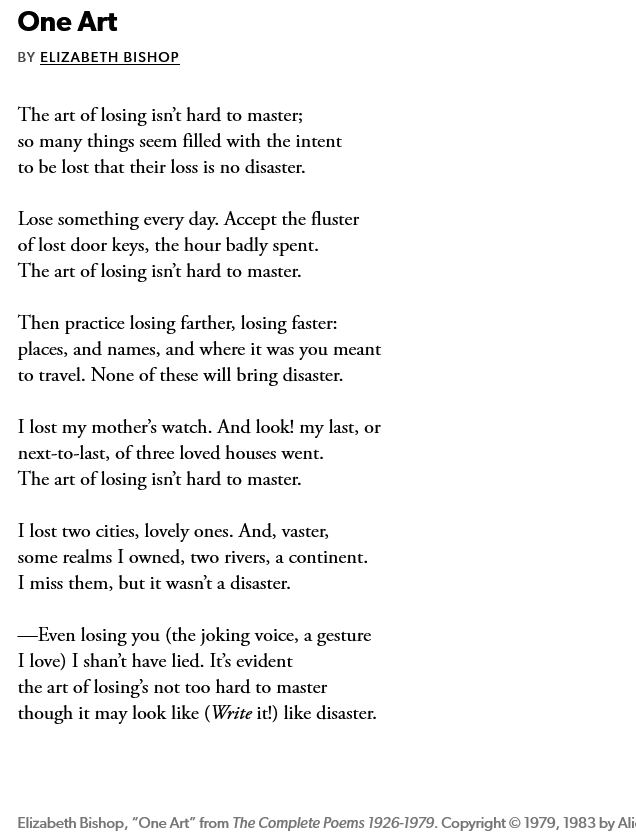
I really enjoyed this example of emulating another poem. John Murillo took the idea of learning to lose and made it his own. Lockward points out that Murillo does more than keep the theme. He uses repetition as Bishop does, repeating the many forms of “lose,” using many words that start with L, and like Bishop, he writes in imperatives as if giving directions.
So one way to emulate a poem is to write to the theme. Another is to make a list of techniques employed by the poet.
My redrafts emulating three different poems
Back in Part Four of this demonstration I announced which poems I had chosen and did some research into the poets. For this exercise, I chose Dead Stars by Ada Limón, Ode by Jane Huffman, and News by Ben Purkert.
So here’s my process for emulating a poem so far:
read lots of poems
pick a few poems I like
research the poets, learn about their process
learn about the poem
What’s next? I need to decide how emulating this poem will improve the poem I’m working on. I’m going to ask myself some questions as I read the poem again.
Ada Limón gives us a clue into her intent and feelings about “Dead Stars” in this video
Why did I choose this poem? I chose this poem because I enjoy the creative combinations of imagery. I was drawn to the mundane becoming philosophical and daring.
What do I like about it? I like the spoken words in italics (not quotes) used twice. I like the questions and what ifs that are somewhat random but make sense because we are all part of the big band, the dead stars.
What technique(s) do I want to try? She uses questions, speech, and of the senses in her details. She creates some interesting double turns/twists in the set up with: It’s almost romantic . . . until you say . . . And it’s true.
How will this improve my poem? I think this twisting language could help improve my poem. My narrator is in a dizzying, swirling, vertigo of facing facts that lead to sudden and life-changing reality, so her language dealing with it could be more twisty. Some dialogue in italics is worth giving a try as well.
Dirty Dishes
In kitchen sinks full of ideas, there’s an impression that even arrests fruit flies Summer’s sandpaper tongue down our throats jealousy, worry, rage all frozen mid-irritation like tinnitus so acute it becomes a wasp nesting in your ear
I am a woodpile of ants in heat: a carpenter of denial
My view telescopes through the broken pane to his sweat on her body behind the bale
I almost believed him as he twisted his favorite cap until he said, A man has needs, but she’s not you
Which is true, but doesn’t mean he didn’t lie when he said it was the last time
The dropped dish shatters like we all do
its pieces, still holdable, I toss into the trash
with my colors, light, hopes and ambition because the glue has lost its flavor and the scissors their artistry
Though broken, I still hunger and itch
the clicking, clacking pieces find junction. How
will I survive without? After indelible marks topple to the tongue?
What if I can ignore and forget? What if he says Stay. Please stay, and I cave.
I didn’t burn the curtains and the bridge?
What would happen if I left with nothing opened, bare, clean of sticky coating
with hope of refreshment in bonding earth nutrients growing, bonding
if I find new understanding wriggling among the moles under the tent of solitude
Why did I choose this poem? I like the repetition and how it builds movement.
What do I like about it? The subtle changes and double meanings of words in repetitions.
What technique(s) do I want to try? The repetition of words in slight rearrangement creates the idea of smaller and larger circles while also talking about small and large circles.
How will this improve my poem? Because my poem talks about swirling and vertigo. I think I can use some of this style of repetition to get some of the spin my narrator is going through to come to life.
Chores
An impression arrests fruit flies. The fruit flies are arrested in kitchen sinks full of ideas. The ideas, frozen in mid-irritation are like tinnitus introducing vertigo. I am dizzy with vertigo. I hear buzzing. I am spinning, spiraling, falling. I am falling. The ground falls away and I am dropping, my arms and my dress fly above my head as I plummet, my pinky toe the stoical point. The pinky toe somehow holds on. Like a pin holding strings connecting to what got me here, to a truth, or many truths long forgotten. That pinky toe pointed, curled and maimed from point-shoes leads the other toes and the foot stepping from the spiral and though dizzy, dizzy and disoriented I see clearly, my view telescopes to his sweat on her body, not hidden by the bale, the dry wasted bale that should have sold, should have fed. I see the clarity distorted in his drops of sweat on her younger body as if finally finding the source of wafting, wind-blown odor of putrid, rotting decay. The putrid decay of our love that had swirled, dizzyingly around until arrested by an impression, here, now, as I stand at the kitchen sink.
Why did I choose this poem? I related to the wind talking and asking my to see.
What do I like about it? I like the juxtapositions creating a different, broader meaning
What technique(s) do I want to try? Again, the spoken words in italics. This time using italics as a shape the wind turns the grass into as well as speech. It’s a great idea. In two quick lines, he turns a believable news fact about sardines into a derogatory accusation.
How will this improve my poem? My poem already has some interesting juxtapositions. What could I cut to make the mind jump? Is there a “news” fact that would paint a picture juxtaposed against an unfounded judgement that would bring the reader to make interesting connections?
The Recall
An impression of fruit flies in furious flight sketches the words, Think. Can you imagine? contentment empties glue of flavor and steals scissors of sharp cuts. Today, Ms. Winters, the Mayor of Little Town was recalled for having a litter in her office Her predecessor was quoted as saying, I told you she could never do the job as well as a man. She wouldn’t stop licking the blood from their heads: blind and mewling in the box. Think. Can you imagine? The hunger says this is dying season and– What indelible marks will topple to the tongue? Like a bridge burner who can’t turn around Maybe refreshment is nothing but moles digging holes under the tent of solitude I will get there, won’t I? To the dark fresh-earth tunnels where scraping, not smoothing, may nourish understanding
Summing up redrafting
There are so many options for redrafting a poem. I’m excited to try some new things when I revise my next poem. For this demonstration, however, we’ve covered a lot. I think the most important thing for redrafting are the questions I asked myself at the beginning:
What are my motivations for redrafting this poem?
What do I like about it?
What don’t I like about it?
If you recall from Part One of this demonstration, I said, “It feels cluttered. There’s too much that isn’t clear. I want to know more of the story, the character, motivations, and conflict.” Toward that end, I think writing the narrative poem was a great first redraft. The opposites game draft, combined with the original then split lines, were the next most helpful generative drafts.
The new redrafting techniques: Thesaurus game and Put a color on it, didn’t influence this poem very much, but they were enormously helpful with some other poems I was revising.
I’m very excited about the new digital tools I found: Poemage and Scandroid. I imagine I’ll have a lot of fun with them as I continue revising my poems.
Now that my redrafting toolbox is overflowing, an important part of the Review process will be choosing the correct tools for an efficient and effective redraft.
Next Steps
I will read over all of my redrafts and let them inform me as I make some decisions about changes to my original poem. Then I will post it to Scribophile for critique.
While I wait for some feedback, I will continue to learn from other poets. I realized, while writing the post about meter, that I haven’t focused as much on listening to poetry as I have reading poetry. I will work on that through the How Writers Write Poetry MOOCs, YouTube videos, listening to the audio on Poets.org, and exploring some poetry Podcasts.
I enjoyed this video of Naomi Shihab Nye talking about revision.
I also liked some of the things that Juan Felipe Herrera said during this talk. He said once you’ve thrown the words on the page, anything else is a new poem. “If you revise a poem long enough, you have a whole book.”
Using the revision process I’ve been demonstrating, I find his statement is so true. This one short poem, the first one of thirty from NaPoWriMo, has already generated thirty new poems! Think of it: if I took each of the new drafts through the entire process so far, I would have 900 poems and then if I redrafted those . . . One of them would have to be good, right? 😉
I thought I would combine the prompts and was mid-freewrite with the ideas, but then something happened. 🙂
Pegacorn leashed by Maria L. Berg 2021
Flying Free on the Slightest Breeze
I ran to save a pegacorn. It happens. I jumped up and ran to my dock expecting to intercept but it surprised me
It didn’t stop. It flipped in a flash, floating on a slight breeze, landing halfway
to the neighbor’s dock It eyed me and its escape one more flip then gone
I sprinted through the weeds ignoring the bushes grown together I found footing over the sharp wet rocks and leaped
over the watery gap to the wobbly planks in time, just in time to grab
that mythical horse’s horn and deliver it to a thankful mermaid ready for a flying adventure
Great Balls of Fire by Maria L. Berg 2021
Here’s the original poem of somewhat combined prompts:
Fireballs Happen
The great ball of fire commands the day burns up the clouds for full display brightens the blues, the greens, yellows, and pinks and heats up the ant invasion
The great ball of firing neurons attenuate to every black speck, ready to hate the second it moves, obsessively out for the kill if only this year it could end
The great ball of fire from ant-filled wood each crackle a hope lifting my mood they burned, they burned the entire glorious day diminished, but never gone
As I admire the great balls of fiery rhododendrons each tattooed blossom aflame in summer, my neurons burn with hope that the bomb of toxins I desperately set in the bathroom will push back
No! Destroy the enemy, so I may some day bake and bathe undisturbed under the great ball of fire in the sky
Looking over my favorite lines from my two upside-down poems in the last post, I started noticing some interesting, slightly altered repetition. But before we jump into the next round of drafts which will get us looking at rhythm and rhyme, I want to share something fun I found.
Poemage
Poemage is a visual close-reading tool developed at the University of Utah for exploring the interaction of sonic patterns in poetry. I downloaded the free beta version, saved my poem draft as a .txt file and put it in the program’s poems file. Here is the Poemage analysis of my draft as it is now.
Having only begun to play with this tool, I can see how it will be useful during redrafting. Here’s the analysis of the vowel slant rhymes in my poem.
I started looking at the purple “EY” words and enjoy how they sound together:
embrace decay, vacated frame remains, erasable spaces may flavor irritation.
That’s a poem right there. Let’s look at light green “EH”:
stepping where refreshment telescopes impression let dress arrest empty heads tent indelible contentment
Not as easily a poem, but I can imagine those words in some interesting rhymes.
Force into form
At the end of demonstration four I talked about the four forms I chose for this demonstration: Trolaan, Synchronicity, Ottava Rima, and Nove Otto. I like using RhymeZone to explore my rhyming options. Let’s get started.
Trolaan This form is made of four quatrains (stanza of four lines) with an abab rhyme scheme. There is also a rule about the first letter of each line of each stanza. I’m going to play with the slant rhymes I identified above instead of exact rhymes for this one.
Body Wriggles an Empty Head
An impression arrests all fruit flies in frame after dizzying dress a spiral of space
No contentment embraces nor kitchen sinks emptied nourish erasable remains or navigate pinky-toe stepping
Obscured by crackling and smoke over the permeating decay onward desire in motion opening curious spaces vacated
Beneath the tent of solitude body wriggles an empty head bone bending, not breaking, ensued both imagination and flavor fed
Synchronicity This form has eight three line stanzas with the syllable count 8/8/2. It is written in first person and has a “twist” in the last two stanzas.
Flavorless Glue and Lost Scissors
cracked, speckled, broken window pane a sudden impression alerts arrests
kitchen sinks full of ideas frozen in mid-irritation stillness
like tinnitus introducing dizzying, swirling vertigo I fall
my view telescopes to his sweat on her body behind the bale the source
flavorless glue and lost scissors leave me hungry, full of desire stagnant
juggled stomach stones clack and click what marks will topple to my tongue? undone
~~~~~~~~~~~~~*~~~~~~~~~~~~~
clean of any sticky coating the bridge burner can’t turn around no choice
under the tent of solitude refreshment wriggles in the dark tunnels
Ottava Rima This form has both rhyme and syllable rules. It is written in 8 line octives. Each line has 10 or 11 syllables and follows the rhyme scheme abababcc
Before stuck by pins
An impression arrests the fruit flies in kitchen sinks full of imagination frozen in mid-irritation we spin insatiable hunger sketches impressions of furious flight before stuck by pins curious spaces for contemplation what indelible marks will come tumbling to the tongue when the stomach is rumbling?
Contentment empties the glue of flavor and steals the lost scissors of sharp-edged blades leaping from dizzy existence, I waver with nothing I’ve left, clean of sticky trades refreshment wriggles under the tent savored where scraping, not smoothing, may nourish new shades having abandoned the house to fruit flies in dark fresh-earth tunnels I find thought alive
Nove Otto This form also has both rhyme and syllable rules. It is a nine line poem. Each line has 8 syllables. The rhyme scheme is aacbbcddc
It all happened so fast
cracked, speckled, broken window pane fruit flies frozen over the drain what marks will topple to my tongue who knows what hateful things I’ll say now seeing through our loves decay the vertigo of years undone obscured by fire’s crackle and smoke his touch erased by rains first soak to dreams of solitude I run
Revise for Meter
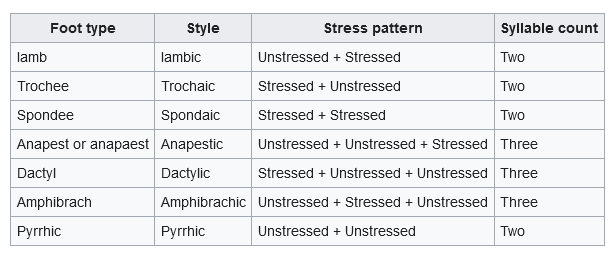
I found more great resources and tools that led me to some more redrafting ideas. First, there are two free poetry MOOC Packs from The University of Iowa’s International Writing Program: How Writers Write Poetry and How Writers Write Poetry II. In Class 5 of How Writers Write Poetry, poets Richard Kenney and Bill Trowbridge present Meter, Prosody, and Scansion in fun and interesting ways. I like how Mr. Trowbridge demonstrates how different types of feet are used to emphasize an image, a metaphor and/or an emotion.
Here’s a chart of the different poetic feet
Poetic Meter (from Wikipedia)
This led me to another redrafting idea. In the book The Ode Less Travelled by Stephen Fry (Yes, the British comedian), Stephen really breaks down poetic meter with tons of examples, starting with the iamb, of course. I took up his challenge to write lines of iambic pentameter and gave a redraft of my poem in iambic pentameter a try. Here’s what I came up with.
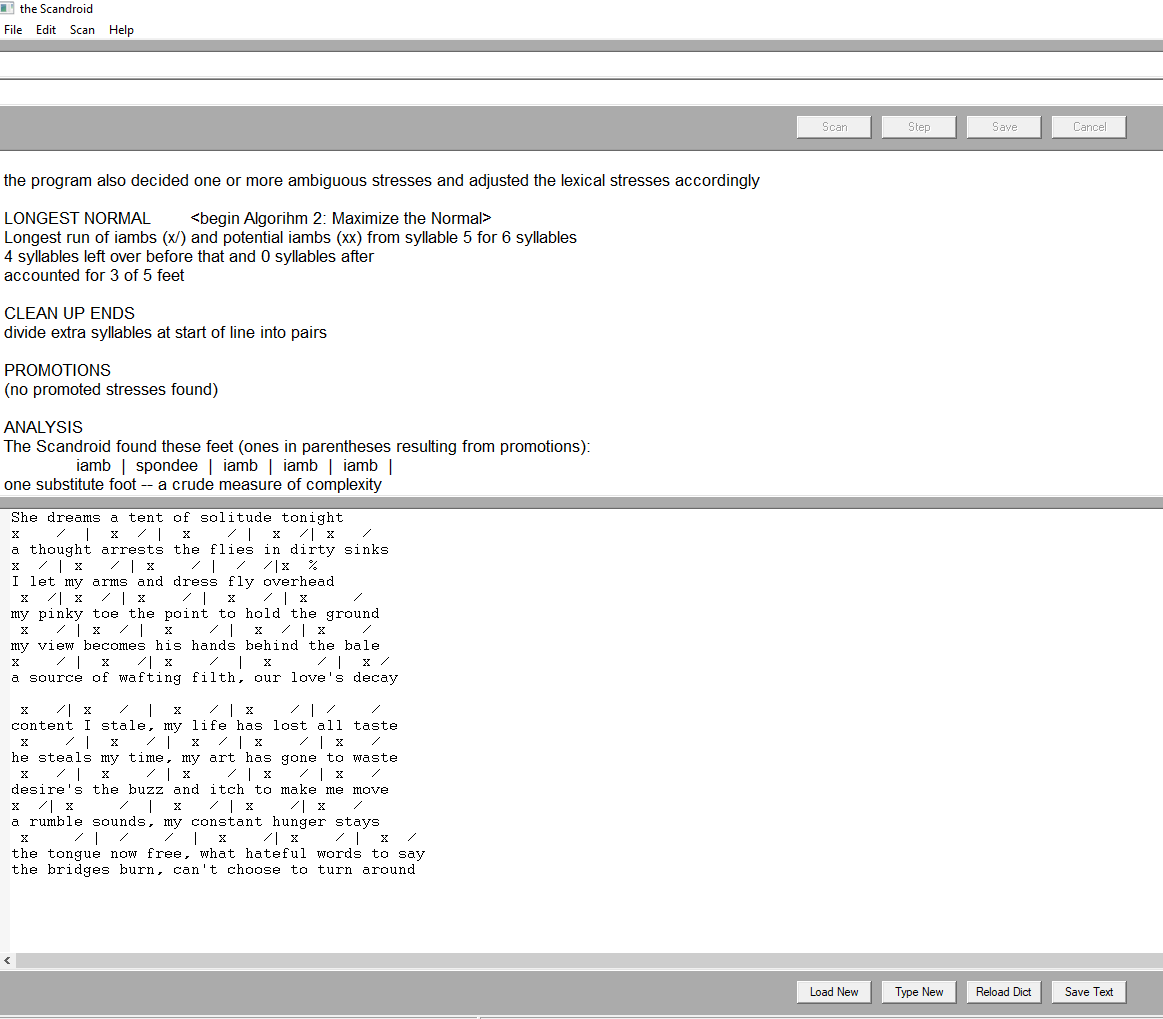
She dreams a tent of solitude tonight a thought arrests the flies in dirty sinks I let my arms and dress fly overhead my pinky toe the point to hold the ground my view becomes his hands behind the bale a source of wafting filth, our love’s decay
content I stale, my life has lost all taste he steals my time, my art has gone to waste desire’s the buzz and itch to make me move a rumble sounds, my constant hunger stays the tongue now free, what hateful words to say the bridges burn, can’t choose to turn around
Scandroid
Then I found something very fun. Charles Hartman at Connecticut College created a program called Scandroid. I downloaded the free program and typed my attempt at iambic pentameter above into it. Here are the results:
My first Scandroid analysis 5-15-2021
How fun is that!!
Next Steps
This post alone opens a world of never-ending re-drafting possibilities. I can see that part of the revision plan during the review will include picking and choosing which redrafting techniques might work best for a certain poem. However, for this exploration of my process, I can see the effect of every step. The next, and final, step I’ll take in the redrafting phase of this poem’s revision is to emulate poems and poets, but I’ll save that for the next post.
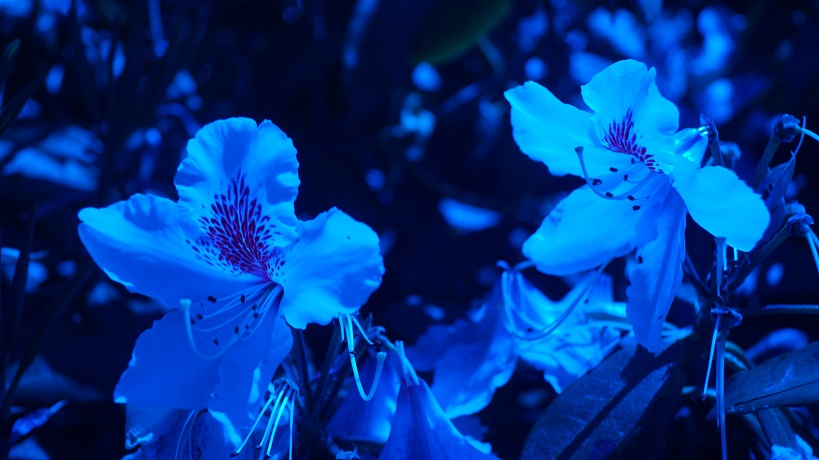
The dVerse Poets Pub prompt for Poetics is Blue Tuesday. Sarah challenges us to write Blue poems which gave me an idea for another redraft, “Put a color on it.” This a great way to think about revising to emotion as well. When you’ve identified the mood and emotion you want your poem to convey, ask yourself what color that is and use that color as a filter for redrafting your poem. The Sherwin-Williams paint colors site is a great tool for exploring color families and color names.
Put a color on it
For this poem, I imagined using a blue lens on my camera and using it to tint my poem. I used some of the draft from the thesaurus game below and made it blue.
Seeing in Blue
An atmospheric perception after the rain in the steam of warm rain captures contrary smoky-azurite wings those wings just can’t agree pulsating rhythmic reflections in a poll the rhythm’s inverted beats in a pool’s still, faded-flaxflower waters
Rapture jammed with glacial conceits fancy whims chilling beneath mid-cloudburst like ebbtide in advance it will advance the tide of the swimming, sense of falling falling, falling into this dive maneuvering eviction from a wondrous whirlpool
The outlook grows lake-water crisp Ow! It bites, clarity after a meditative rainstorm’s punctuation all those taps, droppy drips untimately leads to discovering the fountain, finally find, what’s to find transmitting blissful moonmist
Seeing Blue by Maria L. Berg 2021
I thought of a couple more quick and easy redrafting techniques over the weekend. I am a huge fan of my thesaurus and thought what fun it would be to use my thesaurus to come up with replacements for all of the main nouns and verbs. I’ll call this exercise Thesaurus Game.
Thesaurus Game
Here’s what I came up with using the first stanza of the original short-centered line poem “Indelible Marks” for demonstration:
Permanent Symbols
a perception captures contrary wings flittering in range of a basin’s elbowroom
jammed with glacial conceits mid-provocation like ear-ringing in advance of the swimming, sense of falling, maneuvering eviction from a coil
the outlook grows crisp as if ultimately discovering the fountain transporting pervading corruption saturation
While reading the Back Draft:John Murillo interview, the two versions of “Mercy, Mercy Me” made me think of another, somewhat simple redraft I can do. I can turn it upside down. I think I will add that to my process at the beginning of redrafting.
Turn It Upside-Down
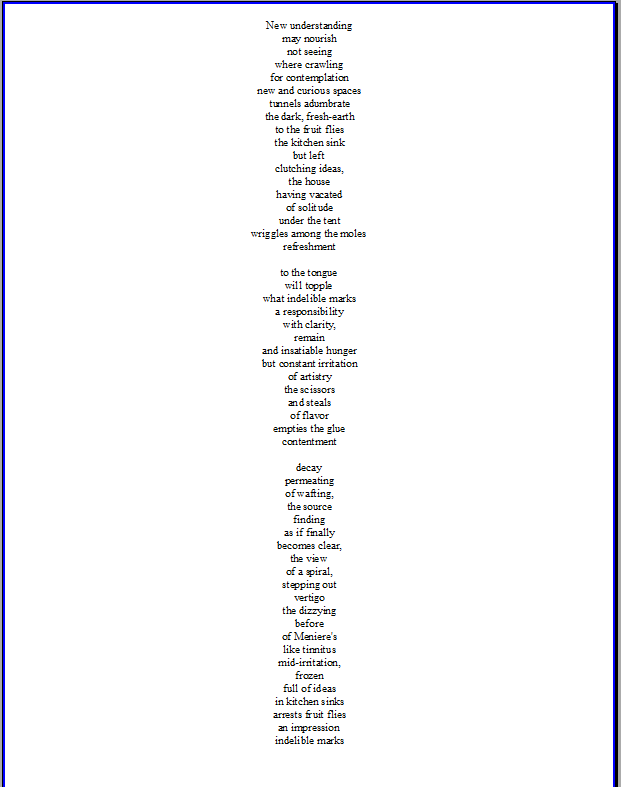
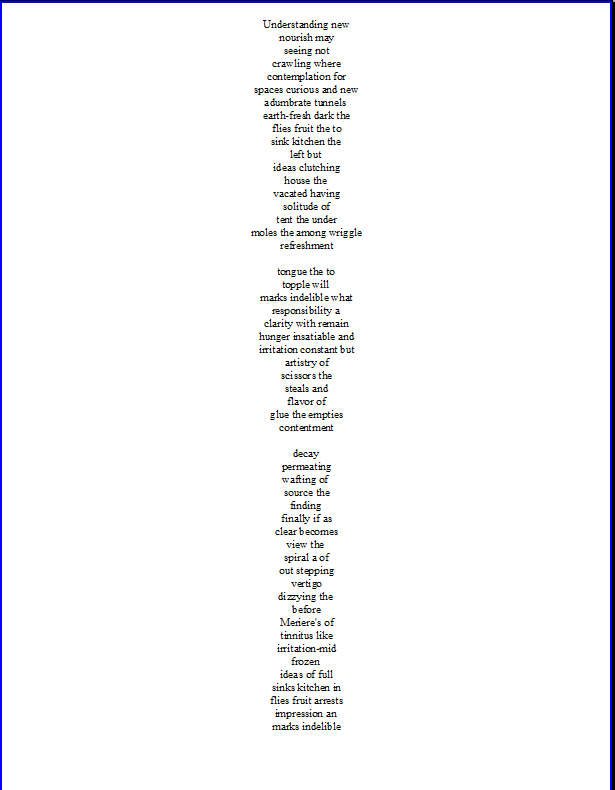
When I took the full, long lines of the current draft and turned them upside down, I didn’t find a lot of inspiration, but when I took the short, centered lines and turned them upside down, I found some interesting lines. That inspired me to completely reverse the words which also revealed some interesting lines.
Drag center line to the right or left to reveal each poem
This comparison block makes me happy! I liked how Back Draft on Guernica was comparing their first draft and final draft poems using JuxtaposeJS, so I created a Juxtapose on the knightlab site, but the HTML wasn’t working with WordPress. I found a work-around which included downloading a plug-in and writing more HTML, and I was planning on trying it for the final poem reveal, but now I don’t have to. Yay for comparison block. Thank you WordPress.








 Experience Writing