I’m not talking about back to school or even the gorgeous turning of the leaves. What time of year is it that I’m so excited about? Gator McBumpypants time!
The manuscript for the fourth Gator McBumpypants adventure is complete and I’m making a new friend for Gator, Herman and Dee Dee.
To share my excitement about the new book, I am having a contest:
Can you guess what kind of animal the new friend will be?
The first twenty people to guess correctly will receive a free digital copy of the new book before the book is released!
I have never tried to play chess, although friends who think they understand me well have recommended it to me. I answered them, “I cannot play with symbols that never change. These bishops, kings, queens, castles, tell me nothing. But if you used figurines like [people we knew], then I could play.” But during the […]
Today, I have been enjoying Alec Nevala-Lee’s posts about the sci-fi connections of Isaac Asimov, John W. Campbell, and L. Ron Hubbard. I have a special friend who is intrigued by the history of L. Ron Hubbard so I’ve been talking about Alec’s posts all day.
Imagine my surprise, when during my own wordpress drafting, I noticed the post above.
When I designed wooden jigsaw puzzles for Artifact Puzzles, it made sense to me that people who liked difficult puzzles might also like chess. I started searching for interesting images with chess involved. I was surprised to find few.
I had big dreams of making a puzzle so that the pieces cut could be used as a full chess set. It didn’t happen, but if you bought a bunch of my puzzles, I’m sure you could play a good game of D&D.
Just now, I went and looked up my puzzle that I put chess pieces in and I’m giggling because one of the comments is so good . They called me a little stinker! Who gets that kind of praise?
I did a lot of Matisse research for my little Matisse puzzle, but it didn’t have anything to do with chess. I love that he did stained glass which is also one of my interests.
I recommend that everyone enjoys Alec’s writing and Artifact Puzzles
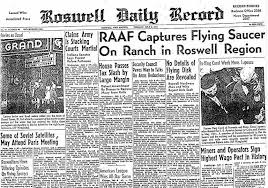
Sadly, I wasn’t able to lift images from Google News Archives. Here’s a pic of the original 1947 report of the Roswell Flying Saucer.
I recently received an email from nanowrimo nudging me to start preparing for this year’s novel. I have had my idea since April and decided to start doing some research. After coming up with very little on the internet, I found myself longing for easy access to world newspapers.
At my local library’s website, in the digital library section, I clicked on magazines and newspapers. In that list I found Google News Archive . You do not need to be logged into the library to access the archive.
If you type a topic into the search bar at the top of the page, you get a list of related articles from their thousands of scanned newspapers.
This morning, I asked a friend what he wanted to read about and he wanted to see the original article about the flying disc found in Roswell, NM in 1947. I typed in 1947 flying disc and got a bunch of recent articles about debunking the Roswell find, so I tried again.
This time I only typed flying disc which brought up The Independent, St. Petersburg, Florida, Wednesday, July 9, 1947. The headline read “‘Flying Disc’ in New Mexico Turns Out To Be Army Weather Device.”
After reading the article, my friend said, “After all these years, now I’m finally convinced.” Wink. Wink.
And the fun did not stop there. Just one column over, there was a small article about how UFO fever spread to Iran. Bright lights were seen in the sky that then exploded (secret weapons test?).
A blurb next to that said “Pennsylvanians Here” and went on to give the names of a couple and their children that came into town on the train and included the address where they would be staying. Next to that was another blurb entitled “No General Name” which informed me that the Tunguses of Siberia do not have a word for reindeer, but like the Eskimos and snow, have many words for specific types of reindeer like tame reindeer, wild reindeer and young reindeer.
I continued exploring this one day in 1947 and found:
Instructions on how to iron three different kinds of rayon
A wedding announcement for a couple married in Seattle
Lists of names of people staying at hotels and resorts
More announcements with names and addresses of people visiting
A picture of two girls at the piano with the headline “Cousins Enjoying Visit Together”
A fraternal order I had never heard of: the Knights of Pythias
the vitamins in cantaloupe are A and C
sauerkraut juice is good with dinner
The schedule for radio shows
Movie ads
Then I found “Husband Held in Los Angeles Silk Stocking Murder” that after talking about Mrs. Mondragon being strangled with a silk stocking lumps in the fact that she is the eighth woman brutally murdered in six months in LA including The Black Dalia. Honestly, this day in 1947 has everything.
I foraged only one day of one newspaper. Imagine what you can do with thousands of days of tens of thousands of newspapers. I hope you find this resource as exciting as I do.
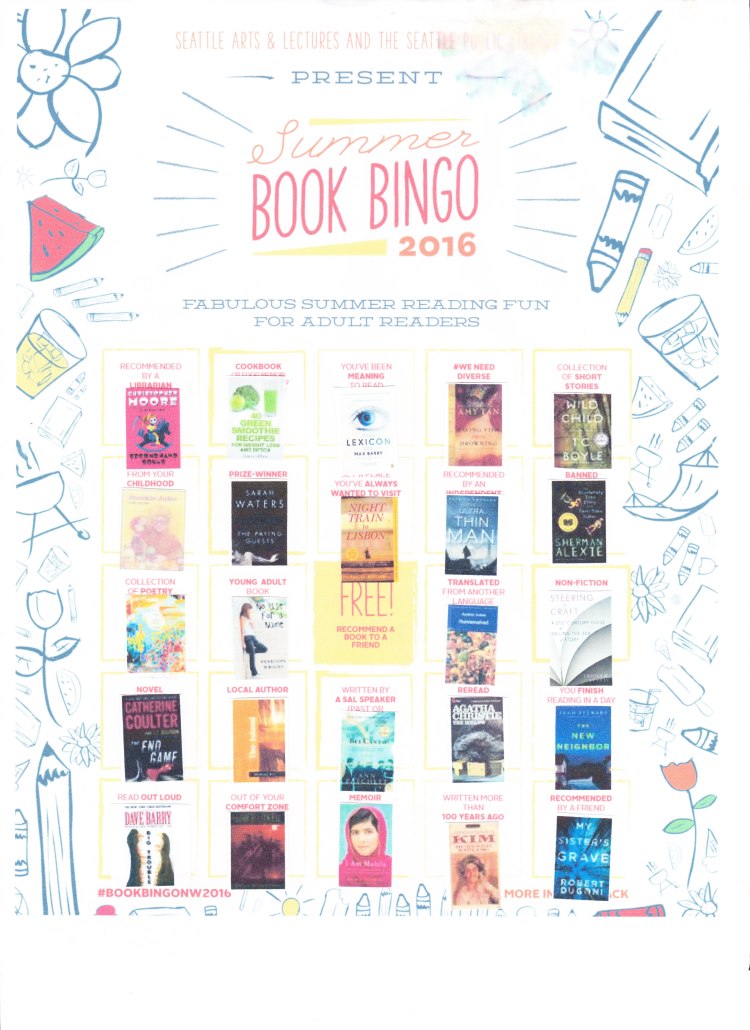
Last post I mentioned that I took on the challenge of Seattle Public Library’s Summer Book Bingo. It took some serious binge reading, but I finished and read an eclectic array of books that I am excited to tell you about.
Recommended by an independent bookstore The Ultra Thin Man: A Science Fiction Novel by Patrick Swenson- I met Patrick Swenson at an author talk at the Sumner library. At first, I found the chapters switching from third person to first person confusing, but once I got used to it and got into the story, I really enjoyed this space adventure.
Young adult book No Use For A Name by Penelope Wright – I met Penelope Wright at the Pacific Northwest Writer’s Conference. I enjoyed this book, but would have enjoyed it more if I wasn’t concerned for young readers reading this subject matter. I wouldn’t feel comfortable sharing it with teens I know.
Translated from another language Hurramabad by Andrei Volos
Read out loud Big Trouble by Dave Barry- this was a fun read on a car trip to California. I am a big fan of Carl Hiaasen and his influence is very apparent.
Out of your comfort zone Midnight in Ruby Bayou by Elizabeth Lowell- this was more romance than I usually read.
Recommended by a friend My Sister’s Grave (The Tracy Crosswhite Series) by Robert Dugoni- Robert Dugoni was the featured speaker at PNWA16. He was a moving speaker and I really liked this book.
The last three books I read took me on an interesting trip through Central Asia
The Seattle Public Library’s Summer Reading Bingo has been a great inspiration for me to finish a lot of books on my 2016 reading goal list and a lot more. Each square of the board, for those of you not playing along, has a specific kind of book you need to read to fill in a square.
On my quest to blackout their bingo card, I read a memoir, a book that was written over 100 years ago and a book translated from another language. It turned out that the memoir my mother gave me about a year ago was I Am Malala, the book I had from over 100 years ago was Kim by Rudyard Kipling and the book I bought, because I liked the blog a year of reading the world, but I hadn’t read yet was Hurramabad by Andrei Volos.
I didn’t plan to read these books in the order I did and as you will see in my reviews, probably wouldn’t have read all of them without the inspiration of the Summer Reading Bingo Card, but I feel like the coincidence of the connection and the story of the three books is interesting enough to share.
It took me a long time to get past the first few chapters of this book, but I am very glad I did. The second part of the book is about the rise of the Taliban in the Swat area of Pakistan and the events that led up to Malala being shot. This section is full of important historic, religious and cultural information from the point of view of the people living it every day. I recommend the middle section of this book to everyone.
The back of this book says “Magical, mystical, bristling with danger and excitement. . . . I claim shenanigans! That was false advertising–yes, it might have been very exciting in 1911, but that back cover of my paperback was written in 1984, so they knew they were lying. The book has many interesting things to say about the history and culture of India, but it is so boring and full of polite and impolite dialogue that if I hadn’t needed to read “a book from over 100 years ago” for Summer Reading Bingo, I would have gotten rid of it. That said, I am glad I read it directly after I Am Malala and before Hurramabad because that made for interesting mental travels.
This book is amazing! Written as a series of stories about the people of a town called Hurramabad in Tajikistan, it takes the reader into the daily lives, thoughts and troubles of a few specific characters. When I finished the chapter called “A House On The River”, I said Wow aloud to my living room. All of the stories are about leaving in one way or another, arriving at the message that we are foreigners wherever we are. I recommend this book to everyone.
Why is this grouping read is this order interesting to me?
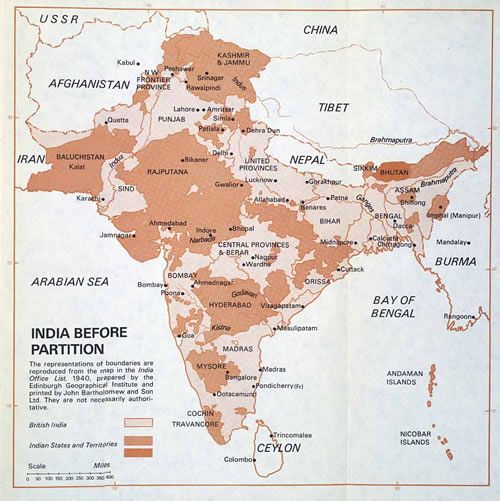
Because Malala’s story mentions that Pakistan was not so long ago a part of India and if you look at the map of India from 1940 it looks like this:
The map of India that includes Pakistan bordering Tajikistan.
This map might be close to what Kim traveled. The hills in the north that he visits could very well be lands that Malala talks about and are mentioned in Hurramabad. All three books talk about joy of nature, being a stranger in one’s own home and the horrors that humans have done to one another over and over again.
One thing I did get from Kim by Rudyard Kipling was the message of life on the Wheel and not on the Wheel. The idea that life keeps repeating until you learn, until you find a better path (are enlightened). These three books tell the tale of the Wheel and how humans can’t seem to stop being horrible to each other.
From over 100 years ago to now this minute issues of misinterpreted texts, are brainwashing people into horrible, even murderous behaviors and I am so glad to not live in a place where I could be shot for going to school, or murdered for making a house, or beaten to death for being a woman walking without a family male escort. My poor brother wouldn’t ever get to work; he has a wife, a daughter, an unmarried sister, a mother, a niece. How would anyone ever do anything?
I have thinking to do. I want all people to have free education and never be misinformed by the selfish wants of powerful leaders, or gun-holding murderers. I hope Malala will some day return to a peaceful Pakistan and the people of Russia and Tajikistan will call each other brother and no longer live in poverty. Mostly, I wish that all Americans will take advantage of their freedom and read and learn and discuss. Stop being cruel to each other when you have everything, more than everything.
As a person who was in the Peace Corps in a small village, The Ivory Coast, West Africa I have to say: Imagine yourself spending your days not letting the fire go out because if you did, you couldn’t eat or even have tea. You might look at life differently.
Happy Education Everyone!
P.S. It was easier than I thought it would be to transfer my Goodreads book reviews to WordPress. You just have to copy the html of your review on Goodreads then switch to html view in your draft on WordPress and paste it in. When I switched back into Visual view I chose to erase the link that said “See all my reviews” and then went to my next review, copied the html and switched back to html view in WordPress and pasted it after the first one. Hope this inspires those of you who haven’t tried it yet. I’m sure I can make the reviews have stars and make the images larger, etc. with just a little html. There are guidelines on Goodreads just above your review box. Hope this helps others who haven’t tried yet.
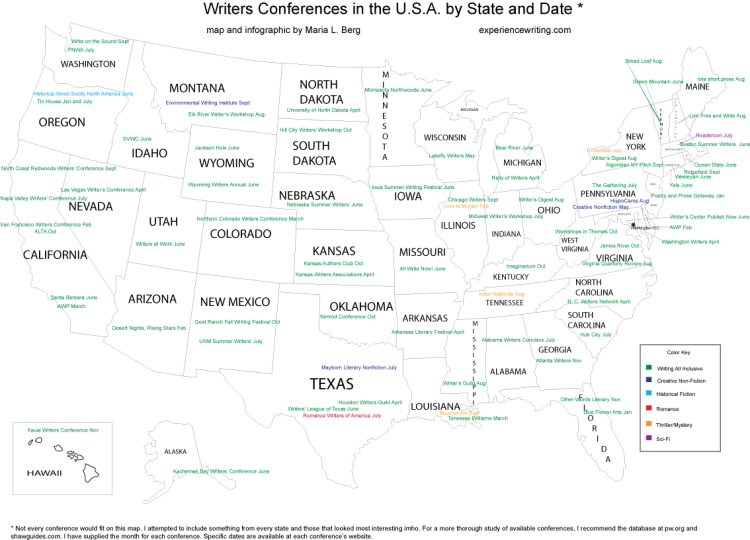
If you would like me to add your favorite writers conference to the map, please let me know.
I wanted this map, it didn’t exist, so I made it. It took a little extra time, but I created what I wanted and there is a lot of information there. Enjoy (and site me).
Last post, I went into detail about some of my favorite aspects of The Pacific Northwest Writer’s Association Conference. Now, I want to speak more generally to what you can get out of going to a writer’s conference. The main point being dive in and buy your ticket as soon as you can.
For a first time author, or someone only starting to write their first novel, a writer’s conference is a huge decision. There are a lot of costs to consider, not only monetarily, but emotionally, and physically. So that brings us back to my final notes from my last post:
Was going to PNWA16 worth the time, money and stress? Absolutely.
Let’s go into the details of why:
Meeting other writers – Everyone is at the conference for different reasons, but they all have one thing in common, they write.
Many writers spend the majority of their time alone and avoiding social situations. Spending time with others might be in critique, or in fear of critique, so the idea of a conference feels like throwing oneself to the slaughter.
Okay, I’m talking about me. I almost didn’t go. I imagined myself hiding somewhere. If I hadn’t made myself responsible by volunteering, I most likely would have excused myself and psycho-somaticly died of the plague. The moment I walked in, however, I didn’t feel a moment of nervousness. Not a moment of disrespect or why is she so weird or they are talking about me or why does she have that look on her face. I felt accepted, wanted, interested and interesting and it was AWESOME. I did what I needed to do and it turned out that I was good at moderating sessions. I made others feel strong and good about themselves. That is a great feeling.
Many of the sessions at writer’s conferences are about creating your writers platform on social media. I had done everything I could for my Gator McBumpypants books, but I had one true fan for my efforts (totally worth it) and it was the daughter of a person in my writer’s social group, not anyone from my social media efforts.
Social media is way more fun when there are real people you met and care about to read your messages. Who knew that a romance writer might be my best twitter friend and the Seattle Library Summer Bingo would turn summer reading into crazy discussion? Suddenly I want to be there when before it was a terrible chore.
Also, it is a great way to meet people who will look at your work before you send it out and let you help them with their work which is a wonderful honor.
Pitching to agents and editors –
This was definitely the most stressful part of the conference AND the reason I was there. I thought it was the only reason to go to a conference and had prepared for my pitch for over six months.
I was surprised to find people that were there and didn’t pitch. Those people have a year up on me.
I was prepared. First day, I walked sheepishly into a room that said practice pitching. It was a round-table of people talking to each other, sounding very knowledgeable while waiting for me to get my nerve up. None of them shared their pitches. A wonderful older man joined us and shared his pitch.He had a good story, but it wasn’t a pitch. He was appreciated and given good feedback. I felt ready. I volunteered my pitch.
I was given praise. I was not asked much in the way of questions. I was told my pitch was awesome. I thought I was ready. I had prepared correctly.
I was not ready.
My months of research and all the nice people couldn’t prepare me for my pitch session.
I thought, I was told I’ll see four to six agents today, I’ll probably see everyone who’s interested in my work. I want to see these agents first, then I will go through the best on my list. From what I was told, I had the impression I might see everyone I wanted in one session.
I got shut down. I felt like I was hit by a truck.
Again. If I hadn’t volunteered to moderate sessions which was stressful, I might have given up and crawled under a rock and died. But somehow, the writers sitting in chairs upstairs where I sat down to decide if I could take another second of thinking I am a writer or should just give up completely were so kind and accepting of my little breakdown, it was like all the horror never happened because one had been through worse and one wasn’t ready to try yet. So, you know, you have to get ready for tomorrow. They helped me decide to stay for the evening presentation. By the time dinner was over, I was ready to try again.
My point is, I thought I had made all the wrong decisions, but I hadn’t. The first day I found out who wasn’t my match and the next day I was ready for the questions that come after the practiced pitch like : Why did you write this? What happens next? What is special about your protagonist? And the best question I got all conference: So how does it end?
I didn’t get to the rest of the wonderful reasons why you should think about going to a writers conference in this post, there is too much to talk about and I have too much reading and writing to do, but I am happy with my info-graphic of possible conferences to think about.
Chuck Sambuchino wrote a great post about choosing a writer’s conference over at The Write Life
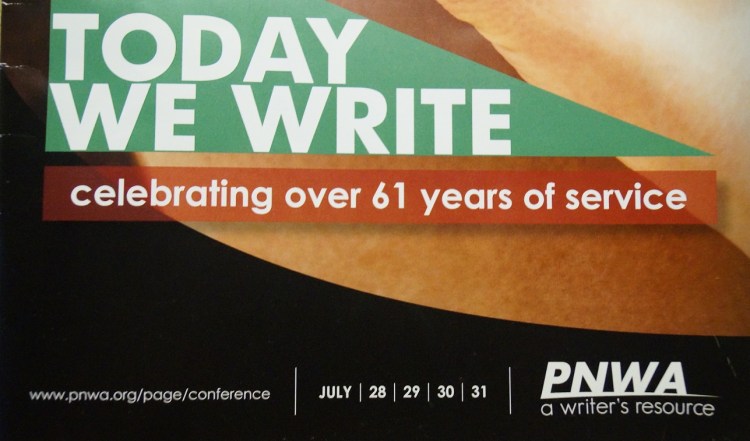
Last weekend I attended my first writers conference, The Pacific Northwest Writers Conference in Sea-Tac, Washington. I learned so much at this conference that I decided to write a few posts about it. To start with, enjoy reading about my favorite events at the conference.
When I talk about moderating a session I mean, I took the opportunity to volunteer to help as needed and was assigned to moderate some of the session. That means that I got to meet and introduce some of the speakers. It was stressful at first, but went very smoothly thanks to Jennifer Douwes and D.C.C. Mealy. They kindly welcomed me, answered my questions and showed me the ropes.
My favorites from the conference:
The featured speakers (dessert/dinner)
The first night, Robert Dugoni was the featured speaker. I read his book My Sister’s Grave in preparation for the conference and really enjoyed it, so I was excited to hear what he had to say before he even started. His speech was moving (I was shocked to hear he had recently had a stroke) and inspiring (the twists and turns of his writing life). He repeated two main themes. First, “It’s just stuff” which I took to mean, don’t write to obtain things but to write the very best book you can every time. Second “Hello, writing my old friend” which to me said, though life has its twists and turns and roller coaster ups and downs, a love for writing doesn’t go away.
The second night there was a sit down dinner with a panel of featured speakers, so I wasn’t sure what to expect. I had read The End Game by Catherine Coulter in preparation, but she wasn’t there. What did happen was Robert Dugoni posed unrehearsed questions to C.C. Humphreys, Steven James, Sheila Roberts and Gerri Russell. Most of the questions were about their writing process and careers. I really enjoyed the variety of personalities and viewpoints. There was a lot of banter and laughing and the vegan entree was even edible. What a night.
The Importance of a Strong Synopsis
I was worried about moderating this panel because it was first thing Saturday morning, directly before my pitch block, and I would be introducing four agents and collecting and reading all of the synopses. Luckily, the agents were happy to introduce themselves and were game to pick and read the synopses. Whew!
Like at dinner, the variety of personalities and viewpoints made this a great panel. I loved the discussion that arose from each synopsis read and the variety of the examples. It really drove home the point that everyone’s story is different.
Ask An Expert: Thriller/Mystery
I’m very glad I volunteered to moderate this panel. Though it took a little while to get the questions rolling, I thought the questions asked spurred a great discussion. Editor Anna Michels (pronounced Michaels) of SourceBooks brought a great perspective from the publishing side to balance the two experienced and interesting thriller authors: Award winner and previous nuclear engineer Mike Lawson (I’m enjoying reading House Secrets) and New York Times bestseller and Jeopardy! champion Boyd Morrison. When I was researching the panel to prepare to introduce them, I was excited to see that Boyd and I have something in common–We both worked for NASA.
My uncle got excited when I told him Boyd writes with Clive Cussler. He says he’s a huge Cussler fan. Now he knows he’s a Boyd Morrison fan as well.
Take a month to save a year
Royce Buckingham‘s presentation held a very useful message. Not every idea we have is our best idea. Even the most prolific writer can’t write every idea they have. Save yourself time and test your ideas before you throw yourself into writing them. Tell your story ideas to people you think could be your audience/market. He mentioned pitching your story at parties as if they are the latest blockbuster movie you just saw. See which idea people get the most excited about and write that one. He recommends talking to at least 100 people before you get started.
Dancing with the stars: How to Connect with Celebrities for a Book Blurb
Chelly (pronounced Shelly) Wood also had some great, unexpected advice. Her presentation was about how supporting charities you are passionate about can help you network and enhance your author platform. I love this idea and am surprised how eye-opening it was.
Her message is that you don’t have to work for the charity, or donate a bunch of money (unless you have a bunch of money to give away), you can show support in other ways. You can promote charities on your website and social media to make others aware. You can volunteer for an event. You can donate (small) percentages of sales, etc.
Her further message is building your platform is all about asking what can I do for others. Get creative: Can you promote a local business that is related to something in your book? Can you invite a guest blogger who writes about something interesting in your book, not specifically the craft of writing? Or offer a guest blog for them?
Chelly designs doll clothes and gives away free patterns at ChellyWood.com
Was going to PNWA16 worth the time, money and stress? Absolutely and here’s why:
Meeting other writers
Pitching to agents and editors
Learning more about the craft
Building a better author platform
Putting the work in perspective
I’m going to write more about this next time. Don’t forget to follow this blog and sign up for my monthly newsletter. You know, free fun stuff for you!
You have so many links to follow and great writers to read from this post, I think you’ll be plenty busy. If not, below are links to other people who attended and wrote about the conference.
I recently read The Hollow by Agatha Christie and one simple but unique description jumped out at me.
“He came in accompanied by Inspector Grange, who was a large, heavy built man with a down-drooping, pessimistic moustache.”
I love the idea of pessimistic facial hair and it really got me thinking. What other isms could be paired with body parts to make unique descriptions? I started a list of isms to join pessimism: optimism, skepticism, nihilism, liberalism, etc. I also wrote a list of often described body parts: cheeks, eyes, lips and so on.Once I exhausted my own ideas, I did a little hunting on line and found some useful sites for more ideas. For isms check out The Phrontistery. I printed out their amazing list of philosophical isms and their definitions. For a list of cliché body part descriptions head over to obsidian bookshelf.
The game
So how do you play The Pessimistic Moustache Game? To start, one player has a list of body parts or other physical descriptions (e.g. gait, scar, laugh, etc.) and the other player(s) has the list of isms. The person with the body part list chooses a body part and says it out loud. Then the other player(s) has to match it with an ism to use as a descriptor. The person who chooses the best ism for the body part gets to choose the next ism and the other player(s) matches it with a corresponding body part.
You can add another dimension to the game by printing out pictures of people to inspire the descriptions though that might limit the responses.
My experiences
To date, this game amuses me to no end. I find the exercise challenging and every match makes me laugh. Has it improved my writing? Have I found the perfect new way to create unique descriptions? Maybe not, but I’ve only played with one other person so far and the possibilities are endless. It sure does make me laugh.
Further development
A couple days ago, I was reading In the Beauty of the Lillies by John Updike and found another very interesting phrase.
“. . . its heavy sweet smell rose around him possessively . . .”
I hadn’t thought of a smell being possessive before. And if a smell can be possessive, why not someone’s fingernails, or lips? The list of isms could definitely be expanded to include other conceptual adjectives that one would not usually attribute to body parts.
Then there is also descriptions of sensations (like smell) and perceptions. The Pessimistic Moustache Game could include matching senses to isms. What is the smell of materialism? What is the texture of postmodern feminism?
I hope you enjoy playing Pessimistic Moustache and it gets the neurons churning while you laugh and laugh. Please send me your favorite matches in the comments, so all my readers can play along.
While preparing my next newsletter, I noticed that my last one had a bunch of great information in it. I don’t want anyone to miss out, so here it is to give you a taste of what goes into my newsletters. If you like it, please sign up to get monthly installments and your free copy of Read to Write: Conflict and Suspense.
So many places to post content. Make it good content!
Give your readers what they want how they want it
No matter what you are publishing to the web, your readers are going to read it differently than they would a book or other type of written media.
Studies have shown (Nielsen 2006) that people tend to scan web content. They look at the title, subtitle and first paragraph and then quickly scan to the end. This has led to two ideas of content design:
Both ideas work together. The F-shape design emphasizes grabbing your reader’s attention with an exciting title, an informative sub-title and summarizing what you are going to talk about in your first paragraph.
The upside-down pyramid is a design where you put the most important thing you want to say (or the conclusion) at the top of your post and make sure everything that needs to be read is on the top two thirds of the page.
Make your content sexy
Sexy content has nothing to do with sex (unless you’re writing erotica). It’s all about reader appeal. What makes someone look at your page of content and think, I want to read this? White space.
White space? Then why write anything, right? No, the blank page isn’t sexy. The sexiness of white space is the breath between ideas, like a rest in music creating suspense.
To create white space in your content you can use:
titles
subtitles
bulleted lists
numbered lists
infographics
images
tables
videos
links
In other words, anything that provides useful information and breaks up the text.
Accessibility
For me, one of the most interesting sections of learning to write for the web was the discussion of accessibility. When scrambling to finish a blog post, or in the excitement of posting a video to youtube, it is easy to forget to make our posts inclusive to as many people as possible.
When posting blog posts and videos in the past, I put very little thought into the image descriptions and alternate text. I didn’t really understand the purpose off these extra steps. But they have a very special purpose.
Imagine that you can’t see. How would you know what the image looks like that the blog post references? The digital voice on your computer would read the description of the image.
Now imagine you can’t hear. The website you are looking at has a great video, but you can’t hear a word the person is saying. Adding text to your video gives this reader access.
Spending just a little extra time with accessibility tools can enhance your content and increase your readability.
SEO: Titles and Key Words
Search Engine Optimization (SEO) has become big business. It is how websites, blogs, people, anything, is found through a search engine on the web. Increasing your SEO may increase your readership. How do you increase your SEO? By using the key words your readers are searching for in your titles, key words and content.
Overwhelming, right? Not anymore. Last month you learned about creating personas. You spent time researching and getting to know your readers. Now, ask each persona, What did you type into your search engine (maybe assign a different search engine to each persona–Fred uses Bing, Jenna uses Yahoo, etc.) to find this content?
This exercise changed my ideas about key words. When I first started blogging, I listed my key words for a blog post one word at a time, but when I search for things I very rarely type one word searches. Pay attention to how you search the web. Try to image yourself searching for a topic and finding your website or blog. How did you get there?
Making sure that your titles, subtitles and phrases in your content all include your key word phrases will increase your SEO.
Take Away
Even if you have taken the time to write and edit the most interesting, well-written content that you know your readers will love because you did the research and took the time to get to know your readers and your competition, you still need to present your content in a way that will appeal to how they read on the web.
Learning new words can be like discovering a new tool that makes a tedious task simple, or tasting a delicious flavor never sampled before.
I love to learn new words. When I come across a new word I enjoy or relate to, I collect it in my writing notebook in One Note and when I update my website, mbercreations.com, I include a new word on my inspiration page. I follow a couple of great word blogs here on wordpress.Sesquiotica by James Harbeck and WordBowl by Ms. Charlie Schroder.
A new vocabulary writing exercise:
A while back, when I was reading House of Leaves by Mark Z. Danielewski, I collected many words and brought my finds to my writing group. We decided to do a writing exercise in which we incorporated our favorite new words from my list into a short piece of fiction. I had been mulling around an idea for a sci-fi story for a while and decided to use it for this exercise. Just for fun, I used all of the words from the list that I could and found some more to create a short beginning to that story. I really enjoyed the exercise, but my piece was most definitely over the top and I put it aside while working on other things.
Revision: Deciding what to keep and what to change.
Recently, I decided to revisit this story for a class assignment hoping to continue to develop it, perhaps finish it, during the class. I expected to simply go through the less familiar words and replace them, but a number of them turned out to be the strongest choice. I didn’t find better words than tessellated and protean to describe parts of my monster rising from the sea and tenebrific truly describes the quality of its shadow. So some of the words I learned from the exercise stayed, and in my opinion began to define the voice of the narrator.
Disappointing feedback gets me thinking.
Imagine my disappointment when the feedback from my peers (three reviews) came to one consensus: they did not appreciate my word choice. The most complimentary said the words were too “technical” and another stated he did not like to look things up in a dictionary while reading. If not while reading, when?
The course is online. The readers are online while reading. How hard is it to split-screen with dictionary.com? Learning new words is easier than ever and people taking a writing class acted as if using a word that was unknown to them was some sort of personal affront. Pareidolia is a great word. If I saw it for the first time, I would be excited to look it up.
The words I used are not archaic or abandoned. They have unique meanings that clearly state what I mean to say. Should a writer be expected to limit her vocabulary? Why shouldn’t she expect her readers to rise to the challenge? Why would a writer limit his joy of language in fear that his reader doesn’t know the same words he does and won’t pick up a dictionary?
How could anyone who wants to write fiction not want to explore every word and its many uses? Isn’t limiting one’s vocabulary to fit an imagined understanding, condemning readers to a truncated experience? Isn’t it wiser to assume a love of language and use all of the tools and weapons at hand?


 .
.
 Last post I mentioned that I took on the challenge of Seattle Public Library’s Summer Book Bingo. It took some serious binge reading, but I finished and read an eclectic array of books that I am excited to tell you about.
 and his influence is very apparent.
 by Sherman Alexie. If you have already had the pleasure of reading it, I recommend
  by Pascal Mercier.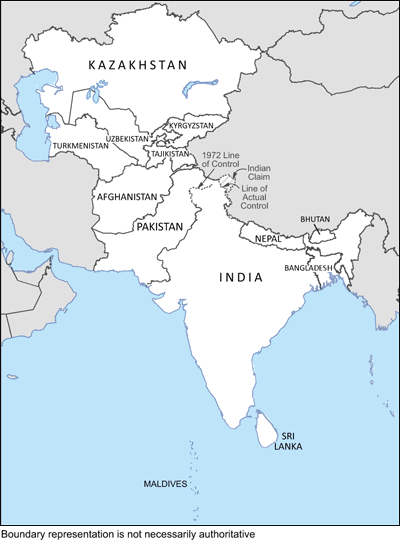





 Experience Writing