Sorry I was away so long. This summer is turning out to be especially busy. But let’s dive back in with a Quadrille. Today’s prompt over at dVerse Poets Pub is to write a Quadrille (a poem of exactly forty-four words) that includes the word “pop” in some way.
Anticipating the Balloon’s Pop
Anticipation fills a thin skin like hot breath in a party balloon As it grows and grows (slowly at first) it pushes in every directions Its expansion creates pressure (growing painful pressure) stretching, warping, weakening until—POP! It deflates, releasing disappointment and possibly joy
I really like the design for the poster and flair by artist Elizabeth Goss.
I’ve been on a bit of an unplanned hiatus. But the fourth of July was lots of fun, the family and guests have left, and it’s time to get back to work. Since I’ve been having trouble focusing on novel revision, I decided to sign up for Camp NaNo this month for some extra motivation.
It’s not too late to set a Camp goal for yourself, and participation is free!
Camp is similar to NaNoWriMo except you set your own word count goal. Word count goals aren’t exactly conducive to revision, so it’s up to the writer to decide how to set up the word count to be equivalent to time spent revising, and how to keep the goal motivational.
I found other writers that are revising during camp and joined a group to motivate each other, and talk about how things are going.
I have set up my manuscript in Scrivener, so I decided that every hour spent working in Scrivener is equivalent to 500 words. And set a goal for the month of 60,000 words. That would be four hours of revision every day of the month. However, I’m also keeping up a daily writing streak in 4theWords. So how can I make it also work for revision?
For a while now, I’ve been using 4theWords for my morning pages, or “daily freewrites” as I call them. It’s surprising to me how motivational just typing in my random thoughts and daily goals can be. But I also want to use the program for my revision. I’ve set up lots of exercises for character interviews, and exploring character arcs, and for thinking through the big picture questions for the re-write. When I’m ready, I think I’ll start a new project in 4theWords and write a complete second draft from scratch. I can then add my word count from the exercises and re-write to my daily word count bringing the time of revision in Scrivener down to a more reasonable two to three hours.
There are also forums in 4theWords where people trying to revise can discuss how it’s going. So through both programs there’s plenty of support and community if I need a break, need extra motivation, or just need to socialize a bit.
Other than the two days I took off for the Fourth of July, Camp has done what I hoped it would do. It has motivated me to look at my manuscript every day and put the work in to see what’s really there, and what needs to change. I know I set myself a challenging goal—and due to the holiday, I’m already behind—but there’s so much work I want to get done. And I think I can increase my word count a little each day so I’ll catch up.
It’s not too late to set a Camp goal for yourself, and participation is free! You may want to set one page of revision as one word, or one hour of revision as one word. There’s no minimum or maximum. I set my goal at 60,000 words because that’s half of my manuscript’s current word count. You can create any goal that will motivate you.
This Month’s Posts
This month I’ll be switching things up a bit. I’ll be talking about Camp NaNo and revision; reviews of, or just commentary on, the books I’m enjoying for Summer Reading Bingo; and fun things that come up in my Writing Life. I’m thinking fun, short posts with whatever insights come my way.
I’m hoping that once I’m really into this revision, I’ll want to get back to Reading Novels Like a Novelist posts. I have a bunch lined up (I’ve been reading a lot), but I wasn’t doing them justice because I wasn’t applying what I was learning from my reading to my manuscript. We’ll see if that changes over the next couple weeks.
For today’s Meet the Bar prompt, Björn introduces us to the work of John Donne and invites us to follow his eighteen line heroic sonnet form. The line about honey in Donne’s poem made me think of a couple Proverbs about honey, so I thought I would rewrite them to fit into the form.
The Token Sent
How you entreat for signs of affection Physical labors would help you to rest Here is some honey to ease your tension Watch out it will drip and stick to your breast Too much honey is bad for your body and so is trying to win too much praise your bawdy talk of passions so naughty and desires written down here so brazen This golden symbol of our lives entwined a treasure to savor upon the tongue viscous union like our hearts’ blood aligned but this small pot of honey won’t last long When you are full, you will refuse honey but when you are hungry, all food tastes sweet I can already sense your heart running and hear the tap of your unsettled feet
Send not honey to a love so needy He will get sticky and wide-eyed greedy
Today’s image
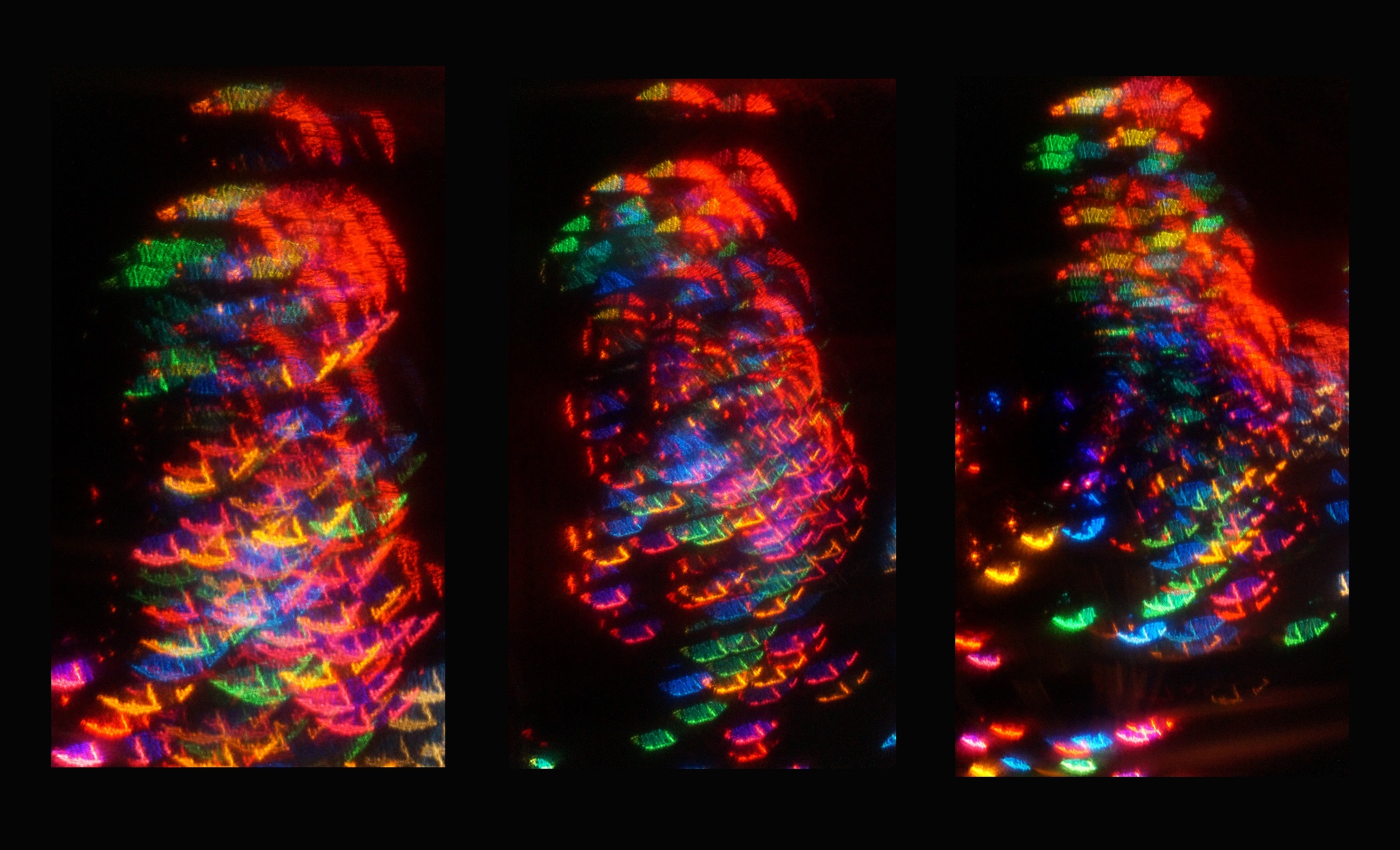
Still excited by exploring my work as triptychs, I played with a horizontal format.
To get back into my abstractions posts, and my reading novels like a novelist (RNLN) posts I thought I’d explore The Prophet as both.
I finally read The Prophet by Kahlil Gibran, originally published in 1923. The short book had been on my radar for a while, but I just never got to it, until now. And I’m glad I did. The text is an exploration of many different abstract nouns in the form of a question and answer. The main character of the story is leaving town because his ship has finally arrived, and the town’s people have one last chance to obtain his wisdom, so each in turn, identified by their roles, asks about an abstraction related to their role. For example: “Then one of the judges of the city stood forth and said, Speak to us of Crime and Punishment.”
The Prophet doesn’t have much of a story, and yet it takes the reader on a journey through the unexpected answers to the requests. When the mason says, “Speak to us of Houses,” you wouldn’t expect “Houses” to be an abstract noun, but in this book it is. He answers: “Your house is your larger body. It grows in the sun and sleeps in the stillness of the night; and is not dreamless.”
Applying What I Learned
Though I don’t think I will ever write in this style, I did think I could apply the way he speaks about abstract nouns in my novel. Also, the idea that people’s roles in a society—their work, expertise, specialty—will determine their questions, their mind-set, and their focus which is a good thing to keep in mind when developing characters.
I thought the most interesting sections in The Prophet were the sections about contradictory abstract nouns: Joy and Sorrow; Crime and Punishment; Reason and Passion; good and evil. His statements were more along the lines of talking about them as a continuum than I expected for this book. He says, “Your joy is your sorrow unmasked.” And when speaking of good and evil he says, “For what is evil but good tortured by its own hunger and thirst?”
How can I use that in my novel? The main characters in my novel each represent one of the big five contradictory abstract nouns: truth/deceit; beauty/ugliness; love/apathy; happiness/misery; wisdom/naivete. I can write out what I want to say about the big five contradictory nouns that my characters represent, and then brainstorm questions that would give the character the opportunity to say those things. Then write the character saying them in his or her own words. I can come up with scenes or find the scenes in the draft where that would fit.
I won’t write two page monologues like The Prophet , but short interesting conclusions that the character has come to through his or her own experiences that tells the reader more about the contradictory abstract nouns the character represents will add interest to the story. It makes sense that Verity would talk about truth and deceit, and Memphis would talk about beauty and ugliness, etc.
I saw that the Summer Book Bingo cards are up, and had a ton of fun picking out the books I’ll read for the different Bingo squares. I chose a selection of Adult and YA fiction, graphic novels, short story collections, a memoir, a couple poetry collections, and even a picture book. I’ll share my full list when I’ve figured it out.
Needless to say, I have a lot of reading to do to get through the stack of books I already have from the library, so I can go stock up on my new list. And I have to up my reading game to two novels a week to finish on time (Bingo ends September 5).
I’ll be combining some of the books I’ve been reading into my coming RNLN posts since I have a bunch of catching up to do, then I may only choose one of the two books I read each week to talk about, or I might post two RNLN posts a week, but slim them down to only focus on the main thing I learned from the novel. Either way, I’m back to reading novels like a novelist, and excited for summer reading.
Today’s images
Inspired by reading Joan Mitchell by Sarah Roberts, Katy Siegel, et al., I started thinking about creating triptychs of my images.
For today’s Poetics prompt, Lisa invites us to be inspired by music. For today’s poem, I put on a record from 1957 (I think it belonged to my grandparents) called “Music From Another World” performed by The Jay Gordon Concert Orchestra. Here’s what it inspired:
Music From Another World
Cautious steps on lit discs across a pond Will they hold or falter, tipping me awkwardly, flailing, falling . . . But no, they hold and I’ve arrived
under the lanterns, swirling in time encircled and pressed close . . . But now, the turns are dizzying, and my head swivels, searching for an escape, an excuse to wriggle free and flee
into the darkness but there’s a tight grip under the lights and the dance spins on far from the chirping frogs in the pond
The chill air bathes us as we catch our breath, watching the lingerers sway We slowly move away from the lanterns to expand with the stars into another world where the music of a billion years travels to pulse in our eyes with our heated hearts.
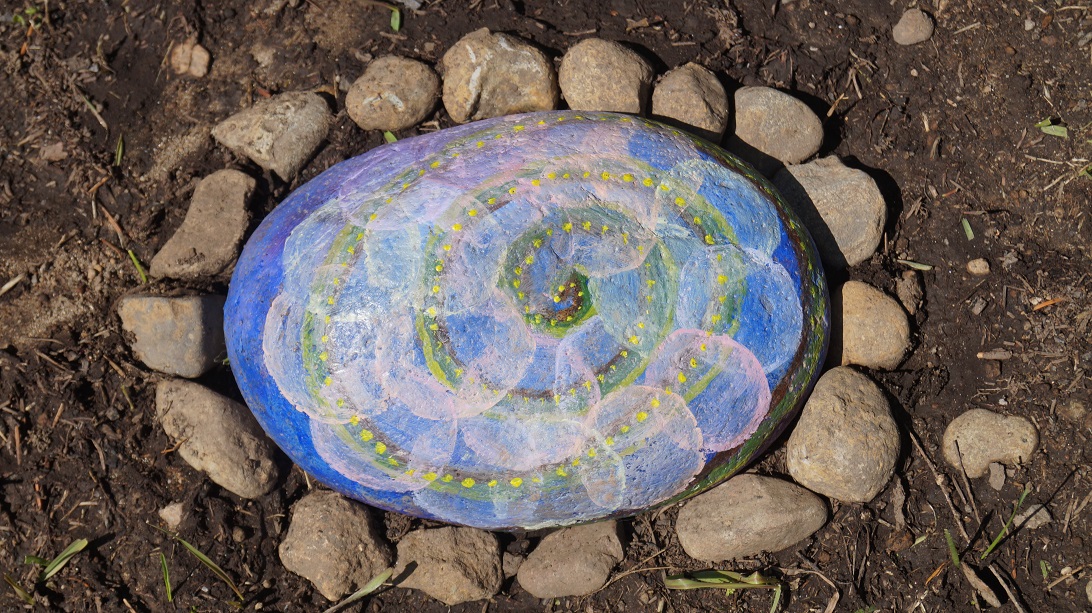
Today is Open Link Night at the pub, so I get to write about anything I want. There are already lots of little green starts coming up from the seeds I planted, and I painted the big rock I dug up from my garden.
When Mixing, It’s Important to Know There Are Warm Shades And Cool Shades to Your Colors
I made sure she came out and saw it: I don’t know why I needed her to see it
She instantly said, “It’s like one of your images. You made it look like your photographs.” I couldn’t believe it, with all its imperfections, she saw it, just as it was.
The rock, the huge-to-me rock that I dug up out of the garden plot I’ve been working for so many years; it was so big I knew I had to paint it, to turn it into a marker, a greeter, a part of the garden.
When I asked him if I could use the plot, the square of overgrowth where my grandfather had planted potatoes, he said, “Go ahead, but the soils bad.” After I’ve tried all sorts of different seeds and plants and worked and worked that soil for a decade, when I showed him this year’s planted garden, he said, “We’ll see. That soil’s bad.”
How can the soil that fed me those incredible baby acorn squash —that I didn’t even plant when the car wasn’t running and I needed food—be bad?
I was so surprised when I dug up that rock after digging in this same square of earth so long. But then, that’s what roots do: they reach down, and around those rocks, and while they reach, they grow and forget about those rocks as their reaching and growing pushes rocks to the surface.
It was hard to decide what to paint. I wanted to create something that would invite me into my garden to work, to weed and to tend, to pay attention. I wanted something that I would want to visit. That’s hard to paint for oneself. It had to have something right and wrong with it, change with the light.
And she was right, I tried to recreate overlapping colored lights with paint, to turn the curled metal of my small mirror into a vine. And she saw it. And she saw me without a word, she just knew it was me, inviting me to my garden.
For today’s Poetics prompt, Sarah invites us to verb animals and use those verbs or verb phrases—like “horsing around” or “pigging out” or our own inventions like “eagle over” or “ant the whole hill”—in our poem.
This Animal Kingdom
He is always sharking— dead-eyed stare, open mouth full of sharpness always moving—prowling for the next morsel to come too close
Me, I emu Unable to fly, I present a feathery girth over questionably designed legs with a deadly kick primed if he gets too close.
In the rare moments he’s not sharking, he squirrels—all his pouches full of nuts and seeds (mostly mine and the morsels’ he sharks)— but he squirrels lazily: I’ll find his burrow
When I don’t emu, I hornbill I spread my striking wingspan, and my caw, generated in my bulbous head, carries elation under the thick canopy, then using my curved, sharp beak I crack the nuts from his hollow.
Me, I Emu by Maria L. Berg 2023
Today’s images
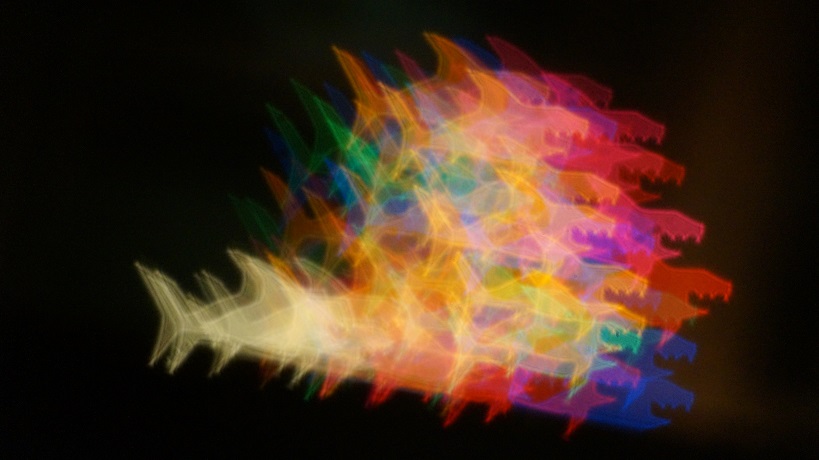
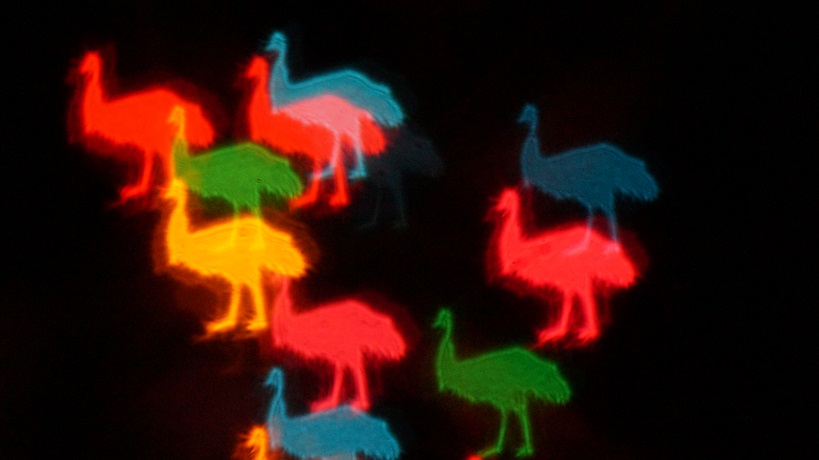
Inspired by today’s poetics prompt, I thought it would be fun to use some animal filters with my new light-wrapped forms in the mirrorworld, to see if I could make them verb. I really enjoyed searching through my filters and picking out all the different animals I’ve created filters of over the years. The shark and the emu filters pictured above, I created to use with the fireworks last Fourth of July.
In my last abstractions post, I talked about The Power of the Center: A Study of Composition in the Visual Arts by Rudolf Arnheim, and the ideas of centric and eccentric composition. Arnheim goes on to talk about how forces like gravity can effect composition which I found interesting.
Arnheim says, “Walking downhill, dropping, or falling is experienced kinesthetically as acceding to one’s own weight. One is being pushed downward by a force situated in the center of one’s own body. . . .The dominant pull of gravity makes the space we live in asymmetrical. . . .Human beings experience the dynamic asymmetry, or anisotropy, of space by means of two senses, kinesthesis and vision. The physical effect of gravity is perceived as tension in the muscles, tendons, and joints of the body. Visually, the world is pervaded by a similar downward pull, whose influence on the dynamic character of the things we see may be illustrated by the difference between what goes on visually in horizontal and vertical surfaces.”
He continues to state that the horizontal orientation is centric composition, since all points have the same relation to the ground, but because of our physical interactions with gravity, vertical orientation is strengthened by a gravitational vector and is thus interacting with an outside center and an eccentric composition. He states that since we must put effort into upward movement, but not into downward movement, we perceive an element in the upper part of the vertical image as having more weight than an element in the lower part. Thus the element in the upper part should be smaller to counterbalance an element below.
Today’s images
I liked the new compositions I was making with the wrapped ring in the mirrorworld, but wanted to see if a smaller ring that actually fit inside the frame of the mirror would have better results. While looking for materials to make the form, I noticed some old wire hat stands I had and decided to try wrapping them with lights. I had three, so I stacked two of them, and wrapped them with colored lights, and left one as is and wrapped it with white lights. This idea has so much potential because they stand freely and I can move them around in relation to each other.
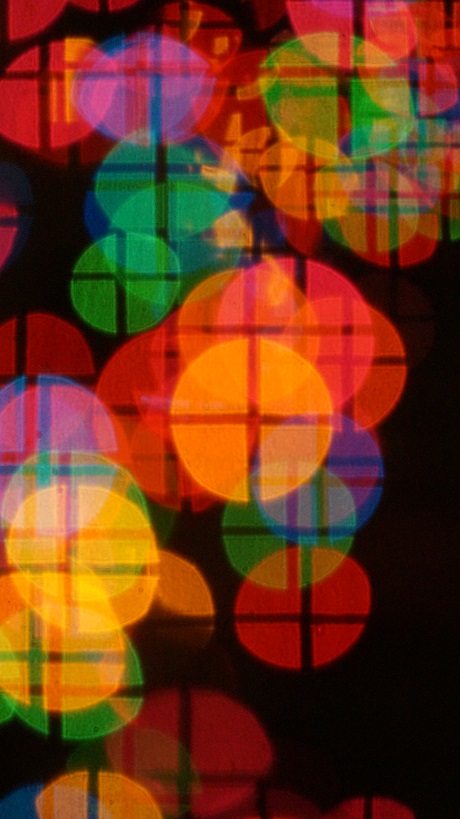
Inspired by Arnheim’s discussion of horizontal and vertical weight, I made a clear plastic filter and drew a symmetrical cross in black sharpie, and I cut out a paper filter with a symmetrical cross in the middle of a circle. The plastic filter creates texture, and I can layer the two filters and move the paper one over the plastic one to cross the crosses at different angles. These images show the paper filter.
What do you think? Do you feel a gravitational pull in the vertical image, but not the horizontal?
For today’s Poetics prompt, Lillian provided some portraits by Thorvald Hellesen (1888 – 1937) as inspiration. I chose “Portrait of Eivind Eckbo” painted in 1914 for today’s poem.
The Man in Motion
He is a whirl of spring air spinning, spinning always turning but with one eye holding my stare like a ballerina in an eternal pirouette one leg steady—in the shadow under there under his billowing cloak rising and falling, a dangerous snare— the other continuing the momentum pointing in, pointing out, so beware
He is fluttering soft petals on a fragrant breeze whirling, whirling, but that eye on me stares the head almost appears to have a plan to stay still as the body turns, but then all hair it snaps around and is back and then it does it again—SNAP! the head has come around, never losing that stare
And the spinning never stops as with each turn he becomes more aware that he’s a pastel shimmer in motion more breezy, more one with the spring air and forgets he has a leg on the ground in the shadows under that cloak that has flown off somewhere.
For those readers who are wondering where my Reading Novels Like a Novelist (RNLN) post is, those posts are on hold for now. I’m still reading and taking notes on a novel a week, I’m just not into spending the time writing about them right now. We’re having some early summer weather here in the South Sound, and I have flower beds to find, and ants to battle, lawns to mow, and a garden to plant, and the weird thing is; my back gets sore, and I get tired. What’s that about? This crazy excitement for working outside will hopefully last through next week and then I’ll probably get back to talking about noveling (and revising my novel, of course).
Today’s Images
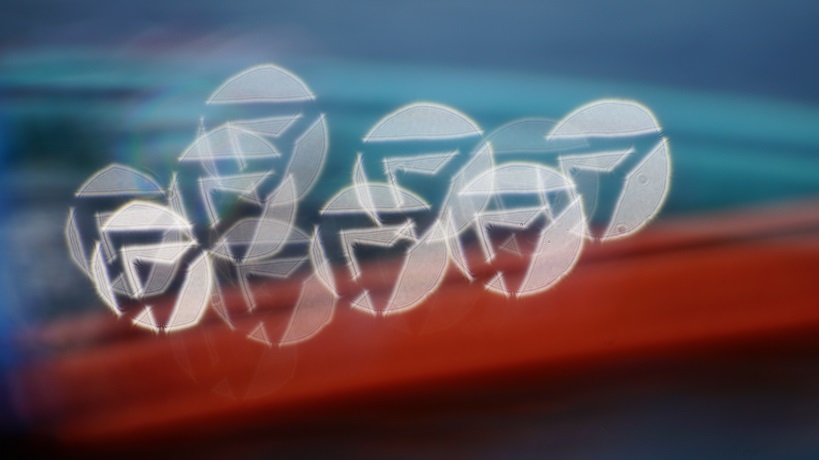
I finally found some new pool noodles, so my floating studio has a new façade! I made a new tiny brad filter with a moving triangle on a triangle inspired by a diagram of Jean Victor Poncelet’s treatise on the projective properties of figures in Visual Thinking by Rudolf Arnheim.
While I was setting up my floating studio, a ginormous fish swam under it, and then came back to see what I was doing (sorry I didn’t take its picture, I was kind of stunned, and my camera was still on the porch). I think it might be a bass and live under the dock. I hope it comes to visit again, but not when I’m swimming.
It’s Open Link Night at dVerse Poets Pub which means there’s no poetry prompt, so head over and link up one of your poems and enjoy reading poetry by poets from all over the world!
For today’s poem, I’m continuing to focus on contradictory abstract nouns. I’ve collected and printed out an extensive list of abstract nouns ( I’m hoping to eventually have a definitive list of all of the abstract nouns in the English language to put in my three dimensional chart of where they fit on the continua of fear, control, and bias). At the moment, the words are on strips of paper in a cup. I selected peculiarity and sympathy to think about today.
Sympathy in Peculiarity by Maria L. Berg 2023
She says peculiarity is orange
like this Fanta orange? zesting fizzy, bright and sweet? she ponders, head tilted, then smiles and shakes her head
like a construction cone (worn as a hat), or safety vest (over an evening gown)? she laughs, then frowns, then smiles, her orange lips stretching almost to her orange hair staring into me, waiting silently
the orange peculiar to oranges?
she knows orange is my favorite color I’m in my orange flightsuit, drinking an orange soda, under an orange tree in an orange plastic chair
I would say that orange is sympathetic in an agreed juicy taste and spherical shape sharing an understanding of orangeness
but do they feel sorrow—as they fall from the tree—in the falling; do they feel peculiar in their oneness; do they feel compassion for the others still clinging, and afraid?
While contemplating the next steps in my study of contradictory abstract nouns, I started reading The Power of the Center: A Study of Composition in the Visual Arts by Rudolf Arnheim, and realized that focusing on composition, both in my images and in my poetry is a logical next step.
Arnheim proposes that there are two compositional systems: the centric and the eccentric. The centric is the self-centered attitude. The eccentric is the recognition that one’s own center is not the only center, and stands for any action directed toward an outer center, and is in turn affected by the outer center.
Arnheim states, “The tension between the two antagonistic tendencies trying to achieve equilibrium is the very spice of human experience, and any artistic statement failing to meet the challenge will strike us as insufficient. Neither total self-centeredness nor total surrender to outer powers can make for an acceptable image of human motivation.”
So Arnheim has set up a dialectic of composition: The centric system gives rise to the eccentric system which is in conflict with it, and the two create tension while trying to come to equilibrium. As he talked more about centric and eccentric systems they seemed to correlate with my ideas of inner and outer control.
Though I’m just beginning to read the book and think about centric and eccentric composition, I was inspired to try something new in the mirrorworld to change my compositions. In December of 2021, I tried making “wreaths of light” by wrapping lights around a metal ring. Today, I wrapped the metal ring in lights and put it in the mirrorworld. I tied it to a bar overhead so it would stand up. I’ve always draped the string-lights between the mirrors, so this changes many aspects of the compositions. The most interesting change is that the wires between the lights are no longer part of the composition.
For today’s Poetics prompt, Mish introduced us to the surrealist images of Erik Johansson and asks us to write a poem inspired by one of a selection of his works. For today’s focus, I was most drawn to “Drifting Away.”
Watching the Others Drifting Along
That explains a lot, really— It’s the waves (in the dip between the crests) that lull us into believing the fluffy clouds are harmless the crows cawing as they chase past the steeple carry no omen the open barn doors only invite the cattle home not to slaughter, not to ruin It’s so easy to forget the bottle will soon be tossed the upheaval will arrive
Outside the glass, the eccentric, the other center pushes and pulls, cycles and swirls, always
But in that lull, when the sun hits just right the water splashed and dripping could be a refreshing rain, not the evidence that I am only in a bigger bottle.









 Experience Writing